Rare 1881 Trade Dollar Errors (List & Pictures)
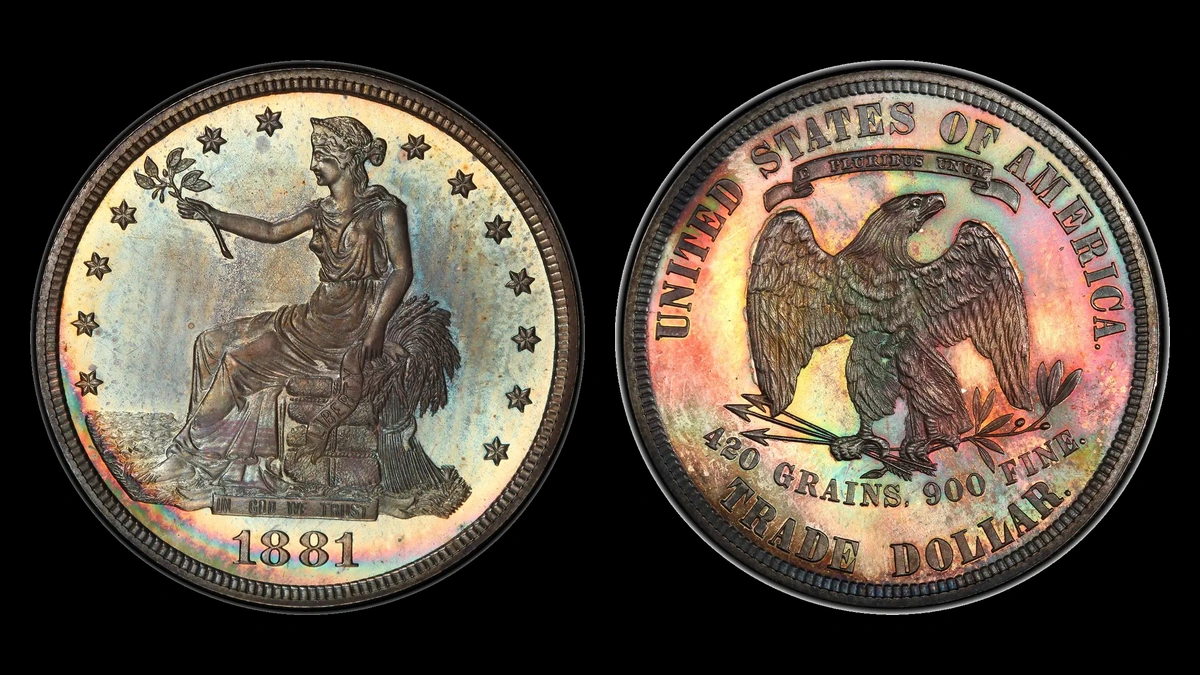
A weak head and fine doubled lettering belong to different comparisons on an 1881 Trade dollar. These three groups of 1881 Trade dollar errors concern proofs, the specially prepared collector issue, with estimated whole-coin values of $1,000–$40,000.
A PR67 sold for $39,100 in February 2006 as a general condition comparison. That record is not identified as a sale of one of the particular features below.
1. 1881 Dollar A Soft Head and Upper Stars: Weak Strike Error
The published account connects flat upper detail with dies that were not always set correctly. A proof could leave the press with shallow areas even though it had not lost metal through wear.
Proof preparation does not guarantee that every feature is sharp. Later rubbing and polishing can also flatten detail, so the surface needs examination.
How to Identify
Compare the same head and upper stars under two lighting angles to rule out glare. Then inspect them against the lower, better-protected design.
Look for original texture within the weak areas. Fine lines crossing several features or smooth rubbing can suggest later alteration rather than detail that never formed fully.
What It’s Worth
$1,000–$20,000 is the estimate for original weakly struck proofs from impaired through attractive collector condition. Weakness is not automatically a premium; buyers may prefer sharper detail.
An 1881 PR66 brought $10,925 in August 2006 at American Numismatic Rarities. That general proof result is not specifically attributed to a weakly struck specimen.
2. 1881 Dollar Gaps in Lower Drapery and Leg Feathers: Incomplete Detail Error
One recorded proof variety has incomplete clothing folds near the sea and feathers along the inner edge of the eagle’s right leg. The reference also notes minor reworking of the front die.
It does not establish that reworking caused every missing line. These local gaps should be checked separately from broad softness in the head or stars.
How to Identify
Follow the lower clothing folds while retaining the nearby sea detail in view. Then compare the specified leg-feather boundary using a labeled reference to establish the eagle’s own right side.
Match the local gaps on both faces rather than assuming all shallow areas have one cause. Wear and polishing after striking can remove fine lines too.
What It’s Worth
$1,000–$20,000 is the estimate for matching proofs in collector conditions. Eye appeal and preservation supply much of the value.
The general $10,925 PR66 result offers condition context, not a measured premium for missing folds. If one coin has weak striking and incomplete details, it still receives one complete value.
3. 1881 Dollar Fine Repetition in 420 GRAINS, 900 FINE: Doubled Reverse Error
This separate variety has very small repeated outlines in the reverse weight-and-fineness inscription. The doubled pattern was already in the die and could reach a coin in a single strike.
The reference describes this variety as sharply struck throughout. It is a different comparison from the incomplete-detail coin above.
How to Identify
Use a sharp enlargement of several characters in 420 GRAINS, 900 FINE. Do not expect the bold separation shown on stronger doubled dies from other dates.
Compare with an identified 1881 example and check its generally sharp design. Camera movement may duplicate every bright edge, whereas the real feature remains in the same small parts of the inscription.
What It’s Worth
$1,500–$40,000 is the estimate for identified examples across impaired through exceptional proof condition. Fine doubling can interest specialists while overall grade strongly influences price.
PCGS records $39,100 for a PR67 sold by Superior in February 2006. The general record does not identify that coin as this doubled-reverse variety.
Conclusion
Inspect the head and stars for broad weakness, lower folds and feathers for local gaps, and reverse wording for fine repetition. Keep each comparison tied to the appropriate proof variety.
The quoted auction records illustrate the importance of condition. They do not establish separate premiums for these features, and shared features on one coin should never be valued as multiple dollars.