Rare 1837 Capped Bust Dime Errors (List & Pictures)
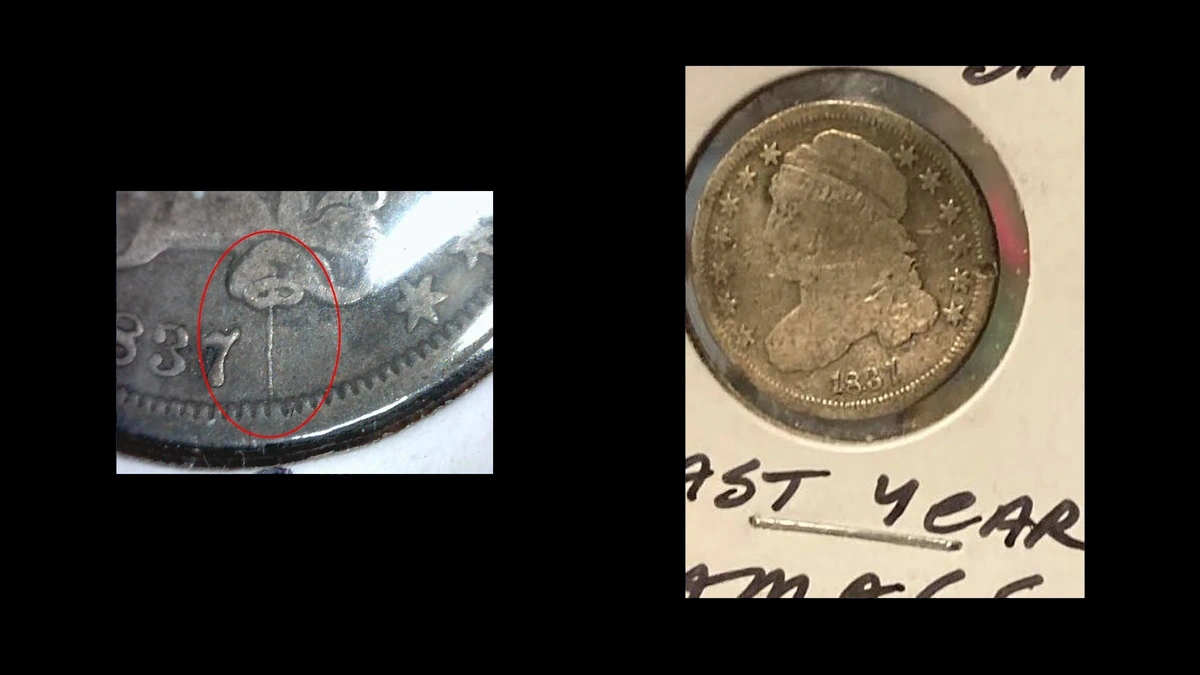
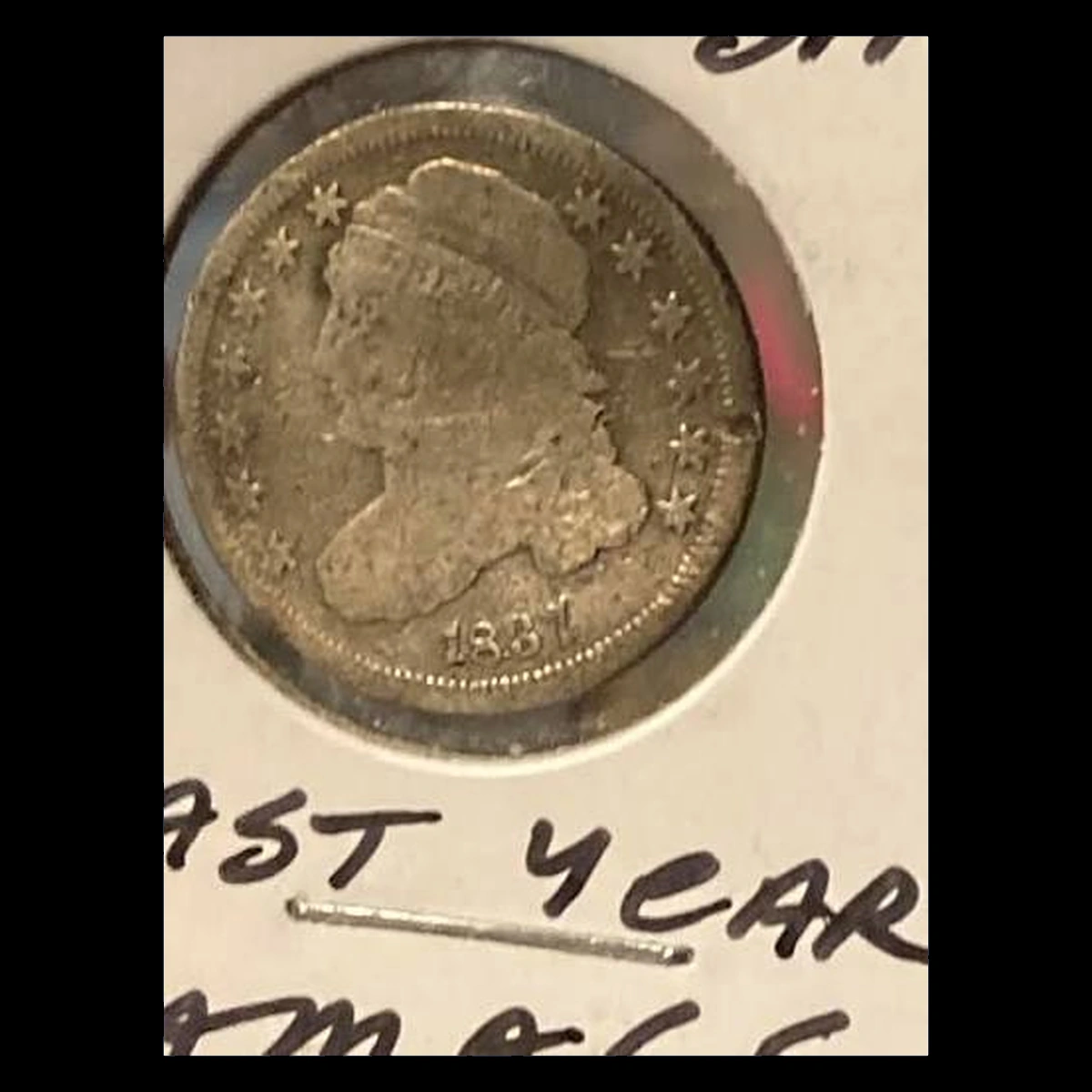
The Newman–Simpson 1837 dime with small reverse rim breaks brought $33,600 in September 2020. The 1837 Capped Bust dime errors below span estimated whole-coin values of $100–$35,000, with exceptional preservation accounting for much of the upper end.
Inspect the portrait, reverse rim, and face-to-face alignment in that order. Capped Bust has Liberty facing right and an eagle above 10 C.; do not confuse it with the same-year Liberty Seated design.
| Inspection area | Feature | Price context |
|---|---|---|
| Front and date | Raised die cracks | $100–$1,500 circulated estimate |
| Reverse rim above D STA | Small cuds | $150–$2,000 circulated estimate |
| Alignment of both faces | Mild die rotation | $100–$1,500 circulated estimate |
The normal weight is about 2.67 grams and diameter about 18.5 millimeters, allowing for wear. The edge is reeded.
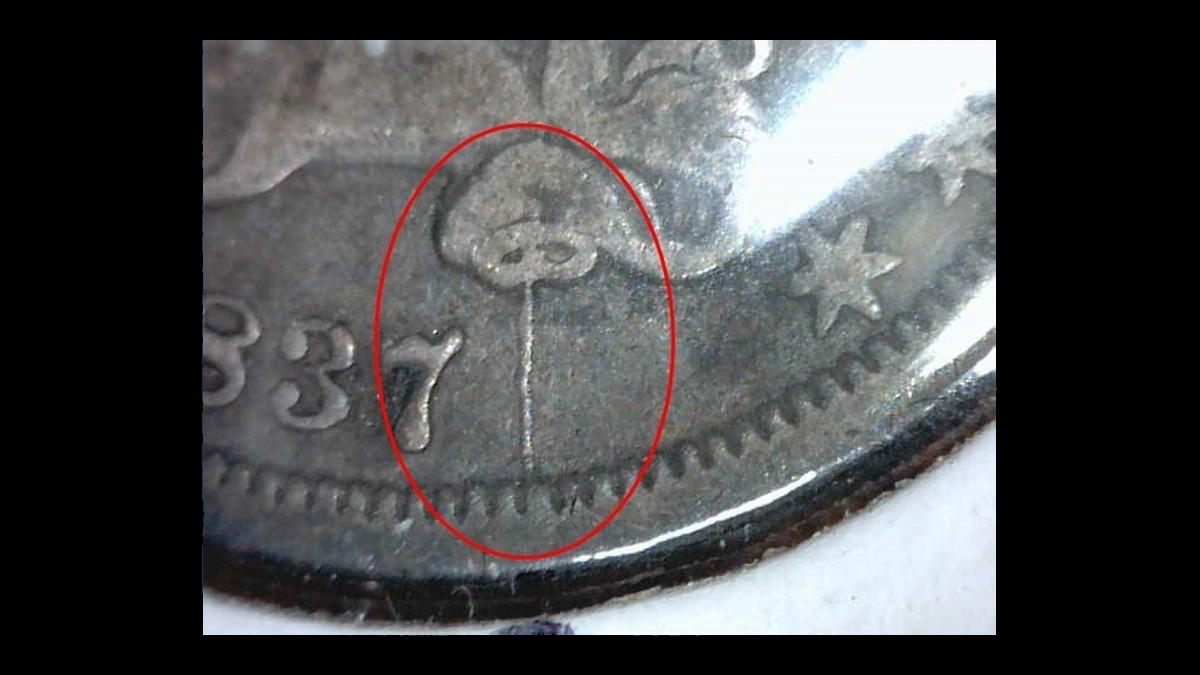
1. 1837 Dime Raised lines across Liberty or the date: obverse die cracks Error
A crack in a die can leave a raised line on each coin it strikes. Metal presses into the narrow opening, recording the tool’s damage without requiring the coin itself to split.
An identified JR-4 example has a line running roughly from twelve to five o’clock across the front. JR-3 examples can instead show a crack through the upright stroke of the 7.
How to Identify
Inspect the date and portrait under changing light to decide whether a line rises above the surface. A scratch cuts downward, sometimes with disturbed metal along its edges.
For JR-4, follow the broad top-to-lower-right route and compare the surrounding design. For JR-3, concentrate on the 7; do not add its line to the JR-4 pattern.
The JR numbers identify different die pairs. Matching a crack to the correct pair is more useful than describing any raised front-side line as the same variety.
Where a line approaches the rim, check for impact damage that could create a misleading mark. A dark photographic line alone is insufficient to determine whether the feature is raised.
What It’s Worth
Circulated examples with these small cracks have an estimated whole-coin range of $100–$1,500. Fine original surfaces and remaining design detail influence the value within that range.
A JR-4 graded PCGS MS65+ with CAC approval sold for $15,860 at Heritage in January 2026. This was an exceptionally preserved unworn coin with a noted ownership history.
It also has the mild rotation discussed below. The single auction price covers the complete coin and both features; it is not a separate five-figure payment for its crack.
2. 1837 Dime Narrow lumps above D STA: reverse rim cuds Error
On the Newman–Simpson JR-3 dime, small raised breaks appear along the reverse rim above D STA. They occupy places where pieces of the die’s edge had broken away.
Collectors call a rim-connected die break a cud. The extra metal reflects the gap in the tool, rather than a lump added to the finished coin.
How to Identify
Locate D STA in the reverse inscription and study the rim directly above it. Look for the narrow raised patches and how they connect with the border.
An impact can squash or fold an existing rim, so examine the nearby edge grooves for crushed metal. The documented breaks should match the shapes formed during striking.
Check the front date as an additional comparison: the Newman–Simpson coin has an uncracked 7. The later crack seen on other JR-3 dimes is not required for this reverse break stage.
Front and reverse dies did not necessarily deteriorate together. A matching reverse feature should therefore not be rejected solely because the 7 lacks the later crack.
What It’s Worth
Estimated whole-coin values are $150–$2,000 for circulated pieces with similar original rim breaks, and roughly $10,000–$35,000 for premium unworn examples. Those groups should not be treated as interchangeable.
The Newman–Simpson JR-3 graded PCGS MS66 with CAC approval sold for $33,600 in September 2020. Its color, exceptional surfaces, and ownership history are part of that result.
The sale shows what one outstanding dime achieved, not what the small cuds alone are worth. Later rim damage cannot borrow the same price comparison simply because it creates a raised area.
3. 1837 Dime An eagle that stays tilted: mildly rotated dies Error
After inspecting each face, check how they relate to each other. A die installed at an unusual angle can leave the reverse tilted relative to an upright front.
The recorded JR-4 has a mild rotation, but the supplied description gives no exact angle. It is the same MS65+ coin with the front-side crack described earlier.
How to Identify
Hold Liberty upright and flip the coin from top to bottom without adding a sideways turn. The eagle should appear upright after this movement on a normally aligned dime.
Repeat the flip while keeping the same grip. A consistent lean is more informative than a single photograph taken with the coin held at an angle.
Separately rotated auction photographs cannot prove the relationship between the faces. Use a paired view that preserves alignment or inspect the coin directly.
If the relationship looks unusual, also inspect the edge for seams or evidence of joined pieces. Do not assign a numerical rotation to the documented JR-4 when its angle was not supplied.
What It’s Worth
A similar small rotation on a circulated coin has an estimated whole-coin range of $100–$1,500. Better unworn pieces require comparisons that account for their higher condition.
The January 2026 JR-4 result was $15,860 for the PCGS MS65+ CAC coin. This is the previously discussed sale, not an additional auction or a second amount to add for rotation.
Small alignment differences should be evaluated in proportion to the coin’s preservation and the actual degree of tilt. The supplied sale does not establish a standalone rotation premium.
Conclusion
Keep the two documented coins distinct: the JR-4 combines a front crack with mild rotation, while the Newman–Simpson JR-3 has reverse rim breaks and an uncracked 7. Each offers a different comparison.
The strongest prices belong to exceptionally preserved whole coins. A worn dime with a similar small feature should be assessed against appropriate circulated examples, with the same sale counted only once.