Rare 1873 Half Dollar Errors (List & Pictures)
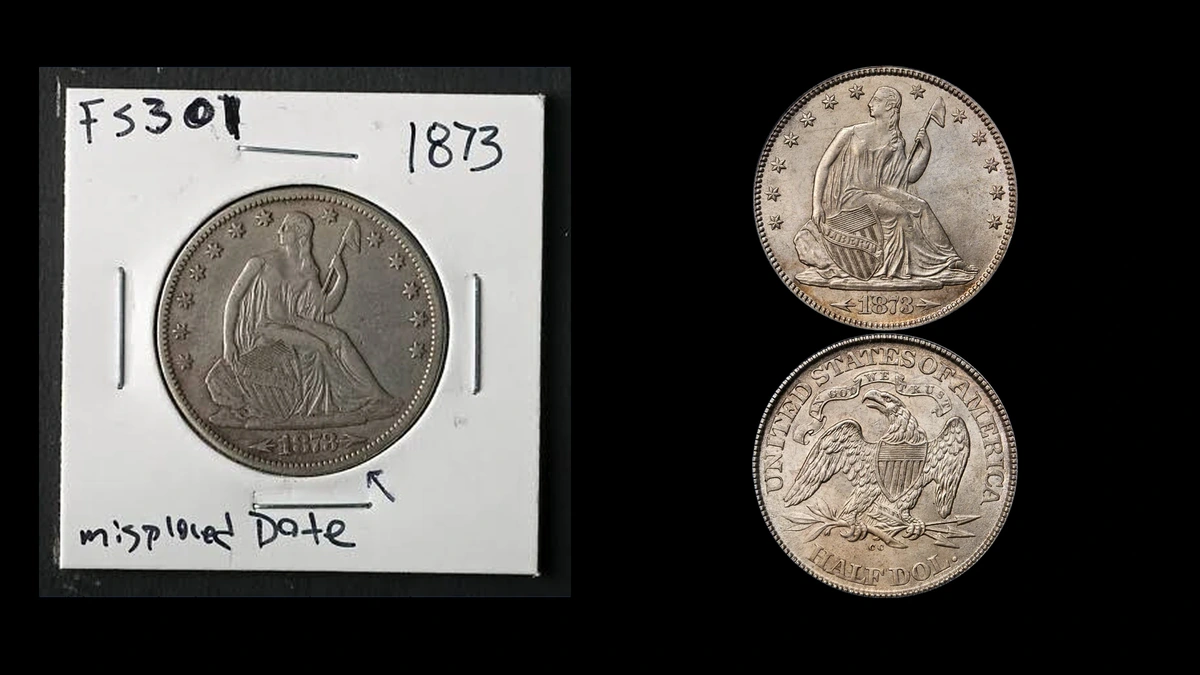
Before identifying 1873 half dollar errors, check the arrows beside the date: they are normal features marking a weight change. Estimates for the categories below span $250–$50,000, although exceptional condition can matter far more than a small error.
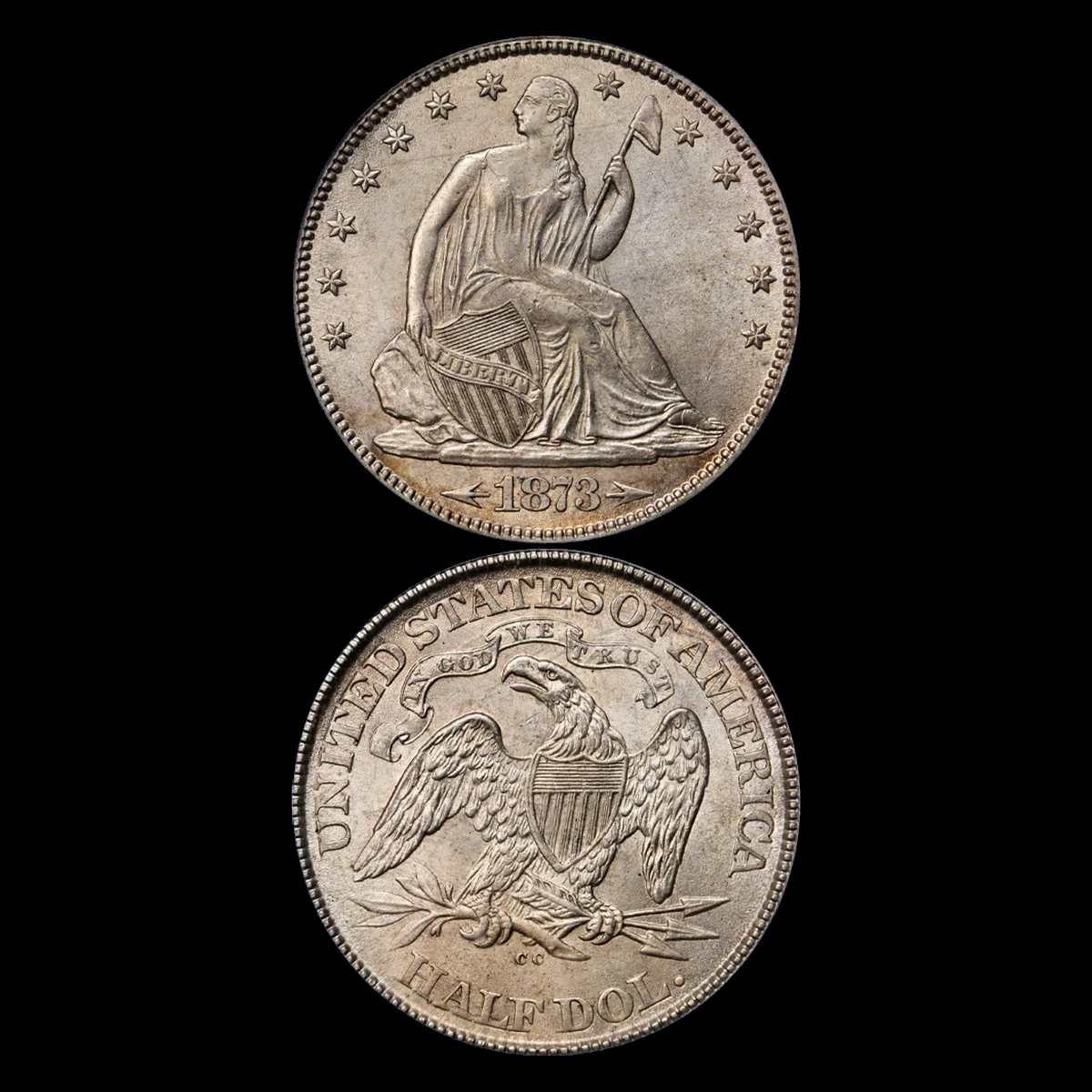
An 1873-CC with fine cracks sold for $42,593.75 in March 2014 at PCGS MS65. Work from the coin’s outline to its date, shield, and surface to understand which comparisons fit.
| What stands out | Possible identification | Value context |
|---|---|---|
| Expanded shape and backward design | Die cap or brockage | $20,000–$50,000 comparison estimate |
| Overlapping dates and reverse words | Double strike in collar | $2,500–$7,500 circulated estimate |
| Extra numeral fragments | Repunched or misplaced date | $250–$6,000 by mint |
| Four-line shield groups | Quad Stripes doubled die | $250–$1,500 circulated estimate |
| Oval flaw near raised elbow | Proof lamination | $12,000–$20,000 for comparable PR66 coins |
| Ridges from rock into stars | Die cracks | $800–$4,000 circulated; exceptional grades higher |
No Arrows halves began at 12.44 grams, while With Arrows halves began at 12.50 grams; both are approximately 30.6 millimeters across with grooved edges. Record the mintmark and the date style before matching an error, because Philadelphia and Carson City comparisons can differ substantially.
1. 1873 Half Dollar A backward design on a stretched coin: Die caps and brockage Error
A backward impression pressed into the surface is a brockage. It can form when a struck coin remains attached to a die and impresses its design into another blank.
A coin that stays on a die through further striking can expand into a cap. A privately held 1873 graded PCGS XF45 has a full backward eagle and a greatly spread outline, with early descriptions also identifying a front-side die cap.
How to Identify
Check that the copied design is both reversed and sunken into the metal. Cap identification also needs the stretching or cup-like form associated with a coin adhering to the tool.
A 2010 report connects the private XF45 to Carson City and describes a separate PCGS AU58 reverse cap in the Nevada State Museum. Keep those two specimens distinct when comparing images or discussing condition.
Examine both faces and the remaining edge for later bending or crushing. The museum account provides context for the two identities, rather than treating them as one coin viewed from different sides.
What It’s Worth
A comparison-based estimate is $20,000–$50,000 for rare nineteenth-century silver caps and brockages of comparable importance. It is not a sale quotation for the museum’s 1873 half.
The June 2025 Mint Error News guide places Barber quarter obverse caps at $20,000 in extremely fine condition and $50,000 unworn. Those different-series guide figures require adjustment for the individual 1873 coin’s shape, condition, identity, and history.
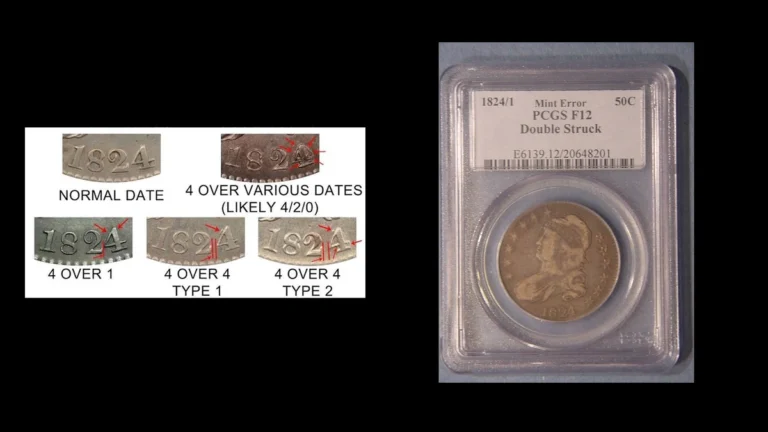
2. 1873 Half Dollar Two dates on a nearly normal-sized coin: Double struck in collar Error
The retaining ring around a blank, called the collar, can keep a coin near normal size even if it turns between strikes. An early account of an 1873-CC With Arrows half describes a second date above and counterclockwise from the first, plus another STATES OF impression lower on the reverse.
How to Identify
Trace related parts of the second date and reverse lettering to establish another complete design position. This broader shift differs from a small numeral fragment already present in a repunched die.
A later Mint Error News illustration identifies a PCGS F12 example as double struck in the collar. The earlier account’s precise arrangement should not be assumed for every coin described by that error name.
Look for crushed rims or sunken copied details that could result from pressing finished coins together later. Authentic repeated design positions must agree across the surviving struck features.
What It’s Worth
Genuine circulated 1873-CC examples with readable overlapping designs are estimated at $2,500–$7,500. That range includes the underlying value of a scarce Carson City half.
A double-struck 1819/8 Capped Bust half graded PCGS XF45 sold for $2,280 in July 2025. Its different design and lighter wear make it a contextual comparison, not a realized price for the 1873-CC F12 report.
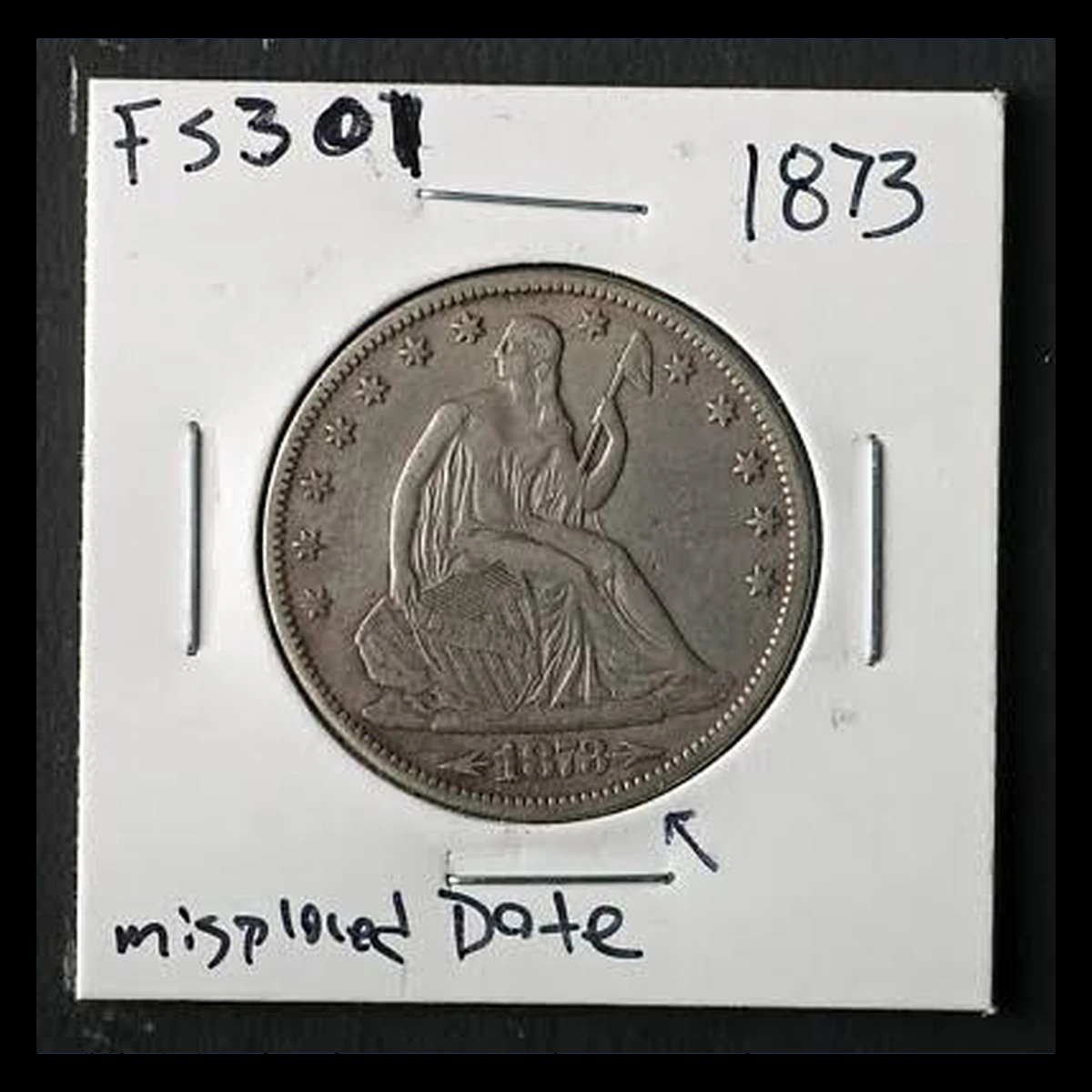
3. 1873 Half Dollar Extra digit pieces beside or beyond the date: Repunched and misplaced dates Error
Small numeral remnants can survive after repeated hand-punching of a date into the die. When a remnant lies away from the intended date position, the feature is described as a misplaced date.
Philadelphia reports include No Arrows Closed 3 and Small Arrows varieties, with repunching at the latter’s 3. Carson City reports include repeated impressions of the 1 and a separate With Arrows misplaced-date variety.
How to Identify
Match arrows, mintmark, and the shape of the 3 before comparing an extra stroke. Open 3 and Closed 3 are normal date styles, not errors by themselves.
A remnant should have the shape and position expected for the particular variety. A fold in Liberty’s dress or a scratch near the date does not become a misplaced digit merely because it resembles one.
Use a photograph of the same mint and date style and check for altered metal. One close-up cannot identify all the reported 1873 date-punching features.
What It’s Worth
Circulated Philadelphia examples are estimated at $250–$2,000, compared with $1,500–$6,000 for Carson City. The difference partly reflects the normal scarcity of the CC issues.
A Philadelphia No Arrows misplaced-date XF45 sold for $252 in March 2018. A Carson City No Arrows repunched-date VF30 realized $2,115 in 2016, pricing the complete coin rather than an added charge for its extra 1 impression.
4. 1873 Half Dollar Four lines in the shield’s groups: Quad Stripes doubled die Error
Inside Liberty’s shield, the Philadelphia Small Arrows Quad Stripes variety shows groups of four vertical lines where the normal pattern has three. The additional outline originated in die preparation and was repeated on coins made from that die.
How to Identify
Confirm Small Arrows beside the date and the absence of a mintmark. Under magnification, compare several shield groups with a normal three-line example at the same scale.
Count separate raised lines rather than dark toning streaks. Wear can merge the small details, while a scratch or flat shelf fails to reproduce the proper four-line pattern.
“Quad” refers to the four lines in those groups. It does not mean that the coin was struck four times or that every feature has four copies.
What It’s Worth
Circulated Quad Stripes examples with readable groups are estimated around $250–$1,500. Clear separation and attractive surfaces make the attribution easier to appreciate.
A dealer inventory offered a very fine example at $325. That is an asking-price comparison, not an auction result or a guaranteed premium for any faint fourth line.
5. 1873 Half Dollar An oval separation beside Liberty’s elbow: Proof lamination Error
A Philadelphia Large Arrows proof graded PCGS PR66 with CAC approval was cataloged with a small original lamination near Liberty’s raised elbow. A weak layer inside the silver alloy separated despite the coin’s careful manufacture as a collector proof.
How to Identify
Direct light across the oval’s boundary without touching the proof surface. Look for separation within the metal rather than a sharp cut or metal displaced by an impact.
Confirm the Large Arrows and surrounding design before matching the cataloged specimen. This is not a modern missing-clad-layer error; the coin does not have a copper-nickel sandwich.
A tiny separation may make little difference to weight. If the coin is certified, examine it through the holder rather than removing it merely to obtain measurements.
What It’s Worth
Comparable attractive With Arrows proofs near PR66 have an estimated whole-coin range of $12,000–$20,000. The small flaw does not establish a large added lamination premium.
A dealer inventory asks $17,950 for a different 1873 Arrows half graded NGC PR66 with no stated lamination. This is neither a completed sale nor the price of the PCGS specimen with the elbow flaw.
6. 1873 Half Dollar Raised lines from the rock through the stars: Die cracks Error
The documented 1873-CC With Arrows MS65 has fine ridges leading from the rock beneath Liberty through left-side stars. Reverse cracks cross leaves and the final TED in UNITED.
These paths reflect fractures in the dies that filled with silver during striking. The Small CC mintmark and matching crack network help identify the tools involved.
How to Identify
Follow the line through several landmarks rather than judging one bright streak. On the reverse, compare the leaves and TED using side lighting.
The actual crack should be raised, unlike a scratch with a cut center and possibly displaced edges. Confirm the arrows and Small CC before assigning the photographed network to a coin.
What It’s Worth
Circulated With Arrows examples with similar minor cracks are estimated at $800–$4,000. Exceptional uncirculated preservation requires an entirely different condition comparison.
The PCGS MS65 sold for $42,593.75 on March 20, 2014, as recorded in Heritage’s archive. The buyer acquired a scarce Carson City half in exceptional condition, not $42,593.75 worth of thin crack lines.
Conclusion
For an 1873 half, arrows, date style, and mintmark establish the right family of comparisons before any error is considered. Then decide whether the unusual feature is a repeated digit, an extra strike, a metal flaw, or a trace from a damaged die.
Keep the evidence behind each price visible: auction results, dealer offers, and cross-series guide estimates answer different questions. None makes condition or a precise variety match optional.