Rare 1894 Dime Errors (List & Pictures)
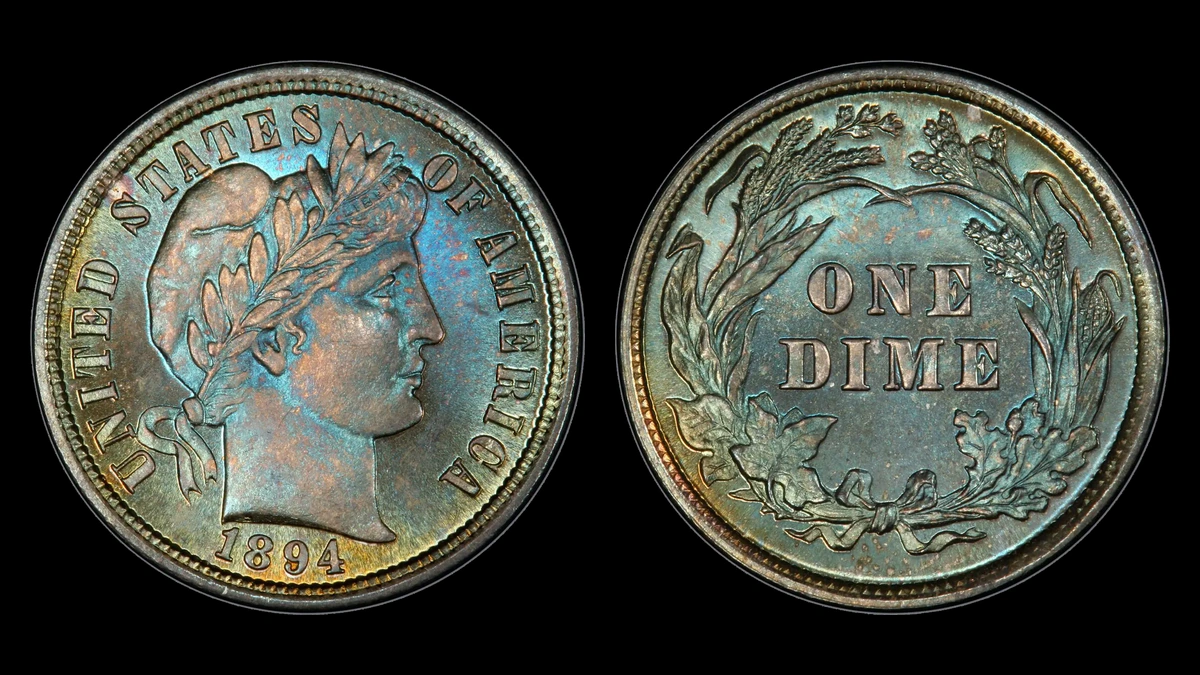
Before checking an 1894 dime for errors, turn it over and read the mint letter. A rare 1894-S sold for $2,160,000 in January 2025, but a small flaw on an ordinary coin does not give it that value.
These 1894 dime errors have ordinary-issue estimates of $50–$1,500. The separate $1.3–$2.2 million range concerns high-grade examples of the rare San Francisco issue; the sections below keep those comparisons apart.
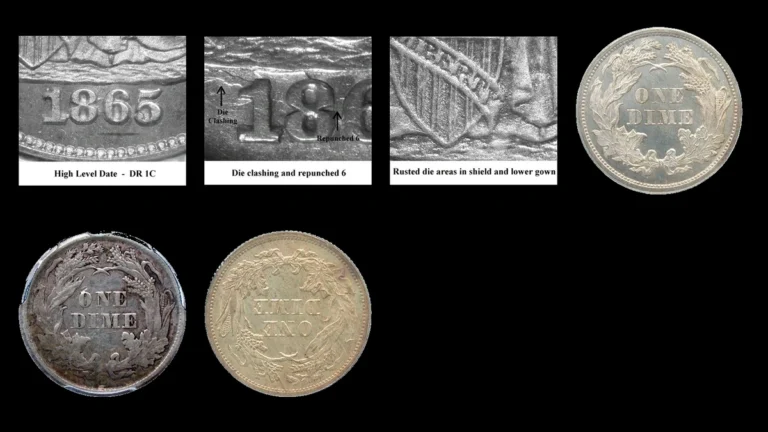
1. 1894 Dime Extra Strokes Appear above the Date: Reported 1894-S Repunching Error
An observer who examined an NGC PR66 1894-S in March 2005 reported extra strokes above parts of 1, 9, and 4. The observer interpreted them as remnants from an earlier position of the date punch.
The date was punched into the steel stamping tool before the coins were made. A surviving earlier impression would repeat on the coin without requiring the coin itself to be struck twice.
How to Identify
The firsthand account identifies three places: the top of 1, above the lower part of 9, and above the horizontal stroke of 4. Compare the complete set rather than selecting one doubled-looking edge.
The reverse S sits below the wreath’s bow. The date and mintmark need expert authentication because an ordinary coin can be altered to resemble this valuable rarity.
The report concerns one examined specimen, not any dime with a rough-looking date. Leave a sealed grading holder closed and use clear photographs for the small details.
What It’s Worth
$1.3–$2.2 million is the supplied whole-coin estimate for a high-grade 1894-S. Auction records for the rare issue include $1.32 million for PR63 in 2019 and $2.16 million for PR66 in January 2025.
Those sales reflect rarity and preservation, rather than a separate premium for the extra date strokes. The supplied information does not establish that either sold coin was the specimen examined in 2005.
2. 1894 Dime Lower Leaves and Stems Have Extra Outlines: Reported 1894-S Doubled Reverse Error
The same observer described doubling in the lower leaves and stems on both sides of the wreath. A doubled die carries repeated detail in the stamping tool, which can then appear on coins made from it.
The account also noted flat doubling along some outer leaf edges. That second effect was attributed to movement during striking and should be examined separately.
How to Identify
Start with the lower leaves and stems beside the bow. Look for matching rounded extra shapes on the two sides of the wreath.
Then compare the outer edges, where a low flat shelf may show a different cause. A second-looking edge anywhere on the wreath does not establish the reported lower-leaf pattern.
Keep full views of the date and S with the enlarged reverse details. A wreath close-up alone cannot identify or authenticate an 1894-S.
What It’s Worth
$1.3–$2.2 million again describes the entire high-grade 1894-S. The January 2025 PR66 result of $2.16 million is a comparison for that rare issue.
Do not add this range to the date-repunching range. Both reported features can belong to the same coin, whose rarity, condition, surfaces, and ownership history drive its value.
3. 1894 Dime A Thin Ridge Crosses the Surface: Die Crack Error
On ordinary Philadelphia and New Orleans issues, the year guide reports cracks without one fixed route. A cracked die leaves a raised silver line where metal entered the opening during striking.
This can look like a scratch at first glance. The difference becomes clearer when the light shows whether the center of the line is raised or cut downward.
How to Identify
Find a section crossing smooth background and tilt it beneath a lamp. A genuine die crack normally forms a continuous solid ridge.
A scratch may have raised lips on either side of a groove. Follow the center of the mark rather than assuming any raised edge means a die crack.
Philadelphia has no mint letter, while New Orleans has O below the bow. The general crack reports do not establish this feature on the rare San Francisco issue.
What It’s Worth
$50–$300 is the year guide’s estimate for worn ordinary issues with modest cracks. It prices the whole coin, not an amount to add to normal value.
The date, mint, wear, and surfaces may account for most of the price. A fine raised line usually attracts less specialist interest than a large die break.
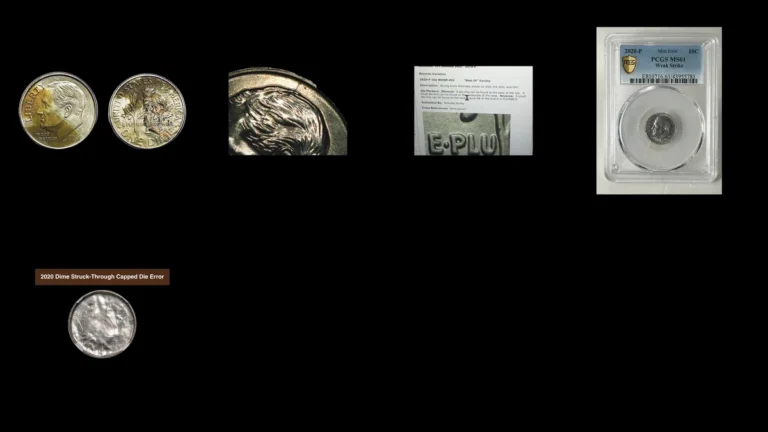
4. 1894 Dime One Patch Lacks Detail: Struck-Through Error
A substance caught between the die and blank can stop part of the design from forming. The reported 1894 Philadelphia strike-through does not identify a retained object or a particular material.
Missing letters in LIBERTY need special care because the raised headband also loses detail through ordinary wear. The surrounding surfaces help separate those possibilities.
How to Identify
Compare the weak area with nearby details of similar height. Wear tends to flatten exposed high points across the design, while a blocked strike can leave one weak patch among sharper details.
Inspect for scraping lines, pits, or rough corrosion that could explain the missing design. A local smooth area can support a blocked strike, but cannot name the blocking object by itself.
Only describe wire, cloth, or another specific material when the impression supports that identification. An empty patch alone supplies no such shape.
What It’s Worth
$75–$500 is the guide-based estimate for ordinary Philadelphia strike-throughs. Small weak patches on worn coins fit nearer the lower end.
A larger clear effect on a better-preserved coin can attract more interest. This is an estimated whole-coin range, without a supplied auction result for one particular 1894 example.
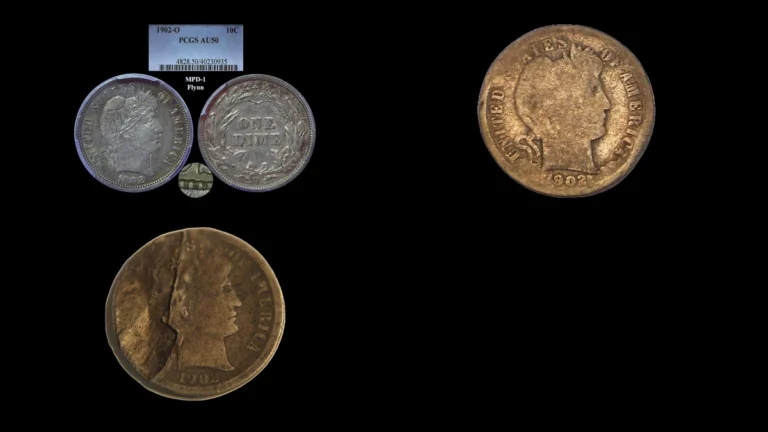
5. 1894 Dime A Thin Metal Layer Separates: Lamination Error
A lamination may leave a lifting flap or a shallow hollow after the flap falls away. It begins with a weak layer inside the silver-copper alloy.
An 1894 dime is silver alloy throughout, unlike a modern dime with a copper center and separate outer layers. Its peeling should therefore be compared with older silver-coin laminations.
How to Identify
Examine where the patch meets intact silver. A thin layer that continues beneath nearby metal is a more useful clue than general roughness.
Do not lift or probe an attached flap. Move the light around it to see the layered boundary.
A scraped channel often has tool lines and displaced metal at its sides. The year guide provides no fixed mint or location for the lamination report, so inspect the actual specimen.
What It’s Worth
$100–$500 is the estimate for an ordinary 1894 dime with visible natural separation. An attractive coin with a clear attached layer can support stronger interest.
A different Barber dime listed as 1912-X sold for $139 in March 2025. It was PCGS Good 4 and had lost about 30% of its reverse layer after striking.
That heavily worn different-year coin is only a broad comparison. Its large missing layer does not set the price of every small 1894 peeling patch.
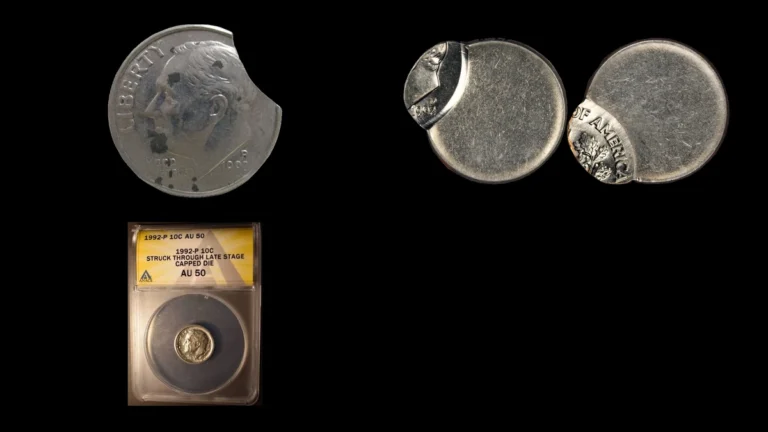
6. 1894 Dime A Curve Is Missing from the Edge: Clipped Blank Error
A blank can be cut partly across an earlier hole in the metal strip. The incomplete disc then receives its rim and design around a gap that was already present.
The 1894 report does not give a specific specimen’s clip percentage or position. A curved notch needs manufacturing evidence before it can be distinguished from a later cut.
How to Identify
Inspect the two ends of the gap for natural struck detail and metal flow. Saw marks, filing, or fresh sharp lips suggest damage after the coin was made.
Weakness on the rim opposite the gap is called the Blakesley effect. It can support a genuine clip, but is only one clue.
A normal dime weighs about 2.50 grams and measures 17.90 millimeters across. Missing metal and wear both lower weight, so low weight alone cannot prove the clip.
What It’s Worth
$150–$800 is the guide-based estimate for genuine clips on ordinary 1894 issues. Size, wear, and original surfaces affect the comparison.
No specific 1894 sale is supplied for the range. It is not a valuation of the rare 1894-S, and a tiny gap on a worn ordinary coin needs a different comparison from a large clear clip.
7. 1894 Dime The Dime Is Wider but the Design Fits: Broadstrike Error
The collar is the ring that limits a dime’s width and forms its edge grooves. When it does not restrain the blank properly, the metal can spread while the full design remains on the coin.
The supplied 1894 account reports this error without a certified example. Later hammering can also widen a coin, so size alone does not settle the cause.
How to Identify
Measure across several directions and follow the entire design on both faces. A genuine broadstrike can spread unevenly but should retain the intended picture.
Examine where the edge grooves change or disappear. Look for natural expansion during striking instead of crushed lettering and later impact marks.
One uneven border may result from a single misaligned die. The complete design, expanded metal, and unusual edge need to fit together.
What It’s Worth
$250–$1,500 is the estimate for a genuine broadstrike on an ordinary 1894 dime. The extent of visible expansion and the coin’s preservation influence its appeal.
A 1900-S broadstrike graded NGC VF30 sold for $342 in March 2026. That worn different-year example offers context for the lower end, rather than pricing an 1894-S rarity or an exceptional unworn coin.
Conclusion
An ordinary 1894 dime with an unusual surface belongs in a very different market from the rare 1894-S. Read the mintmark before using either group’s price range.
Then decide whether the feature is raised, weakly struck, peeling, missing from the edge, or part of an expanded outline. Clear photographs of both faces and the edge are more useful than a close-up that hides the coin’s identity.