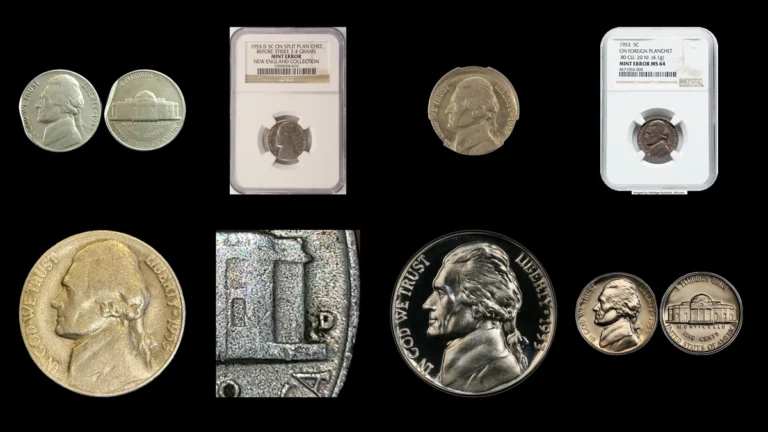
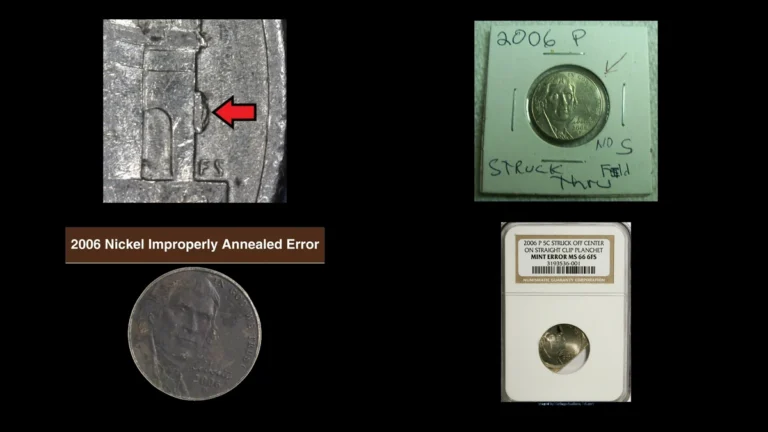
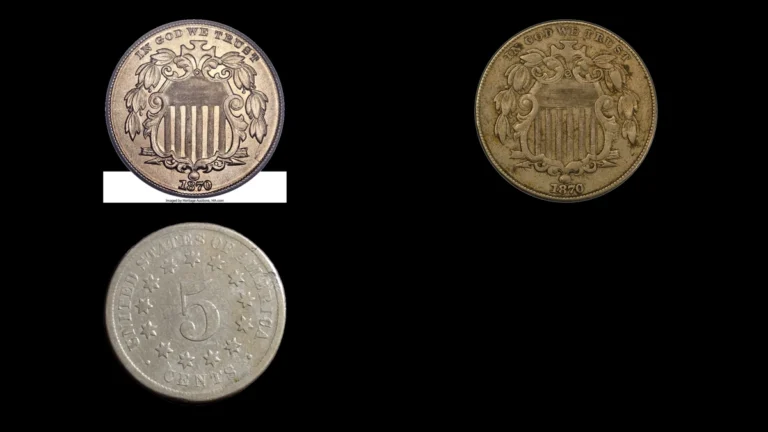
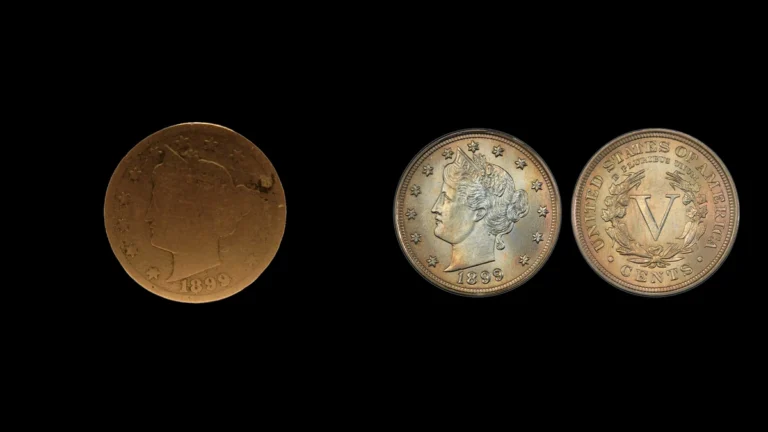
Rare 1944 Nickel Errors (List & Pictures)
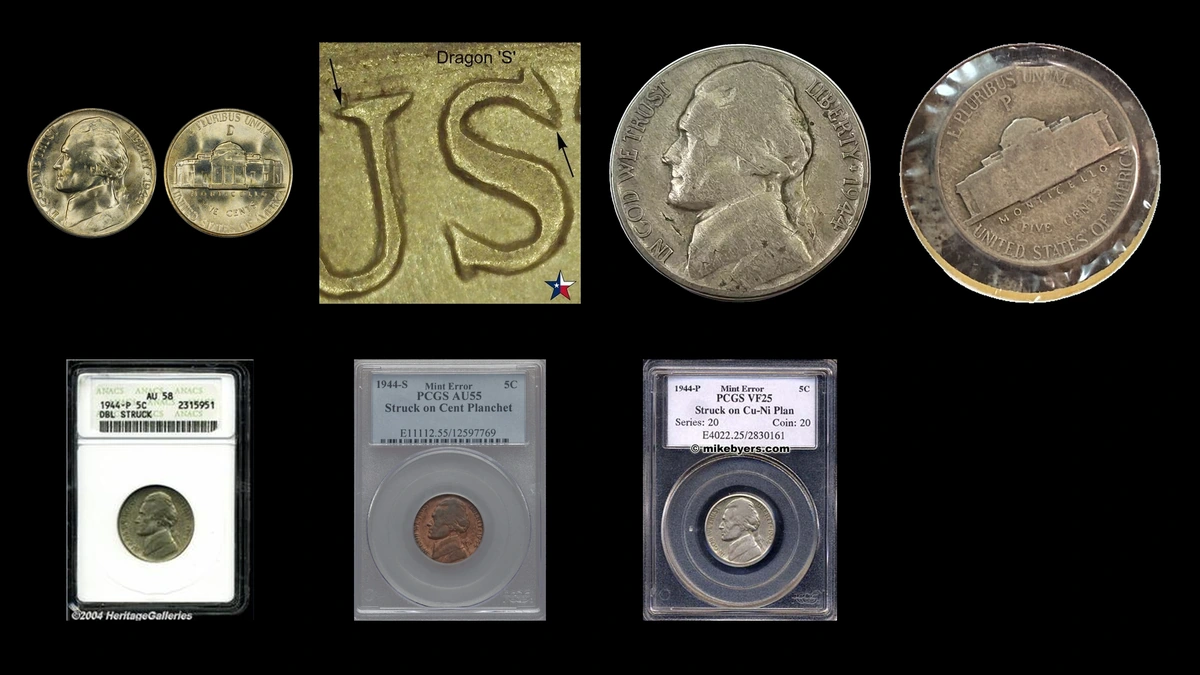
A large P above Monticello and silver in the alloy are normal on a 1944 Philadelphia nickel. An incorrect blank may be much harder to recognize, especially when it still weighs five grams.
Estimated values for 1944 nickel errors range from $15 to $15,000; a documented steel-blank example brought $8,050. Begin with the mint letter and design, then use surface structure, shape, and metal identification to narrow the possibilities.
| What to examine | Error category | Estimated range |
|---|---|---|
| Large mint letter | Repunched mint mark | $15–$500 |
| Repeated design outlines | Doubled die | $15–$300 |
| Separating surface | Lamination | $15–$175 |
| Curved missing edge | Clipped planchet | $25–$350 |
| Blank crescent | Off-center strike | $100–$1,000 |
| Repeated design with expanded outline | Double strike with broadstriking | $250–$1,500 |
| Small silver or copper blank | Dime or cent planchet | $1,000–$4,500 |
| Incorrect full-size alloy | Copper-nickel wrong alloy | $3,000–$12,000 |
| Small magnetic body | Zinc-coated steel planchet | $6,000–$15,000 |
1. 1944 Nickel Extra Letter Strokes Surround the Large Mint Mark: Repunched Mint Mark Error
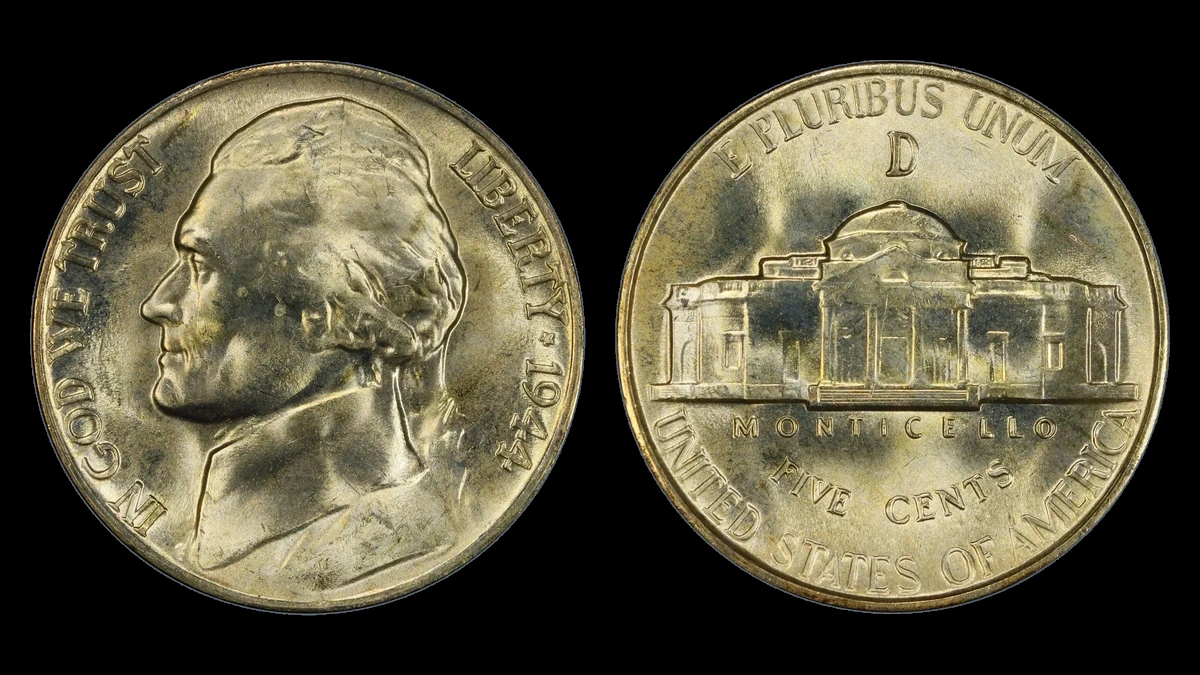
The wartime P, D, or S belongs above Monticello’s dome. Repeated hand punching into a die could leave an earlier letter partly visible beside the final impression.
How to Identify
Follow the junctions between the main letter and its extra stems or curves. Philadelphia forms include sideways, lower, and tilted impressions; Denver includes triple-punched forms, while San Francisco has its own extra S curves.
Match the complete configuration with Wexler’s 1944 photographs. A direction alone, an isolated lump, or a cut beside the letter is insufficient.
What It’s Worth
$15–$500 is an estimated range from minor worn varieties through attractive, clearly separated examples. The supplied listings do not establish a completed sale for every pattern.
The large wartime letter is itself normal, including Philadelphia’s P. Any price comparison must also allow for the ordinary coin’s condition and grade.
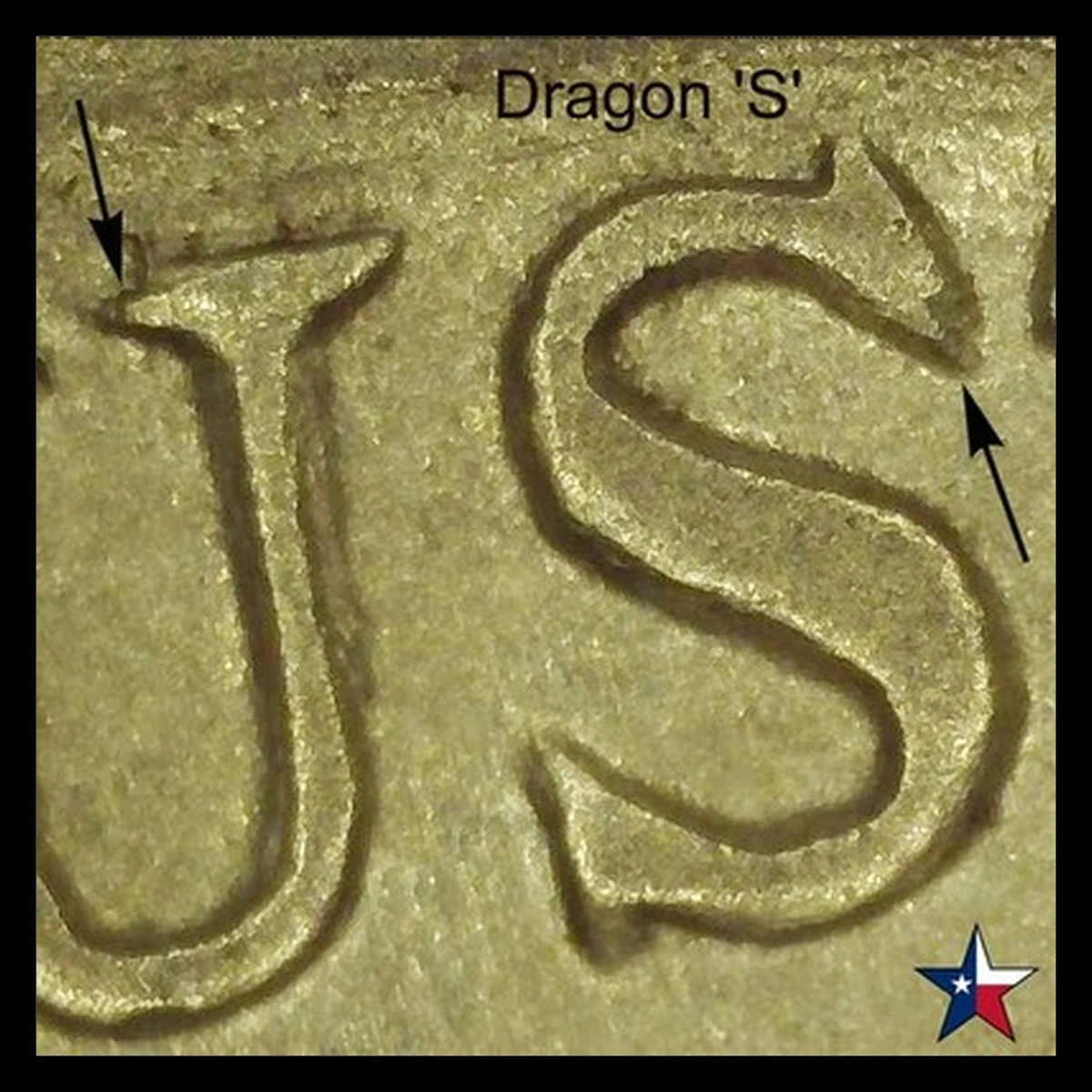
2. 1944 Nickel Lettering Carries Repeated or Thickened Outlines: Doubled Die Error
Obverse and reverse doubled dies are recorded across the three 1944 mints. The affected design was already present in the die, so multiple coins could reproduce the same pattern.
How to Identify
On the obverse, examine the motto, LIBERTY, star, and date according to the variety being considered. Reverse comparisons include upper inscriptions and FIVE CENTS.
Some Philadelphia reverse patterns strengthen toward the right, while modest Denver and San Francisco varieties require close inspection near E PLURIBUS UNUM. Use the correct mint and face when consulting Brian’s 1944 variety photographs.
Flat shelves and general softness do not reproduce a specific pattern of raised separation. Match several details rather than declaring every thick letter a doubled die.
What It’s Worth
$15–$300 is an estimated whole-coin range for the supplied doubled-die varieties. Strength, attribution, and preservation govern the comparison; these are not individual auction results for each catalog entry.
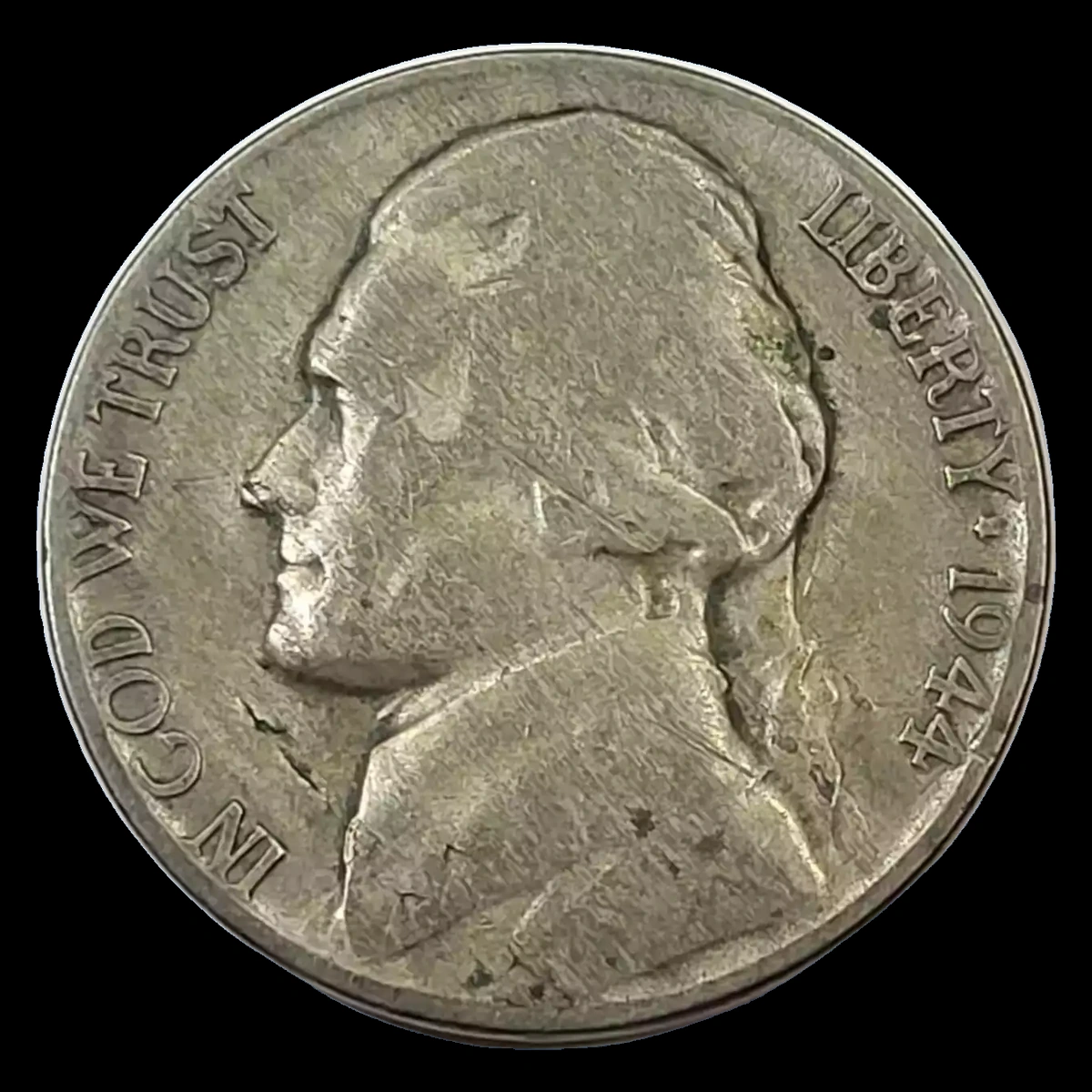
3. 1944 Nickel The Struck Surface Begins to Peel: Lamination Error
A rough patch with a separating edge can reveal weakness within the wartime alloy. Normal 1944 nickel metal contains 56% copper, 35% silver, and 9% manganese mixed together, rather than a silver surface coating.
How to Identify
Locate an actual boundary opening beneath the surface and leave any attached flap in place. A stain or gouge lacks the same natural layer separation.
The recorded Denver specimen has a reverse lamination, while the Philadelphia example is a separate coin. Neither should be described as one half of a matching split pair.
A loose normal wartime nickel weighs about 5 grams, measures 21.2 millimeters, and has a plain edge. Retained flakes may leave weight nearly unchanged, while missing pieces can reduce it; these references also help assess the remaining blank errors.
What It’s Worth
$15–$175 is an estimate for recognizable surface laminations. The Denver MS65 example sold for $27 in April 2008, while a separate Philadelphia NGC MS66 example is recorded at $51 on eBay in May 2018.
These historical whole-coin results reflect different specimens. A mint-made defect can still reduce visual appeal, particularly when the surface is badly disrupted.
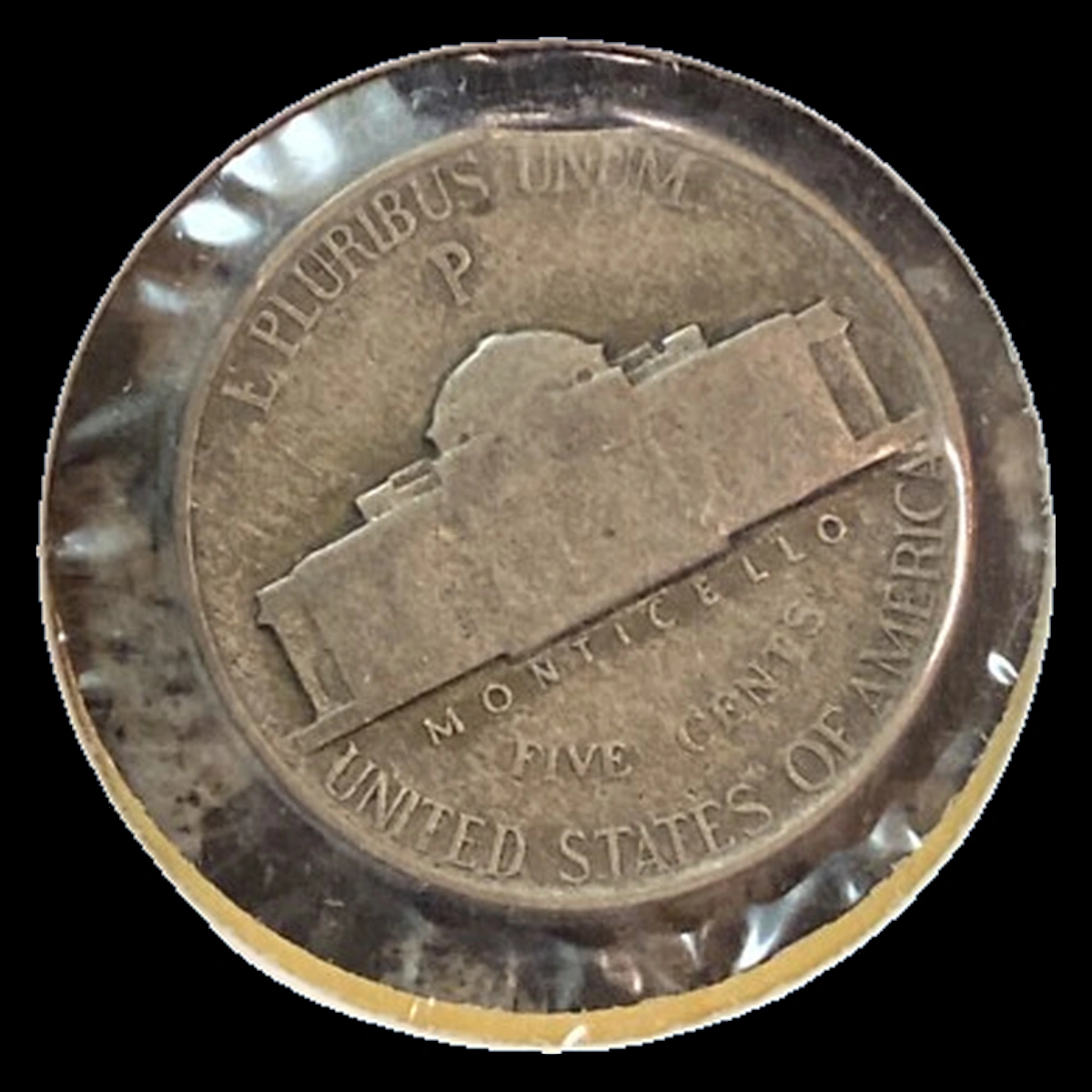
4. 1944 Nickel A Curved Section Is Missing from the Outline: Clipped Planchet Error
A blanking punch overlapping an earlier hole in the metal strip can produce an incomplete disk. The nickel design is then struck onto the metal that remains.
How to Identify
Inspect the ends of the gap for natural strike flow and rim formation, rather than fresh filing or cutting marks. Weakness on the opposite rim can support the diagnosis, but need not be obvious.
Two supplied Philadelphia examples need separate descriptions: the MS64 Full Steps coin has a reported 15% clip and weighs 4.4 grams. The eight-o’clock gap belongs to a more worn specimen, not an established position for the MS64 coin.
Full Steps describes preserved detail on Monticello, not the clip itself. Measure intact portions of the outline when assessing a loose coin.
What It’s Worth
$25–$350 is an estimate for genuine curved clips, depending on condition and the missing section’s visibility. No individual completed sale is supplied for either 1944-P example.
A 1997-P nickel with a 20% clip sold for $124 in March 2025. That later coin uses a different alloy and provides context rather than a direct wartime-nickel price.
5. 1944 Nickel Roughly Half the Design Misses the Blank: Off-Center Strike Error
The recorded 1944-P PCGS MS64 example is about 50% off-center. Its displaced strike leaves unused metal on one side and incomplete design on the other.
How to Identify
Confirm the surviving 1944 date and large P, then follow the transition between struck and untouched metal on both faces. The two sides should support the same misplaced blank.
An intact unstruck crescent differs from the absent metal of a clip. Grinding, smoothing, or trimming after minting should not be confused with natural metal flow from the original strike.
What It’s Worth
$100–$1,000 is an estimated range for 1944 off-center nickels, with strong dated examples generally more desirable. The supplied 50% specimen has no completed sale price assigned here.
A 1948-S nickel struck 15% off-center brought $391 in October 2010. Its different alloy, smaller offset, and preserved step detail limit how directly that result can be applied.
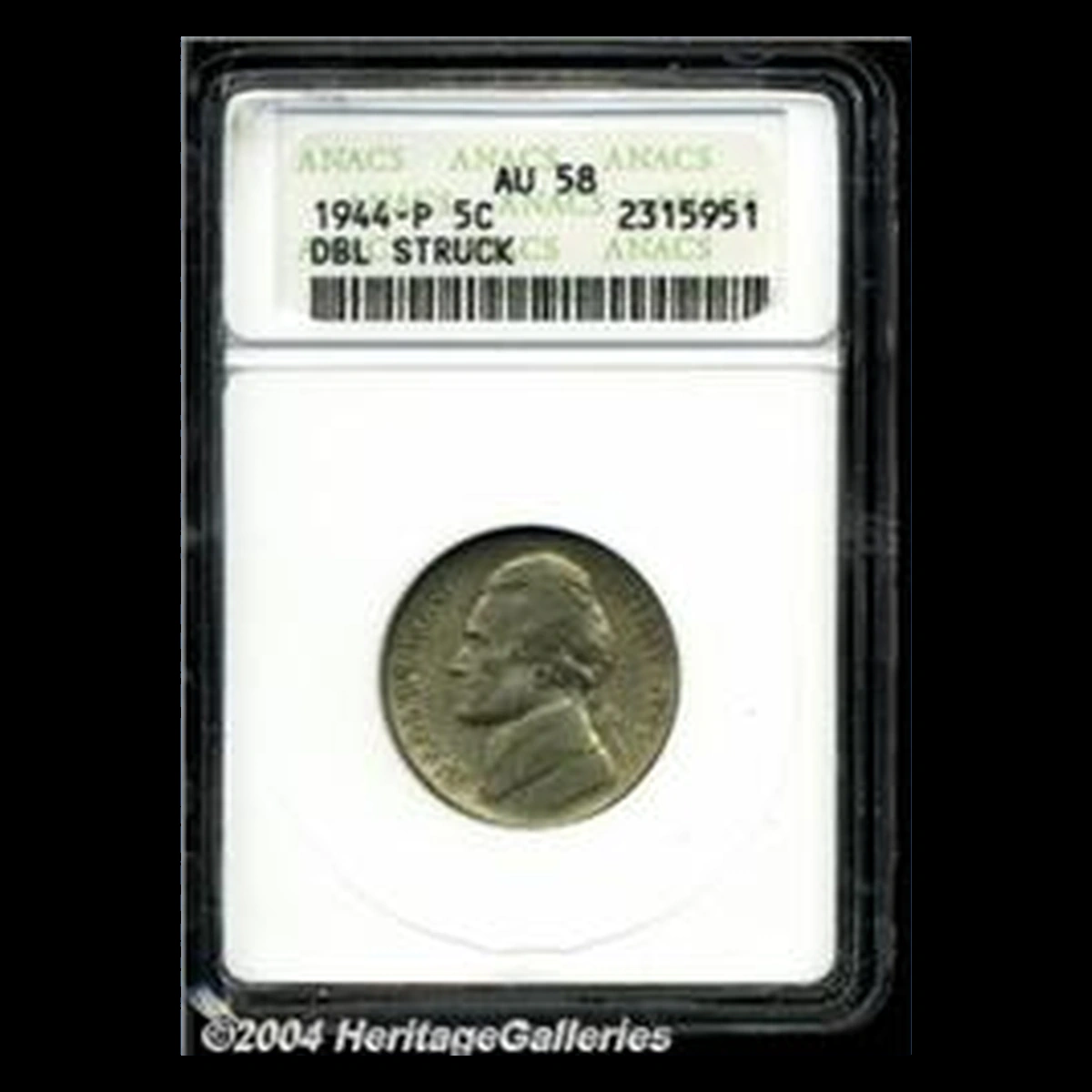
6. 1944 Nickel Repeated Design Appears inside an Expanded Outline: Double Strike with Broadstriking Error
A Philadelphia example graded ANACS AU58 combines two blows with spreading beyond the usual outline. The collar, which normally confines the blank, did not provide its usual restraint.
How to Identify
Find a recognizable letter or portrait feature repeated within the enlarged body and compare the corresponding reverse evidence. A scrape may cross a design, but it does not stamp a second piece of it.
The supplied description gives no exact second-strike displacement or rotation. Do not force the coin to match a diagram with two complete portraits or an invented direction.
What It’s Worth
$250–$1,500 is an estimated range for a confirmed combination of this kind. The two effects belong to one coin and should be valued together.
A 1952 nickel with a second strike 90% off-center was recorded at $196 in October 2010. That different arrangement is a comparison, not a completed sale of the 1944 broadstruck example.
7. 1944 Nickel A Small Silver Blank Truncates the Design: Dime-Planchet Strike Error
Silver is normal in a wartime nickel, so its presence alone cannot establish a dime-planchet error. The recorded Philadelphia PCGS AU50 example combines a smaller blank with a higher-silver alloy and incomplete peripheral design.
How to Identify
A contemporary dime blank normally weighed about 2.5 grams, measured 17.9 millimeters before striking, and contained 90% silver. Compare those characteristics with the heavier 35%-silver nickel, allowing for spreading under the nickel dies.
Check that the outer lettering ends naturally at the small blank instead of being cut off later. The blank need not carry an earlier dime design or acquire the reeded edge of a normally struck dime.
What It’s Worth
$1,000–$3,500 is an estimate for comparable authenticated examples. The AU50 Philadelphia coin sold for $1,620 at Heritage on August 16, 2019.
That result concerns the wrong denomination’s blank, not an ordinary silver wartime nickel. Date readability, remaining design, and original surfaces still affect the comparison.
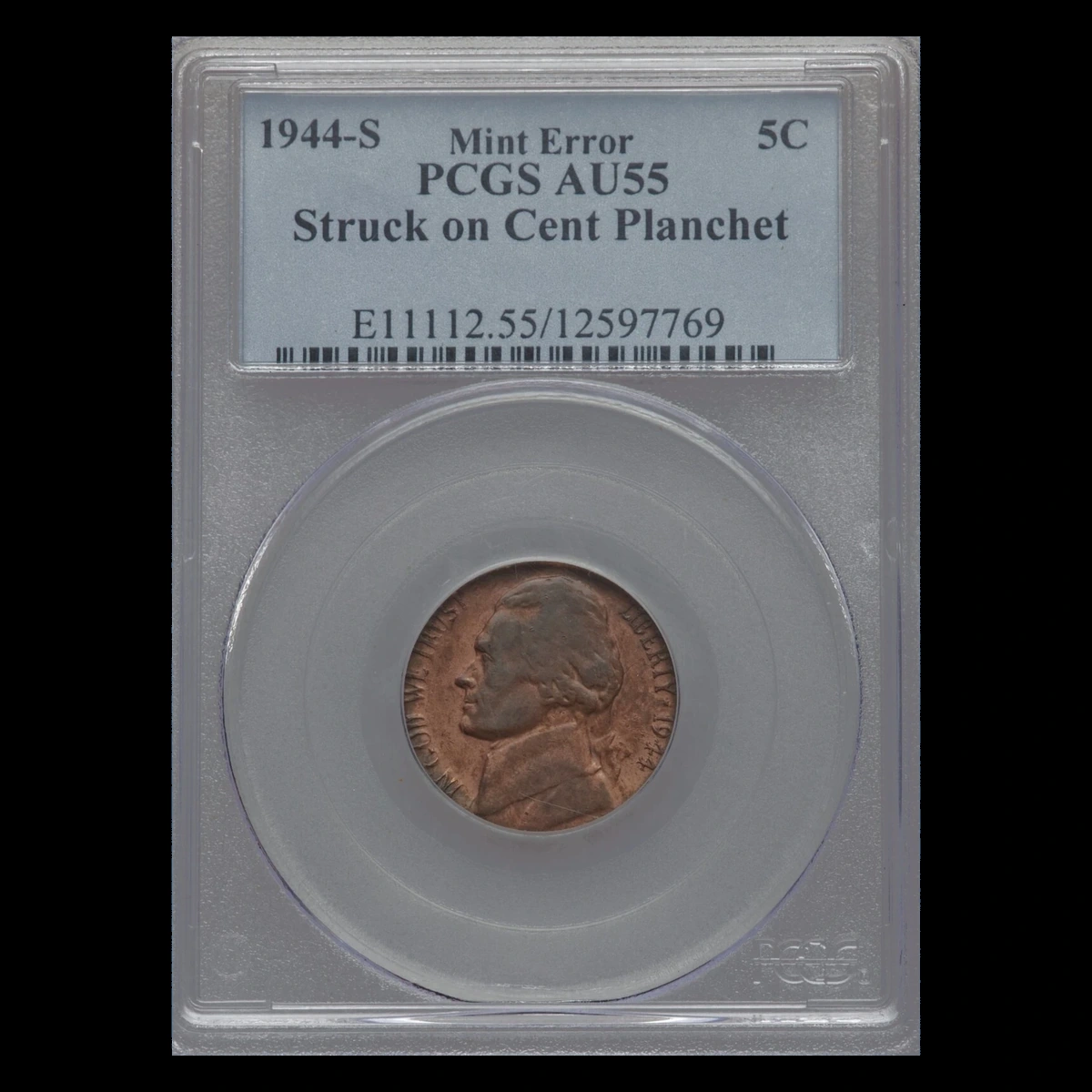
8. 1944 Nickel Copper-Colored Metal Cuts Off STATES OF: Cent-Planchet Strike Error
The recorded Philadelphia cent-planchet example loses part of STATES OF while retaining much of the nickel design. Its smaller blank contacted the collar near six o’clock, and some surviving lettering stretched as the metal flowed.
How to Identify
Compare the lower border and incomplete words with the documented specimen. Those exact locations describe that coin, not every nickel struck on a cent blank.
A period cent blank normally started at about 3.11 grams and 19 millimeters. Copper plating can change a nickel’s color without explaining the smaller body and naturally truncated design.
The large P and wartime design came from the nickel dies. No Lincoln lettering is required because a cent blank had not necessarily been struck as a cent before entering the wrong press.
What It’s Worth
$1,500–$4,500 is an estimated range for comparable confirmed errors. The PCGS MS61 Red and Brown specimen sold for $2,640 on November 21, 2022.
Its grade denotes an unworn coin with noticeable marks and mixed copper coloration. Original color, surviving lettering, and wear matter more than a copper appearance by itself.
9. 1944 Nickel A Normal-Size Coin Contains the Wrong Metal: Copper-Nickel Alloy Error
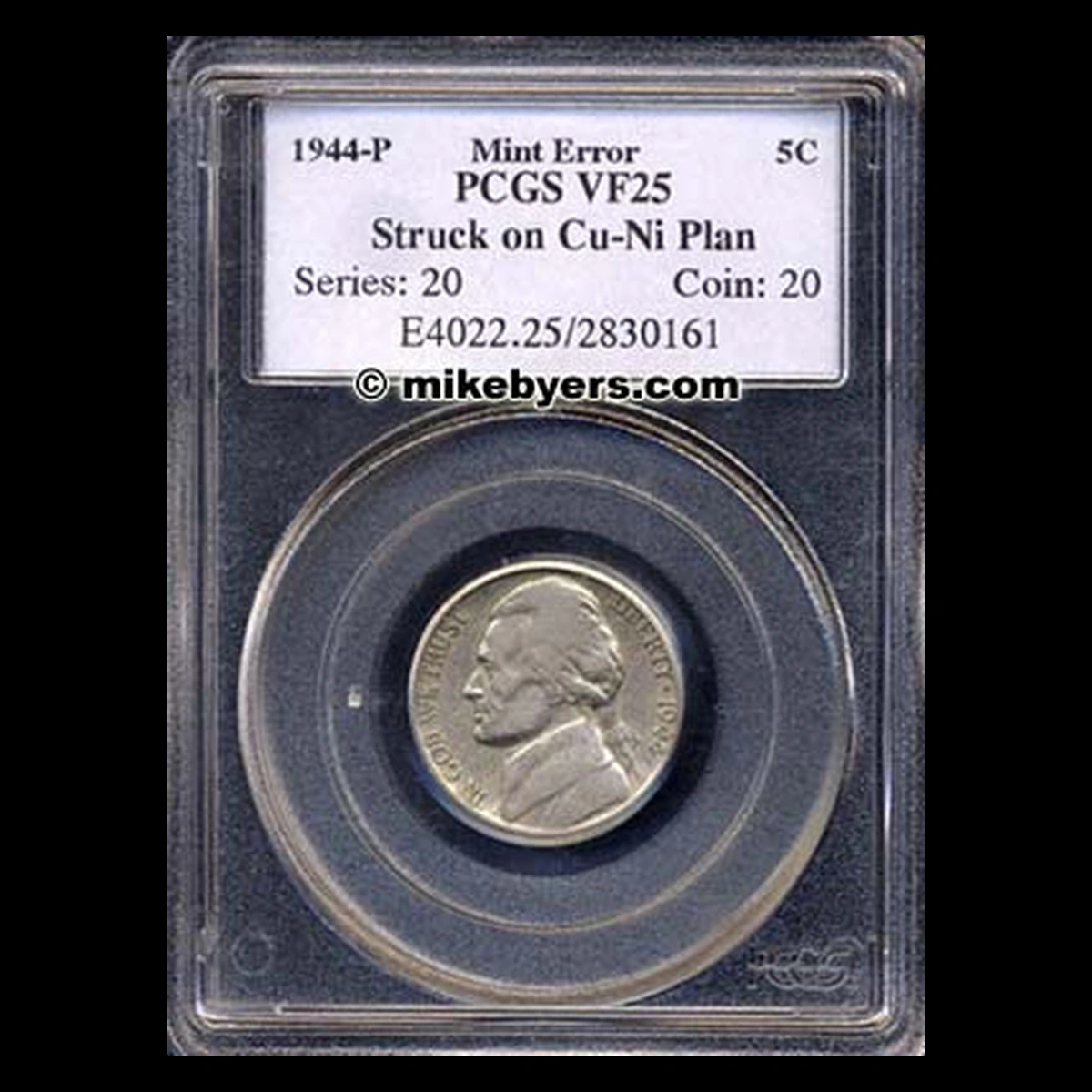
A five-gram 1944-P nickel can still have the wrong composition. The recorded NGC VF25 coin was struck on copper-nickel rather than the required copper-silver-manganese alloy.
How to Identify
Use a specimen-specific material report or nondestructive professional testing alongside authentication of the date and large P. Normal weight alone cannot separate this error from an ordinary wartime nickel.
A different PCGS VF30 example has reported composition of 79.6% copper, 19.9% nickel, and 0.5% aluminum. Those percentages belong to that coin and differ from the usual prewar 75% copper and 25% nickel alloy.
The aluminum-bearing piece should therefore not automatically be described as an ordinary leftover prewar blank. Similar color does not transfer one coin’s laboratory findings to another.
What It’s Worth
$3,000–$12,000 is a working estimate for authenticated 1944 copper-nickel wrong-alloy pieces. The five-gram VF25 specimen brought $6,300 at Heritage on December 21, 2022.
No reliable completed sale is supplied for the separate VF30 aluminum-bearing coin. A generic starting-price field is not a transaction record.
10. 1944 Nickel A Small Magnetic Body Carries the Wartime Design: Zinc-Coated Steel Planchet Error
Documented 1944-P errors include nickels struck on zinc-coated steel blanks. Separate specimens graded XF40 and VF20 preserve different amounts of circulation wear.
How to Identify
Magnetic attraction is a useful starting clue, provided the magnet does not scrape or strike the coin. Confirm the metal, genuine nickel design, and smaller body together, excluding attached steel or alteration.
The blank type normally weighed about 2.7 grams and measured 19 millimeters before striking. It served both 1943 U.S. cents and 1944 Belgian two-franc coins made in Philadelphia.
The finished error cannot establish which supply furnished its blank. The Belgian connection is a possible origin, not a proven history for an individual coin.
What It’s Worth
$6,000–$15,000 is an estimated range for authenticated steel-planchet examples. The supplied reporting records an $8,050 auction result for the VF20 specimen in 2003, including the buyer’s fee.
The separate XF40 example had a $38,000 minimum bid in 2013. That threshold is not a documented completed sale and should not replace the actual transaction when making a comparison.
Conclusion
Start with the normal wartime features before investigating a 1944 nickel: the large mint letter, silver-bearing alloy, and five-gram standard. Then let the unusual detail determine whether the next useful check is magnification, an edge view, or a composition test.
Keep measurements and material results tied to the specimen that produced them. Similar appearance cannot merge two coins’ grades, clip positions, alloy percentages, or sale histories into one example.