Rare 2011 Half Dollar Errors (List & Pictures)
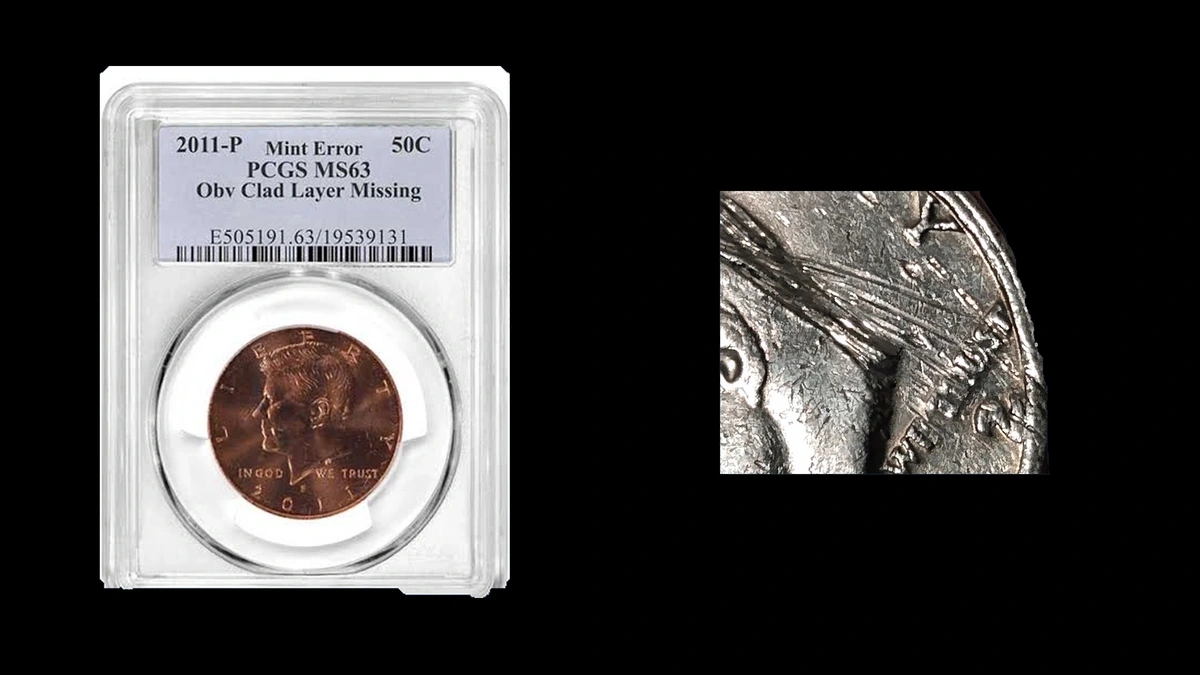
A documented 2011-P half has Kennedy’s portrait struck into exposed copper while its reverse retains the pale outer layer. That provides a concrete example among 2011 half dollar errors, whose supplied estimates range from $5 to $2,500.
A different-year 1995-P on a quarter blank brought $1,680 in July 2022; it does not confirm a 2011 wrong-blank discovery. Examine the outline, layers, and surface details in sequence to distinguish the reported categories.
| Visible clue | Category | Estimated range |
|---|---|---|
| Missing perimeter metal | Clipped planchet | $20–$100 |
| Complete design with outward spread | Broadstrike | $25–$250 |
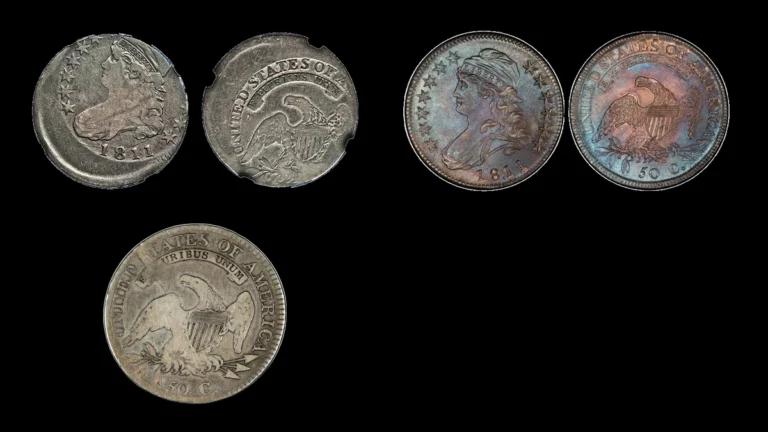
| Blank crescent and displaced design | Off-center strike | $75–$350 |
| Unusual size or composition | Wrong planchet | $1,000–$2,500 |
| Copper portrait, pale reverse | Missing obverse clad layer | $200–$400 |
| Local impression or weak patch | Strike-through | $5–$150 |
| Ridge or rim-connected mound | Die crack or cud | $5–$200 |
| Opposite-design outline | Die clash | $25–$100 |
| Repeated front contours | Doubled die obverse | $30–$150 |
Ordinary Philadelphia and Denver halves are clad, with copper-nickel outer layers bonded to a copper center. Their normal specifications are 11.34 grams, about 30.61 millimeters, and a grooved edge; the normal 2011-S silver proof weighs 12.50 grams and uses a different alloy.
1. 2011 Half Dollar A gap interrupting the rim: Reported clipped planchet Error
A blanking punch overlapping an earlier hole can leave a curved shortage, while reaching the strip’s edge can create a straighter one. The incomplete blank then receives its designs with the missing section already present.
How to Identify
Inspect both junctions between the gap and normal rim for original striking transitions. Saw marks or filing through completed lettering indicate removal after manufacture instead.
Check whether the weight loss broadly fits the missing area and look for possible weakness at the opposite rim. That weakness is supporting evidence rather than a required identical appearance on every clip.
The 2011 P and D reports identify no exact gap shape or location for an individual coin. Read those details from the candidate rather than from the general category.
What It’s Worth
Genuine small through clearly visible clips are estimated at $20–$100. The supplied guide ranges of $20–$50 and $30–$100 overlap and do not represent separate auction results.
A readable date, mintmark, and original border make comparison easier. A damaged edge does not qualify for the range solely because a listing calls it a clip.
2. 2011 Half Dollar Extra width around the full design: Reported broadstrike Error
A broadstrike can preserve the complete portrait and eagle while spreading beyond normal width. The collar ring failed to restrain the blank’s edge during the strike.
How to Identify
Read all the outer lettering on both sides, then examine the expanded margin and altered edge grooves. An off-center strike may lose part of the design instead of retaining it all.
Later flattening can also enlarge a normal coin but often crushes raised details or leaves pressure marks. Spreading alone removes no metal, so the weight can remain near the clad standard.
No measured specimen or particular mint is identified in the supplied 2011 report. A generic broadstrike diameter should not be presented as a measurement of a 2011 half.
What It’s Worth
Modest through clearly expanded examples are estimated at $25–$250. Specialist offers of $165 for a 1990-P NGC MS65 and $175 for a 1983-P MS65 provide different-year asking comparisons.
Those offers help frame a wider range than the 2011 guide’s $10–$25 for slight examples. Neither establishes a completed 2011 sale.
3. 2011 Half Dollar Bare metal next to a shifted design: Reported off-center strike Error
A blank partly outside the dies can retain a plain crescent while intended design falls beyond its edge. The supplied reports concern 2011-P and D ordinary strikes, not an established off-center S proof.
How to Identify
Inspect both faces for matching displacement relative to the original blank. If one design remains centered, a single misaligned die may explain the other side.
Confirm the remaining date and mintmark, then describe the actual direction and amount of offset. Check the unstruck area and surviving edge for trimming or later removal of detail.
What It’s Worth
Readable-date examples are estimated at $75–$350. The year guide suggests $75–$150 for offsets around 10–15% and $200–$300 for larger shifts.
A dealer’s $225 offer for a 1983-P MS64 with a 10% offset is a different-year asking comparison. These ranges are not fixed prices per percentage point; preserved identity and surfaces matter too.
4. 2011 Half Dollar A size or metal mismatch: Reported wrong planchet Error
The year guide describes the possibility of a half-dollar design landing on another coin’s blank and uses a nickel blank to explain it. That explanation does not establish a certified 2011 nickel-blank specimen or its mint.
How to Identify
Measure weight and actual width before proposing another denomination, then inspect composition and the original edge. A nickel blank begins near five grams and 21.21 millimeters, but can spread when struck by larger dies.
Exclude trimming or removed layers as explanations for a small, light coin. The normal silver proof is heavier than clad halves by design and is not automatically a wrong-planchet error.
Keep the visible date and mintmark linked to the measured specimen. Matching a proposed blank’s metal and weight is essential in addition to finding incomplete outer design.
What It’s Worth
An authenticated wrong-blank example is estimated at $1,000–$2,500. A 1995-P on a quarter blank, graded NGC MS67, is recorded at $1,680 from a July 2022 Heritage sale.
That result has an identified quarter blank and another date. It neither confirms the reported 2011 category nor supplies a price for a supposed nickel-blank discovery.
5. 2011 Half Dollar Kennedy appears in copper while the back stays pale: Missing obverse clad layer Error
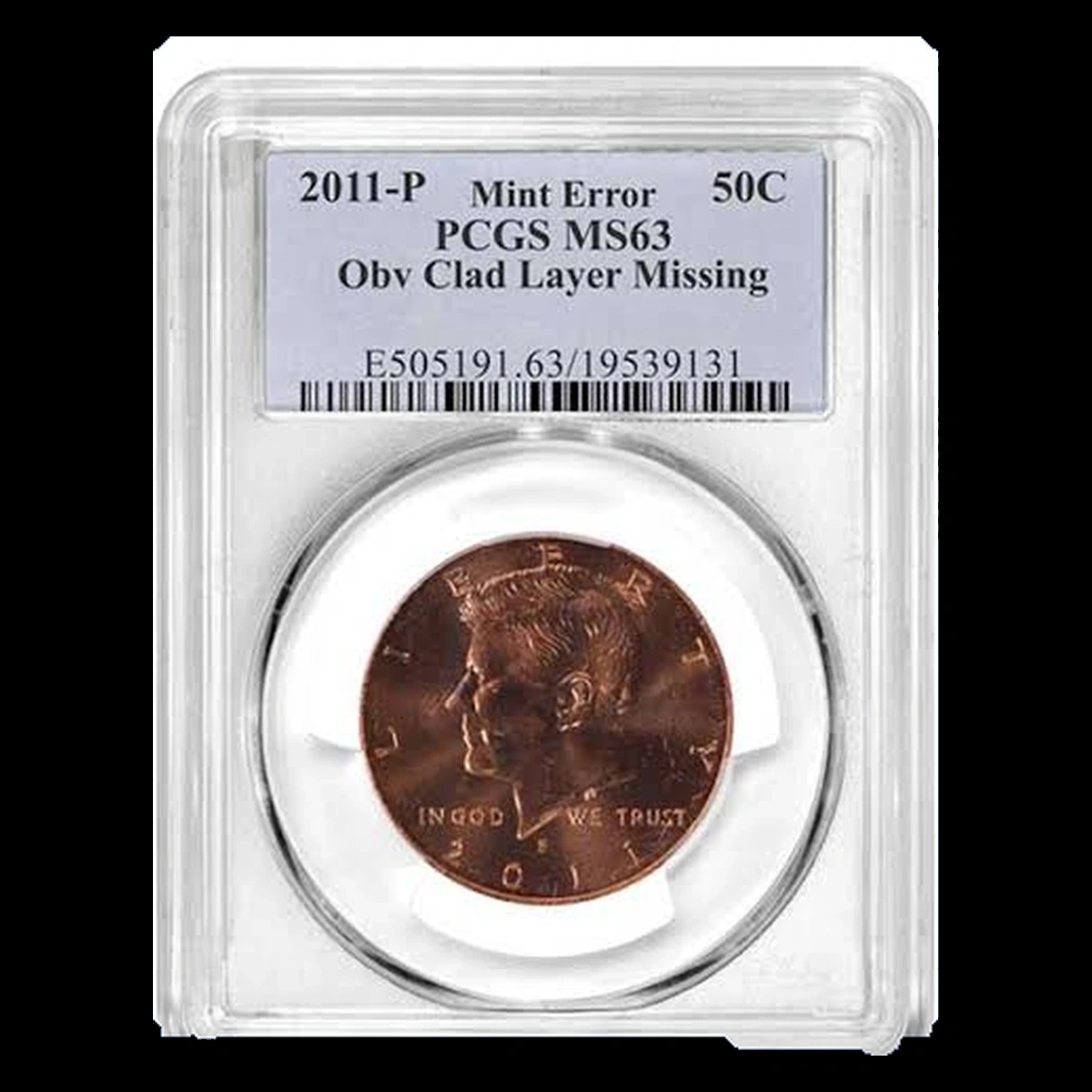
Jon Sullivan’s pictured 2011-P has its portrait struck directly into the copper core. The reverse retains its normal copper-nickel outer layer.
The PCGS article identifies the obverse layer as missing before striking. That sequence differs from peeling away a finished design afterward.
How to Identify
Examine both faces together and follow the remaining layers at the edge. The copper portrait should have original struck texture rather than grinding lines, scraping, or chemically roughened metal.
Record the actual weight instead of assigning a generic missing-layer figure. The normal 2011-S silver proof uses a different construction and does not have pale copper-nickel skins to lose.
What It’s Worth
An attractive authenticated example missing the full obverse layer is estimated at $200–$400. Smaller or less conspicuous losses require their own comparisons.
The PCGS photograph documents the coin’s identity but supplies no sale price for Sullivan’s specimen. The range is therefore an estimate, not a recorded payment or an automatic premium for brown coloration.
6. 2011 Half Dollar An impression or patch where detail failed to form: Reported strike-through Error
A barrier between die and blank can interrupt the design during striking. A solid object may leave a recognizable impression, while packed material can prevent details from filling normally.
How to Identify
Start where normal design returns beside the affected area and inspect for original boundaries. Scrapes crossing nearby details or metal pushed up beside a dent can indicate later damage.
Compare other high points for ordinary wear and check the opposite face. The 2011 report supplies no exact material or location, so it should not automatically be labeled wire or grease.
What It’s Worth
The supplied range is $5–$150, from slight local weakness to recognizable impressions. A dealer offers an undated Kennedy with strike-throughs on both faces, graded PCGS AU58, for $125.
That is a retail asking price for a lightly worn coin of unestablished date, not a completed 2011 sale. Ordinary weak striking must be excluded before a faint patch is assigned an error premium.
7. 2011 Half Dollar A thin ridge or broad rim mound: Die cracks and cuds Error
Different degrees of die breakage produce different raised features. A narrow fracture leaves a ridge, while a missing perimeter section can create a mound replacing detail at the rim, called a cud.
How to Identify
For a line, confirm that it rises above the surface rather than forming a groove with displaced edges. For a mound, establish the actual connection to the rim.
Inspect nearby edge grooves for a blow or folded metal that could imitate a break. The supplied 2011 report gives no fixed path or location and does not require any metal to have been cut out of the coin.
What It’s Worth
Small genuine cracks are estimated at $5–$30, while clearer rim cuds are estimated at $30–$200 on ordinary clad coins. These are modest modern Kennedy comparisons rather than transactions for named 2011 specimens.
A short ridge should not inherit the range for a broad area of missing die. Later edge damage remains damage even if it makes an equally conspicuous lump.
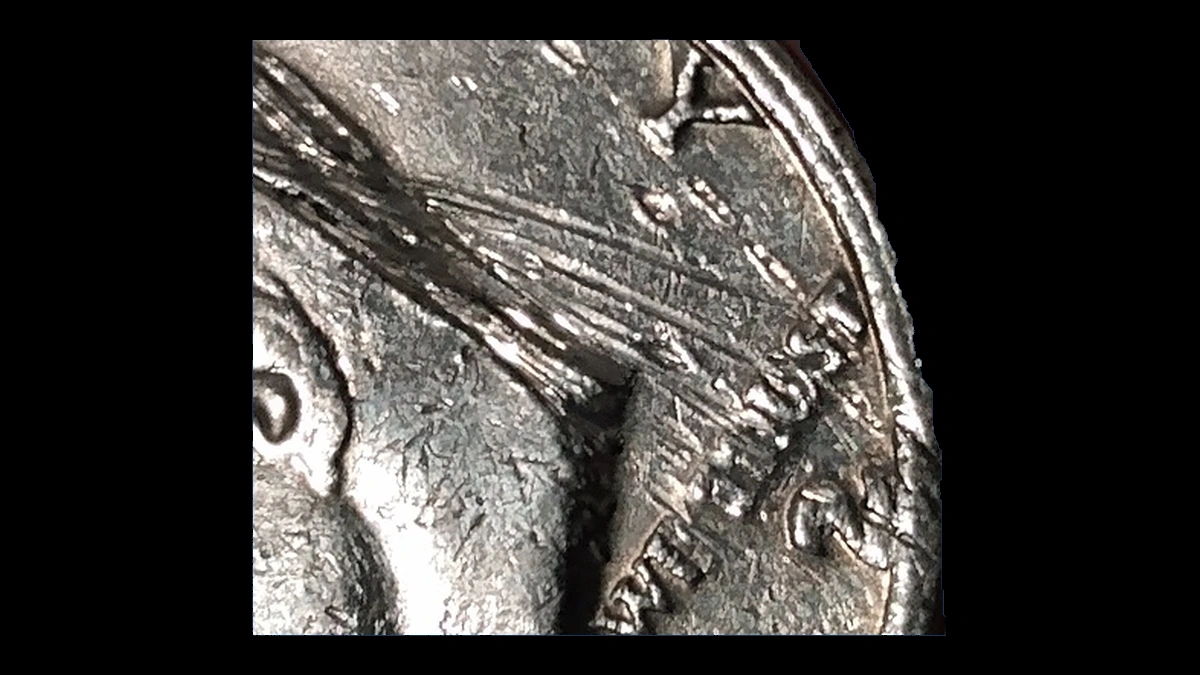
8. 2011 Half Dollar A trace of the other face near portrait or eagle: Reported die clash Error
The P and D reports describe possible extra outlines without one fixed pattern. Clashes occur when empty dies contact each other, leaving opposing design traces that can transfer to later coins.
How to Identify
Match a recognizable portion of the other design at the same scale and expected reversed position. A complete eagle or portrait need not appear, but an isolated line vaguely resembling a feather is weak evidence.
Inspect for disturbed surfaces or crushed edges from later pressing of finished coins together. Random scratches and polishing lines also need to be separated from actual transferred contours.
What It’s Worth
Recognizable clashes are estimated at $25–$100. Faint but identifiable traces sit lower than strong, coherent outlines on attractive surfaces.
The supplied guide does not provide a sale of an individual 2011-P or D example. The visible design match matters more than a nickname or resemblance suggested by one photograph.
9. 2011 Half Dollar Extra contours in LIBERTY, the motto, or date: Reported doubled die obverse Error
The reported inspection areas are LIBERTY, the motto, and the date on P and D coins. They are not a confirmed list of doubled letters belonging to one named die.
A true doubled die already contains the added shape before striking. Movement during a strike can instead produce a flat shelf, which has a different cause.
How to Identify
Choose a comparison from the same mint and examine whether rounded extra contours persist under changing light. A feature on a Denver tool cannot automatically identify a Philadelphia coin.
Check the arrangement across affected details without demanding equal doubling on every letter. A flat ledge reducing the main letter or general thickness alone does not establish a collectible die variety.
What It’s Worth
The 2011 variety guide gives an estimated $30–$150 for identifiable genuine repeated design. It supplies no named 2011 auction example at the upper amount.
Clear contours and better surfaces can support stronger interest within this minor-variety comparison. Striking shelves do not automatically receive the same added value.
Conclusion
The photographed missing-obverse-layer 2011-P offers a specific match: an original copper portrait with a normal clad reverse. The other reported categories still need their own outline, edge, or design evidence on the coin being examined.
Use the correct clad or silver-proof standard and preserve any loose surface metal. When comparing values, keep an undated dealer offer, a different-year auction, and an estimated 2011 range clearly separate.