Rare 1845 Half Dollar Errors (List & Pictures)
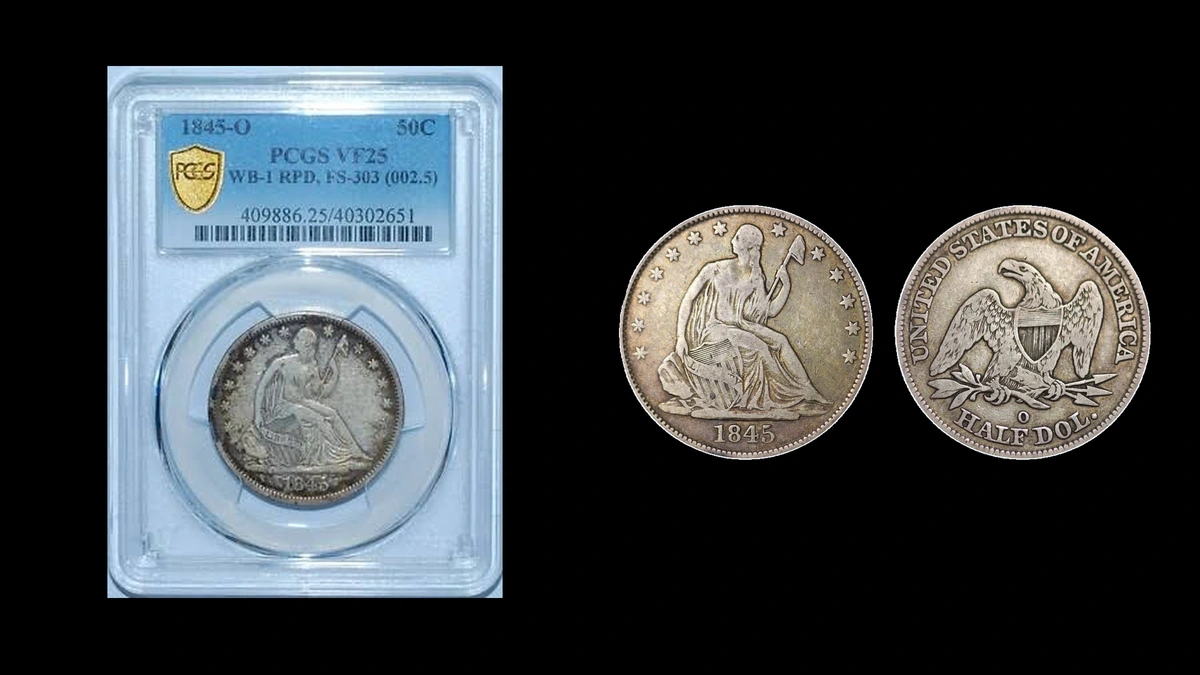
The Newman 1845 proof carries a crack and small die lump, but its rarity and preservation explain its $35,250 April 2013 sale. An ordinary half dollar with a raised line belongs to a different comparison group.
These 1845 half dollar errors span estimated values of $100–$45,000. Start with the front date and elbow, inspect the reverse mintmark and transferred shapes, and reserve proof diagnostics for an independently identified proof.
| What to notice | Location | Feature | Estimated value |
|---|---|---|---|
| The lower foot of 1 is absent | First date digit on Large O coins | Footless 1 | $200–$700 |
| Repeated numeral fragments | Date, with separate varieties | Repunched or tripled date | $150–$1,500 |
| A clothing fold is missing | Below Liberty’s left elbow on O coins | No Drapery | $200–$18,000 across stated grades |
| A sideways oval appears inside O | Reverse mintmark | O over Horizontal O | $250–$1,000 |
| An opposite-design trace appears | No fixed location supplied | Clashed dies | $100–$600 |
| A crack near HALF and lump below 8 | Both faces of the Newman proof | Die crack and chip | $30,000–$45,000 for the rare proof comparison |
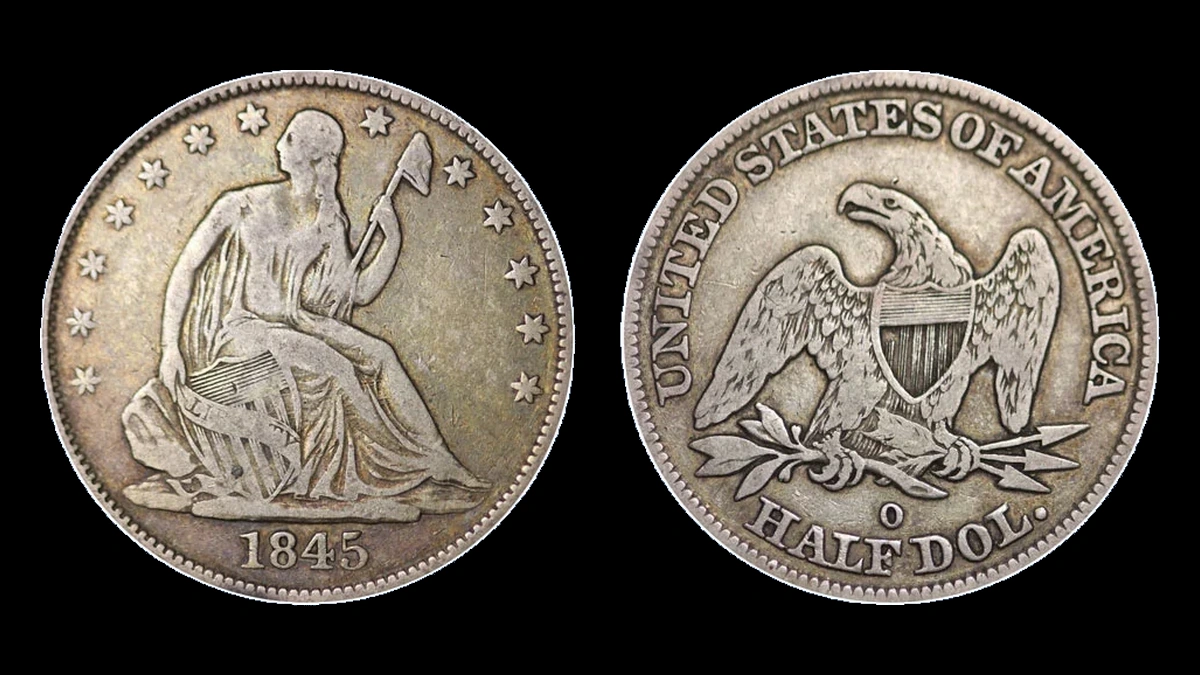
The mintmark O identifies New Orleans; Philadelphia has no letter below the eagle. Normal unworn weight is about 13.36 grams and diameter about 30.6 mm, with edge grooves, but these measurements do not establish proof manufacture.
1. 1845 Half Dollar The First Digit Has No Lower Foot: Footless 1 Error
The named feature is a missing small foot at the bottom of the first 1 in 1845. PCGS lists it among the New Orleans Large O varieties.
A generally weak date is not the same diagnostic. The remaining vertical stroke and surrounding metal must be considered with the absent foot.
How to Identify
Compare a normal 1845-O at similar wear and magnification. Follow the 1 down to the place where its foot should join the main stroke.
Inspect for scraping, local smoothing, or broad wear that also removed neighboring detail. An unreadable lower-date patch cannot establish a specific Footless 1 variety.
Confirm the Large O reverse and keep the full date visible in the photographic record. The absence must match an identified example on an otherwise convincing original surface.
What It’s Worth
Estimated range: $200–$700 for identified circulated examples. The year guide reports a $297 GreatCollections result for a PCGS Genuine coin.
The corresponding 2024 listing identifies the variety, but its displayed starting bid is not the final result. Genuine indicates authenticity with a condition problem, rather than a problem-free numeric grade.
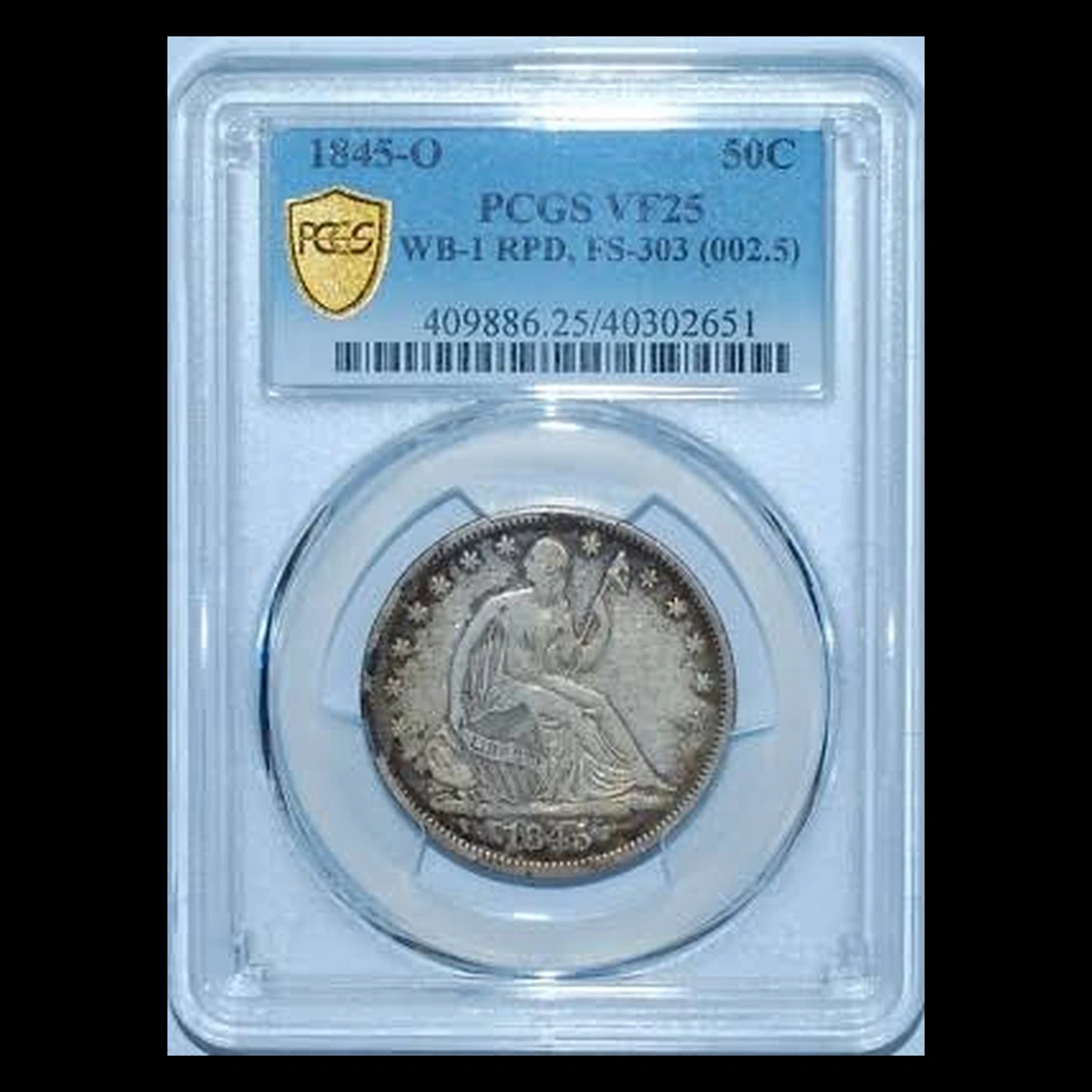
2. 1845 Half Dollar Date Numbers Retain Earlier Impressions: Repunched or Tripled Date Error
Additional curves and strokes can remain when a date punch is applied repeatedly to the die, the steel stamping tool. A tripled date records three punch positions, not three strikes of the coin.
References include the prominent New Orleans tripled date, other O-mint repunching, and minor Philadelphia remnants. Each arrangement needs its own image comparison.
How to Identify
Read the mintmark first and compare the whole date with the selected variety. The Liberty Coin Service guide names the 1845-O tripled date, while an attributed photograph supplies its exact strokes.
Trace each remnant as part of an earlier numeral. A low flat shelf or reflection does not demonstrate another application of the date punch.
The repeated numbers were in the die before the blank entered the press. Overlapping portraits would require a different explanation from this date-punch feature.
What It’s Worth
Estimated ranges: $150–$600 for modest circulated repunching, and $400–$1,500 for a clear tripled date with moderate to light wear. December 2025 repunched-date results included $180 at VG8, $210 at Fine 12, and $348 at VF35.
The guide’s $1,195 figure for ANACS VF35 is an asking price. It is not a completed transaction and should not be assigned automatically to Philadelphia’s minor date strokes.
3. 1845 Half Dollar The Elbow Fold Is Absent: No Drapery Error
The fold belongs beneath Liberty’s left elbow, on the viewer’s right. PCGS attributes its absence on this variety to heavy polishing of the front die.
Polishing removed a shallow design element from the tool, so later coins no longer received it. Wear and later smoothing can also erase a fold on a finished coin.
How to Identify
Compare the correct elbow area with a normal coin of similar wear. Checking Liberty’s other elbow will lead to the wrong location.
Inspect the arm and surrounding folds to see whether they remain clearly defined. General flattening or local abrasive marks weaken the case for the die-polishing variety.
Confirm O on the reverse and compare the complete front with an attributed No Drapery example. The missing fold is a specific feature, not a reason to ignore the rest of the coin’s condition.
What It’s Worth
Estimated ranges: $200–$1,500 for collectible worn coins, and $4,000–$18,000 for attractive MS62–MS64 examples. Unworn preservation places the latter group in a separate market range.
PCGS records $16,100 for an MS64 in January 2010. The year guide also reports $960 for a lightly worn AU50 in 2022.
These are prices for complete coins at different levels of preservation. The missing fold alone does not supply a five-figure premium.
4. 1845 Half Dollar A Sideways O Survives Inside the Upright O: Repunched Mintmark Error
The most useful remnant of the earlier horizontal O is inside the upper portion of the final letter. A worker had applied the mintmark sideways to the die, then corrected it with an upright impression.
Coins from that tool could preserve both outlines. Extra material in the opening is not sufficient unless it retains part of the sideways oval.
How to Identify
Magnify the upper interior of the O and trace the extra curve. Compare with an identified O over Horizontal O rather than another coin with an unexplained bump.
Check for dirt, attached material, corrosion, or contact damage. Each can alter the opening without creating the recognizable earlier letter.
Keep the 1845 date and reverse context available. The actual horizontal contour within the upright mintmark is the decisive feature to match.
What It’s Worth
Estimated range: $250–$1,000 for clear circulated examples. A published historical record lists a $329 sale in 2016 for the variety.
The $348 December 2025 VF35 repunched-date coin offers same-mint condition context only. It does not measure the separate value of a horizontal O.
5. 1845 Half Dollar A Faint Outline Belongs to the Opposite Face: Clashed Dies Error
A die clash can copy a fragment of the reverse onto the front, or vice versa. The tools mark each other when they meet without a blank between them.
The 1845 guide reports minor clashes without a mint, finish, or exact position. A specific portrait or eagle outline must therefore be established from the actual example.
How to Identify
Choose a trace long enough to compare with an actual feature on the other side. Use photographs of both faces to test a position consistent with the dies meeting.
Under changing light, follow the shape through the surrounding original surface. A scratch, polishing line, or reflection can be conspicuous without reproducing a design.
Record the mint and finish before selecting any reference. The generic category does not justify placing an invented clash at a fixed location.
What It’s Worth
Estimated range: $100–$600 for circulated coins with small identifiable clash traces. Ordinary Philadelphia 1857 XF40 and AU50 sales at $240 and $338 in 2025 offer different-year condition context.
The 1845 guide supplies the minor-clash report. Neither ordinary 1857 result is a documented 1845 clash sale.
6. 1845 Half Dollar A Proof Has a Crack Near HALF and a Lump Below 8: Die Crack and Chip Error
The Newman proof has a ridge starting at the lower-right tip of F in HALF and extending into the open area below D. A separate faint line above it connects the letters.
On the front, a long raised lump lies below the left side of 8. Heritage described both identifying features when offering the coin as NGC PR65 in 2013.
How to Identify
Establish proof manufacture independently from the whole coin and expert attribution. A normal circulation strike does not become this rare issue because it also has die damage.
Follow the F-to-field crack under angled light without merging it with the separate connecting line. Then check the long lump beneath 8 on the front.
Both features should match the same proof reference. Normal weight, diameter, or an unrelated ridge alone cannot establish that identity.
What It’s Worth
Estimated range: $30,000–$45,000 for the rare proof comparison. The Newman NGC PR65 brought $35,250 in April 2013.
The amount reflects proof rarity, preservation, and ownership history together. It is not a separate fee for the crack and chip, and it cannot price an ordinary half with a similar-looking line.
Conclusion
Locate the actual feature before naming it: the absent foot of 1, extra date strokes, missing elbow fold, sideways O, transferred shape, or the proof’s paired die marks. Keep New Orleans and Philadelphia comparisons distinct.
The estimated $100–$45,000 span covers very different coins. Worn varieties, unworn No Drapery examples, and the rare Newman proof require their own condition and identity checks before any price comparison is meaningful.