Rare 1921 Quarter Errors (List & Pictures)
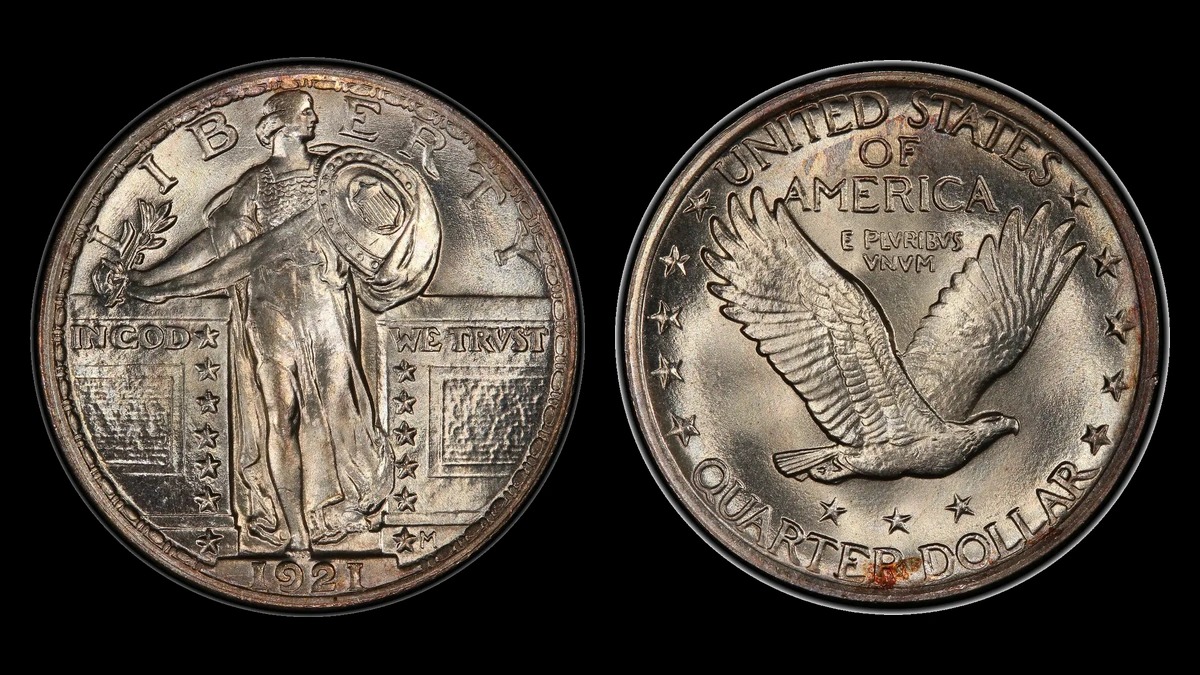
Even without an identified error, an ordinary MS66 quarter brought $7,150 in August 1990. Condition contributes heavily to the estimated $190–$10,000 whole-coin range for reported 1921 Standing Liberty quarter errors.
Inspect the surface for separating metal or raised die damage, then compare both faces for a displaced strike. The exposed date often wore away in circulation, so missing numerals alone do not establish an error or confirm 1921.
1. 1921 Quarter A Sheet Separating from the Surface: Lamination Error
A thin flap or rough opening can develop where the original silver-copper blank had an internal weakness. Separation along that weakness is called lamination.
The 1921 reports do not establish one fixed location. This coin contains silver throughout its alloy, so the fault is not a modern outer coating coming off.
How to Identify
Look for a layered boundary or an attached sheet and compare it with the smooth high points produced by wear. Side lighting can reveal a gap beneath lifted metal.
Pits from corrosion and a gouge with scraped edges have different causes. Leave any flap untouched and include the date in the full-coin photographs.
What It’s Worth
$190–$3,500 is the estimated whole-coin range for genuine laminations. On a lower-grade example, much of that amount can belong to the collectible date.
A clear natural separation may attract more interest than an indistinct rough spot. Cleaning or scraping can reduce the appeal of the surrounding coin, which matters even when the lamination is authentic.
2. 1921 Quarter Raised Lines and Rim Lumps: Die Cracks and Cuds Error
A split in the die leaves a narrow raised copy where coin metal fills it. If a piece breaks from the die’s edge, a larger rim-connected mass can replace normal design; collectors call that mass a cud.
Both forms are reported for 1921. No single route through Liberty or the date identifies every example, and a thin crack does not prove a large missing die piece.
How to Identify
First determine whether the feature is a narrow ridge or a broad raised area. Move low light across it to distinguish elevation from a scratch cut into the silver.
A cud needs a clear connection to the rim and loss of the normal design beneath it. Inspect for a dent that might instead have pushed metal inward, using opposite-face weakness only as supporting evidence.
What It’s Worth
$190–$4,000 is the estimated whole-coin range for minor cracks, while substantial authenticated rim breaks are estimated at $250–$6,000. Do not add the ranges for several connected features on one quarter.
PCGS records an ordinary MS66 sale at $7,150 in August 1990. That well-preserved unworn coin demonstrates the value of condition, not a documented crack premium.
3. 1921 Quarter Bare Metal Beside an Incomplete Design: Off-Center Strike Error
When a blank sits partly beyond the dies, some of the intended design misses the metal. An unstruck area remains opposite the missing portion.
Off-center strikes are reported for 1921 without one fixed percentage or direction. Philadelphia produced all regular 1921 Standing Liberty quarters, so no mintmark is normal.
How to Identify
Trace the outer design to see whether part truly runs off the coin. A complete design within an expanded border points instead toward a broadstrike.
Compare both faces to see whether they fit the same misplaced blank. A shift confined to one face can result from one misaligned die.
Inspect the bare area for cutting, grinding, or later flattening. Establish 1921 from surviving date detail rather than assigning that year to an undated coin of the same general shape.
What It’s Worth
$500–$10,000 is the estimated value for an authenticated dated example. It includes both the scarce date and the actual displacement.
A clear crescent and readable year make comparison easier. A greater shift need not mean a higher price if it removes the date or later damage obscures the striking evidence.
Conclusion
Separate the collectible 1921 quarter from the additional feature being examined. Worn date digits and a missing mintmark can be normal, while a genuine error needs a layered separation, raised die-damage shape, or incomplete strike with untouched metal.
The $190–$10,000 estimates describe whole coins. Original surfaces and a readable year make the comparisons useful, and the ordinary $7,150 sale should remain a condition example rather than an error record.