Rare 2003 Dollar Errors (List & Pictures)
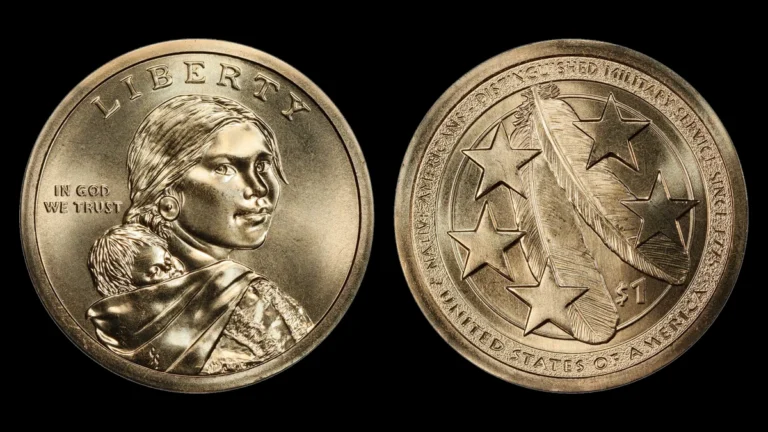
The estimated values for 2003 Sacagawea dollar errors range from $5–$3,500. A dramatic off-center dollar from a different year, 2000-P, brought $3,120 in April 2021.
Inspect surface detail first, then follow any cracks or peeling metal before comparing the outline with an ordinary dollar.
| Visible feature | Possible explanation | Estimated range |
|---|---|---|
| Locally faint or blocked design | Strike-through | $5–$250 |
| Raised line or lump | Die crack, chip, or cud | $25–$2,500 |
| Separating surface metal on S Proof | Lamination | $100–$1,500 |
| Expanded border around complete designs | Broadstrike | $50–$500 |
| Gap in the blank’s outline | Clip | $50–$1,000 |
| Blank crescent and missing design | Off-center strike | $300–$3,500 |
1. 2003 Dollar A small area loses its detail: struck through material Error
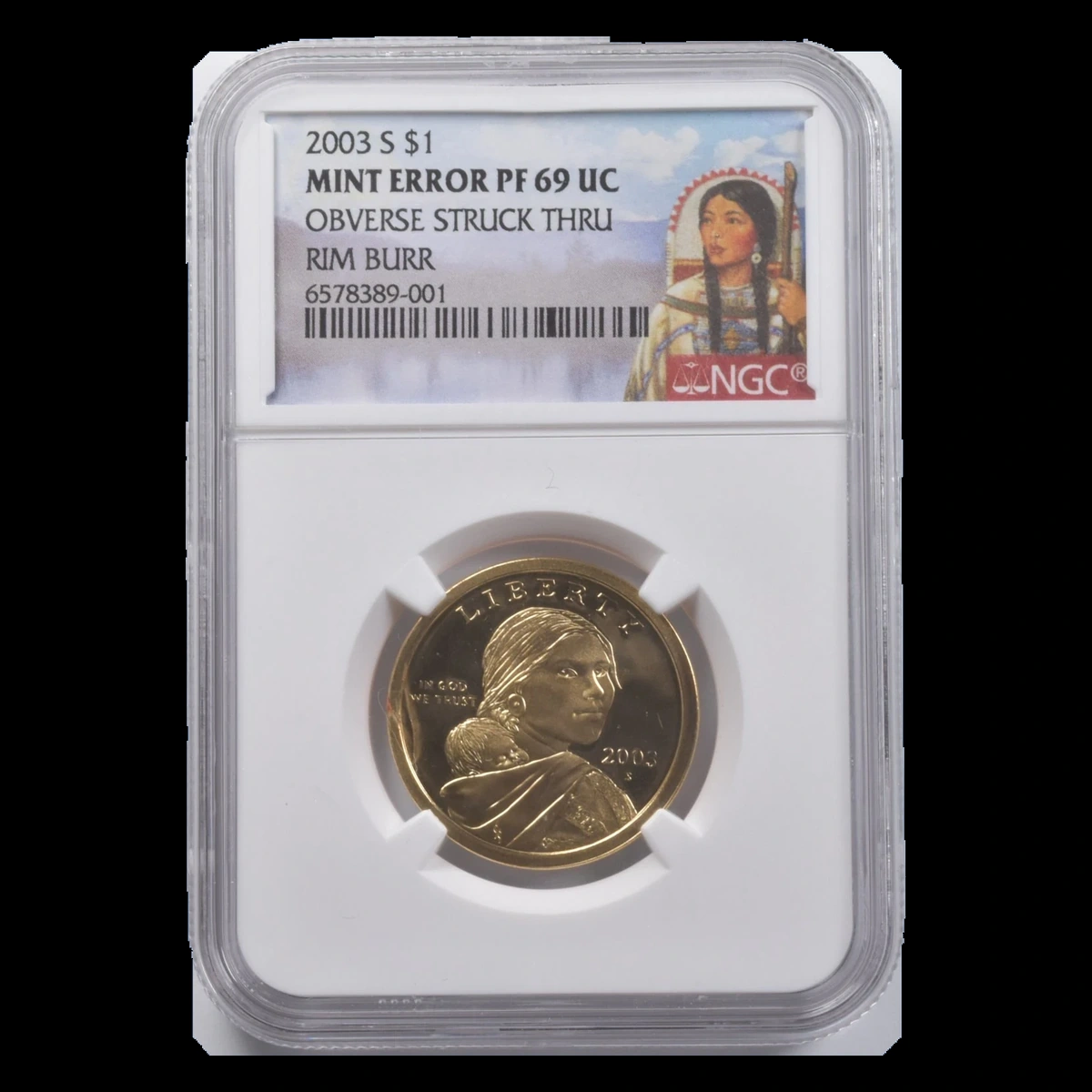
Faint lettering beside crisp detail can mark an obstruction during striking. Grease may soften the design gradually, while harder material can leave a more distinct impression.
A seller described a 2003-D dollar as a grease error without a grading-service opinion. Its title is a claim to examine, not confirmation of the cause.
How to Identify
Follow the transition from normal detail into the weak area under angled light. Compare the same letters and nearby portrait on another 2003 dollar.
Wear usually affects exposed parts across the design, while a scrape can leave cut lines and displaced metal. Isolated weakness needs a closer explanation before it can be called a strike-through.
What It’s Worth
The estimate is $5–$250, including $5–$75 for mild grease-filled detail and $50–$250 for a more obvious authenticated obstruction.
The supplied 2003-D listing asked $69.99 with offers invited. No completed sale or independent authentication was supplied for it.
2. 2003 Dollar Lines or lumps stand above the surface: die damage Error
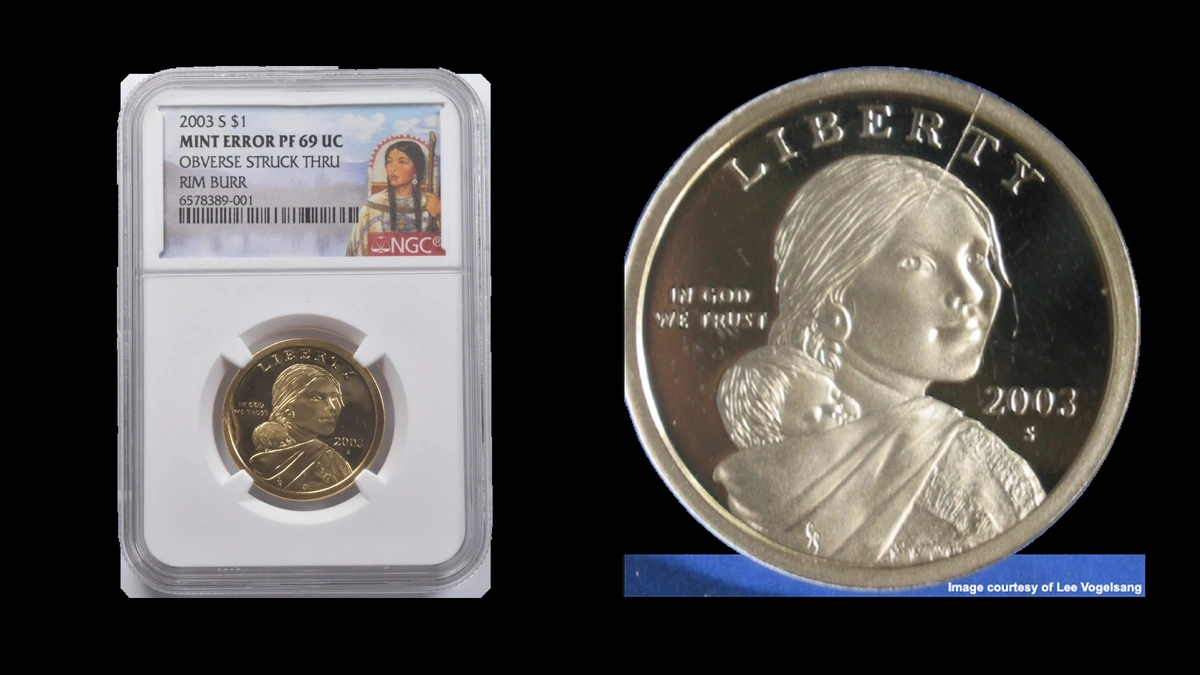
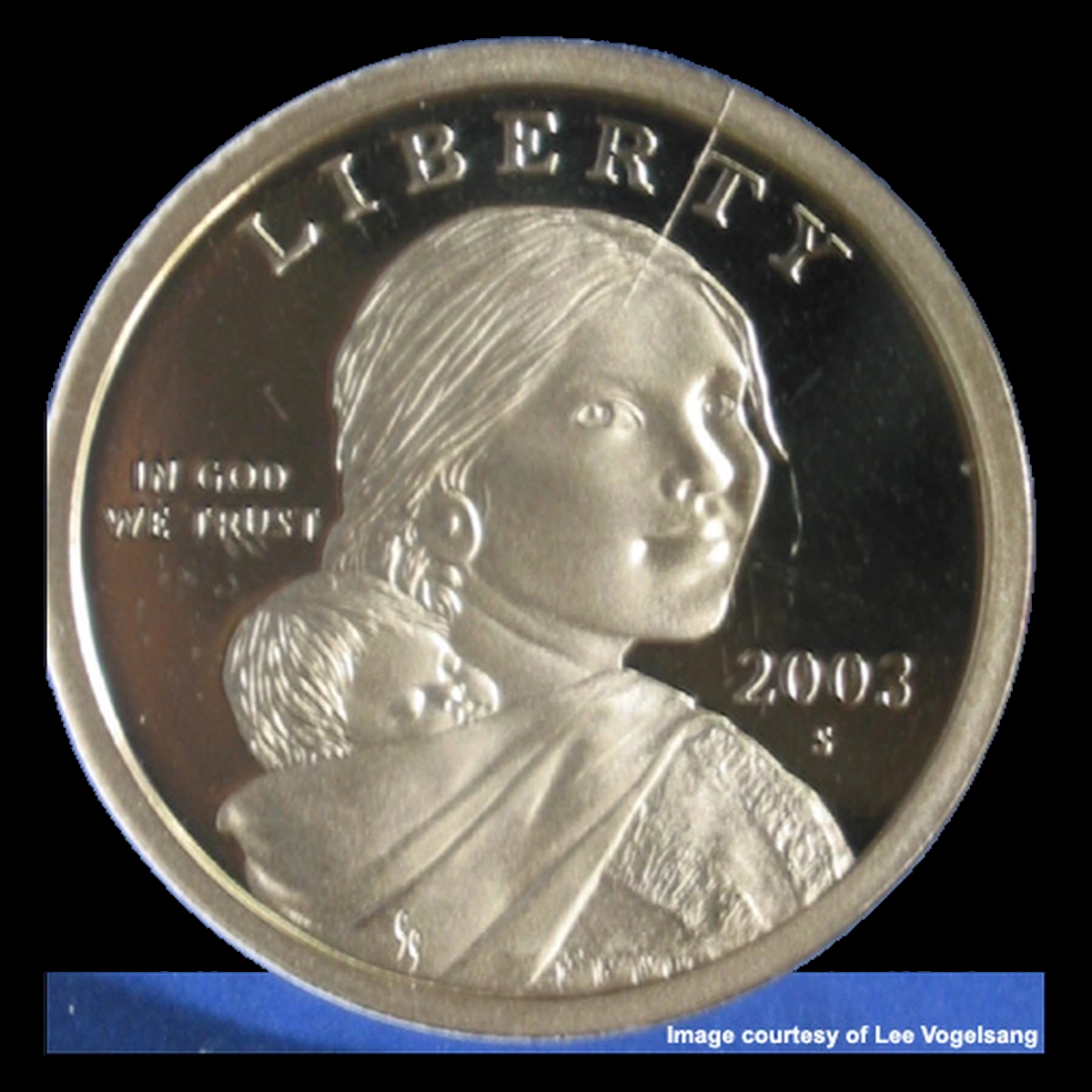
Two documented 2003-S Proof cracks start near the upper portrait-side rim. One approaches the portrait near eleven o’clock, while the other runs into the forehead near one o’clock.
These raised lines copy openings in the steel die that stamped the coin. Small chips and larger border-connected breaks, called cuds, are also reported, but they do not automatically share those Proof locations.
How to Identify
With the portrait upright, trace the upper rim inward at the two reported positions. Side lighting should show raised metal rather than the recessed path of a scratch.
A lump elsewhere needs its own comparison. For a possible cud, look for a substantial raised mass joining the rim and replacing nearby design.
The documented Proof photographs establish particular crack patterns. They do not authenticate every raised mark on a 2003 dollar.
What It’s Worth
The combined estimate is $25–$2,500: ordinary cracks or chips are around $25–$750, larger cuds $75–$1,500, and the documented S Proof crack type $250–$2,500.
No sale figure was supplied for either photographed Proof pattern. Their special collector finish should remain separate from ordinary-coin comparisons.
3. 2003 Dollar A thin layer separates on a Proof: lamination Error
Peeling or flaking metal can expose a separation within the coin’s surface. This is called lamination, and a 2003-S example was cataloged by GreatCollections in an ICG Proof 68 DCAM holder.
DCAM describes strong contrast between frosted designs and reflective fields. The lamination description does not mean that the entire brass outer layer is missing.
How to Identify
Look for a boundary where metal lifts, splits, or has fallen away. Rotate the light across the reflective surface to distinguish a thin separation from a flat color change.
Do not lift a flap or remove material for a better view. An attached edge can help explain the separation, while peeling paint or an added coating requires a different diagnosis.
What It’s Worth
A confirmed 2003-S Proof lamination has an estimated range of $100–$1,500.
The ICG Proof 68 DCAM specimen appeared at auction in February 2021. Its selling price is not disclosed in the supplied evidence.
4. 2003 Dollar The design is complete inside a wide border: broadstrike Error
A broadstrike spreads beyond the normal boundary because the surrounding collar did not contain the blank. This type is reported for 2003-D without measurements for a specific specimen.
How to Identify
Check whether all intended letters and main designs remain on both faces. An enlarged border with complete designs differs from an off-center strike that loses part of the picture.
Useful normal specifications are 26.5 millimeters across and 8.10 grams. Measure a loose coin at several angles, but also inspect for flattened relief from later hammering.
A smooth edge proves nothing by itself. The normal 2003 Sacagawea edge is plain.
What It’s Worth
An authenticated 2003-D broadstrike is estimated at $50–$500.
No exact measured example or completed sale accompanies the report. The visible spread and preservation determine which comparisons would be useful.
5. 2003 Dollar Metal is missing from the outline: clipped blank Error
A clipped blank reaches the press with a gap already present. Overlapping an earlier punched hole can produce a curved gap; other cutting problems can leave a straighter boundary.
The supplied 2003-D report covers the category without establishing a separate specimen for every shape.
How to Identify
Examine how the struck rim and design approach the gap. Weakening near its ends, and sometimes across the coin, can support an original clip.
Saw marks, filing, or a cut through fully formed detail suggest later removal. Reduced weight confirms missing metal but cannot establish when it was lost.
What It’s Worth
A genuine clipped 2003-D dollar is estimated at $50–$1,000.
A clear substantial clip with readable identity is easier to compare than a tiny gap on a damaged coin. No exact sale was supplied for this reported category.
6. 2003 Dollar A blank crescent faces an incomplete picture: off-center strike Error
A misplaced blank can receive only part of the intended design. An untouched crescent remains beside the struck area, and both faces reflect the displaced blank.
Off-center dollars are reported for 2003 without a fixed mint or percentage for one identified specimen.
How to Identify
Find the surviving front date before assigning the year. The flying eagle was used on other early Sacagawea dollars and cannot identify 2003 alone.
Track the unstruck area across both faces. A shifted front with a centered back suggests a misaligned die, while complete expanded designs point toward broadstriking.
What It’s Worth
A substantial authenticated 2003 off-center strike has an estimated range of $300–$3,500.
A 2000-P dollar about halfway off center sold for $3,120 in April 2021 in NGC MS66. Its year, displacement, and excellent unworn condition cannot be assigned to an unexamined 2003 coin.
Conclusion
Surface defects and altered outlines require different evidence. Trace raised lines, preserve loose metal, and compare a wide border or missing section with the complete design of a normal dollar.
For the reported categories, keep uncertainty about the exact mint, size, and cause visible. Proof examples belong with Proof comparisons, and the strong 2000-P off-center result remains a reference from another year.