Rare 1814 Half Dollar Errors (List & Pictures)
Several 1814 half dollar errors share a coin with a major die variety, so one unusual detail may explain only part of its value. The supplied estimates span $150–$10,000, and a Single Leaf example graded NGC MS62 realized $8,812.50 in August 2016.
Begin by reading the edge, then inspect the strike, date, and eagle-side details. This route helps separate repeated manufacturing steps from small features already present in the dies.
| Clue | What to investigate | Value context |
|---|---|---|
| Repeated words on edge | Repeated edge lettering | $150–$1,000 circulated |
| Bare crescents | Off-center strike | $700–$2,500 alone; $3,000–$6,000 compound |
| Border teeth across portrait | Multiple strikes | $3,000–$6,500 comparable examples |
| Old curve under final 4 | 1814/3 overdate | $300–$4,000 circulated |
| Unexpected design outlines | Die clash | $200–$3,000 circulated |
| Rough area near eagle’s beak | Planchet flaw | $1,500–$2,500 unsold estimate |
| Extra A strokes at E | E over A in STATES | $350–$8,000, depending on grade |
| One leaf instead of a pair | Single Leaf variety | $1,000–$10,000, depending on grade |
Philadelphia made these halves without a mintmark, to an original standard of 13.48 grams and about 32.5 millimeters. Their edges carry words rather than the grooves of modern halves; wear and distortion should be considered when checking measurements.
1. 1814 Half Dollar A second sequence of words on the edge: Repeated edge lettering Error
The edge inscription was applied before the front and back designs were struck. A collector reported an 1814 half with doubled edge lettering and a design about 5% off center, but did not specify which letters repeat or their overlap direction.
How to Identify
Read the entire normal inscription, FIFTY CENTS OR HALF A DOLLAR, using overlapping photographs as you turn the coin. Look for a convincing second sequence rather than a single crowded join where normal lettering meets.
Compare the shape and depth of repeated letters with the surrounding edge. Flattening or later engraving may imitate doubling, and an off-center face alone does not prove that the edge received a second lettering pass.
What It’s Worth
Circulated coins with clearly readable repeated edge lettering are estimated at $150–$1,000. The collector’s report supplies no sale price for its 1814 example.
An 1834 doubled-edge half graded ANACS Fine Details because of cleaning sold for $220 in July 2026. That different-year comparison illustrates the importance of condition; any additional face-strike error on an 1814 must still be valued as part of one whole coin.
2. 1814 Half Dollar Unstruck crescents beside displaced designs: Off-center strike Error
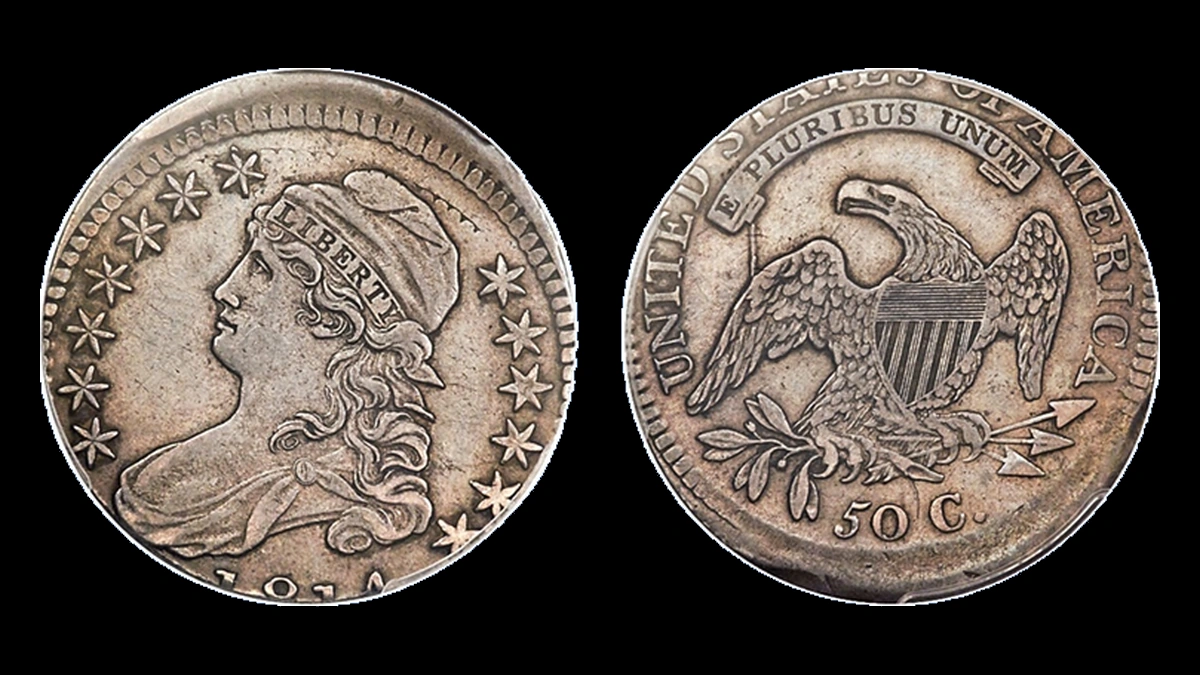
On the documented PCGS XF45 half, the strike sits about 5% off center, cutting into the date and upper reverse lettering. Bare crescents remain where the blank was outside the dies.
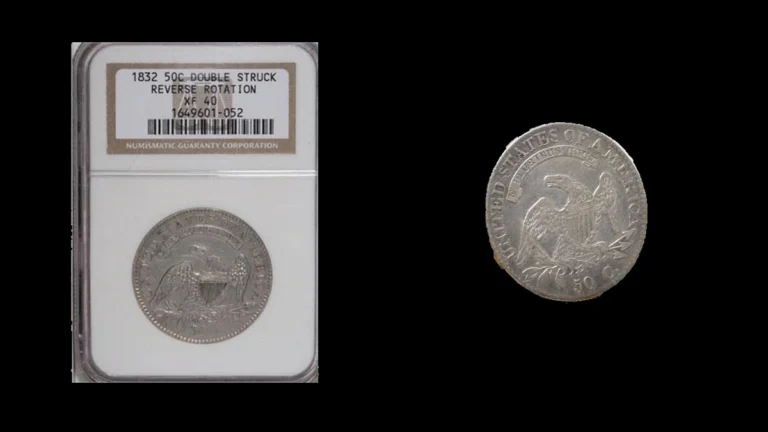
This coin also received several strikes, initially shifting toward 6:30 and subsequently toward 5:30. It is a different specimen from the collector’s doubled-edge report.
How to Identify
Photograph both full faces and compare the missing design with the positions of the plain areas. Metal left unstruck differs from a gap produced by clipping or filing.
The partly lost date and reverse lettering help show the displacement. Additional tracks of border teeth reveal that one offset cannot explain all the surviving impressions on this particular coin.
What It’s Worth
A mildly off-center 1814 without repeated strikes is estimated around $700–$2,500; a comparable compound example is estimated at $3,000–$6,000. Condition and how much identifying detail remains affect both ranges.
The PCGS XF45 coin brought $4,465 at Heritage in April 2017, as reported by Coin World. Its multiple-strike evidence is included in that price, not an additional purchase to be priced separately.
3. 1814 Half Dollar Border teeth crossing Liberty’s portrait: Multiple strikes Error
A curved row of small border teeth across the upper portrait is displaced too far inward to belong to the final design. Repeated teeth near the top edge provide further evidence that the same XF45 coin received at least three strikes.
Later blows flattened much of the earlier detail. The surviving border fragments therefore matter more than searching for three complete portraits.
How to Identify
Compare the interior arc with the spacing and shape of the normal border teeth, called dentils. Then locate the separate repetition near the upper edge to test whether the evidence requires more than one earlier impression.
Count coherent design positions, not individual teeth. Side lighting can help reveal flattened remnants underneath the last strike.
What It’s Worth
About $3,000–$6,500 is the estimate for an extremely fine example with similarly clear multiple-strike evidence. The reported $4,465 April 2017 sale is the same transaction discussed in the off-center section.
Calling a coin triple struck does not establish its value unless the extra positions can be followed. Wear, damage, and the clarity of those remnants all influence the comparison.
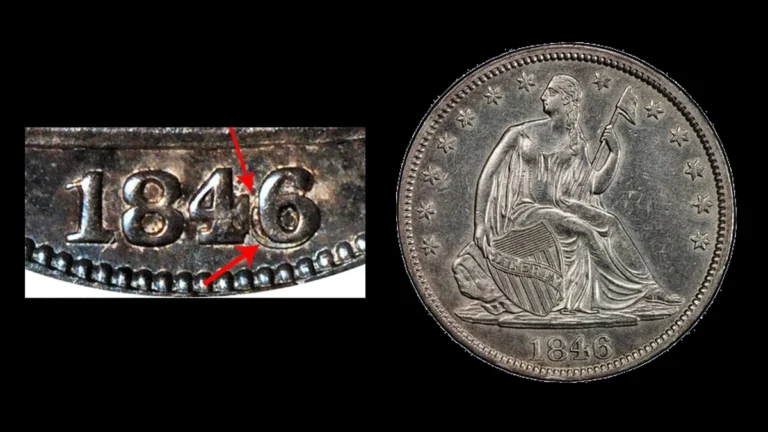
4. 1814 Half Dollar Curved remnants beneath the final 4: 1814/3 overdate Error
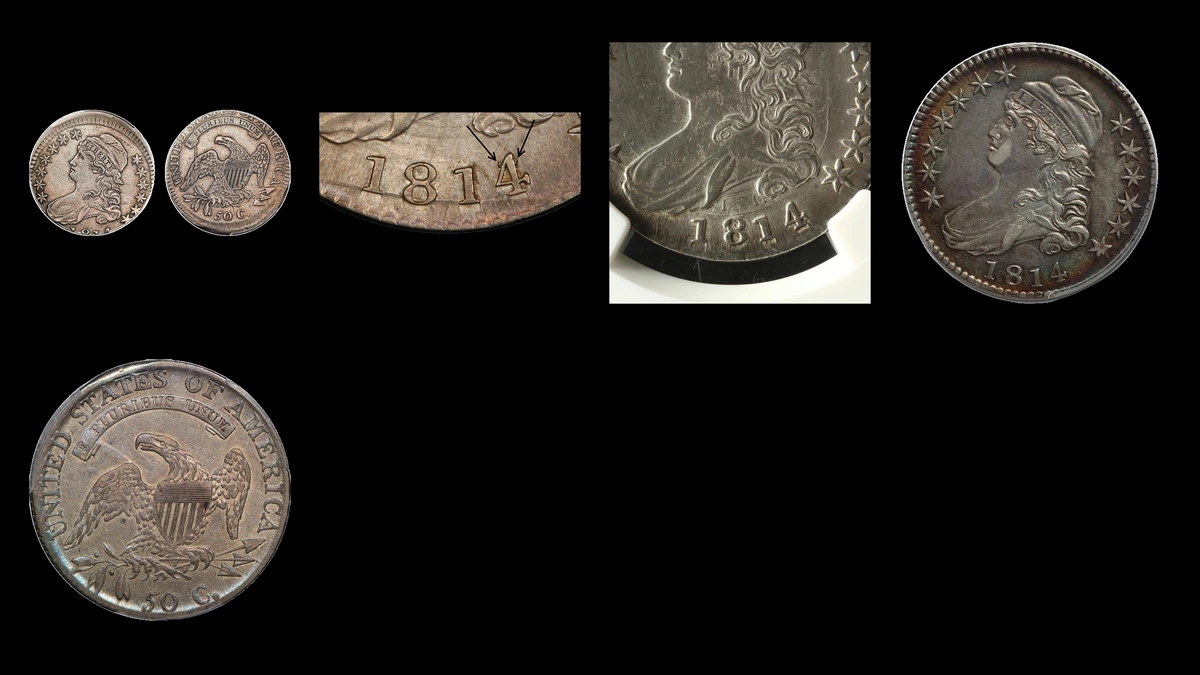
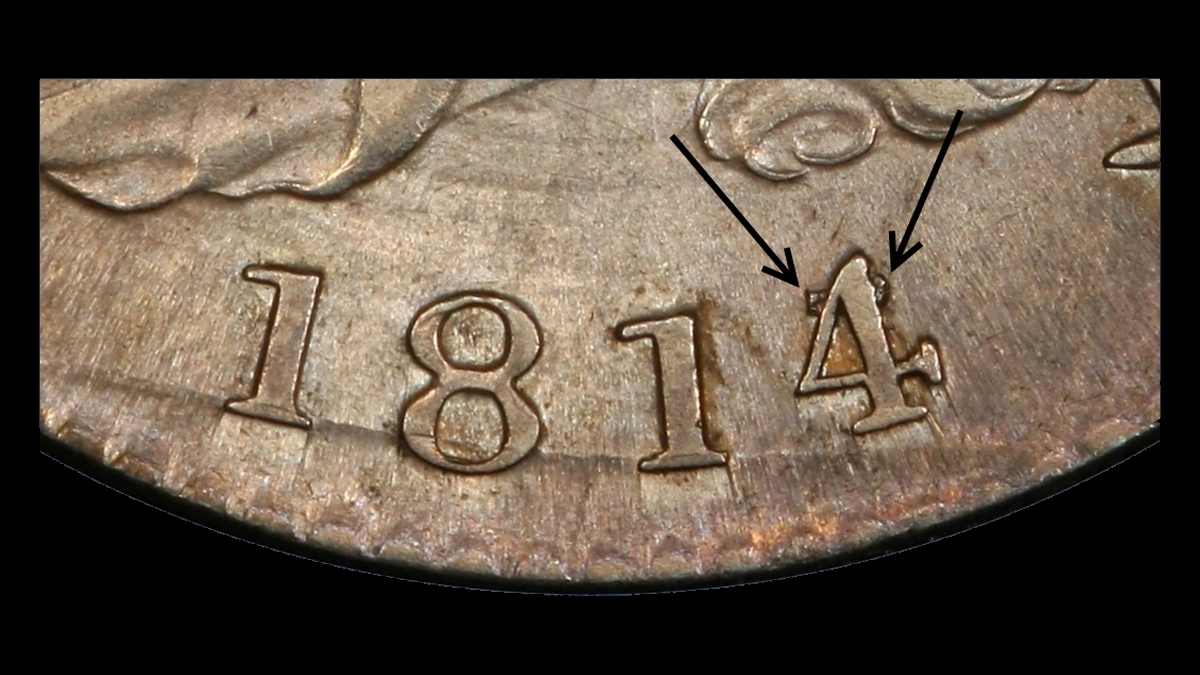
The last digit can preserve part of a 3 beneath the 4. The date was changed in the obverse die, so each resulting coin received the corrected digit and surviving earlier curves together.
How to Identify
Keep all four date digits visible while comparing the curves within and around the final 4 with a verified 1814/3. A blurry or thick 4 is insufficient, and scratches or added marks need to be excluded.
O-101 and O-101a describe this die pairing at different stages of use. Nearby cracks may change, but the underlying 3 remains the crucial overdate feature.
This is a change to a die, not evidence that an 1813 coin was struck again. It should not be confused with the separate multiple-strike error above.
What It’s Worth
Readable circulated examples through extremely fine are estimated at $300–$1,500, with attractive about-uncirculated coins around $1,500–$4,000. These are whole-overdate values.
The AU55 specimen with a reverse planchet flaw discussed below carried an unsold $1,500–$2,500 estimate. Its flaw and surface quality must remain part of any comparison with a cleaner overdate.
5. 1814 Half Dollar Traces of the opposite design: Die clashes Error
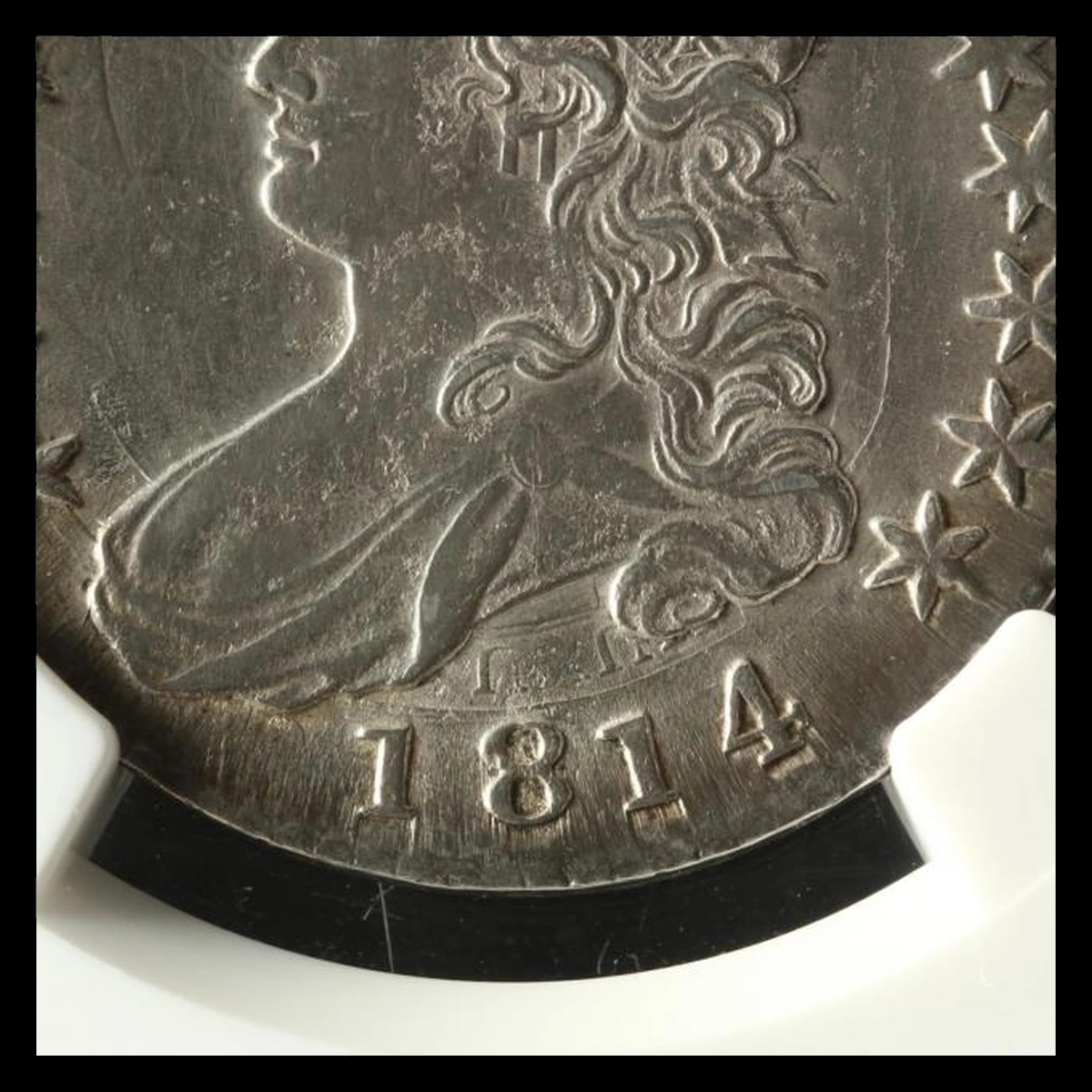
Both normal-date and overdate 1814 halves can carry strong clash traces. These form after the dies collide without a blank between them and pick up outlines that appear on later coins.
How to Identify
Look for a recognizable fragment of the opposite design, then compare photographs of both faces with one reversed to test the alignment. A deep or conspicuous line is not necessarily a clash if its shape has no design counterpart.
One cataloged coin has a separate metal streak in front of Liberty’s nose. Keep that feature distinct from clash traces rather than treating every nearby mark as another transferred outline.
What It’s Worth
The supplied circulated range is $200–$3,000. Sheridan Downey’s Mail Bid Sale 47 recorded $732 including the buyer’s fee for a clashed PCGS AU50 and $2,861 for an attractive PCGS AU55 with CAC approval.
The difference reflects the complete coins, including condition and appearance. Bold clashes on damaged surfaces do not automatically outrank subtler traces on an attractive half.
6. 1814 Half Dollar Rough metal from the wing junction toward the beak: Planchet flaw Error
A cataloged 1814/3 graded PCGS AU55 has an irregular patch running from the eagle’s body and left-wing junction toward its beak. The catalog attributes that texture to a flaw in the original blank, also called a planchet.
How to Identify
Match the patch’s route to the certified coin and examine how surrounding struck details meet the rough metal. Dark toning alone cannot establish a planchet flaw.
Later corrosion can leave pits, while tools can disturb the surface with cuts. The description does not establish a separating layer, so the feature should not automatically be renamed a lamination.
Include the date in documentation so this rough reverse remains linked to the correct 1814/3 specimen. Its overdate and flaw coexist on one coin.
What It’s Worth
The recorded estimate was $1,500–$2,500 in Sheridan Downey’s Mail Bid Sale 47, lot 32, and the coin did not sell. Neither endpoint is a completed transaction.
The overdate and limited circulation wear already contribute substantially to value. The flaw’s appearance should be judged with the original surfaces rather than assigned a fixed added premium.
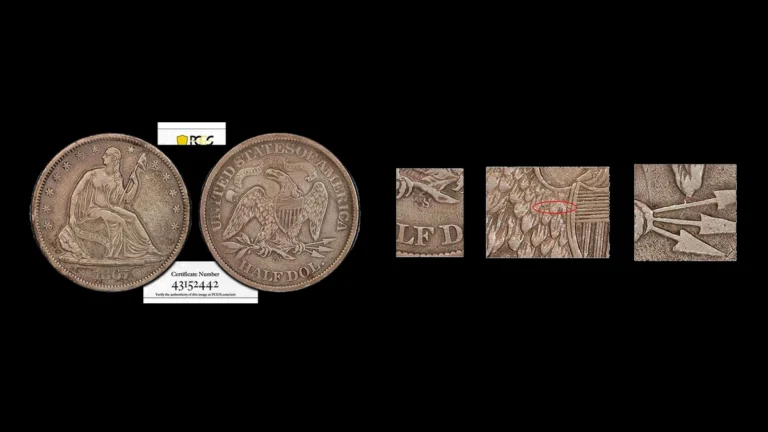
7. 1814 Half Dollar Pieces of an A beside the E in STATES: E over A Error
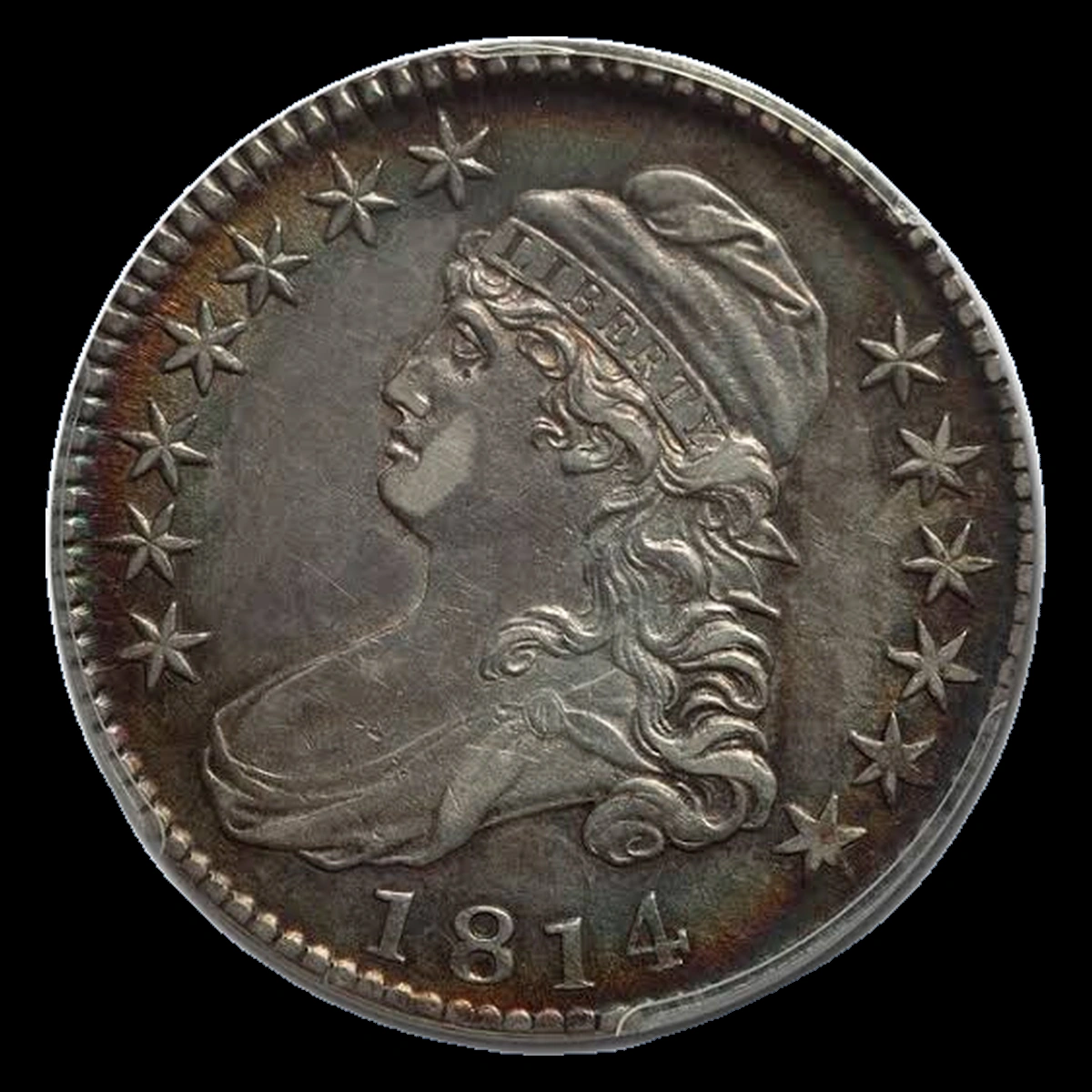
Find the E in STATES and inspect the small strokes beside it. On the O-108 variety, they survive from an A entered into the reverse die before the correct E was punched over it.
How to Identify
Compare the retained strokes with a verified E/A photograph and check that they fit parts of an A. The NGC date reference describes the corrected letter.
Use angled light to separate raised remnants from dirt or scratches beside a normal E. The correction was already in the die, so it does not indicate that each coin was struck twice.
What It’s Worth
Very fine through extremely fine examples are estimated around $350–$1,500; especially attractive about-uncirculated pieces can reach $5,000–$8,000. Original shine, detail, and surface quality help explain the wide difference.
Mail Bid Sale 47 recorded $539 including the buyer’s fee for a PCGS VF35 E/A. A later Sheridan catalog cites a PCGS AU58 at $7,500 in Heritage’s August 2024 sale.
8. 1814 Half Dollar A lone leaf beneath the eagle’s wing: Single Leaf variety Error
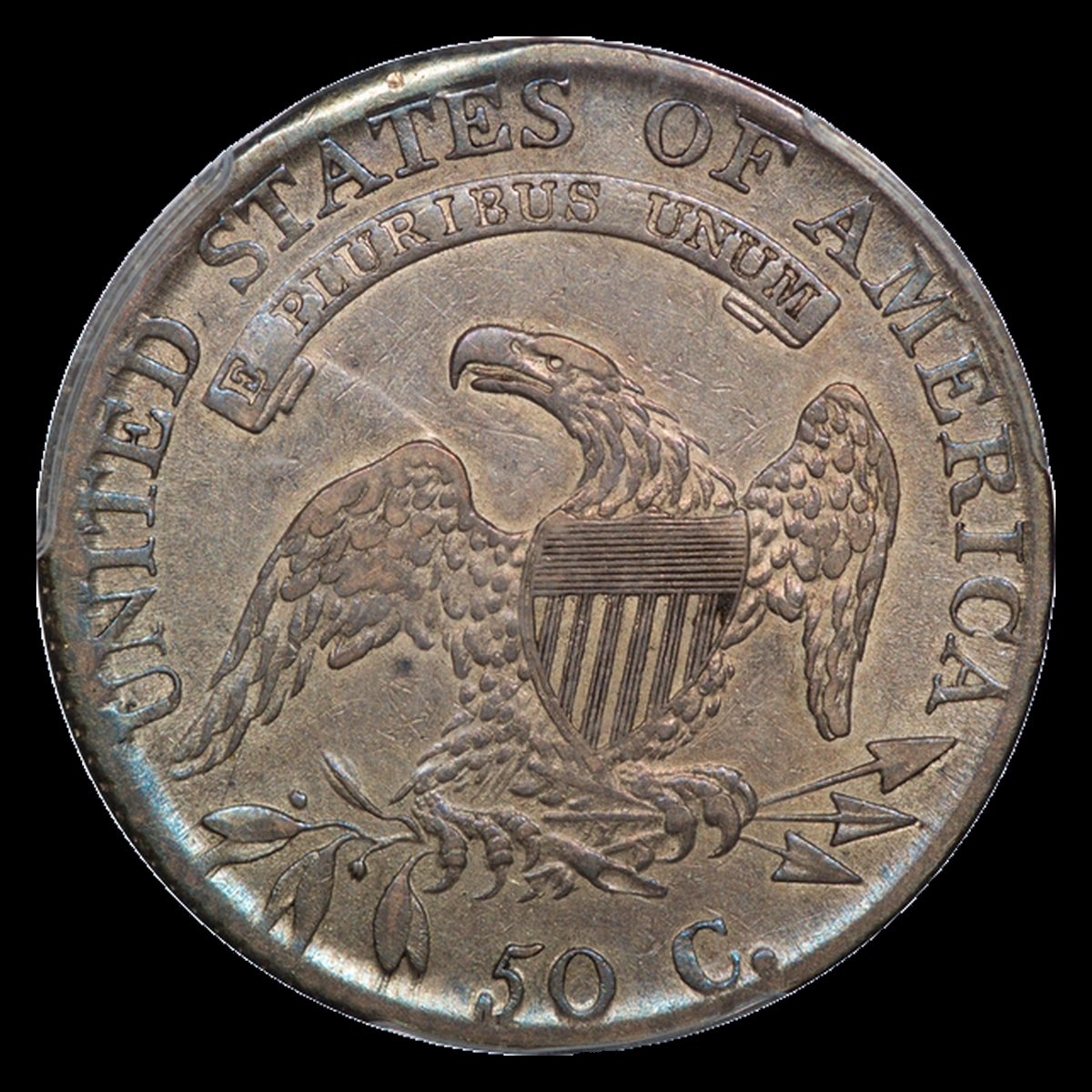
The O-105a reverse shows one leaf where the corresponding group normally has two. Its identity depends on the whole branch-and-wing pattern, not merely on finding a faint leaf on a worn coin.
How to Identify
Use the stem and nearby wing as landmarks when comparing a normal reverse with a known Single Leaf example. Equal image magnification helps prevent mistaking one leaf group for another.
Check the surrounding feathers and branch for wear or a generally weak strike. Dirt may also hide a leaf, but scraping it away would damage useful evidence.
The visible pattern names the variety. The supplied evidence does not settle exactly how the leaf disappeared from the die, so attribution should not depend on an invented cause.
What It’s Worth
Extremely fine coins are estimated at $1,000–$2,200, while comparable uncirculated examples fall around $7,000–$10,000. An NGC MS62 Single Leaf realized $8,812.50 at Heritage in August 2016.
Mail Bid Sale 47 recorded $1,430 for PCGS XF45 and $1,595 for PCGS XF40. The lower grade’s higher result illustrates why surfaces and bidding can matter more than a small numerical grade difference.
Conclusion
On an 1814 half, edge lettering, strike displacement, and die varieties record different stages of manufacture. Follow each feature’s own evidence while keeping the complete coin in view.
The off-center and multiple-struck XF45 has one sale history, and the flawed AU55 is also an overdate. Recognizing these overlaps prevents double-counting value and makes comparisons with coins of similar wear and surface quality much more useful.