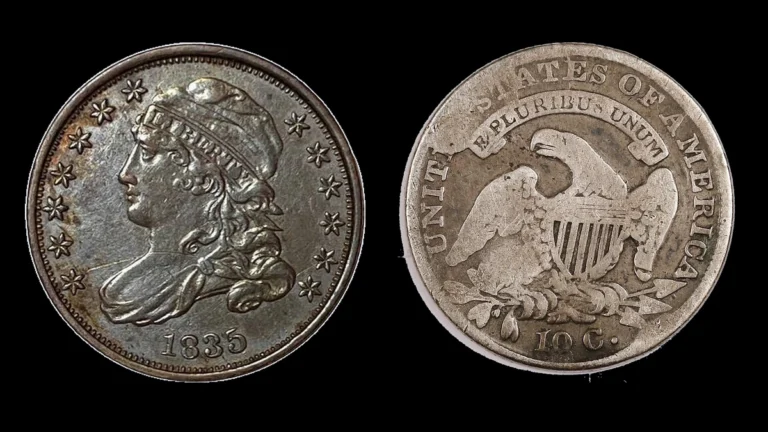
Rare 1825 Dime Errors (List & Pictures)
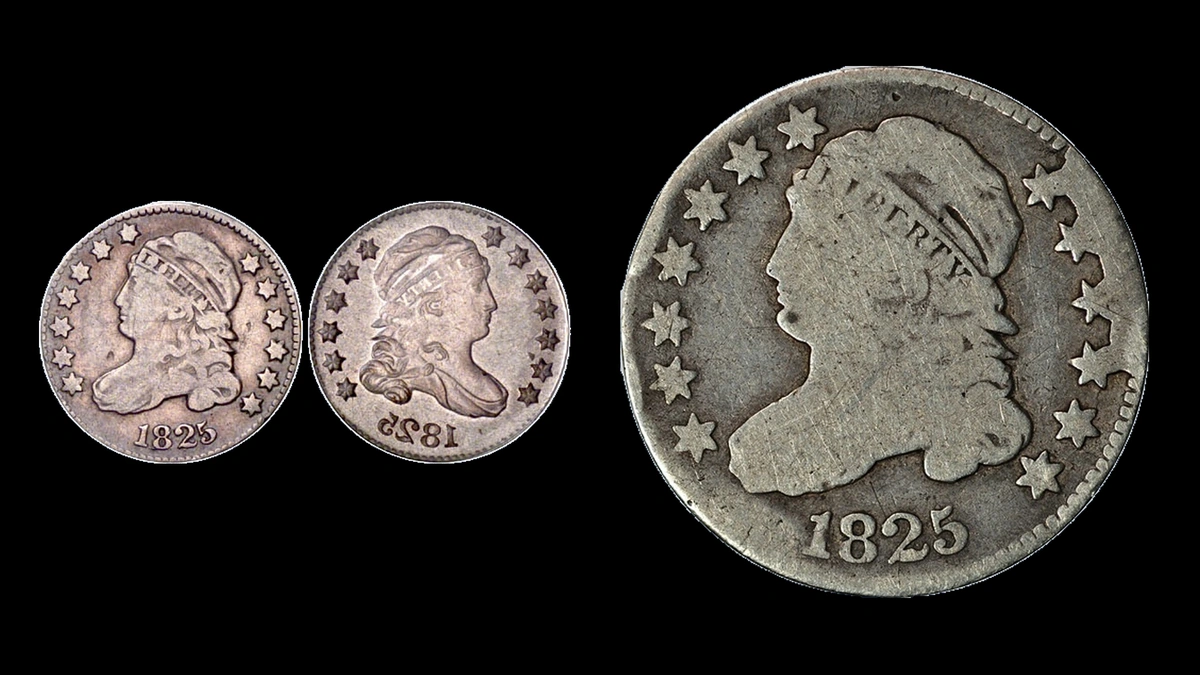
A superb 1825 JR-1 dime sold for $21,600 in February 2023, with a repunched A among its identifying features. The 1825 dime errors below span estimated whole-coin values of $100–$25,000.
Compare the two faces first, then inspect the reverse lettering and the rim. This earlier Capped Bust dime normally weighs 2.70 grams and measures 19 millimeters.
| What stands out | Identification | Estimated whole-coin range |
|---|---|---|
| Backward sunken portrait | Full obverse brockage | $8,000–$25,000 |
| Extra outline beside A | Repunched letter | $100–$25,000 |
| Raised lines or rim patches | Die cracks and cuds | $100–$6,000 |
1. 1825 Dime Liberty replaces the eagle: full obverse brockage Error
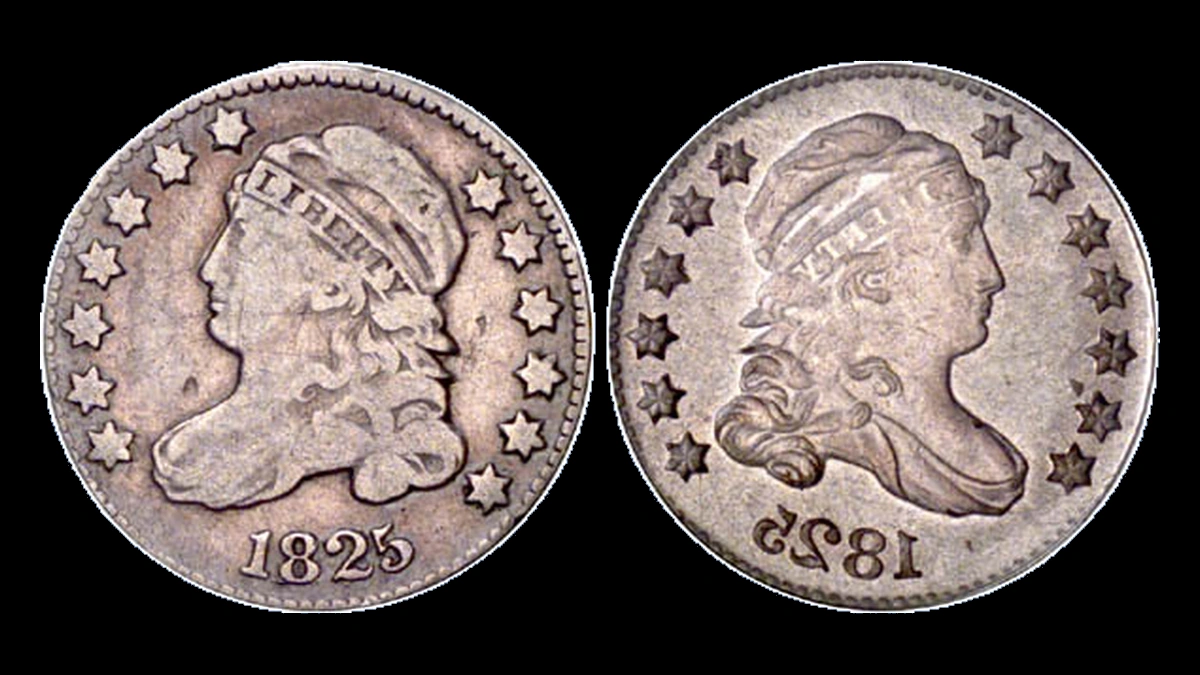
One face has a normal raised portrait, but the other has Liberty backward and sunk into the surface. This combination is a brockage, formed when an already struck coin intervenes between a new blank and a die.
The struck coin’s raised design presses a reversed impression into the new coin. The Logan collection example shows a full front-design brockage, with its normal portrait linked to JR-2.
How to Identify
Inspect both portraits together, checking the direction of the lettering and the depth of the reversed image. The expected eagle should be absent from the face occupied by the full brockage.
A reversed photograph alone cannot demonstrate a brockage because it does not establish the actual surface relief. A faint clash also differs from this complete sunken portrait.
Check the entire coin for crushing, joined edges, and tool marks that could result from later alteration. Coins pressed together after minting need to be distinguished from a genuine strike against an intervening coin.
The date and normal raised face remain important for identification. Do not assign a grade to the Logan example when none is supplied here.
What It’s Worth
A genuine full obverse brockage has an estimated whole-coin value of $8,000–$25,000. Clear identification, completeness of the reversed design, and original surfaces affect the result.
No recorded sale of the Logan coin is supplied. A different 1827 reverse-design brockage graded NGC MS64 brought a $14,000 hammer price in January 2007.
That comparison excludes buyer fees and concerns another year, another design configuration, and an older sale. It supports only a cautious comparison, not an exact 1825 valuation.
2. 1825 Dime A second edge beside A: repunched letter in STATES Error
On some 1825 reverses, the left side of A in STATES has an extra outline. Part of an earlier letter entry remained after the letter was punched again into the die.
JR-1 and JR-3 share this reverse tool, so both can show the feature. It does not mean the entire reverse is doubled or that the finished dime received a second strike.
How to Identify
Magnify the A while retaining enough surrounding lettering to keep its position clear. The added raised shape should follow the letter’s left side rather than merely form a random nearby line.
The PCGS variety description provides a reference for this repunching. A cut next to the letter is not the same as a repeated punched outline.
Turn to the front when separating JR-1 from JR-3. Compare the eighth star’s relationship to nearby border teeth with the correct variety reference rather than deciding from the shared A alone.
What It’s Worth
The estimated whole-coin range is $100–$25,000 across worn through exceptional unworn examples. Most of that wide spread reflects preservation rather than a fixed value for the extra outline.
The JR-1 sale index lists a PCGS MS65+ CAC at $21,600 in February 2023 and a PCGS AU50 at $630 in April 2025. The latter has circulation wear, whereas the MS65+ is exceptionally well preserved.
Both prices cover complete coins of the variety. A worn example with a clear repeated A should not inherit the high-grade coin’s five-figure result.
3. 1825 Dime Ridges and raised rim patches: die cracks and cuds Error
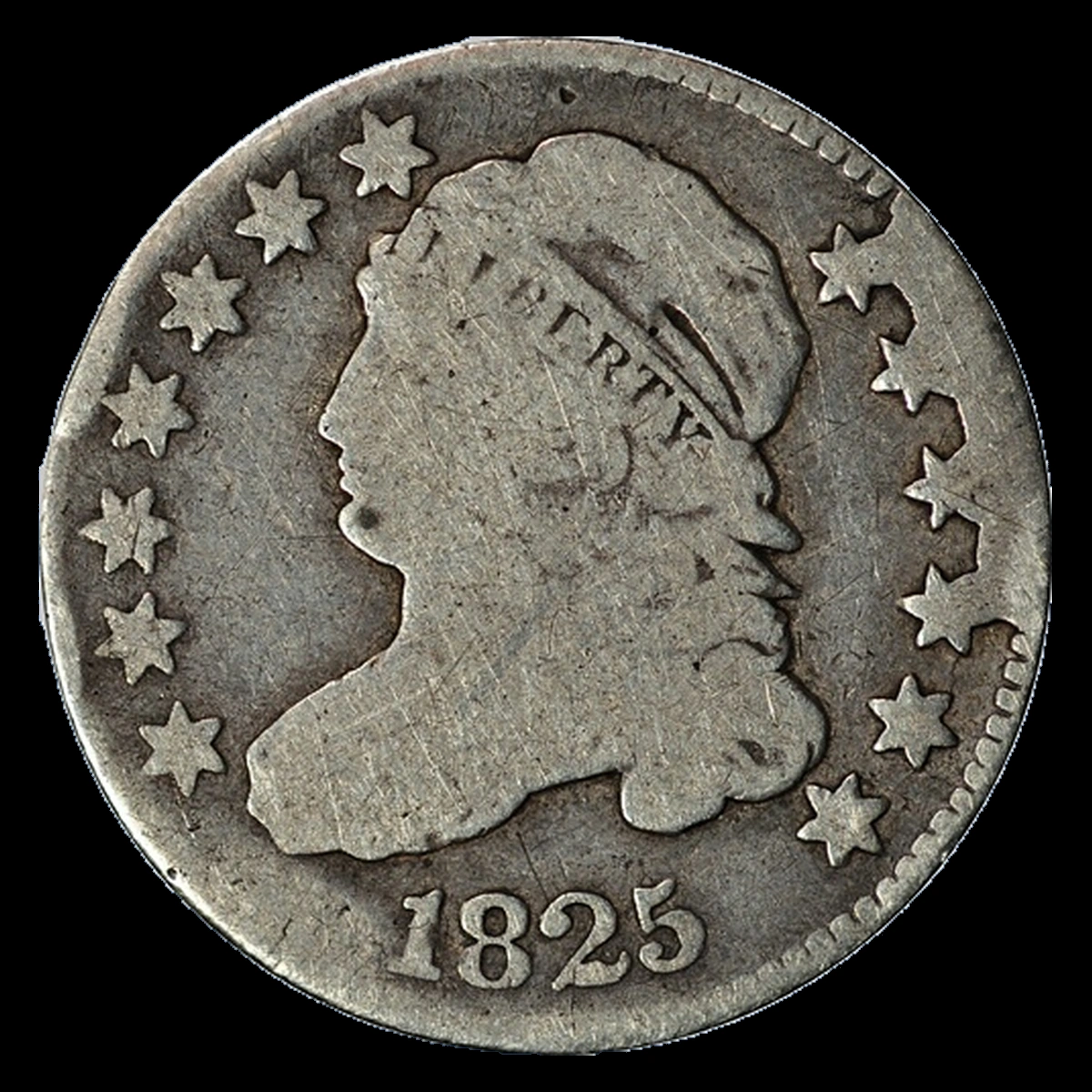
Different 1825 die pairs developed damage at different star and letter positions. A narrow crack produces a raised line, while a broken portion at the die’s edge can produce a rim-connected patch called a cud.
Reported front rim breaks occur near stars 5–6 on JR-1, stars 3–4 on JR-3, and stars 8–11 on JR-4. These are separate variety locations, not one continuous break around every coin.
How to Identify
Locate the affected stars and compare their arrangement with the appropriate variety. Look for the raised patch’s connection to the rim and any design detail still visible within it.
Some detail can remain when a damaged portion of the die stays in place. Weak detail alone, however, does not establish that a piece of the tool broke.
On the reverse, JR-4 and JR-5 can have a crack left of U, between the wing and border. JR-5 also has a line from the upper-right D toward the rim.
Use references for actual 1825 specimens even if a related die appears on a later date. A dent or crushed edge is a separate explanation and should be checked against the surrounding edge grooves.
What It’s Worth
Estimated whole-coin values are $100–$6,000 from worn through lower-grade unworn examples with these cracks or breaks. A prominent patch may attract more interest than a fine ridge, but condition remains central.
The PCGS AU50 JR-1 sold for $630 in April 2025 was not identified as a matching rim-break example. Its price provides ordinary variety context and does not isolate a cud premium.
Match the actual damaged-die stage when a closer comparison is available. Neither the number of cracks nor the number of affected stars creates a set of separate premiums to add together.
Conclusion
A full backward portrait is a different event from a repeated letter or a broken die edge. Start with the visible form, then use the exact letter and star positions to refine the identification.
The $21,600 JR-1 demonstrates the importance of exceptional preservation. Keep that sale separate from the estimated brockage range and from circulated coins whose small die features may add only modest interest.