Rare 1829 Half Dollar Errors (List & Pictures)
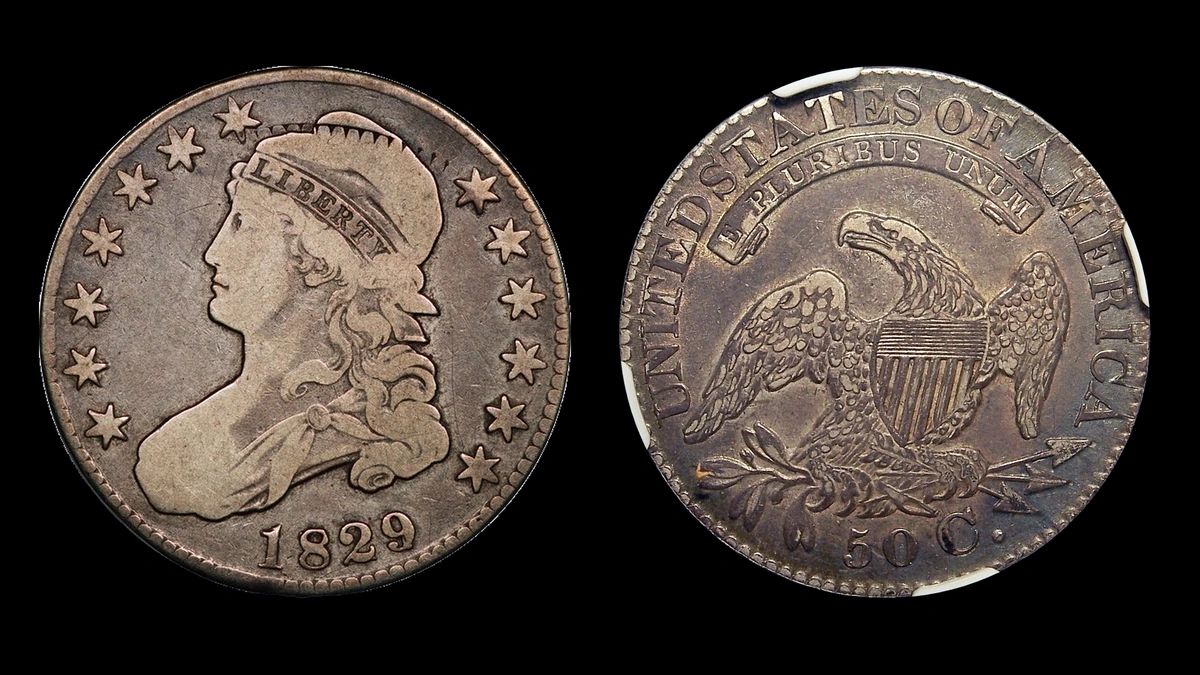
A 25% off-center 1829 half dollar brought $3,220 in February 2007. A different off-center example carried an incorrect 1830 holder label, making its surviving design more useful than the printed date.
These 1829 half dollar errors and reported features span estimates of $75–$5,500. Inspect the complete design first, follow specific surface marks, and finish by reading the entire edge.
| Clue | Location | Feature | Estimated value |
|---|---|---|---|
| Missing picture beside bare metal | Both faces | Off-center strike | $1,500–$5,500 |
| Border-tooth tracks inside the cap | Front portrait | Reported double strike or loose-die restrike | $600–$3,000 |
| An unexplained curved ridge | In front of Liberty | Unresolved raised arc | $75–$250 without error premium |
| Raised rim-connected patches | Two seller-indicated areas | Reported cuds | $150–$450 |
| A narrow depression near C | 50 C on the back | Threadlike strike-through | $200–$700 |
| Two raised routes across reverse detail | Outer letters and denomination | Die cracks | $100–$1,000 |
| Repeated or incomplete edge words | Whole edge | Edge-lettering errors | $150–$900; compound example $1,500–$2,000 |
These Philadelphia halves have no mintmark and use a lettered edge. Normal unworn measurements are about 13.48 grams and 32.5 mm; wear and distorted strikes can affect comparison.
1. 1829 Half Dollar The Picture Extends Beyond the Metal: Off-Center Strike Error
Two documented coins show different displacement. One is 5% off center toward about 7:30, while another is about 25% off center toward 10:30.
The smaller shift cuts off the bottom of the date and top of STATES OF. The larger shift removes the denomination and most of UNITED.
How to Identify
Read the surviving design before trusting a holder label. Heritage corrected an erroneous 1830 label on the 5% example’s NGC Fine15 holder.
Compare both faces and the direction of missing detail against the appropriate coin. The two examples do not share one required pattern of absent lettering.
Inspect original unstruck metal and the edge for later cuts. A shifted design and bare area should fit one displacement rather than damage to a completed coin.
What It’s Worth
Estimated range: $1,500–$5,500 for circulated examples with clear displacement. The 5% coin sold for $1,880 in September 2016, while the 25% example brought $3,220 in February 2007.
The latter was ANACS VF Details with scratches, not a problem-free grade. A different-year 1827 struck 10% off center brought $2,640 at NGC VG8 in September 2025, adding heavy-wear context rather than another 1829 record.
2. 1829 Half Dollar Border Teeth Cross Liberty’s Cap: Reported Double Strike or Loose-Die Restrike Error
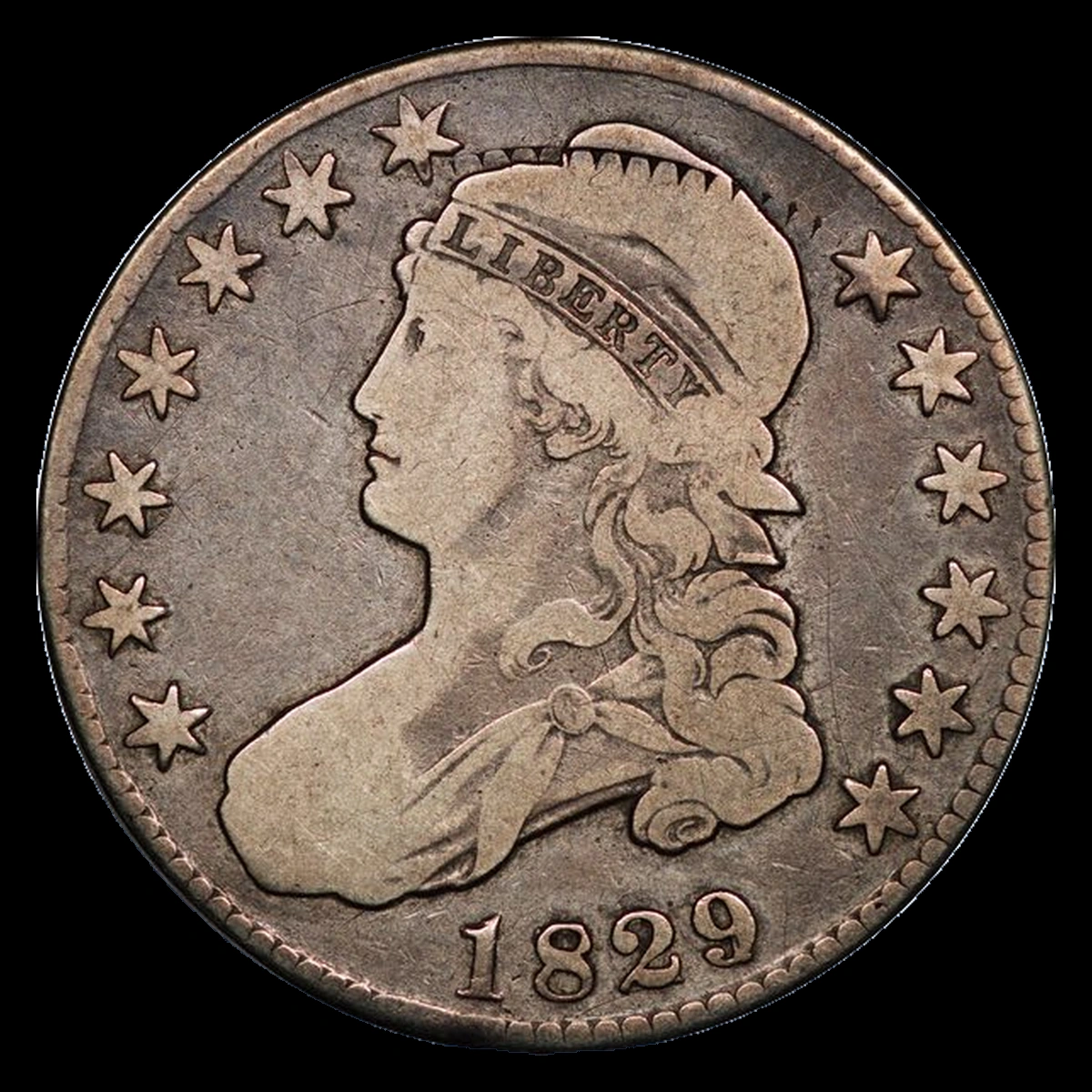
A row of small tooth-like marks appears over the cap on the coin described in Sheridan Downey’s catalog. Its spacing resembles the small border teeth normally found near the rim.
The description calls it double struck while also discussing a loose die, meaning the steel stamping tool. It does not establish two complete portraits or matching repeated designs on the back.
How to Identify
Compare the cap tracks with the shape and spacing of the normal border teeth. A shifted contact should leave a coherent piece of the border rather than unrelated dents.
The Downey catalog identifies the former Logan coin as Fine15 and notes the loose-tool interpretation. Inspect the reverse for support without requiring repetition the account does not claim.
Preserve the 1829/7 date and lettered edge with the close-up. The evidence centers on the surviving tracks, not an imagined second full head.
What It’s Worth
Estimated range: $600–$3,000 for a worn example with convincing displaced second-impression evidence. No realized price is supplied for the cataloged Fine15 coin.
An 1824 with a front double strike sold for $2,880 at PCGS VF20 in January 2022. Its different date and potentially clearer second strike provide context without equating it to the limited 1829 cap marks.
3. 1829 Half Dollar An Arc Runs in Front of Liberty: Unresolved Raised Arc Error
The owner describes a curved mark from the bust toward the top of Liberty’s nose, separate from three straight scratches nearby. Its cause remains unsettled.
The 2024 discussion considers tool marks, a transferred impression, and metal displaced beside a scratch. “Raised arc” describes the appearance without deciding that it is a mint error.
How to Identify
Separate the curved mark from the straight scratches and find its actual endpoints. Illuminate from opposite directions to see whether its raised metal borders an existing groove.
Use wider views of both faces when evaluating any proposed transferred design. Being raised alone does not prove a mint origin because later damage can push metal upward.
What It’s Worth
Provisional whole-coin estimate: $75–$250 for an ordinary worn coin with this appearance, with no separate error premium. The $185.25 offer for a different seller-described 1829/7 cud coin is only nearby condition context.
If further examination identifies a collectible error, use comparisons for that established cause. An unresolved photograph cannot supply that premium.
4. 1829 Half Dollar Two Advertised Patches Reach the Rim: Seller-Reported Cuds Error
A seller marked two alleged cuds with arrows on an uncertified 1829/7 described as Fine to Very Fine. The listing does not state their exact positions independently of the photographs.
A cud is a raised area connected to the rim, made when a piece breaks from the outer edge of a die. Metal fills that missing section during striking.
How to Identify
Trace each arrowed patch into the border and compare the normal detail it replaces. An arrow is a locator, not authentication.
Inspect both faces for edge impacts that crushed or pushed existing metal outward. Supporting weakness opposite the patch may help but need not be dramatic on every genuine cud.
The 1829/7 identification and surfaces require assessment alongside the breaks. Two alleged cuds should be evaluated separately rather than accepted as a pair.
What It’s Worth
Estimated range: $150–$450 for similar circulated coins with genuine rim-connected breaks. The seller asked $185.25, reduced from $195.
That figure is neither a completed sale nor independent confirmation of the advertised features. Greater size and clarity may attract more interest after the breaks are established.
5. 1829 Half Dollar A Narrow Impression Lies Near C: Threadlike Strike-Through Error
Downey describes a threadlike or wirelike impression near C in 50 C. The catalog’s XF–AU assessment indicates moderate to light wear rather than a grading-service label.
A narrow obstruction between blank and die could leave a recessed trace as the design formed. The wording does not prove that material remains embedded in the coin.
How to Identify
Locate the denomination and inspect how the depression meets the raised C. Preserve the surrounding letters and full date for comparison with the cataloged example.
Use angled light to look for cutting tracks or sharp displaced lips. A scratch made after minting cuts through a surface that was already complete.
Keep “threadlike” as a description of the narrow form unless evidence identifies the substance. The boundary with the original lettering is the important structural check.
What It’s Worth
Estimated range: $200–$700 for a convincing example with moderate to light wear. No sale amount is assigned to Downey’s coin.
An 1821 struck through thread graded ANACS VF35 brought $176.25 in January 2015. It provides a lower-grade different-year comparison, not a value for an ordinary later groove.
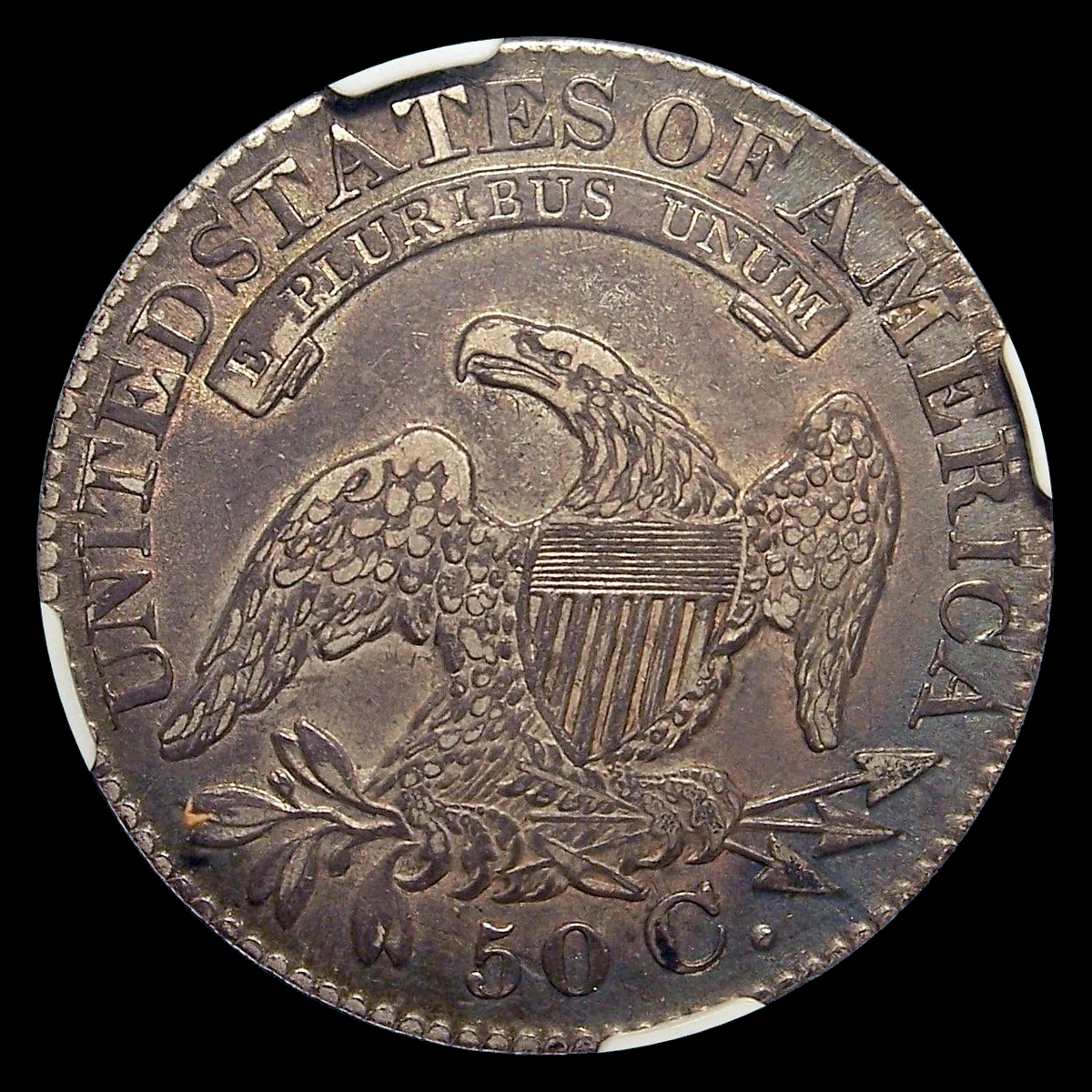
6. 1829 Half Dollar Raised Lines Follow Two Reverse Routes: Die Cracks Error
Large Letters O-110a has one route along the tops of TATES OF AMERI. Another crosses from the leaves through 50 C toward the arrowheads.
Metal entered cracks in the die, producing ridges on the coin. The illustrated reference is NGC XF45, with moderate circulation wear.
How to Identify
Use the O-110a reference to check upper and lower routes separately. Agreement along the outer lettering does not prove the denomination route.
Follow each ridge under changing light and retain the named letters as landmarks. A scratch or split in the coin is different from a raised line copied from the tool.
What It’s Worth
Estimated range: $250–$650 around XF, or $100–$1,000 across broader circulated grades. Surface condition and visibility of the two routes affect the comparison.
An 1826 with cracks on both faces sold for $1,020 including buyer’s premium at PCGS AU58 in August 2025. That nearly unworn different-year coin provides an upper-condition reference.
7. 1829 Half Dollar Edge Words Repeat or Lose Part of Their Sequence: Edge-Lettering Error
Reports include a tripled edge and a separate off-center coin with part of HALF omitted. The edge was lettered before the two face designs were struck.
Repeated or slipping lettering contact can disrupt the inscription. A separate 1829/7 doubled-edge report should not automatically be treated as the tripled example.
How to Identify
Record the whole inscription in order, including gaps and repeats. Overlapping photographs can accidentally count the same stretch twice.
Tripling requires three recognizable letter sets. The compound off-center example instead reads FIFTY CENTS OR LF A * DOLLAR, with part of HALF absent.
Inspect the interruptions for damage or later cutting. A short missing word segment is not the same as an entirely unlettered edge.
What It’s Worth
Estimated range: $150–$900 for circulated edge-lettering errors, or $1,500–$2,000 for the stated compound appearance. The incomplete-wording coin with the 5% off-center strike sold for $1,880 in September 2016.
That is the same transaction discussed earlier and includes both features. A cleaned, heavily worn 1834 doubled-edge example brought $220 in July 2026, offering a different-year lower-quality comparison.
Conclusion
Some 1829 features have documented striking explanations, while the arc remains unresolved and the cuds remain seller-reported. Keep those evidence levels separate as you examine the design, rim, and entire inscription.
The estimated $75–$5,500 span concerns whole coins with different wear and surface problems. The corrected holder date and the combined edge-and-off-center example both show why the physical coin matters more than one label or one isolated mark.