Rare 1878 Half Dollar Errors (List & Pictures)
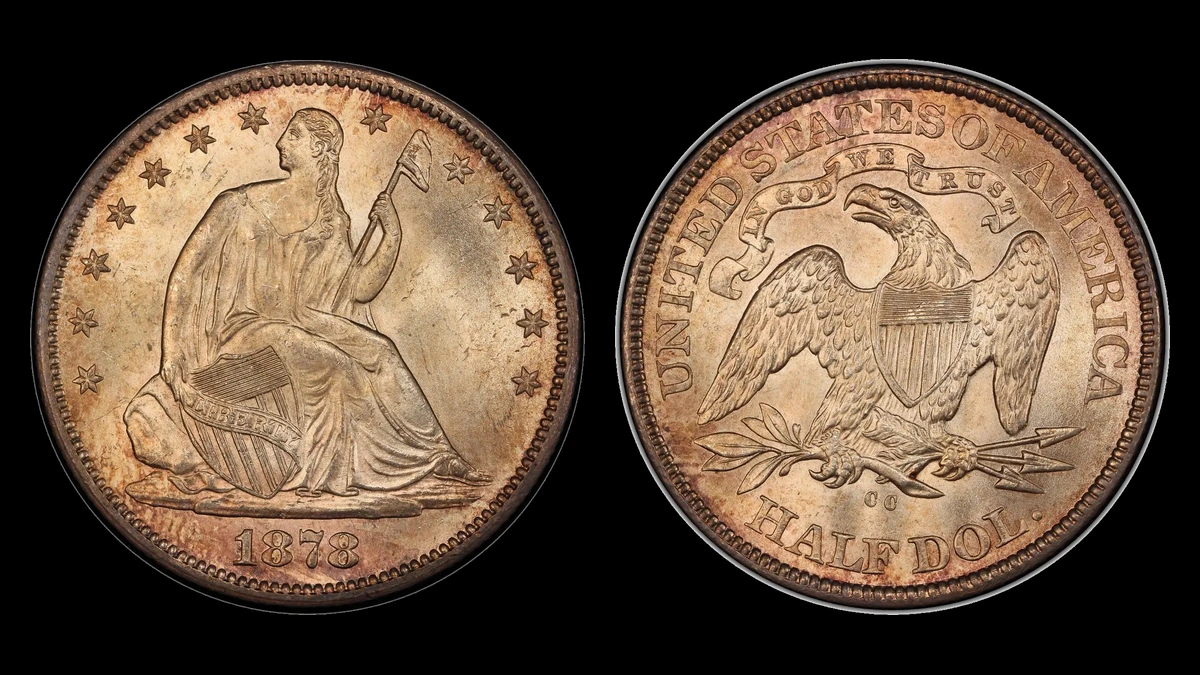
Before pricing an unusual 1878 half dollar, turn it over and look for an S. That small letter separates two very different comparisons in this guide to 1878 half dollar errors.
A Philadelphia edge error is estimated at $1,500–$3,000 around MS63. Exceptional San Francisco coins in MS64–MS66 fall around $190,000–$300,000, including a $288,000 Stack’s Bowers sale in March 2020.
Follow the back-of-coin and edge checks below to see which feature you are examining.
1878 Half Dollar A Tiny S and a Raised Line: Reverse Die Crack Error
On the rare 1878-S, the mintmark is unusually small. A fine raised line above the middle of UNITED provides another useful landmark on the back.
These features belong to the issue itself. The crack is not an extra rarity that only a few 1878-S coins have.
The same reverse die, or steel stamping tool, had developed the crack while in use in 1877. When silver filled its fracture during striking, the tool left a ridge on the coin.
How to Identify
Keep the front and back in your comparison photographs. Start by reading the full date, since an 1877 coin can show an earlier stage of this cracked reverse die.
Locate the small S below the eagle, then look above UNITED with a 10× magnifier. Match the line’s position to the photographs in Bill Bugert’s 1878-S register.
View the line under light from the side. A die crack leaves metal standing above the surface, while a scratch usually cuts into it.
The date, mintmark, and die features must agree. A close-up of the line alone cannot rule out an altered date or an added mintmark.
Correct weight and diameter are useful checks, but they do not establish authenticity. For this valuable issue, have the complete coin examined by a professional grading service.
A normal unworn half dollar is 12.50 grams and about 30.6 millimeters across. Its edge has grooves, although an edge-striking error can change its shape.
What It’s Worth
Estimated whole-coin range: $190,000–$300,000 for exceptional examples graded MS64 through MS66. These grades describe unworn coins with strong preservation.
An MS66 example sold for $288,000 at Stack’s Bowers in March 2020. The scarce San Francisco issue and the coin’s condition explain that level.
The line is useful for identification, not a $288,000 bonus to add to another half dollar. Worn 1878-S coins require comparisons in their own grades.
1878 Half Dollar Two Levels Around the Edge: Partial Collar Error
An 1878 Philadelphia half with a partial-collar strike has a different clue: a step along its edge. One part of the edge sits wider than the other.
The collar is the metal ring that holds a coin blank to its intended width during striking. If the blank sits only partly inside, the exposed portion can spread beyond the ring.
Collectors sometimes call the resulting shape a railroad rim. The important feature is the change in level, not simply an area with weak or missing grooves.
How to Identify
View the coin from its side and rotate it through the light. Photograph enough of the edge to show how the narrower and wider parts meet.
Inspect that boundary with a magnifier. A collar step should fit the struck shape; filing marks or a series of flattened knocks suggest later damage.
The example used here is a Philadelphia coin, so check for the absence of a mintmark. Do not transfer its price to an 1878-S solely because both coins have an unusual edge.
If you can safely measure a loose coin, compare different parts of its width with the normal diameter above. An enlarged portion supports the edge observation but does not replace a match to an authenticated partial-collar example.
What It’s Worth
Estimated range: $1,500–$3,000 for a genuine Philadelphia partial-collar example around MS63. That grade describes an unworn coin with noticeable marks or other small flaws.
A seller offered a PCGS MS63 example for $2,929.99. This was an asking price, and an ended listing does not establish a completed sale at that amount.
For a different-series comparison, a 1925 Vancouver partial-collar half sold for $432 in September 2025. It also graded PCGS MS63, but its date, design, and collector demand differ.
That difference shows why an identical grade and error name do not produce identical values. For an 1878 purchase, compare the date, surfaces, and clarity of the edge step together.
Conclusion
The mintmark is the useful first split: a tiny S leads to the rare San Francisco issue, while the partial-collar comparison here is from Philadelphia. The visible checks then move to the line above UNITED or the stepped edge.
Keep their values separate. Neither a small crack nor an uneven edge alone places a coin in the six-figure range of exceptional 1878-S halves.