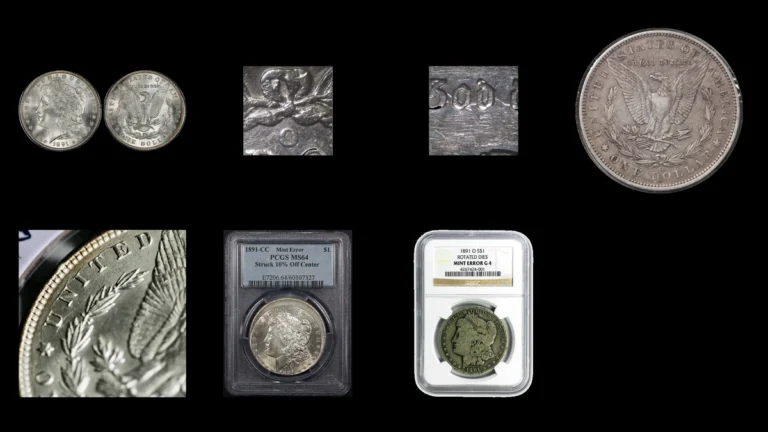
Rare 1879 Morgan Dollar Errors (List & Pictures)
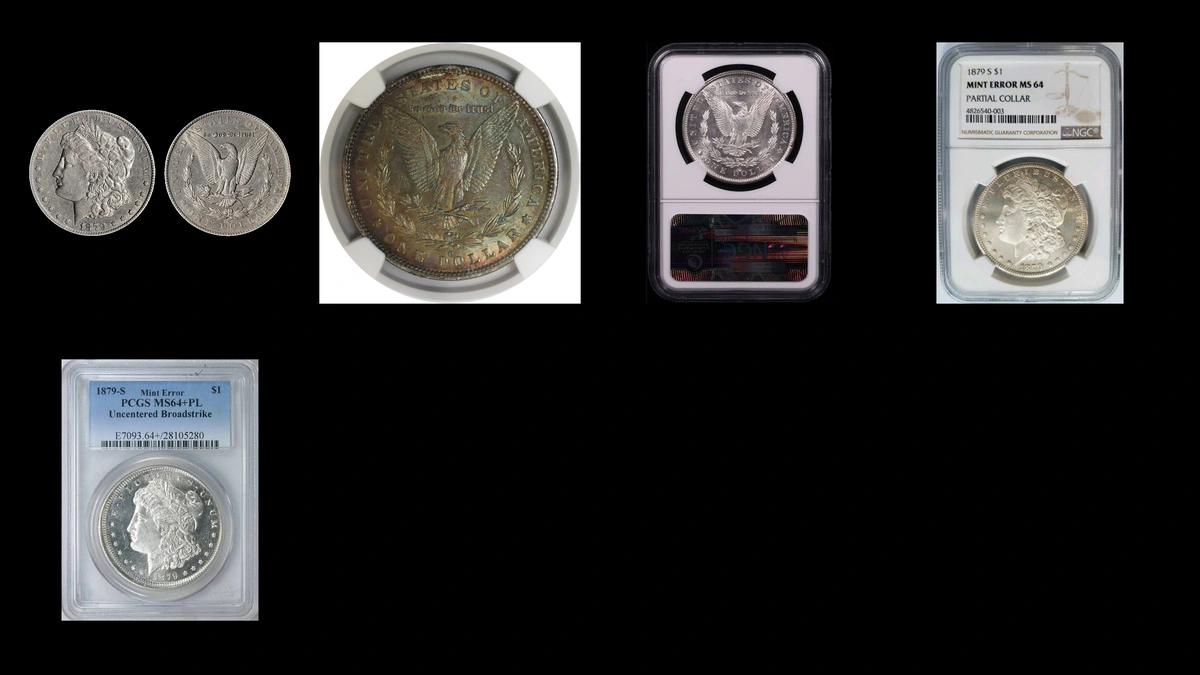
A Capped CC dollar graded MS64 sold for $14,640 in March 2026. This 1879 Morgan dollar errors guide covers estimated whole-coin values of $75–$25,000.
Identify the mint-mark pattern first, then compare surface defects and the rim evidence that separates several unusual production sequences.
| What looks unusual | Category | Estimated range |
|---|---|---|
| Overlapping CC or sideways O traces | Repunched mint mark | $75–$25,000 |
| Peeling silver above STATES | Lamination | $75–$600 |
| Depression interrupting design | Strike-through | $100–$4,000 |
| Grooves beside expanded edge | Partial collar | $150–$3,500 |
| Complete design in uneven wide blank | Broadstrike | $1,000–$6,000 |
| Unstruck area and missing design | Off-center strike | $2,000–$10,000 |
| Dished face with reshaped high rim | Struck coin through upsetting mill | $4,000–$15,000 |
1. 1879 Dollar Earlier letters remain under the mint mark: repunching Error
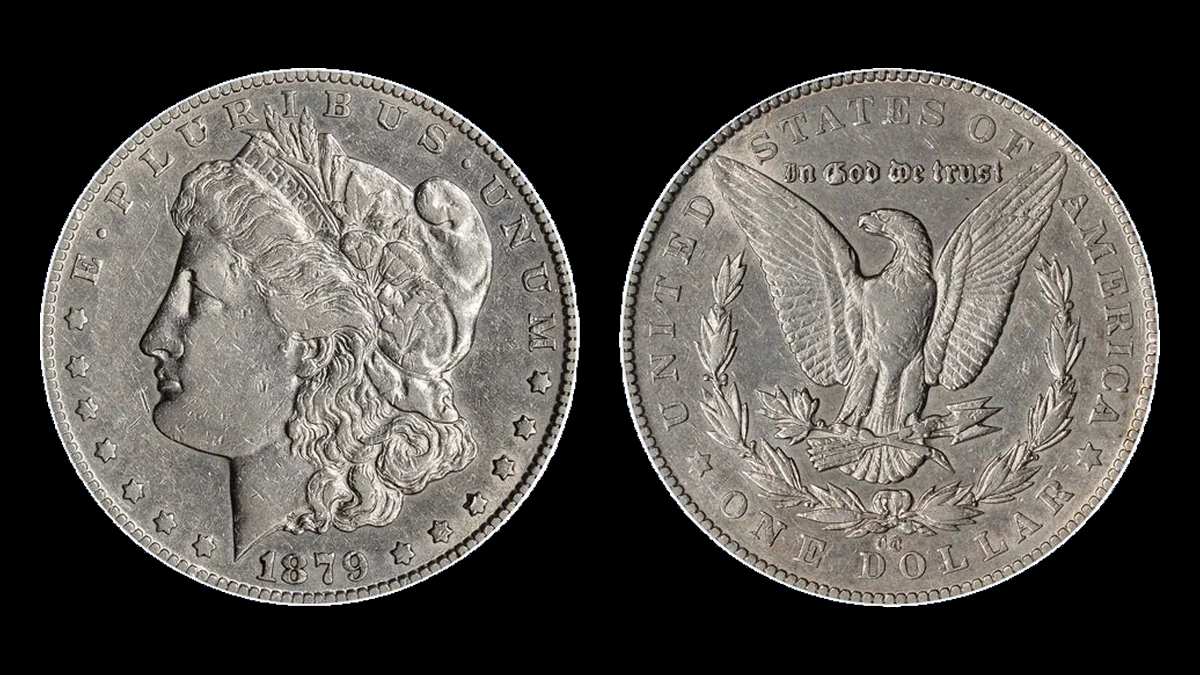
Capped CC describes larger Carson City letters punched over an earlier smaller CC in the die. Tool work helped obscure the underlying letters and left the familiar rough-looking pattern.
The name does not mean a coin became stuck over a die. New Orleans has a separate variety with an upright O over a sideways O.
How to Identify
For Capped CC, examine both letters and the surrounding raised marks together. Compare remnants of the smaller CC with an identified photograph, then check for engraving or a seam from an added mint mark.
For the O variety, trace the surviving horizontal curves around the upright letter. They should fit an earlier sideways O rather than simply form a thick normal mint mark.
What It’s Worth
The combined estimate is $75–$25,000: Capped CC examples are around $300–$25,000 and O-over-horizontal-O examples around $75–$1,500.
A PCGS MS64 Capped CC with CAC approval brought $14,640 in March 2026. The scarce Carson City issue contributes substantially to that whole-coin value.
2. 1879 Dollar A thin layer lifts above STATES: lamination Error
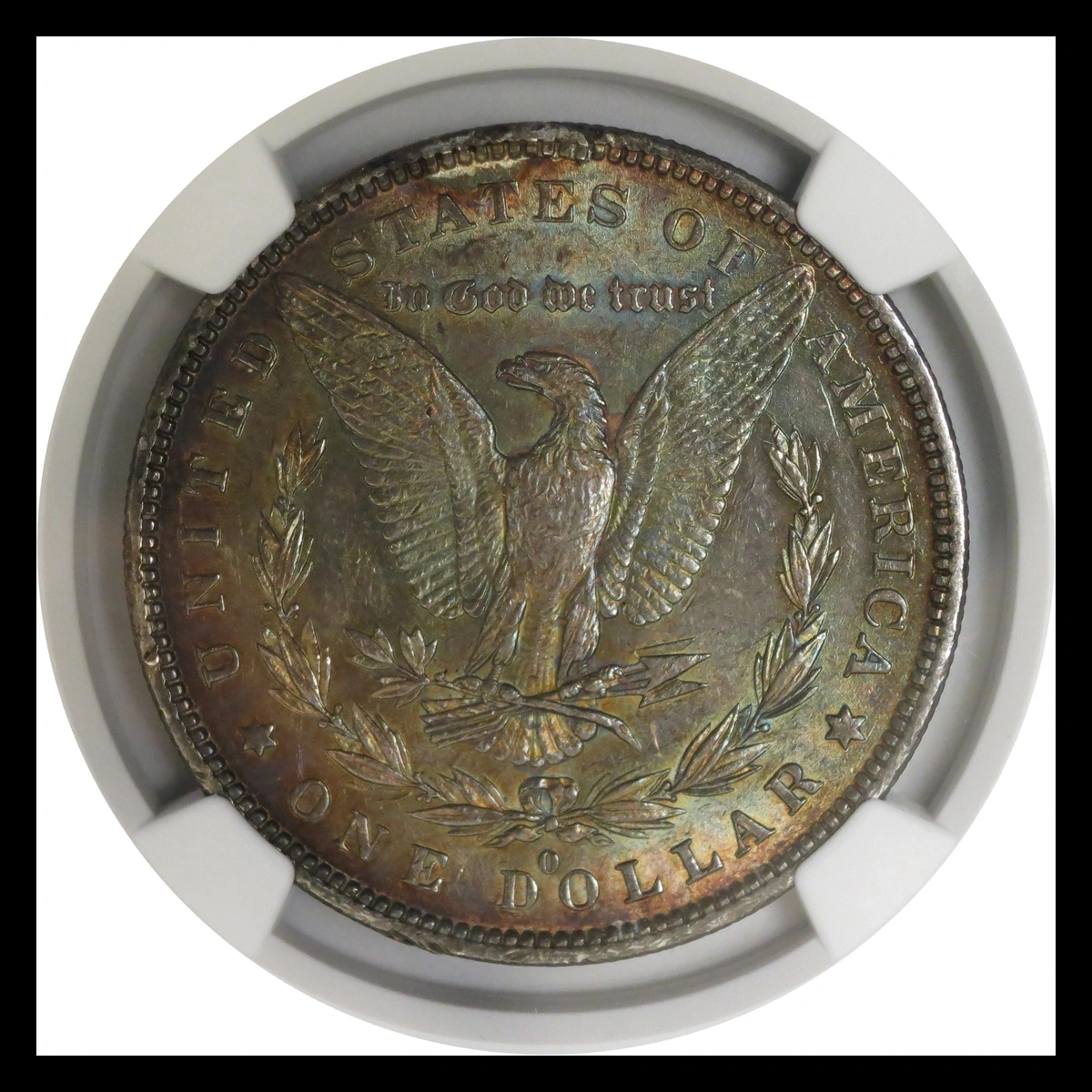
A documented 1879-O has a peel above STATES on the reverse. The separation began within the silver alloy rather than in the die’s lettering.
The seller describes the example as NGC AU55, indicating light wear. Its toning is separate from the physical layer separation.
How to Identify
Include STATES in a close view and follow the peel’s attached edge with side light. A physical boundary should remain recognizable as reflections change.
Check for scraping or metal displaced by an impact. Do not lift the layer, since its original connection helps explain the defect.
What It’s Worth
Comparable 1879-O laminations are estimated at $75–$600.
Coin Exchange listed the described NGC AU55 example at $166.66 for check or wire payment. The out-of-stock status does not establish a completed sale at that asking price.
3. 1879 Dollar A hollow interrupts the picture: struck through material Error
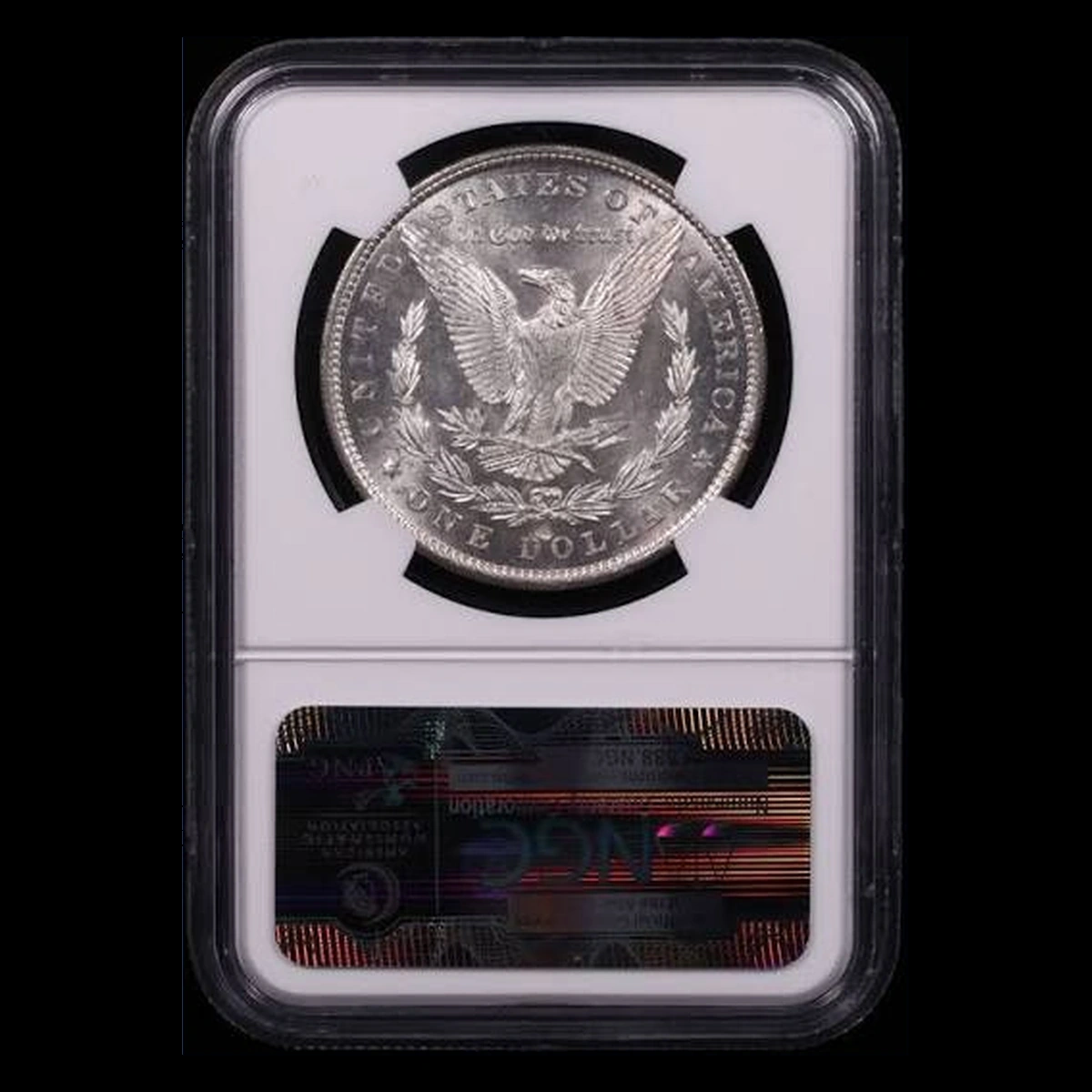
Material between the blank and die can prevent the normal design from forming. Reported examples include a Philadelphia reverse line and an 1879-S NGC MS64+ impression near the eagle.
Two Carson City coins are separate comparisons: an NGC XF45 with a reverse impression and a PCGS AU55 with a front impression. Their shapes and trapped materials should not be assumed identical.
How to Identify
Select the correct mint and face before comparing an impression. Examine how the normal design stops or changes at the affected area.
A later scratch may cut across finished relief and push up a ridge. Change the lighting to look for those signs rather than naming a trapped object from a dark mark alone.
What It’s Worth
The estimated range is $100–$4,000, including $100–$1,500 for Philadelphia or San Francisco and $400–$4,000 for comparable Carson City pieces.
No exact transactions were supplied for these examples. Carson City’s higher underlying issue value does not mean each depression automatically earns a larger error premium.
4. 1879 Dollar Edge grooves survive beside smooth expansion: partial collar Error
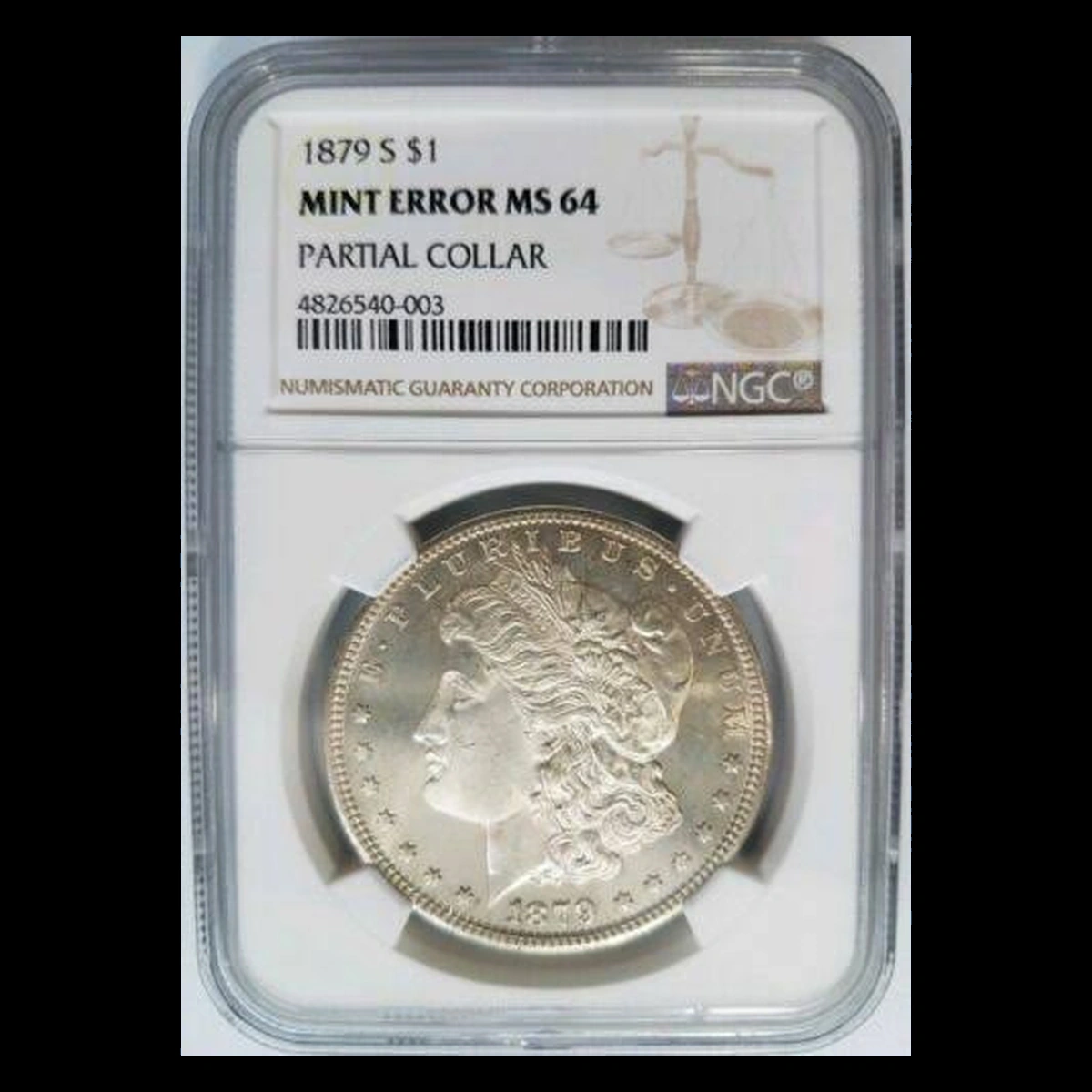
A Philadelphia NGC MS62 dollar retains grooves near its reverse rim while much of the edge spread without restraint. It also missed the earlier preparation step that raises a small rim on a blank.
The holder called it a broadstrike, but Heritage explained that the surviving grooves support partial collar. A separate Philadelphia AU Details and a tilted-collar 1879-S require their own comparisons.
How to Identify
Follow the transition from grooved to smooth edge under magnification. Original grooves demonstrate some collar contact, while filing can remove grooves after minting.
On the Philadelphia combination, inspect near the reverse rim. For the tilted 1879-S, edge photographs should show how the step changes height around the coin.
Normal Morgan references are 38.1 millimeters and 26.73 grams. Measurements help describe a loose candidate, but the actual edge pattern identifies the collar interaction.
What It’s Worth
Partial-collar examples, including the blank-preparation combination, are estimated at $150–$3,500.
The Philadelphia MS62 sold for $2,820 in August 2013. That single price covers both the missing prepared rim and partial-collar strike on one coin.
5. 1879 Dollar Unequal margins surround a complete design: broadstrike Error
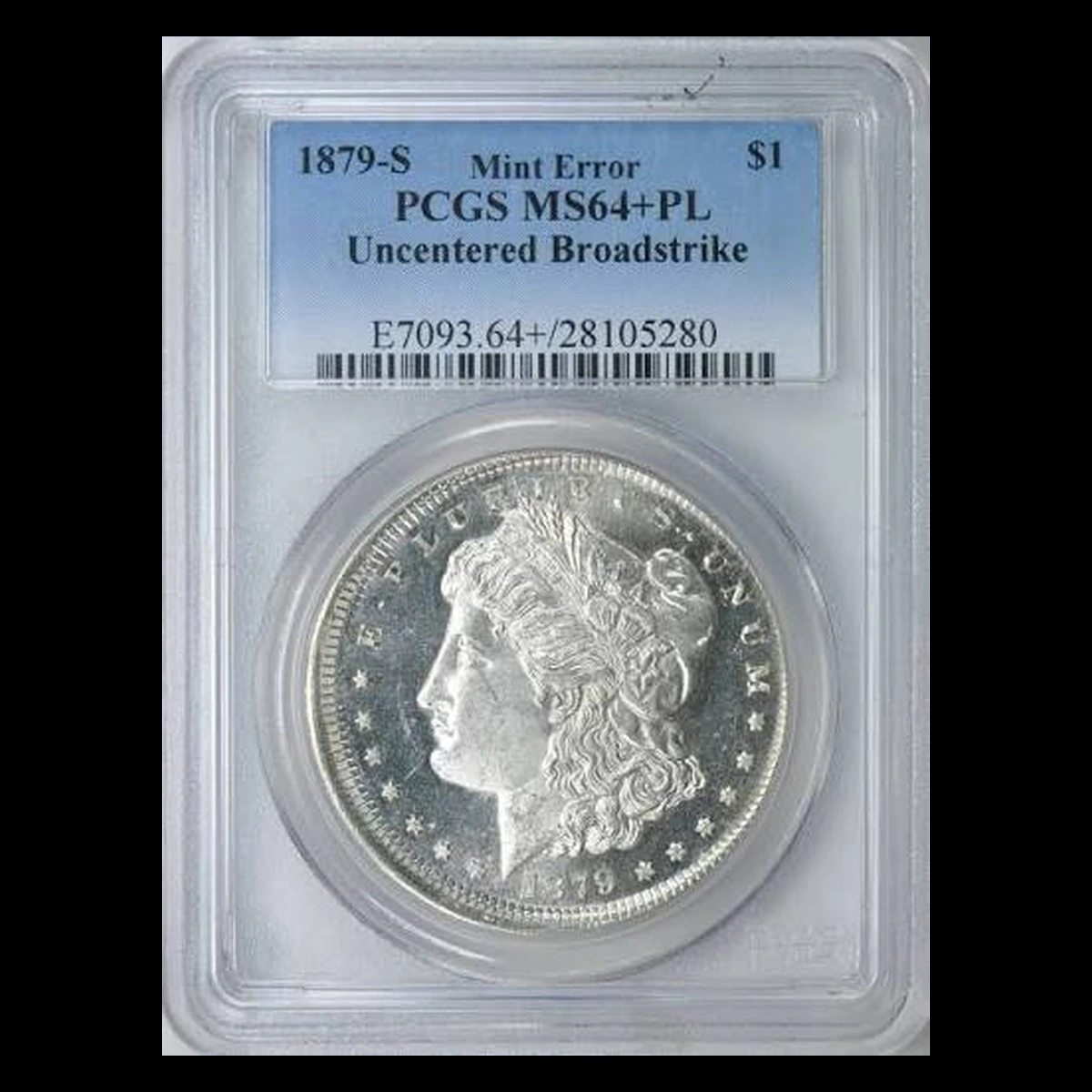
A documented 1879-S spread unevenly because the collar did not contain it. Its entire intended design remained, making it an uncentered broadstrike.
GreatCollections offered the coin as PCGS MS64+ PL. PL means prooflike reflection on an ordinary strike, not manufacture as a collector Proof.
How to Identify
Trace every outer star and letter on both faces. The design must remain complete despite unequal borders.
Inspect the expanded silver for original flow rather than crushing or hammer dents. Edge views should also be checked for surviving collar grooves.
Compare the whole outline with the certified MS64+ PL specimen. Leave a sealed dollar in its holder.
What It’s Worth
Recognizable 1879-S broadstrikes are estimated at $1,000–$6,000.
The March 2014 archive supplies no disclosed price here. A different-year 1883-O PCGS MS64 broadstrike was reported at $2,300 in October 2008.
That comparison needs adjustment for the actual coin’s expansion and condition. Reflection alone cannot transfer either the grade or price.
6. 1879 Dollar The design misses part of the blank: off-center strike Error
Mint Error News describes an 1879-O graded PCGS VF30 as 20% off center. Bare metal remains opposite the design that ran beyond the blank.
The supplied percentage does not establish a clock direction. VF30 describes a circulated coin with clear major details.
How to Identify
Confirm the 1879 date and O before concentrating on the blank crescent. An undated Morgan cannot be assigned to this year from its design alone.
Compare the missing design and unstruck area on both faces. Inspect the boundary for grinding or cuts and record the actual direction from the coin.
What It’s Worth
Comparable genuine 1879-O off-center dollars are estimated at $2,000–$10,000.
An 1883-O graded XF40 brought $2,520 in May 2024. That different date with a smaller shift is not a direct sale comparison for the 20% 1879-O VF30.
7. 1879 Dollar A high rim surrounds a dished face: struck coin through the upsetting mill Error
The Newman collection 1879-S looks thick and slightly concave. NGC identified it as an already struck coin that passed through the upsetting mill.
That machine normally squeezes a blank’s edge to raise a small rim before striking. Here the rim-forming step occurred after the design was present, rather than proving an originally thick, concave blank.
How to Identify
Examine the side profile and full face together. Compare the continuously reshaped rim with the certified NGC MS61 specimen.
Look around the entire edge for irregular hammering, cuts, or repeated dents. Artificial rolling or bending can create a thick-looking rim without the documented manufacturing sequence.
A specialist needs to assess how the reshaped edge relates to the existing design. A concave appearance alone does not establish passage through the Mint’s mill.
What It’s Worth
A securely authenticated comparable 1879-S error is estimated at $4,000–$15,000.
The Newman collection NGC MS61 sold for $8,225 on April 25, 2013. Its recognized sequence and original rim evidence distinguish it from a later altered dollar.
Conclusion
Error names are useful only when they match the physical evidence. Capped CC concerns overlapping mint marks, while the returned-to-mill dollar records rim work after the design was struck.
For expanded shapes, check complete designs and surviving edge grooves before selecting a category. Keep different dates, grades, and asking prices attached to their own examples, and preserve any loose lamination flap during inspection.