Rare 1921 Peace Dollar Errors (List & Pictures)
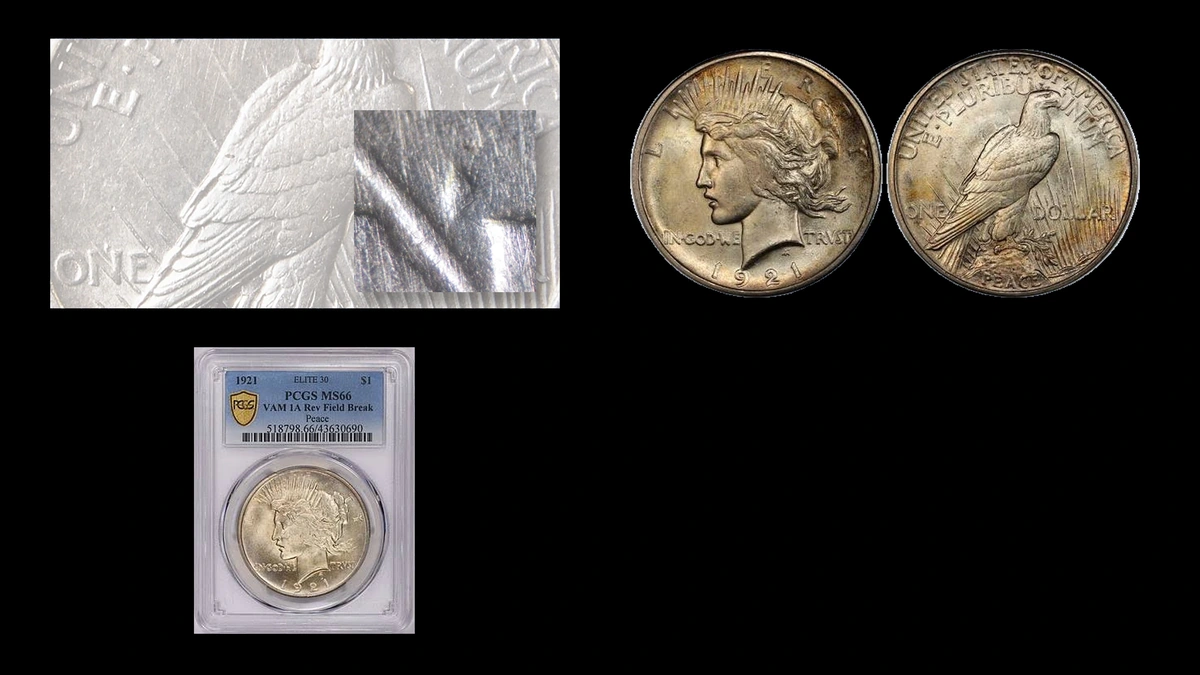
A VAM-1A graded MS66 reached $32,000 in December 2021, combining a recognized die break with exceptional preservation. The estimated whole-coin span for 1921 Peace dollar errors here is $150–$35,000.
Examine the small raised features, reverse rays, and fine surface lines before checking face alignment. VAM numbers identify particular die patterns; the name alone does not make an ordinary scratch or bump part of a variety.
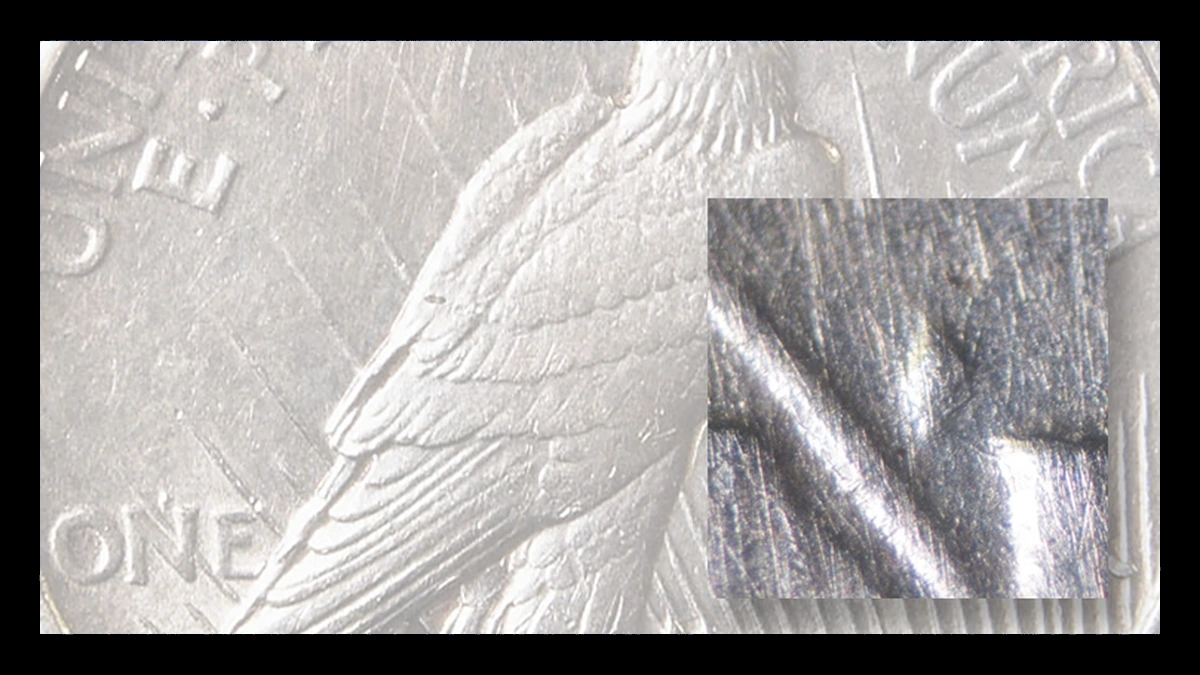
1. 1921 Dollar A Fixed Raised Dot: VAM-1B Die Gouge Error
A gouge in the die creates a hollow that silver can fill, leaving a raised feature on the coin. John Roberts describes VAM-1B as a strong dot-like example of this tool damage.
Its exact location and shape must match an attributed coin. Dirt, residue, or metal pushed upward by a later impact can produce a misleading spot.
How to Identify
Compare the dot and nearby design together with a clear VAM-1B photograph. Changing the light angle can reveal elevation without scraping the surface.
Look for an adjacent dent that could account for displaced metal. A raised speck by itself is insufficient, and the supplied description does not justify inventing a fixed position in the design.
What It’s Worth
$150–$1,500 is an estimated whole-coin range for correctly attributed VAM-1B examples. No specific auction result for this variety is supplied.
The collectible date and original surface condition contribute alongside the tool feature. Heavy wear may flatten the dot and make attribution less secure.
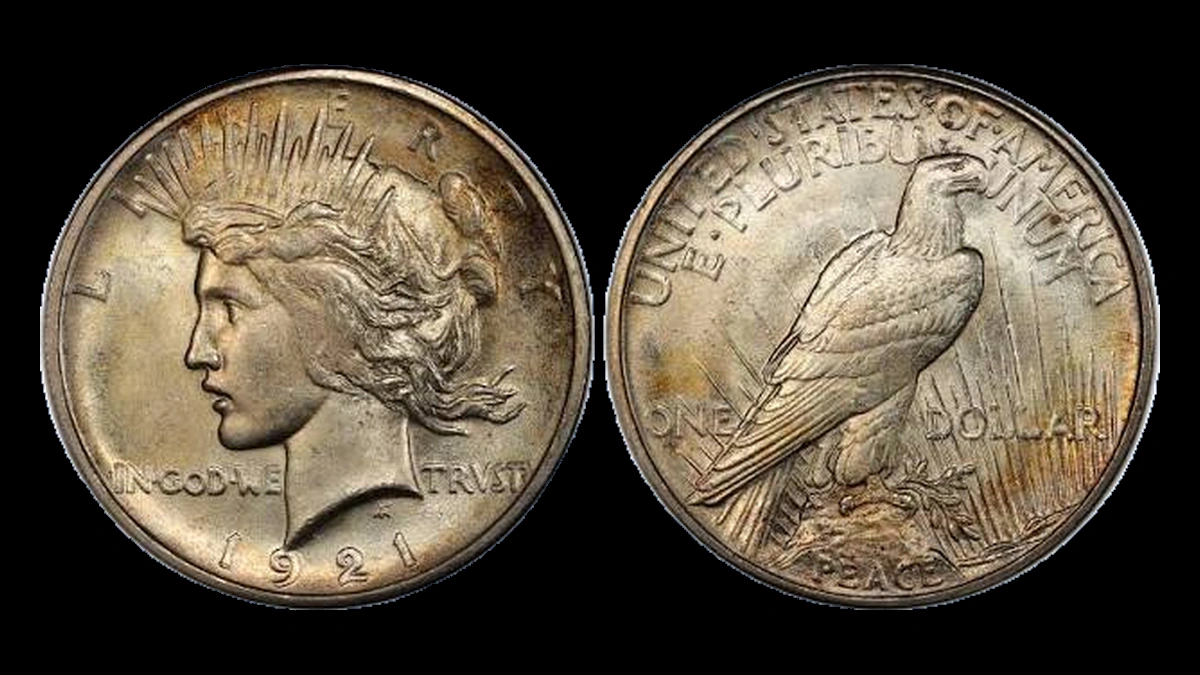
2. 1921 Dollar A Ray Passing over the First L: VAM-3 Re-engraving Error
At the first L in DOLLAR, a strengthened sunray crosses the letter instead of disappearing beneath it. This hand-reworked die pattern is VAM-3, also called FS-1003.
John Roberts’s illustrated study explains the re-engraving and nearby strengthened rays. A collision between the dies is not established as its cause.
How to Identify
Find the L immediately after O and follow the ray across it. The raised continuation should match the attributed pattern rather than a scratch cut through the letter.
Fine lines below the R in DOLLAR and crisscrossing lines at the front of Liberty’s crown can support the comparison. Keep the ray crossing as the primary clue, especially where wear makes secondary marks difficult to see.
What It’s Worth
$200–$3,500 is the estimated range across worn and attractive unworn examples. An NGC MS63 sold for $840 at Stack’s Bowers in August 2023, recorded by PCGS.
MS63 means unworn with noticeable marks. Strike strength and preservation still influence the complete dollar’s value after the variety is identified.
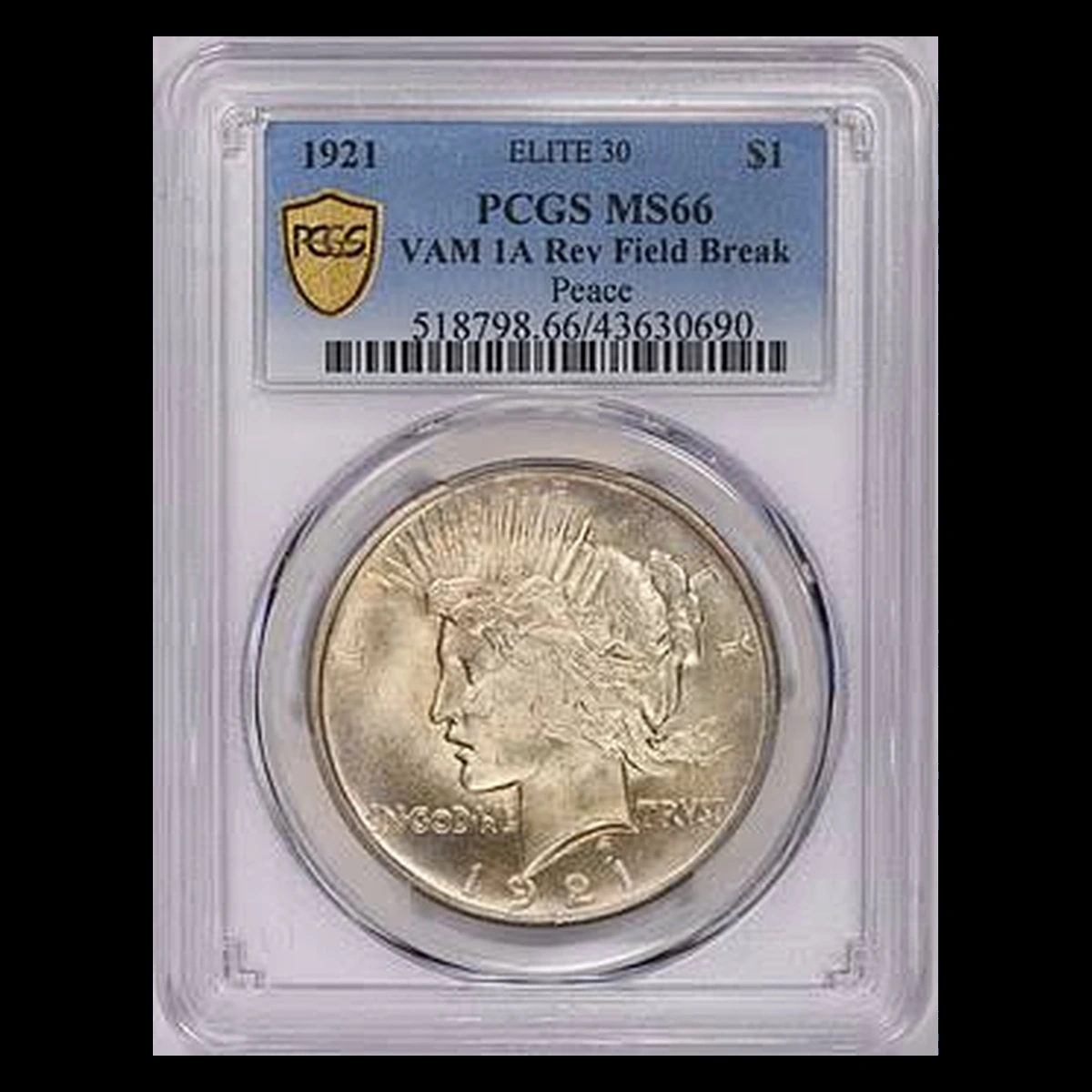
3. 1921 Dollar An Abnormal Patch Right of the Eagle: VAM-1A Field Break Error
The smooth background to the eagle’s right can show the VAM-1A reverse field break. “Field” means the open area around the design, where damage to the die changed the struck surface.
A later dent or scrape can also occupy that space. The location is a starting point, while the actual boundary must establish the variety.
How to Identify
Hold the eagle upright and compare the affected area with a VAM-1A photograph that includes nearby rays or letters. Matching those surroundings prevents an isolated crop from concealing a position mismatch.
Use low light to inspect height and outline. Parallel cuts or a hollow bordered by pushed metal can instead indicate handling damage.
What It’s Worth
$200–$35,000 is a broad whole-coin estimate for confirmed VAM-1A examples. PCGS records a $32,000 eBay result in December 2021 for an MS66.
The high-grade unworn preservation is essential to that result. A worn or cleaned dollar does not acquire the same price from the field break alone.
4. 1921 Dollar Fine Raised Lines in the Fields: VAM-1F and VAM-1H Die Polish Error
Polishing a die can leave tiny grooves that become raised lines on the coins it strikes. VAM-1F and VAM-1H describe two different patterns from such work.
The VAM-1H auction description mentions swirling lines around OF on the reverse and some near WE on the front. These features can occur on ordinary strikes and do not establish a collector Proof.
How to Identify
For VAM-1H, change the light angle around OF and WE to reveal the fine curved pattern. Tool-polish lines rise slightly above the surface, whereas cleaning generally cuts scratches into it.
VAM-1F requires its own identified photographs. Do not borrow the VAM-1H locations or rely on general shininess to assign either variety.
What It’s Worth
$200–$20,000 is an estimated span from worn coins to exceptional unworn examples. A PCGS MS65 VAM-1F sold for $2,400 in March 2018.
An MS65 VAM-1H with CAC approval brought $7,343.75 in October 2021. Its auction account also cites a different MS66 VAM-1H sale at $19,200 in 2019.
These are complete-coin prices with different condition evidence. Recognizing raised tool lines does not turn a modest coin into the highest-grade comparison.
5. 1921 Dollar A Consistently Tilted Eagle: Rotated Reverse Error
PCGS describes 1921 examples with the reverse about 20 degrees counterclockwise from its normal relationship to the portrait. The entire reverse turns together because of the die’s orientation.
No part of the design has to be missing. A tilted photograph or one crooked-looking letter cannot demonstrate the same effect.
How to Identify
Hold Liberty upright with the date level and flip the dollar top to bottom without twisting sideways. The eagle should normally finish upright.
Repeat that controlled motion using a fixed guide, or turn the whole sealed holder. Measure a repeatable departure from upright rather than independently rotating two photographs until they appear different.
What It’s Worth
$200–$2,000 is an estimated whole-coin range for a confirmed rotation near the reported angle. The supplied evidence gives no specific sale for this category.
A worn and an attractive unworn dollar still need different comparisons even if both show the same angle. Clear demonstration of the relative orientation is essential.
Conclusion
The 1921 Peace dollar features here require several distinct comparisons: a specific dot, the ray across L, a field-break boundary, raised polish patterns, and a fixed relationship between faces. None is established by a dramatic photograph alone.
Keep the surface untouched and match the correct variety before applying the $150–$35,000 estimates. The $32,000 VAM-1A result includes exceptional preservation as well as the recognized die feature.