Rare 2009 Sacagawea Dollar Errors (List & Pictures)
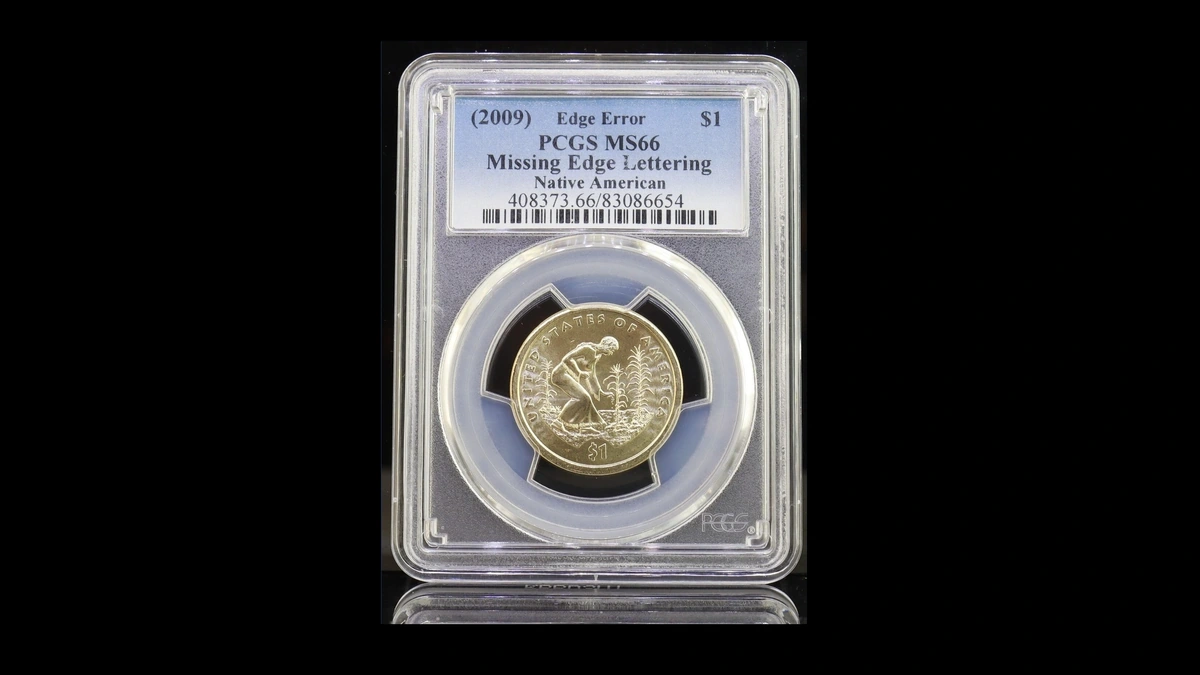
A plain-edge coin with three overlapping strikes sold for $1,800 in January 2018. It combines two kinds of 2009 Sacagawea dollar errors, so that result does not price missing edge lettering alone.
The estimated ranges below span $20–$2,500. Identify the woman planting corn, beans, and squash on the back, then examine the edge, design details, surface metal, and outline.
1. 2009 Dollar Shallow, Interrupted, or Absent Words: Edge-Lettering Error
The date and mintmark moved to the edge for the 2009 Native American dollar. Ordinary coins received that inscription in a separate operation after the two faces were struck.
A weak pass can leave shallow characters, a partial pass can leave gaps, and a missed pass can produce a plain edge. PCGS reported a weak MS67 example and the first complete missing-edge discovery in March 2009.
How to Identify
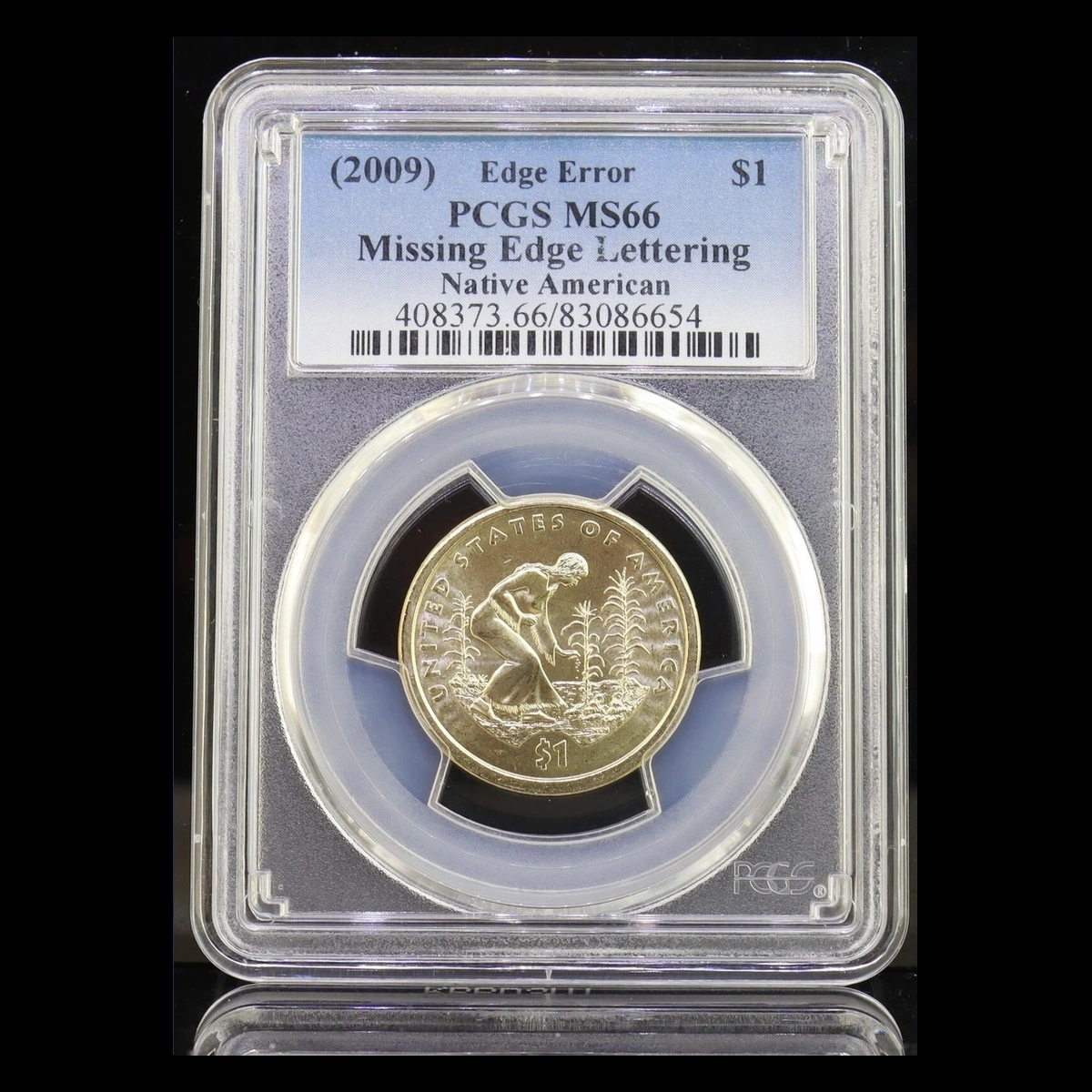
Photograph the entire circumference in overlapping views and mark every surviving groove. A faint inscription should not be called completely absent.
The planting scene identifies the 2009 issue if its date is missing, but it cannot recover the missing mintmark. Earlier eagle-reverse Sacagawea dollars normally have plain edges, and normal Position A or B lettering directions are not errors.
Check a loose candidate for sanding or filing against the normal specifications of about 8.10 g and 26.5 mm. Compare ordinary, satin-finish, and Proof pieces separately rather than treating their different surfaces as one grade comparison.
What It’s Worth
$20–$400 is the estimated range for weak or partial lettering, with $25–$800 for ordinary completely plain-edge examples. A PCGS MS67 plain-edge dollar sold for $114 in February 2018.
The $1,800 January 2018 coin also had three strikes, two off center, as recorded in Mint Error News. Comparable authenticated combinations have an estimated $800–$2,000 range for the complete coin.
2. 2009 Dollar Repeated Outlines in the Portrait or Scene: Doubled Dies Error
Front and back doubling has been reported for Philadelphia coins. A doubled die carries repeated design detail in the steel tool and transfers it to coins struck from that tool.
The reports do not establish one fixed location for every candidate. Ordinary outlines and flat shelves created by movement during striking can both be mistaken for a second design edge.
How to Identify
Compare the same small area with a normal dollar at equal magnification. Raised, coherent extra outlines need to match a documented variety rather than a general impression of thickness.
Examine each face independently if both seem affected. A confirmed portrait feature does not automatically prove doubling in the planting scene.
What It’s Worth
$25–$400 is an estimate for confirmed doubled designs. Visibility, recognized attribution, and surface preservation matter, while two affected faces do not automatically double the value.
3. 2009 Dollar A Raised Line or Rim Lump: Cracked and Broken Dies Error
A crack in a die can leave a thin raised line, while a missing piece at its edge can leave a broad rim-connected lump called a cud. Both form when coin metal enters an opening in the tool.
The supplied reports describe a large Philadelphia front crack and a separate large Denver cud. They do not provide one shared location or one coin with both features.
How to Identify
Use low light to establish that the feature rises above the normal surface. A scratch or a split through the coin itself has a different physical relationship.
Trace a suspected cud into the rim and look for an adjacent dent that might explain pushed-up metal. A detached bump is not sufficient, and the P crack photograph cannot authenticate the different D break.
What It’s Worth
$25–$500 is the estimated crack range, while genuine rim cuds are estimated at $75–$1,200. The size, visibility, and original surface condition determine the relevant comparison.
These ranges concern separate types of coins. They are not two amounts to add merely because both involve damaged tools.
4. 2009 Dollar A Patch Interrupting the Planting Scene: Strike-Through Error
The reported Denver strike-through affects the reverse. Material between the die and blank blocked part of the scene as the coin was struck.
No specific obstruction material or retained object is established. The shape and texture of the actual impression must support any closer description.
How to Identify
Follow a plant stem, letter, or other intact detail toward the affected patch. Its boundary should explain why that detail failed to form.
Inspect for scrape grooves or pushed-up edges indicating later damage. Photograph the full scene and the transition into the impression without probing it or disturbing any material that might remain.
What It’s Worth
$50–$1,500 is the estimated range for confirmed strike-throughs. The supplied guide reports a $930 eBay result in 2022 for a 2009-D graded MS61.
That reported result concerns an unworn coin with numerous marks. It does not establish that the unknown obstruction remained attached.
5. 2009 Dollar Copper Exposed Across a Face: Missing Outer Layer Error
The dollar’s copper center is normally enclosed by manganese-brass outer layers. A missing layer can expose the center, making the surface look different from its normal golden color.
The Philadelphia report concerns this bonded metal construction, not gold plating wearing away. If the layer was absent before striking, design details could form directly in the exposed center.
How to Identify
Use neutral light and compare both faces before concluding that one is bare copper. Chemical staining and warm lighting can produce misleading color.
Combine a precise weight with the remaining edge layers and condition of the raised design. A missing full layer should reduce the normal 8.10 g weight, while pits, erosion, or removed metal may indicate a later change.
Do not scratch the surface to test it. An examination must establish both the missing layer and when that loss occurred.
What It’s Worth
$100–$1,000 is the estimate for a confirmed missing layer. The guide reports an $820 eBay sale in 2020 for a 2009-P MS62 example.
That grade describes an unworn coin with visible marks. An intact exposed face differs from an ordinary stained dollar and should be priced accordingly.
6. 2009 Dollar A Curved Opening in the Outline: Clipped Blank Error
A Denver curved clip is reported for 2009. This kind of missing section can form when the blank cutter overlaps a hole already punched in the strip.
The incomplete disc then receives its design around the gap. The report does not establish one size or location that every example must match.
How to Identify
Inspect both ends of the curve for struck rim details that weaken or stretch naturally toward the opening. A weak area opposite the clip can support the diagnosis but need not be obvious on every coin.
Look along the exposed boundary for saw grooves or filing. Low weight confirms missing metal only; the edge transitions help show whether it disappeared before or after striking.
What It’s Worth
$50–$1,500 is the estimated range for genuine clips. The guide reports $1,010 in 2019 for a 2009-D MS63 curved-clip dollar.
The missing area and surviving design should be compared with that reported coin. A later cut belongs outside the mint-error range regardless of its size.
7. 2009 Dollar The Scene Tilts After Flipping: Rotated Reverse Error
A reported 2009-D has about 100 degrees of reverse rotation. The error concerns the angle between the portrait and planting scene, caused by a die’s orientation.
It is unrelated to the normal direction of the separately applied edge words. Upside-down edge lettering does not show that the two face designs are misaligned.
How to Identify
Place the upright portrait beside a fixed vertical guide and flip the coin top to bottom without turning it sideways. Preserve the guide in the second view to measure how far the reverse departs from upright.
Repeat the motion to rule out movement in your fingers or holder. The reported 100-degree figure is not an angle to impose on another candidate, and no direction of turn is supplied.
What It’s Worth
$100–$800 is an estimate for a genuine large rotation of the reported scale. The source guide reports $585 for a 2009-D MS64 example, without an independently checked auction record here.
That unworn grade and substantial angle provide context. A slight tilt or ordinary edge-lettering direction does not establish the same premium.
8. 2009 Dollar Part of the Scene Falls Beyond the Metal: Off-Center Strike Error
The reported 2009-D example is described as about 45% off center. A misplaced blank received only part of the design, leaving untouched metal opposite the missing picture.
The surviving planting scene may identify the year even when edge lettering is lost. It cannot prove Denver if the D itself is absent.
How to Identify
Compare both faces with the complete outline visible. The incomplete designs and unstruck area should agree with the same displaced blank.
Check for overlapping additional images before treating it as one off-center strike. A centered reverse with only the front shifted suggests a different die-alignment problem.
What It’s Worth
$300–$2,500 is the estimated range for substantial authenticated examples. The guide reports a $945 result in 2023 for the 45% off-center Denver coin graded MS65.
This reported single-strike coin is distinct from the $1,800 triple-struck plain-edge example. The latter’s combined features require their own comparison.
Conclusion
The planting scene can establish the 2009 issue when edge lettering is absent, but a missing mintmark must stay unidentified. Examine the whole edge before deciding whether its words are weak, partial, or entirely missing.
For other errors, connect the visible surface or shape to its production cause. The $20–$2,500 estimates include reported comparisons, while the $1,800 sale concerns one coin with both missing lettering and three strikes.