Rare 1956 Half Dollar Errors (List & Pictures)
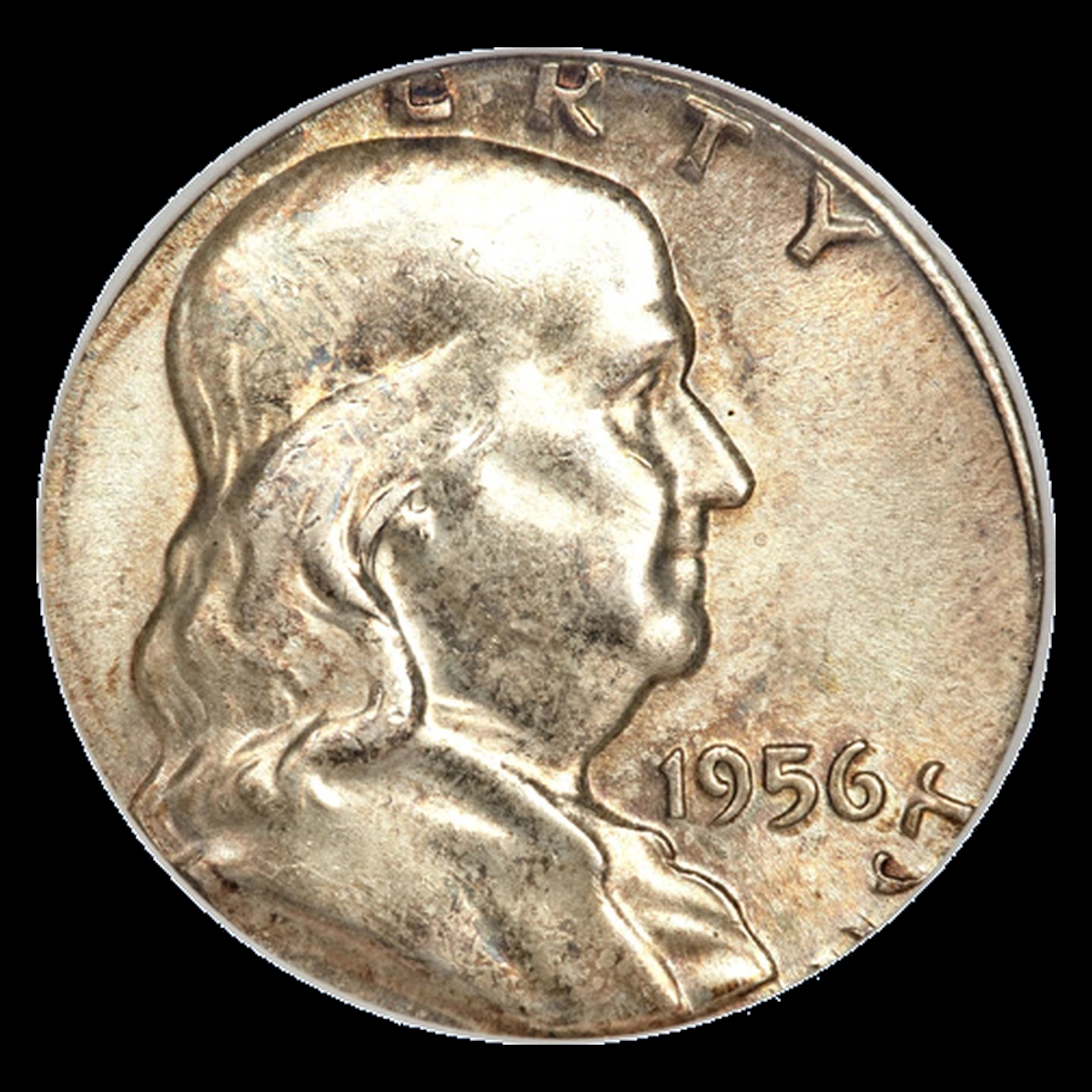
A 1956 Franklin half dollar on a quarter planchet sold for $1,150 in December 2009. Its smaller disc retained the date while losing parts of the outer inscriptions.
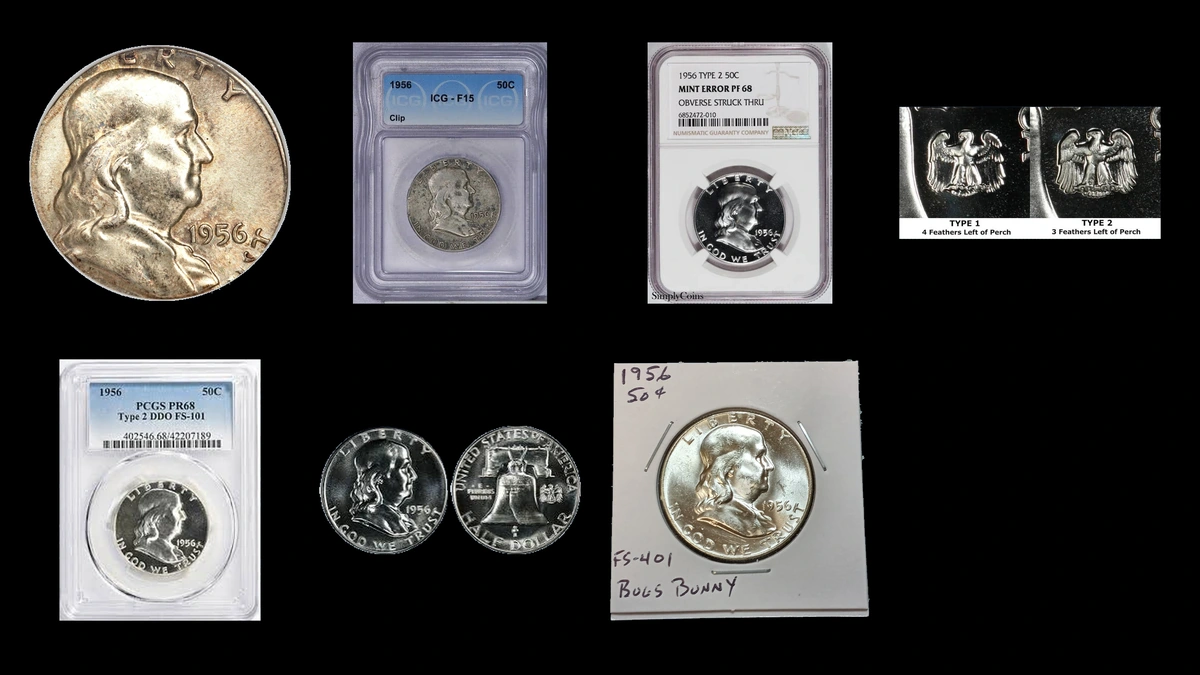
The working estimates for 1956 half dollar errors span $40–$4,000. This guide starts with the edge and metal, then separates unusual eagle designs, doubled details, and die clashes.
The normal coin weighs 12.50 grams, measures 30.6 millimeters across, and has a reeded edge. Both ordinary strikes and specially made collector proofs use silver-copper alloy, so normal measurements alone do not distinguish their finishes.
| Where to look | Possible feature | Estimated whole-coin value |
|---|---|---|
| Entire outline | Quarter planchet | $1,200–$4,000 |
| Missing curved edge | Clip | $75–$500 |
| Lifted silver layer | Lamination | $40–$200 |
| Interrupted front design | Strike-through | $150–$750 for the proof category |
| Eagle feather pattern | Proof-style reverse on ordinary strike | $75–$600 |
| Front letters and date | Doubled die obverse | $50–$900 |
| Reverse lettering and details | Proof doubled die reverse | $50–$1,000 |
| Mouth or separate nose trace | Die clash | $45–$1,000 |
1. 1956 Half Dollar The Date Fits but Outer Words Do Not: Quarter Planchet Error
A smaller blank can receive the central half-dollar design while leaving too little room for surrounding letters. The documented 1956 example was struck on a quarter planchet, the prepared disc normally used for a quarter.
Heritage describes that disc as shifted toward one o’clock on the front. Its small size and placement belong to the same wrong-planchet coin, rather than proving a separate off-center strike on a full half-dollar blank.
How to Identify
Measure the actual coin and inspect its entire edge for cutting or filing. A silver quarter blank starts near 6.25 grams and 24.3 millimeters, although striking can increase its width.
The auction description supplies no measured dimensions for this specimen. Do not present a blank’s starting specifications as measurements of the finished error.
On the cataloged coin, compare the surviving date and missing portions of IN GOD WE TRUST and UNITED STATES OF AMERICA. The mintmark area is absent, but 1956 identifies Philadelphia because it was the only mint producing half dollars that year.
What It’s Worth
A working estimate is $1,200–$4,000 for a genuine, identifiable quarter-planchet strike. Metal, remaining date details, and preservation must support the comparison.
The ANACS MS62 example sold for $1,150 on December 4, 2009. This historical result concerns an unworn coin with noticeable marks, not every small silver disc carrying part of Franklin’s portrait.
2. 1956 Half Dollar Part of the Rim Is Missing: Clipped Planchet Error
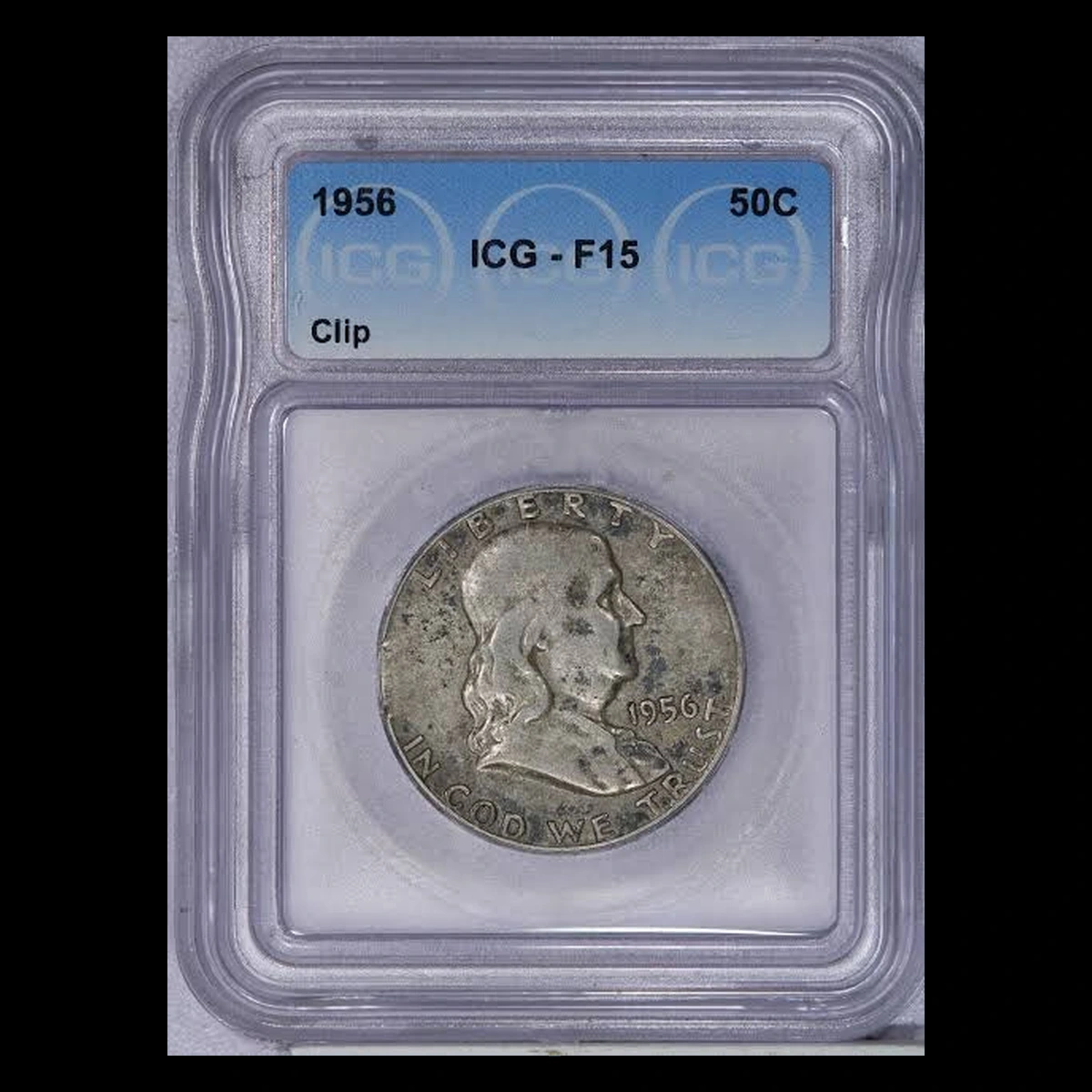
For a coin that otherwise has the half dollar’s normal size, examine a missing crescent as a possible clip. An incomplete blank can result when the cutting punch overlaps a previously punched hole in the metal strip.
The supplied examples include a two-percent clip graded PCGS MS64 and a different coin with a nine-percent curved gap near one o’clock. Their missing areas must not be combined into one specimen description.
How to Identify
The reported nine-percent clip removes part of R and all of TY in LIBERTY, with much of OLL missing on the reverse. Those letter losses identify that example’s position, not a required pattern for all 1956 clips.
Inspect how the rim and lettering formed beside the gap, looking for a natural transition rather than a cut through finished details. A weak rim opposite the gap may offer additional support.
Compare weight loss with the missing section and ordinary wear. Use the two-percent coin’s own pictures when evaluating that smaller clip.
What It’s Worth
Genuine 1956 clips have an estimated $75–$500 range across modest unworn pieces and more noticeable gaps. Percentage does not provide a simple multiplier for price.
The two-percent MS64 sold through GreatCollections in November 2017, but the supplied public page does not disclose its final price. A separate 1962-D four-percent clip graded MS61 sold for $84 in March 2011, offering a lower-priced historical comparison.
3. 1956 Half Dollar Silver Lifts from the Surface: Lamination Error
An opening within the metal can exist even when the outline and design position look normal. Lamination is a separation along a weak layer in the alloy, sometimes leaving an attached flap.
The supplied 1956 account does not identify a particular location or say whether its example is an ordinary strike or a proof. This alloy separation is different from loss of an outer clad layer on later copper-nickel coins.
How to Identify
Under angled light, trace an actual layer boundary instead of judging only by color or roughness. Do not probe or lift a flap.
Look for cuts crossing the finished surface and corrosion cavities that could explain the area another way. An original separation should show how one layer opened away from surrounding metal.
A flap that remains attached may leave weight near normal; a piece that has fallen away may reduce it. Neither reading replaces a close surface examination.
What It’s Worth
Visible lamination on an ordinary worn or lower-grade unworn coin has an estimated $40–$200 whole-coin value. The estimate uses comparable Franklin peeling errors and ordinary lower unworn 1956 prices around $30–$50.
There is no named 1956 flap sale behind this range. Surface damage can offset interest in the error, while an exceptional proof requires a separate condition comparison.
4. 1956 Half Dollar Part of the Front Design Failed to Form: Strike-Through Error
A missing or depressed area on a proof calls for a different inspection from peeling silver. Material caught between a die and the blank can interrupt the design as it is struck.
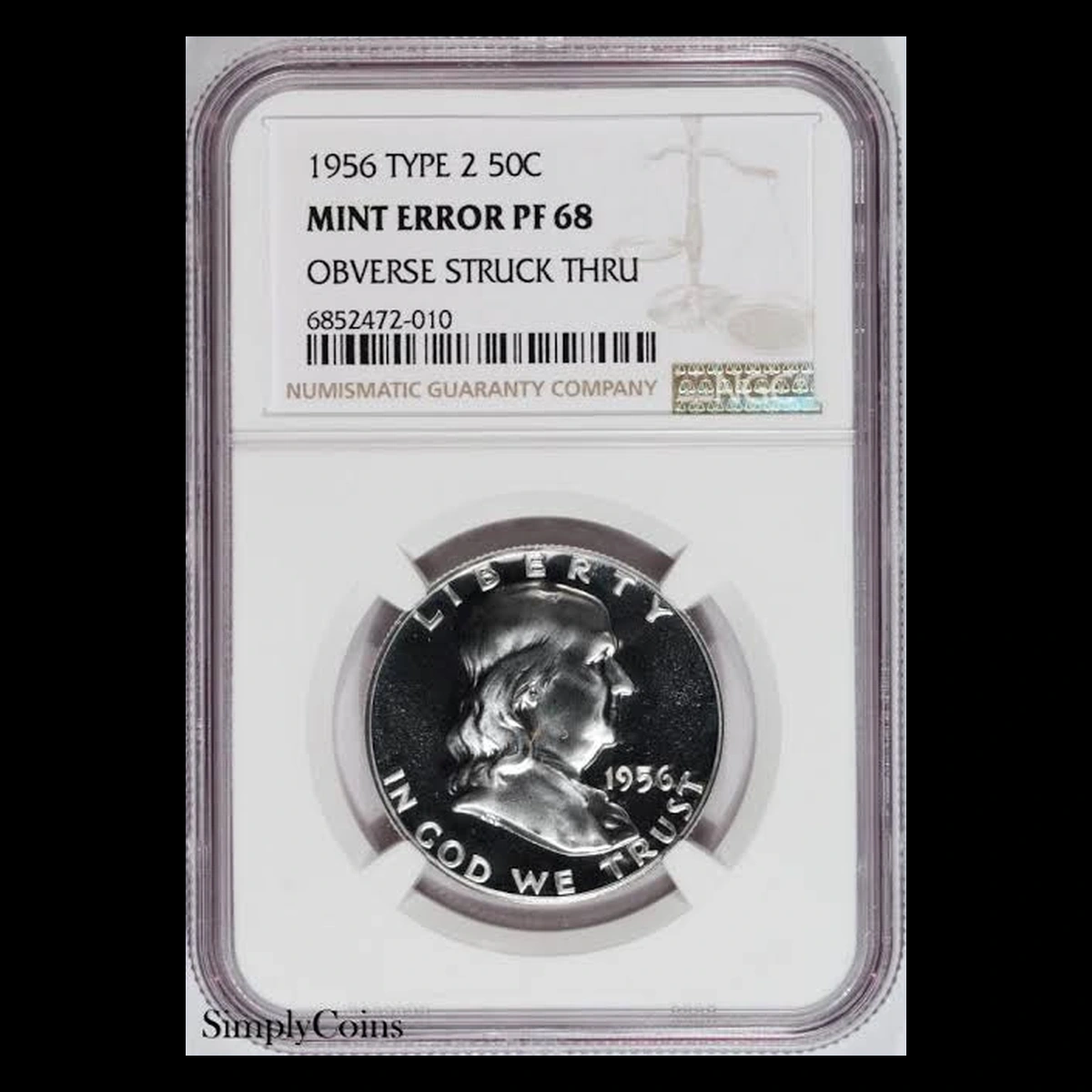
A 1956 Type 2 proof was cataloged as obverse struck through and graded NGC PF67 Cameo. The material was not identified, so a separate report of a thread-shaped mark cannot establish what obstructed this particular coin.
How to Identify
Find the affected front area in the auction photographs, then follow its boundary with the normal design. Look for detail that failed to form rather than lines freshly scraped across an already finished surface.
Change the viewing light without wiping the coin. Proofs have reflective areas that can reveal scratches or produce misleading reflections.
Cameo refers to frosted designs contrasting with reflective fields, and PF67 describes high preservation. Neither label by itself explains a depression or identifies thread, grease, or wire.
What It’s Worth
An attractive Type 2 proof with a visible genuine strike-through has an estimated $150–$750 range. Its proof quality and the visibility of the error both contribute.
The PF67 Cameo example sold in May 2015, but its final price is not publicly shown in the supplied material. The estimate is not a substitute for that hidden result and does not automatically apply to an ordinary strike with a small line.
5. 1956 Half Dollar The Eagle Has a Different Feather Pattern: Proof-Style Reverse on a Business Strike Error
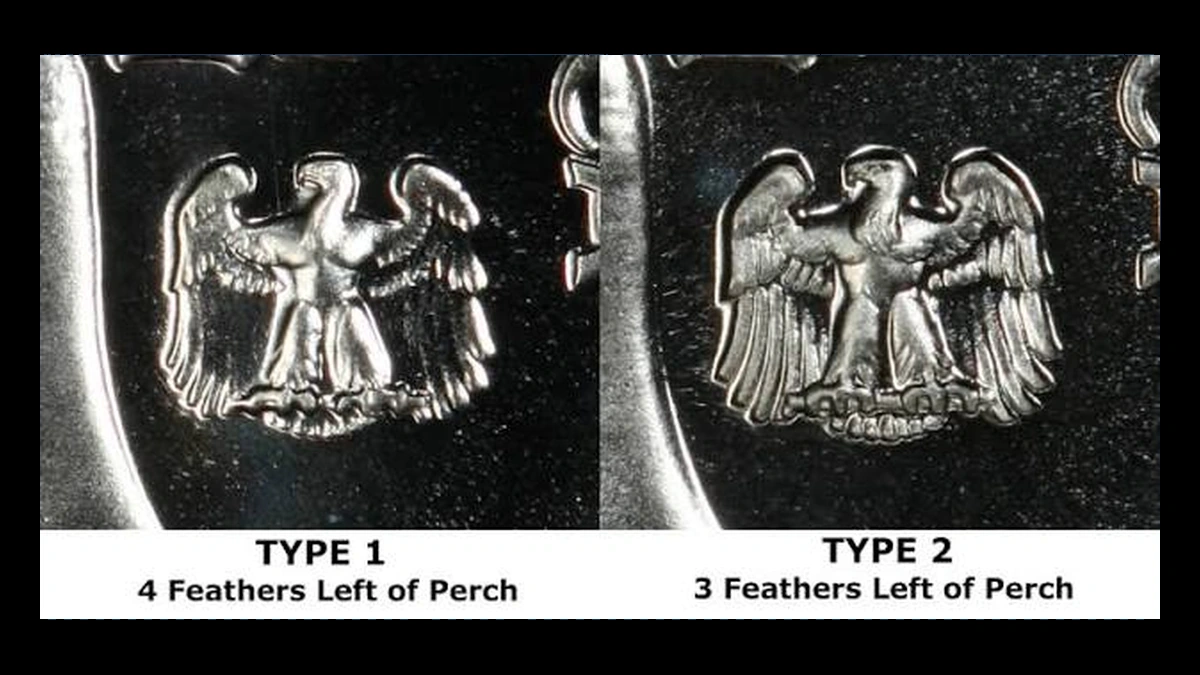
Before searching for doubled feathers, identify which eagle design is present. Type 1 and Type 2 are intended designs, not two strikes superimposed on one coin.
Type 1 is normally associated with business strikes made for ordinary use, while Type 2 is normally associated with collector proofs. Error-Ref reports a small number of ordinary 1956 strikes carrying the Type 2 reverse.
How to Identify
Establish the production finish from the whole coin before judging the pairing. Cleaning can make a business strike shiny, and toning can obscure a proof’s reflective appearance.
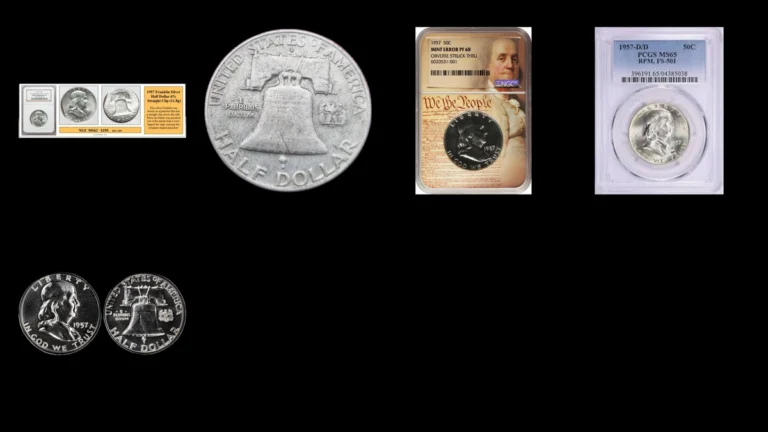
In the illustrated reverse comparison, Type 2 shows three feather tips left of the perch and four on the other side. Type 1 shows four and five in the corresponding areas.
The unusual combination requires both a Type 2 eagle and a confirmed business strike. A normal Type 2 proof has the expected design and is not this mismatch.
What It’s Worth
An identified Type 2 reverse on a business strike has an estimated $75–$600 value in lower to middle unworn grades. This is a working estimate built from normal 1956 values and an allowance for the reported pairing.
No completed sale of the particular combination is supplied. Without confirmation of the ordinary-strike finish, the feather pattern alone does not justify this premium.
6. 1956 Half Dollar Front Letters Carry Extra Shapes: Doubled Die Obverse Error
With finish established, inspect the date, LIBERTY, and IN GOD WE TRUST for repeated or unusually thickened design elements. A doubled die contains these features in the steel tool before it strikes the coin.
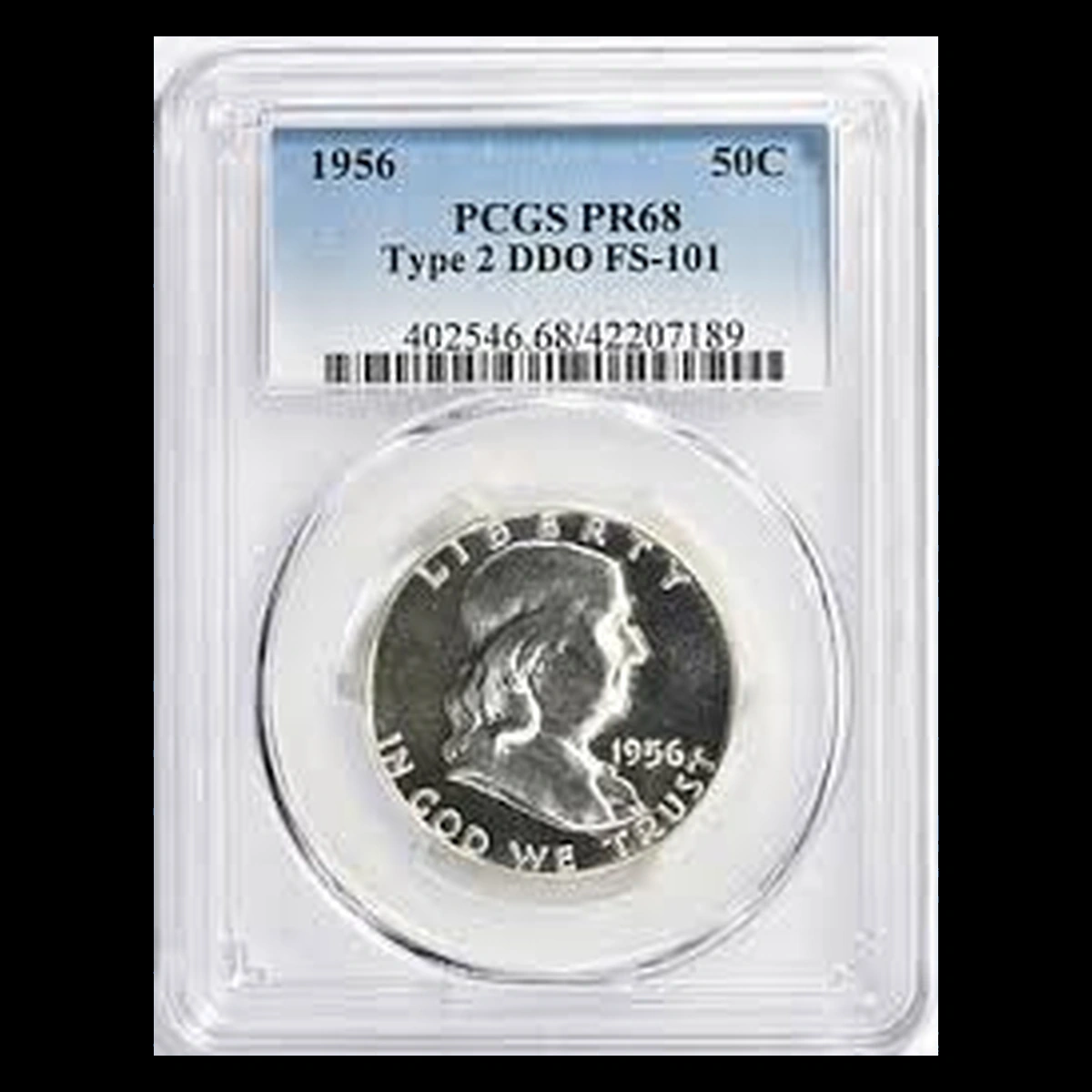
Wexler lists several 1956 obverse varieties on business strikes and proofs. One can show inward spreading and separation, while another chiefly shows thickening, so there is no single combined pattern that every example must display.
How to Identify
Select the same finish and compare several marked areas against one entry in Wexler’s catalog. Follow the actual contours of the letters rather than accepting their apparent heaviness.
A low, flat shelf produced by movement during striking is different from a documented doubled-die pattern. Rotate the light to rule out a bright reflection that only resembles another edge.
Keep variety identity separate from proof quality. Cameo contrast may change value but does not establish the doubling.
What It’s Worth
Modest identified business-strike varieties are estimated at $50–$200, with comparable proof varieties at $100–$900. Grade and surface contrast account for part of the spread.
The supplied year guide estimates a Type 2 doubled-obverse PR67 Cameo around $315–$375 and reports higher values for superior grades. That figure is a guide estimate for a specific combination, not a universal price for thick lettering.
7. 1956 Half Dollar The Back Shows Repeated Lettering: Proof Doubled Die Reverse Error
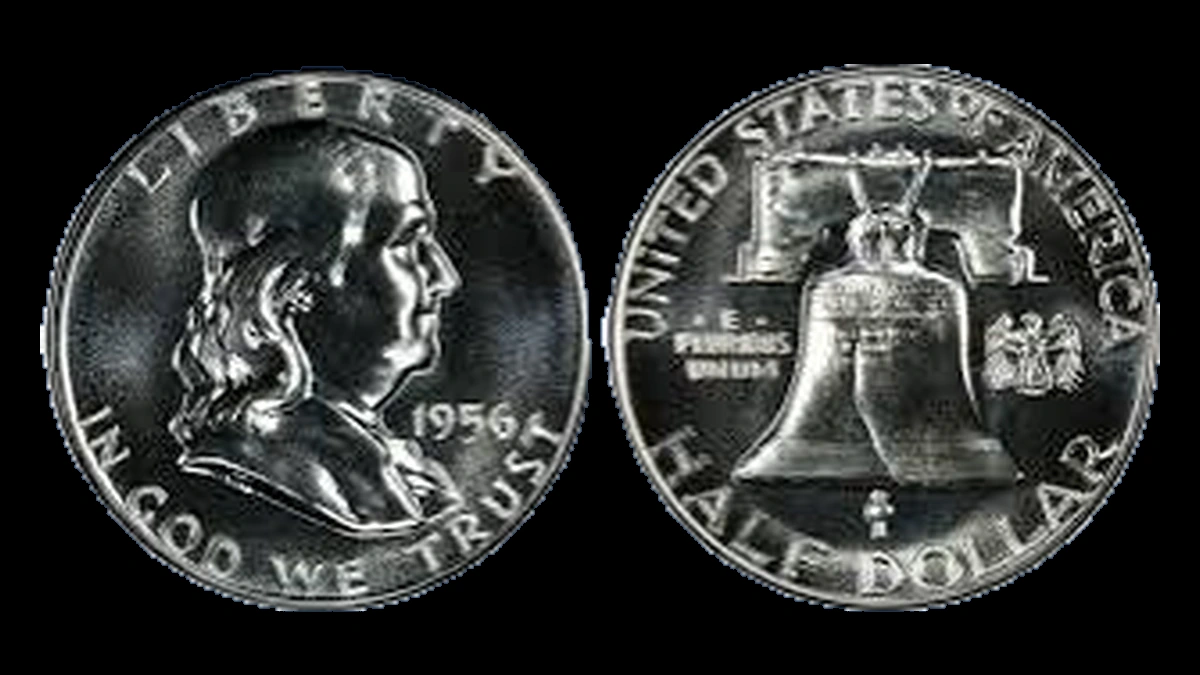
Reverse doubling needs its own match even if the front has already been identified. Documented proofs can show extra outlines in lettering, the eagle, or the lower bell area, and some have doubling on both sides.
More than two outlines can occur on some varieties. The common cause is repeated detail in the die, not repeated blows delivered to each finished coin.
How to Identify
First choose Type 1 or Type 2, then examine UNITED STATES OF AMERICA, HALF DOLLAR, and E PLURIBUS UNUM. Use the same documented die when extending the comparison to bell or eagle details.
Do not assemble a diagnosis from the strongest marks on several different examples. Normal differences in feather count also must not be counted as doubled feathers.
Use changing light to separate repeated raised contours from reflections and flat strike-related shelves. A complete reverse photograph helps preserve the relationship between the diagnostic areas.
What It’s Worth
The discussed proof reverse varieties have estimated values of $50–$1,000. Their specific patterns, grades, and Cameo contrast can produce quite different prices.
The year guide reports November 2025 sales of $65 and $216 for two different PR67 reverse varieties. Those guide-reported results show why a shared numerical grade does not make distinct varieties interchangeable.
8. 1956 Half Dollar A Toothlike Projection Appears at the Mouth: Bugs Bunny and Other Die Clashes Error
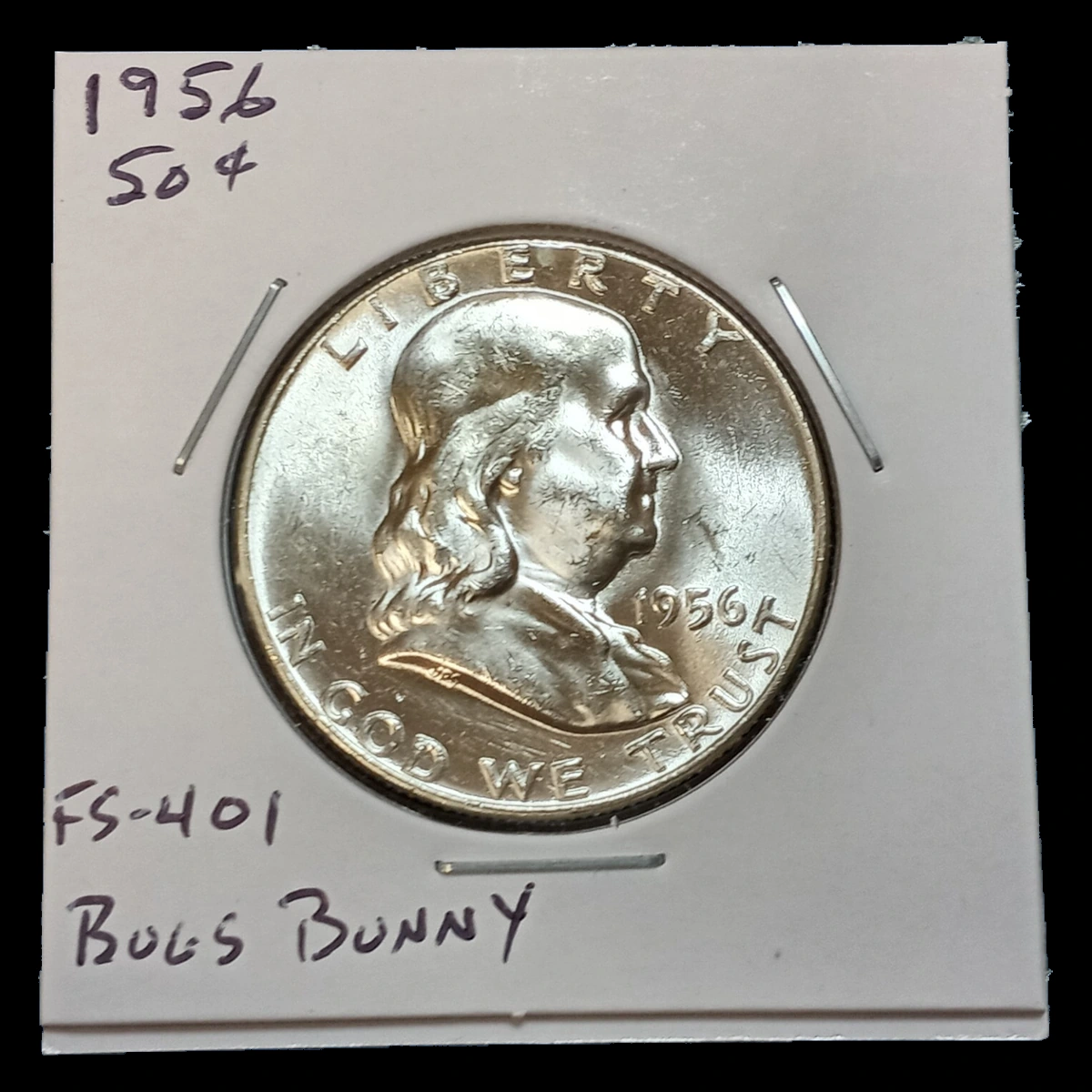
A small projection below Franklin’s upper lip can be the Bugs Bunny clash. When the dies meet without a blank between them, the eagle can mark the obverse die and leave an unwanted trace on later coins.
The supplied material also describes a separate nose-area clash. It is not an additional mark required to identify every Bugs Bunny coin.
How to Identify
Inspect the raised mouth projection and compare its shape with a known 1956 example. Check for adjacent cuts or displaced metal that might instead explain it as damage.
A suspected nose trace needs a separate comparison with the opposing design. Finding the familiar mouth feature does not authenticate an unrelated line elsewhere on the face.
Examine the bell independently for Full Bell Lines, or FBL. That designation concerns the clarity of the bell’s lines and affects condition comparisons rather than proving a clash.
What It’s Worth
Ordinary unworn Bugs Bunny examples have an estimated $45–$200 range, while superior FBL pieces are estimated at $200–$1,000. A separate nose clash should not automatically inherit those higher mouth-variety prices.
Reported eBay results for NGC MS64 examples include $48.52 in September 2026 and $68 in July 2026. The guide also reports $989 for an MS66 FBL in March 2022, a substantially different condition comparison.
Conclusion
A useful 1956 inspection keeps size, surface formation, finish, and design variety as separate questions. The quarter-planchet coin needs physical evidence, while the unusual Type 2 pairing depends on proving the coin is a business strike.
Match doubled details to one documented die, preserve any loose metal, and distinguish recorded sales from estimates or hidden results. Those steps help connect a coin’s actual features with an appropriate price range.