Rare 1975 Nickel Errors (List & Pictures)
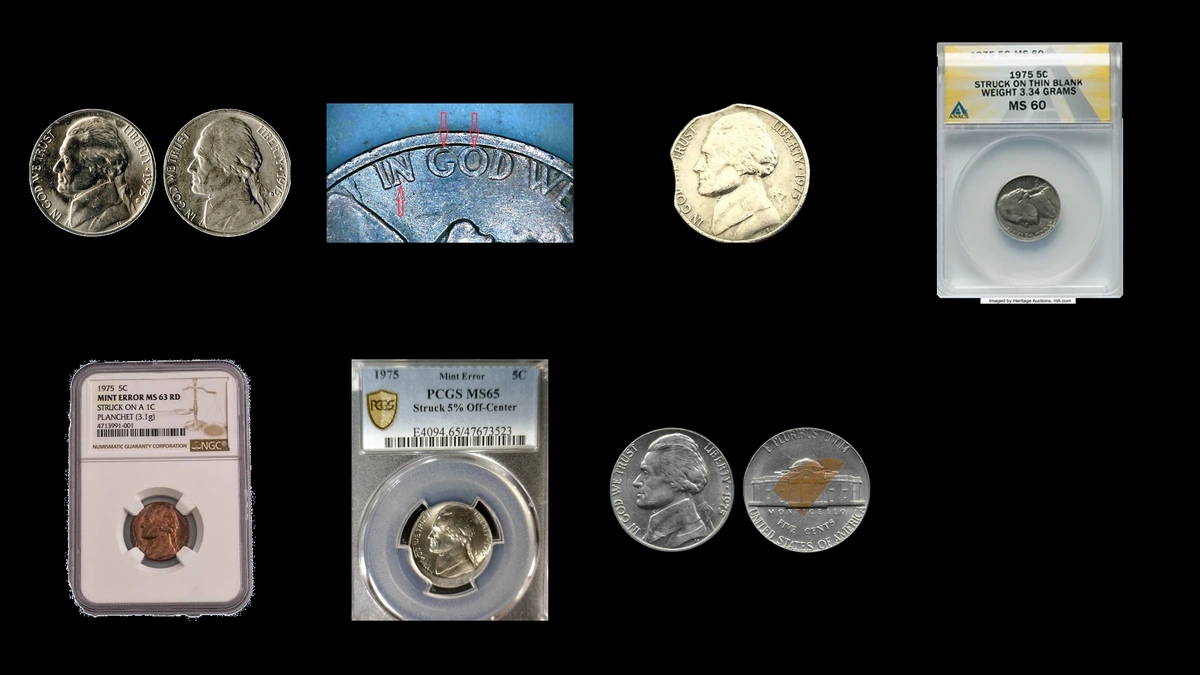
One valuable 1975 nickel has an unusually high D; another has too little room for the full date because it was struck on a foreign blank. The latter, attributed to 1975-S, sold for $1,955 in September 2010.
These 1975 nickel errors have supplied estimates of $10–$3,000. Start with mintmark placement, then compare the disc, surface, and overlapping designs to separate small variety features from unusual striking accidents.
1. 1975 Nickel The Whole D Sits Too High: Misplaced Mintmark Error
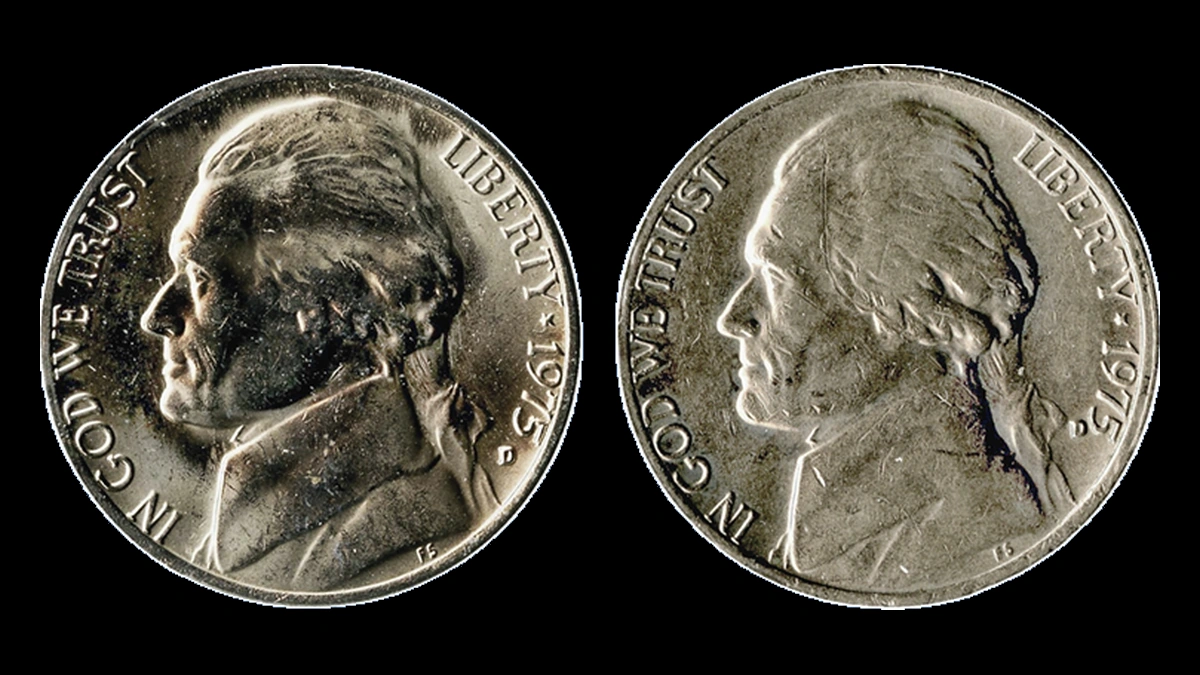
The recognized High D sits between the back of Jefferson’s head and the final date digit. The error concerns the placement of the entire mintmark in the die, rather than a second outline beside it.
An example from the Fred Weinberg Collection was graded NGC XF40, indicating wear, and attributed as a high misplaced mintmark. Its position is the feature to match.
How to Identify
Place an ordinary 1975-D beside the candidate with both portraits upright. Compare the D’s relationship to Jefferson’s head and the final 5, keeping the full date area visible.
Inspect the base of the letter and the surrounding surface for added metal or alteration. Normal small placement differences should not be assigned to the scarce High D without a precise match.
A normal 1975 nickel weighs about 5 grams, measures 21.2 millimeters, and has a plain edge. These general checks help describe a loose coin, but they do not authenticate mintmark placement.
What It’s Worth
$250–$1,200 for authenticated worn examples and $1,200–$2,000 for especially attractive pieces are the supplied estimates. The NGC XF40 High D realized $1,080 in May 2022.
That amount belongs to the recognized misplaced position. It is not a premium for every D that looks a little higher in a tilted photograph.
2. 1975 Nickel Another Curve Appears Beside D: Reported Repunched Mintmark Error
A repunched mintmark changes the letter’s outline rather than merely its location. In this period, a shifted second application of the mintmark punch could leave overlapping shapes in a working die.
The supplied 1975-D report does not establish a particular numbered variety. A filled center or a thick D alone does not demonstrate a repeated punch.
How to Identify
Look for an additional curved letter form around the main D and compare it with a documented nickel example. Keep any metal filling the center separate from the proposed outer impression.
Change the light to rule out shadows and reflections. A flat shelf caused by movement during striking does not establish a repunched mintmark.
What It’s Worth
$10–$50 for worn examples and $50–$150 for attractive unworn coins are working estimates for authenticated minor repunching. No specific 1975-D auction result accompanies the report.
The extra curve must be identifiable as a repeated mintmark. Neither a filled D nor ordinary strike doubling automatically receives the same premium.
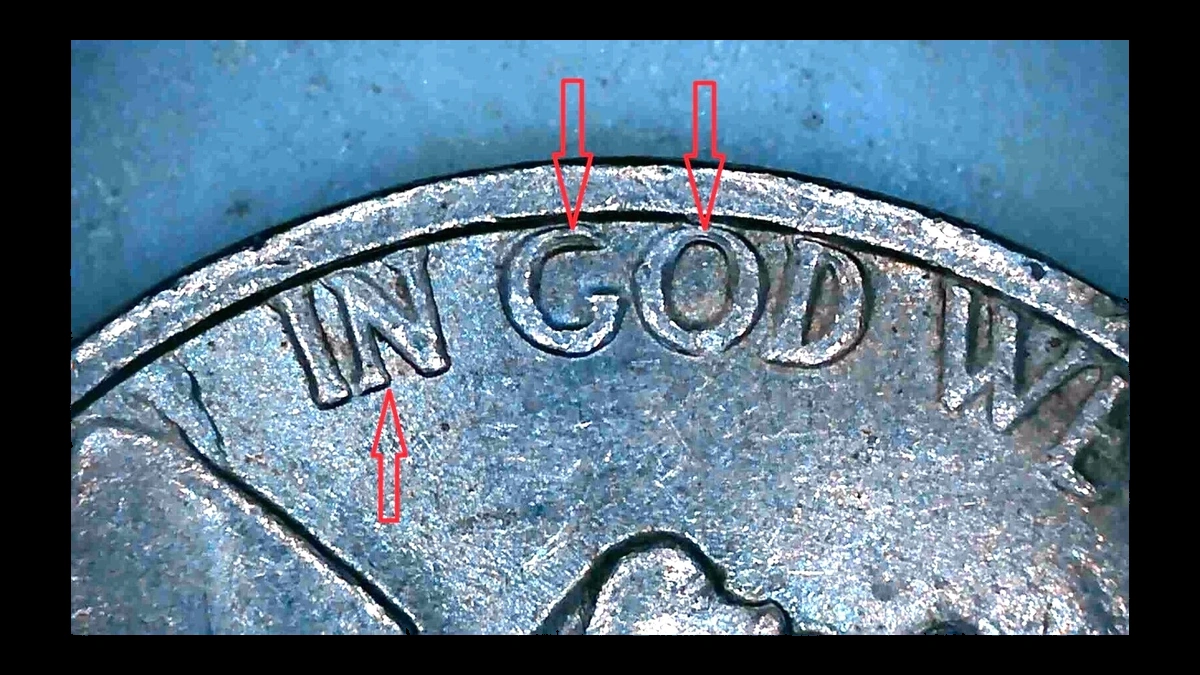
3. 1975 Nickel Repeated Corners and Curves in the Lettering: Doubled Die Error
Front and reverse doubling are both reported for 1975 nickels. These are separate patterns to investigate, not evidence that any one coin necessarily has doubling on both faces.
A doubled die carries the repeated design before it strikes a coin. Movement during striking can create a different effect: flat ledges beside otherwise normal lettering.
How to Identify
Compare several letter corners and curves under steady magnification. Consistent rounded separation or split corners provides more useful evidence than one bright edge visible at a single angle.
Photograph nearby normal letters as well as the unusual ones. A front-doubling comparison should match the front report, and a reverse comparison must be established independently.
What It’s Worth
$20–$75 for modest verified doubling and $75–$250 for stronger examples with little wear are the estimates. They are not realized prices for a named 1975 die variety.
Flat strike doubling and damaged wide letters should not be priced as a doubled die. The repeated design needs to remain convincing beyond an extreme enlargement.
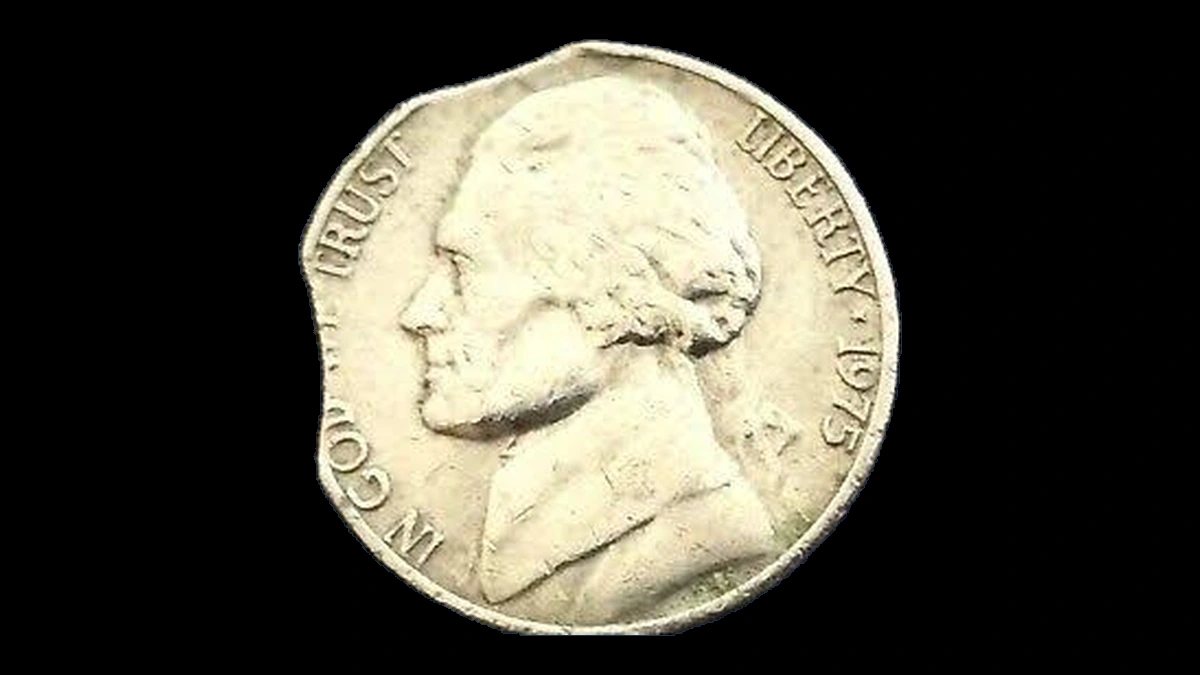
4. 1975 Nickel Two Gaps Accompany an Unfinished Cut: Clipped Planchet Error
The recorded combination has two curved sections missing from the edge and an incomplete cutting trace in the remaining metal. The blanking punch overlapped earlier openings and left another cut unfinished before the disc was struck.
Because that last cut did not pass completely through, some metal remains attached. It should not be confused with a crack produced by bending a finished nickel.
How to Identify
Follow each missing curve and the retained cutting trace separately, noting how the design meets them. Saw marks or filing at an opening suggest later removal rather than an incomplete original blank.
Leave the unfinished cut closed and never flex the coin to test it. Opposite-rim weakness can support a clip attribution, but its absence is not enough to reject an otherwise genuine example.
What It’s Worth
$50–$150 for worn combinations and $150–$400 for clearer, attractive examples are the supplied ranges. The NGC MS62 1975 double-curved and incomplete-clip combination sold for $288 in October 2019.
The attached metal helps explain the error. Breaking it away would change the coin and destroy part of that evidence.
5. 1975 Nickel Normal-Looking Width but Too Little Metal: Thin Planchet Error
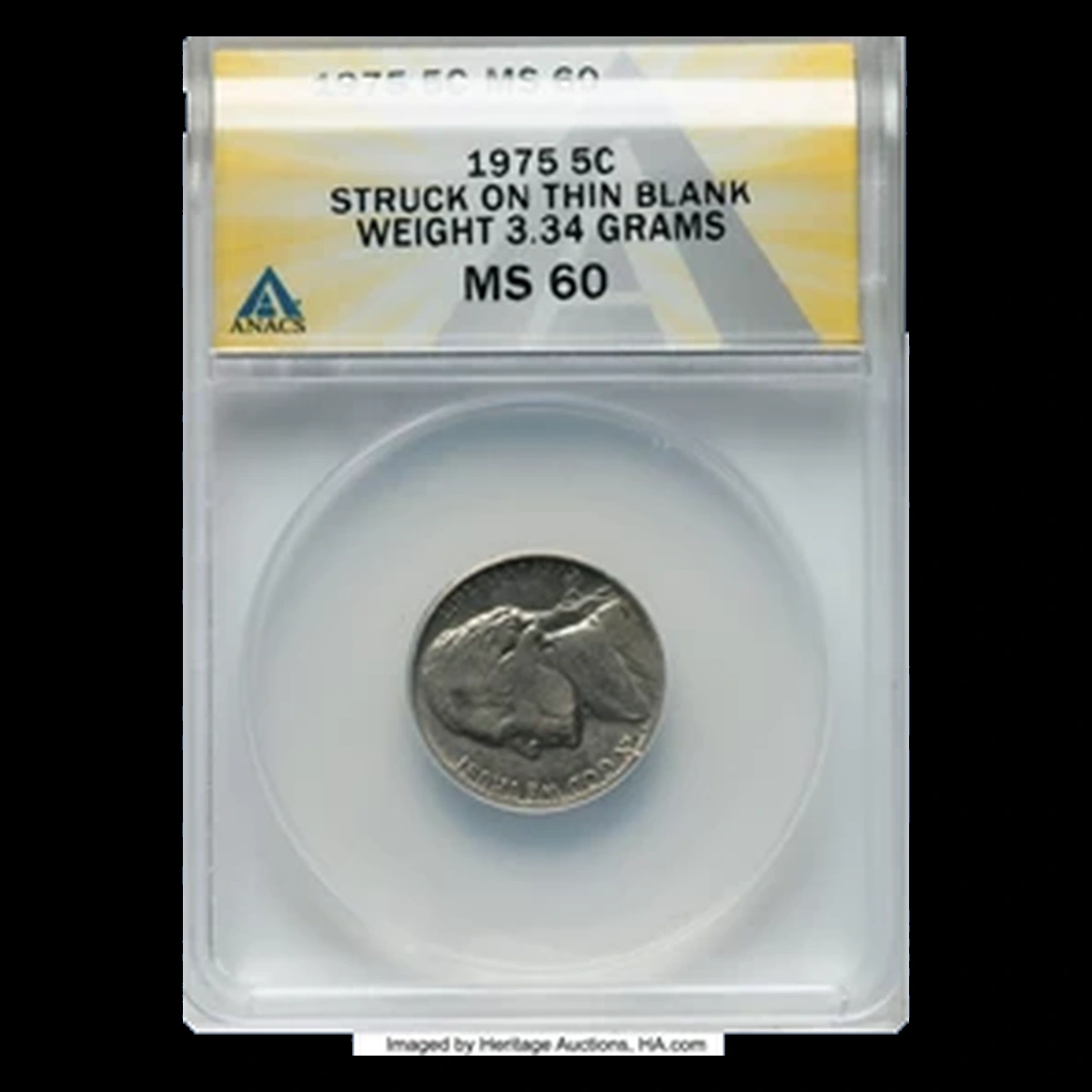
An unusually light nickel may have started on a blank that was too thin rather than too small. A supplied auction summary records a 1975 example weighing 3.34 grams.
The reduced metal can affect how fully the design forms. Its weight does not, by itself, identify a foreign blank or another denomination.
How to Identify
Confirm the weight on a reliable scale and compare the diameter and thickness with an ordinary nickel. A small wrong blank and a thin nickel blank can both weigh less than normal.
Inspect both faces and the edge for grinding, heavy scraping, or porous chemical damage. Original surfaces must support the thin-blank explanation, since wear or later metal removal can also reduce weight.
What It’s Worth
$75–$200 for worn authenticated examples and $200–$500 for attractive pieces with convincing original surfaces are the estimates. No sale amount is supplied for the 3.34-gram 1975 specimen.
A 1987-D nickel on a rolled-thin blank weighing 3.7 grams sold for $73 in September 2024. That different-year result shows why low weight alone is not a guarantee of a high price.
6. 1975 Nickel A Small Disc Cannot Hold the Nickel Design: Wrong Planchet Error
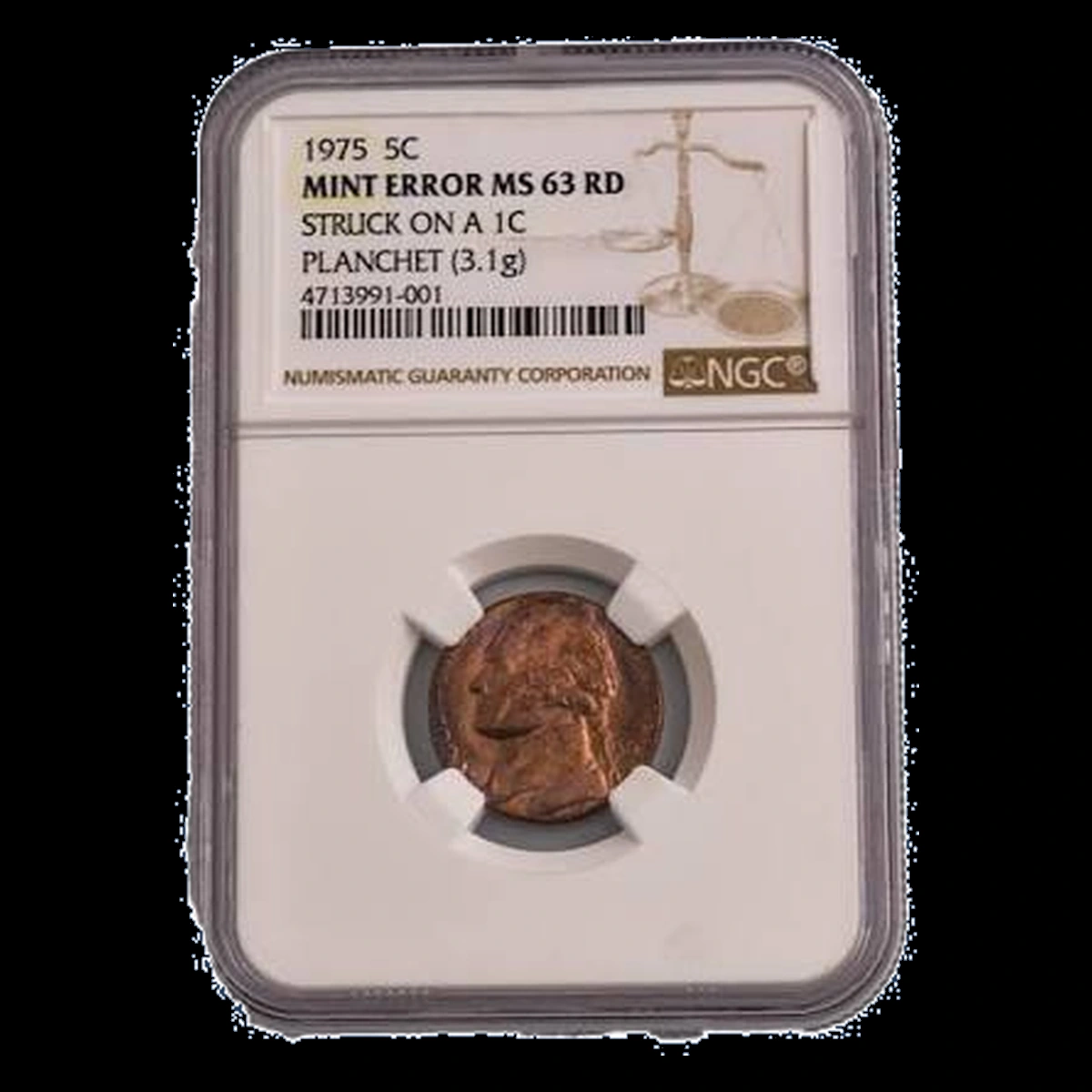
Wrong-planchet examples include a Denver nickel on a 3.1-gram copper cent blank and another on a 2.3-gram layered dime blank. Both began with less room for the nickel design than a normal blank provides.
A separate Proof, with specially prepared collector surfaces, is attributed to 1975-S on a Liberian ten-cent blank weighing 1.91 grams. Much of its date is missing, so the year and mint depend on the auction attribution rather than complete visible numerals.
How to Identify
Keep the three actual weights separate and compare composition as well as size. The contemporary cent used the older copper alloy, while a dime has bonded layers; neither should be explained as a modern zinc cent.
| Recorded blank | Reported weight | Identification limit |
|---|---|---|
| Denver cent-planchet example | 3.1 grams | Older copper cent metal |
| Denver dime-planchet example | 2.3 grams | Layered dime metal |
| Attributed Liberian Proof | 1.91 grams | Year and mint rely on specialist attribution |
Cent and dime blanks begin at about 19.05 and 17.9 millimeters respectively, although striking can spread them. Examine the cropped design and edge for plating, filing, or chemical alteration, and preserve a Proof’s original mirrored surfaces.
What It’s Worth
$200–$1,000 for cent- or dime-planchet errors and $800–$2,500 for the attributed Liberian Proof type are the estimates. The NGC PR66 Cameo Liberian example brought $1,955 in September 2010, while a later attributed example realized $1,140 in July 2021.
The Denver dime-planchet coin appeared in a five-coin sale. Its individual price cannot be established from that group total.
7. 1975 Nickel Older Lincoln Details Cross the Nickel Design: Double Denomination Error
A struck cent entering the nickel press retains clues that an unused blank cannot provide. One supplied example is specifically attributed as a 1975 nickel over a 1975 cent.
On a separate coin, Memorial columns cross Jefferson’s cheek and part of Lincoln’s coat crosses E PLURIBUS. The older date on that specimen is indistinct and must not be supplied from the nickel date.
How to Identify
Locate recognizable cent details and follow where the later nickel impression crosses them. The underlying design should belong to the struck metal rather than a backward impression made by squeezing finished coins together.
Inspect the edge for a seam or attached pieces, and compare the metal with the contemporary cent’s normal 3.11-gram starting weight. Exact surviving columns and coat details belong to the described specimen, not every overstrike.
What It’s Worth
$400–$1,000 for worn or less distinct examples and $1,000–$3,000 for attractive coins with easily read overlapping designs are the estimates. The NGC MS64 Brown 1975-over-1975 example sold for $900 in August 2022.
A separate PCGS MS64 Brown coin with an indistinct earlier date realized $516 in September 2019. Their identical numerical grades did not produce identical prices, and unworn condition alone does not ensure the higher estimated range.
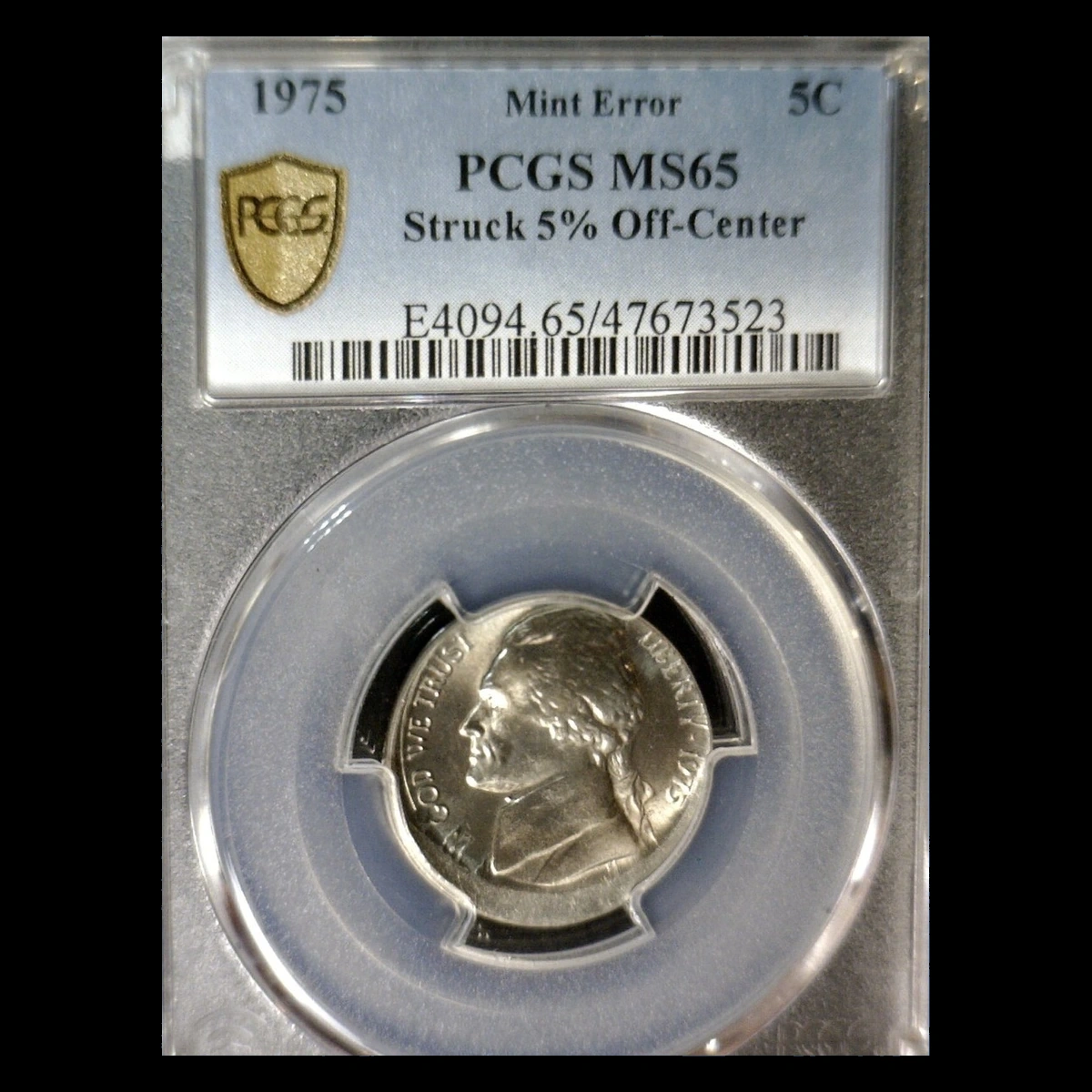
8. 1975 Nickel Solid Blank Metal Lies Beside a Shifted Design: Off-Center Strike Error
An off-center nickel keeps the metal of its blank but misses part of the design. The blank entered the press in the wrong position, leaving an unused area opposite the cut-off impression.
How to Identify
Include the date and the whole outline in photographs, then compare both faces using a fixed edge reference. A shift on only one face may instead reflect a misaligned die.
The bare area should retain original surface rather than grinding marks or flattened remnants of letters. A genuine off-center strike also differs from a clip, where part of the disc itself is absent.
What It’s Worth
$25–$150 for modest shifts and $150–$750 for dramatic dated examples are the supplied estimates. A 1999-D struck 65% off center sold for $75 in September 2024.
That different-year comparison shows that a large blank crescent alone need not reach the higher range. Readable identification and surface quality remain important.
9. 1975 Nickel A Later Impression Crosses an Earlier One: Double Strike Error
A coin left in the press can move between blows and receive a second impression across the first. The documented 1975-D also has counting-wheel damage, which occurred after striking.
How to Identify
Find two recognizable design positions and follow where the later one overlaps or flattens the earlier detail. A narrow shelf beside one letter does not establish a second complete strike.
Inspect both faces for the sequence and distinguish raised design from scraped paths. Counting-wheel damage does not count as another minting event, while unusual width can result from repeated striking without a wrong metal blank.
What It’s Worth
$100–$400 for worn or damaged double strikes and $400–$1,500 for attractive, distinct overlapping impressions are the estimates. A different-year 1987-P graded NGC AU58 sold for $159 in March 2025.
No individual realized price is supplied for the damaged 1975-D. Its later scraping needs to remain part of any condition comparison.
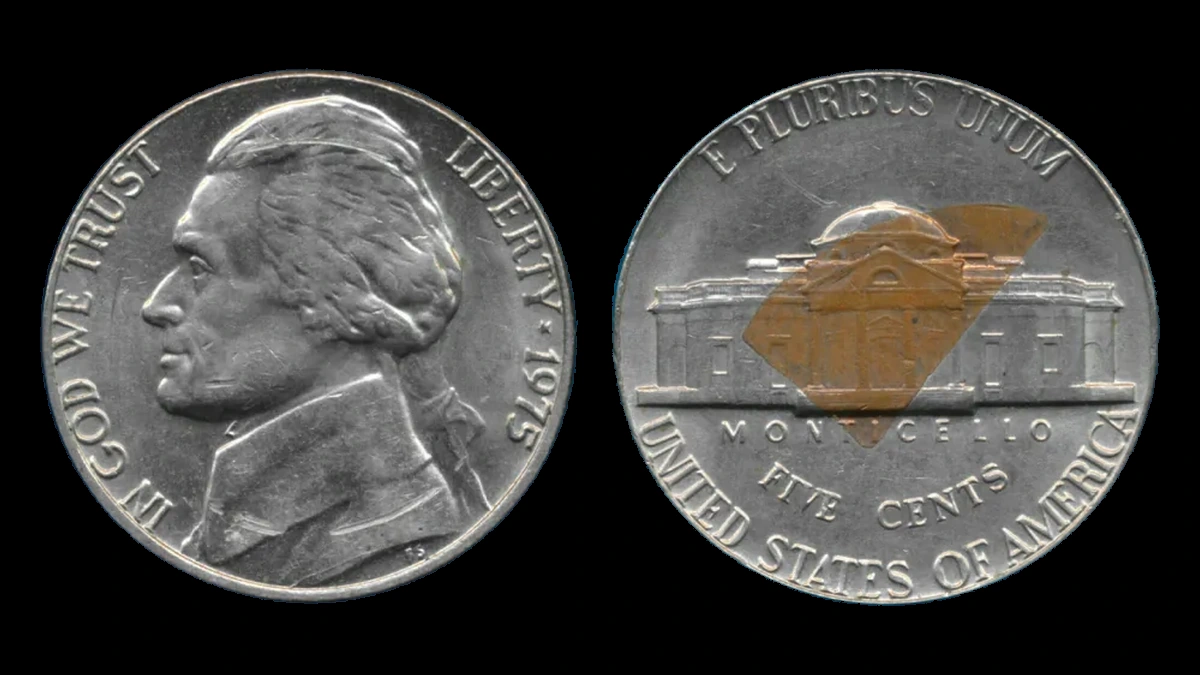
10. 1975 Nickel A Separate Copper Piece Remains on the Reverse: Attached Fragment Error
The cataloged 1975 nickel has a copper fragment on its reverse and damage on its front. NGC assigned AU Details, indicating light wear together with a condition problem.
The important initial distinction is actual attached material versus a color change. A normal nickel has a uniform copper-nickel alloy, not a copper core covered by removable outer layers.
How to Identify
Use low light to examine whether the copper-colored area has a separate physical boundary. Do not pry at it or assume that an opposite dent explains how the fragment became attached.
Photograph both faces and the edge before seeking an assessment of the metal and contact area. Removing the piece would change the object and could destroy evidence of its origin.
What It’s Worth
$100–$300 for authenticated pieces with wear or damage and $300–$600 for stronger examples with clearly original attachments are the estimates. The recorded coin with front damage sold for $228 in March 2023.
This comparison concerns a separate fragment, not a brown stain or plated surface. The condition of the opposite face remains relevant even though the unusual material is on the reverse.
Conclusion
A precise description is especially useful for 1975 nickels: a high D, a repunched D, and a filled D are different observations. Likewise, low weight can come from several causes that require the size, metal, and original surfaces to agree.
Keep unfinished cuts and attached fragments intact. When older cent details survive, photograph their relationship with the nickel design and record only the dates that can actually be established.