Rare 1977 Quarter Errors (List & Pictures)
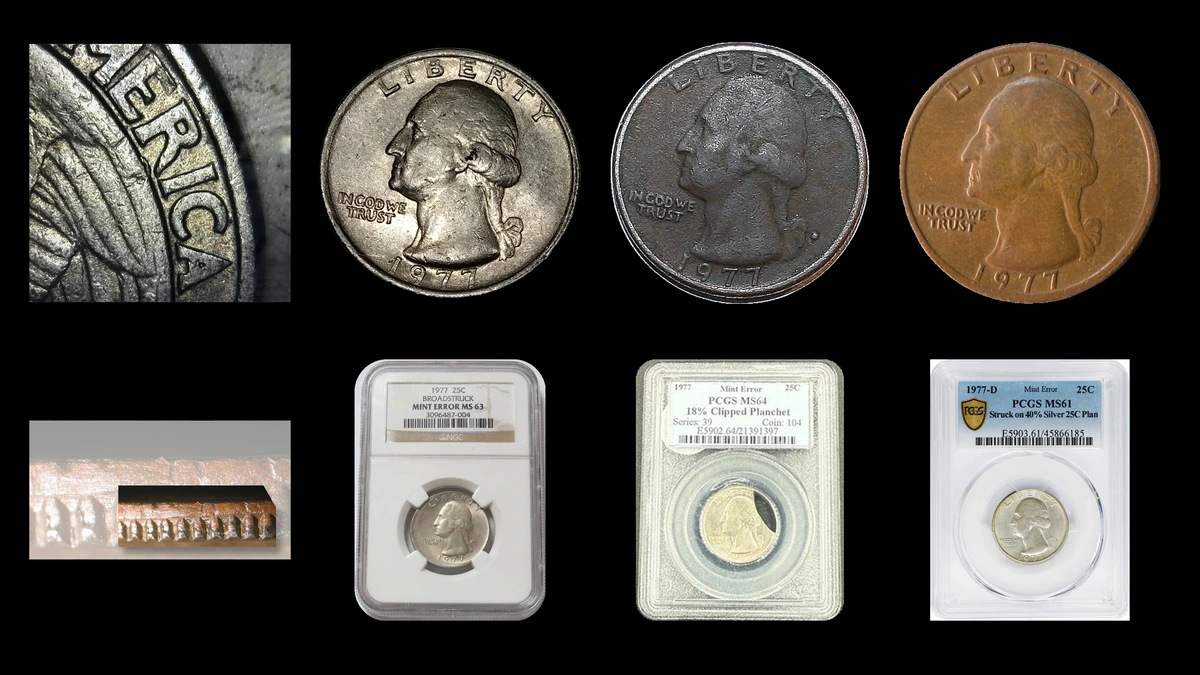
A copper-colored quarter, a silver-bearing quarter, and a quarter carrying old nickel details need different explanations. Color and size alone cannot sort every 1977 quarter error.
Estimated ranges span $5–$15,000. A 1977-D quarter on a 40%-silver blank sold for $4,935 in January 2016, despite wear and improper cleaning.
Start with small design clues, then follow the surface, edge, and underlying metal checks below. A Philadelphia quarter normally has no mint letter in 1977.
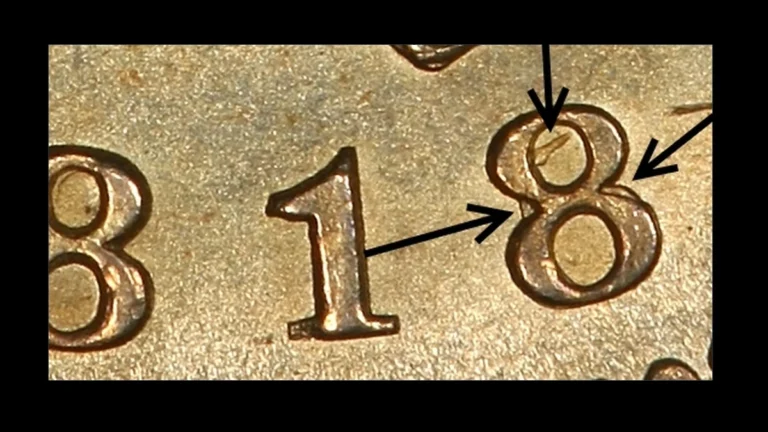
1. 1977 Quarter Extra Outlines in LIBERTY: Doubled Front Design Error
Minor front doubling is reported for Philadelphia and Denver quarters. Philadelphia descriptions emphasize LIBERTY, with subtler effects around the date and designer’s letters.
A doubled die carries repeated detail before it strikes the coin. The reports do not establish one exact cataloged pattern for every example.
How to Identify
Compare the corners and edges of LIBERTY with a normal coin of similar wear. Look for a fixed raised repeat rather than thickness alone.
A low flat shelf can come from movement during striking. Follow nearby details under changing light, keeping Philadelphia and Denver patterns separate.
What It’s Worth
$5–$300 is the estimate for a confirmed minor doubled-front variety. Recognizable separation on original surfaces supports stronger interest than a blurred letter edge.
A named variety needs an actual pattern match, not just a dramatic photograph.
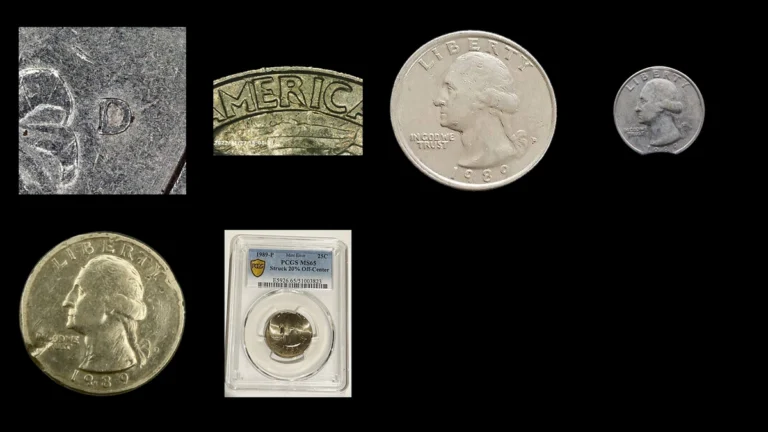
2. 1977 Quarter Part of Another D: Repunched Mintmark Error
The Denver year guide reports a repunched mintmark without a fixed direction or catalog number. An earlier punch impression would need to leave a recognizable part of another D.
Mintmarks were added to dies by hand. A repeated placement could create overlapping letter shapes that later coins copied.
How to Identify
Trace the straight stem and outside curve of the main D, then follow the suspected extra piece. It should fit an earlier letter rather than stop as a shapeless bump.
A filled center can come from a chipped die, while a flat ledge can result from striking movement. Dirt or metal pushed toward the letter by a hit does not establish repunching.
What It’s Worth
$5–$350 is the conditional estimate for an authenticated repunched-D variety. Clear remnants and undisturbed surfaces make a stronger example.
The report supplies no verified auction result for a specific 1977 pattern. An ordinary damaged or filled D should not receive this variety price.
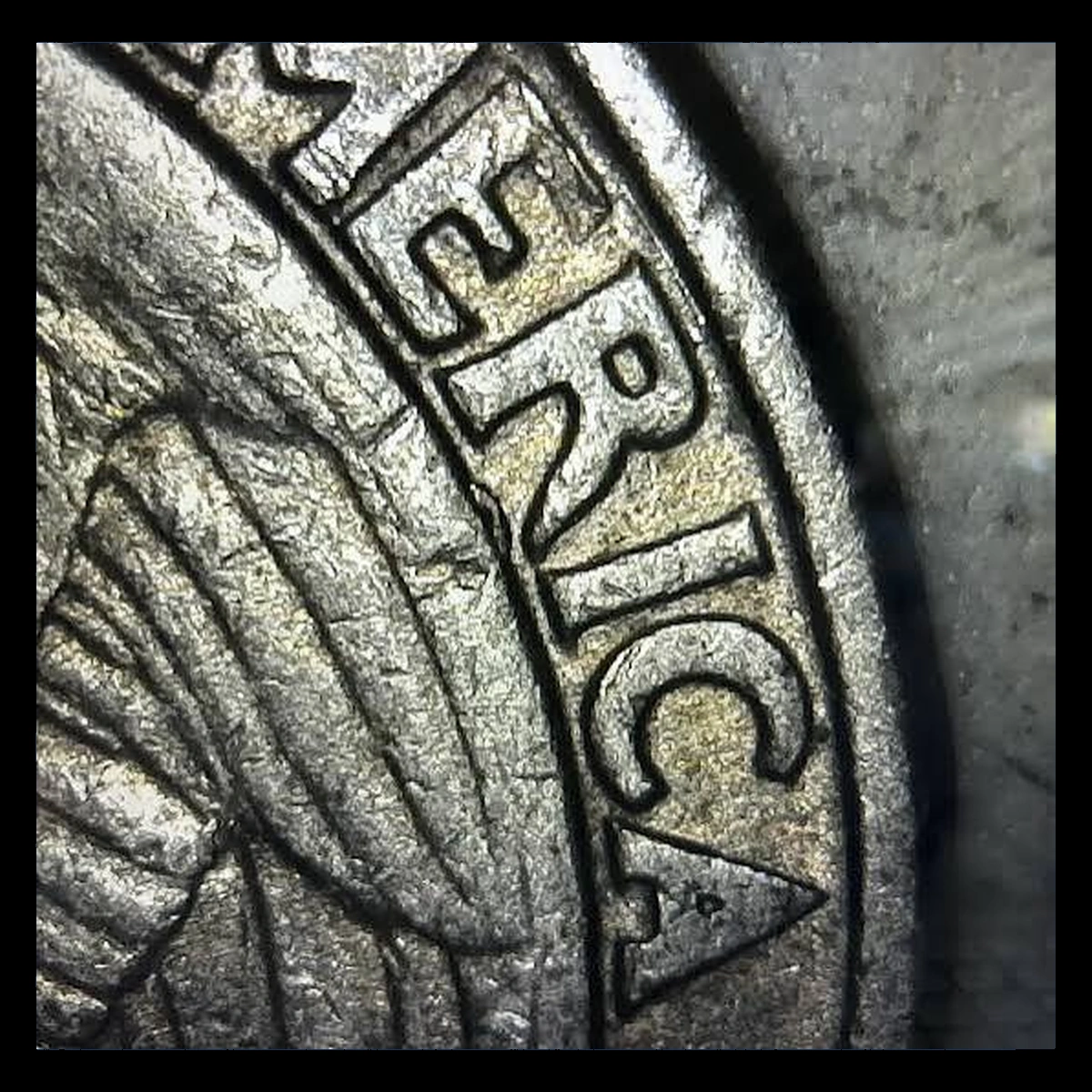
3. 1977 Quarter Raised Lines, a Filled D, or a Rim Blob: Die Breaks Error
Denver reports include thin cracks, a filled D, and a cataloged reverse cud called CU-25c-1977D-01R. A cud is a raised mass connected to the rim where part of the die broke away.
These are separate appearances of damaged tools. They should not be described as though every feature occurs on the same quarter.
How to Identify
For the reverse cud, match its outline and rim connection with the Washington quarter cud catalog. Do not guess its position from the catalog number.
For a filled D, inspect the opening for original raised metal without scraping it. A fine crack requires another check: it should rise above the surface rather than cut into it.
What It’s Worth
$5–$500 covers genuine small cracks, filled-letter die damage, and stronger rim breaks. The smallest features normally occupy the lower part of the range.
A clear cud replacing visible design generally has more appeal than a tiny line. The supplied catalog entry establishes a pattern, not a realized sale price.
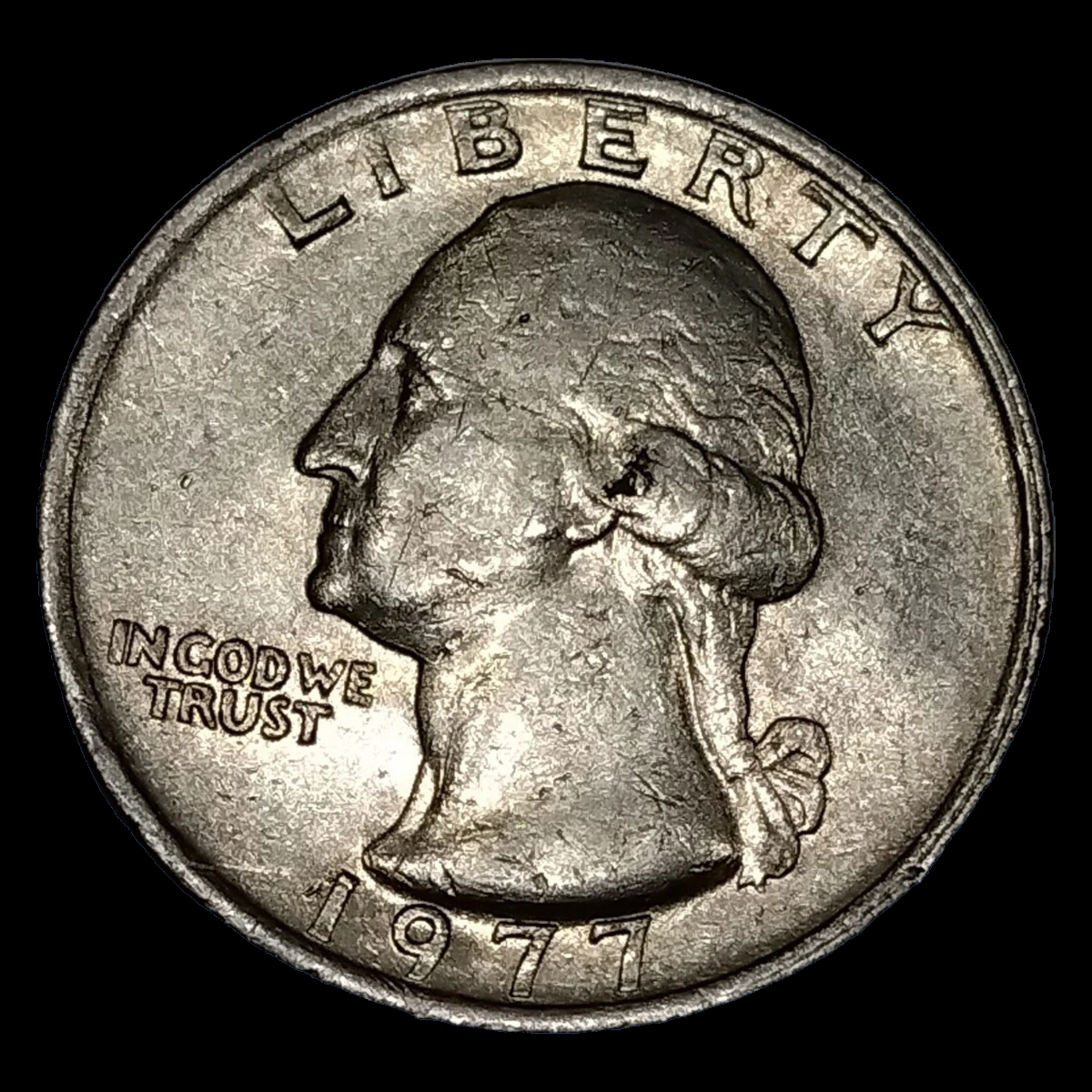
4. 1977 Quarter Only Washington Is Shifted: Misaligned Front Die Error
A documented Denver quarter has a front die shifted downward by 5%. Only half its date remains, and NGC graded the coin MS63.
This describes the position of one stamping tool. It differs from an off-center blank that produces corresponding displacement on both faces.
How to Identify
Compare the eagle side with the front, keeping the whole outline visible. Determine whether Washington alone has moved toward the lower edge.
Preserve the incomplete digits in photographs rather than filling them in. The grading record can support the year when part of the date is missing.
Check for filing or impact damage at the lower border. A shared unstruck crescent with both designs displaced instead points toward an off-center strike.
What It’s Worth
$5–$150 is the estimated range for genuine front-die misalignment. Losing part of the date makes a stronger display than a barely uneven rim.
The estimate depends on original struck features, not a normal coin with digits filed away.
5. 1977 Quarter An Unusual Surface Color: Improper Annealing Error
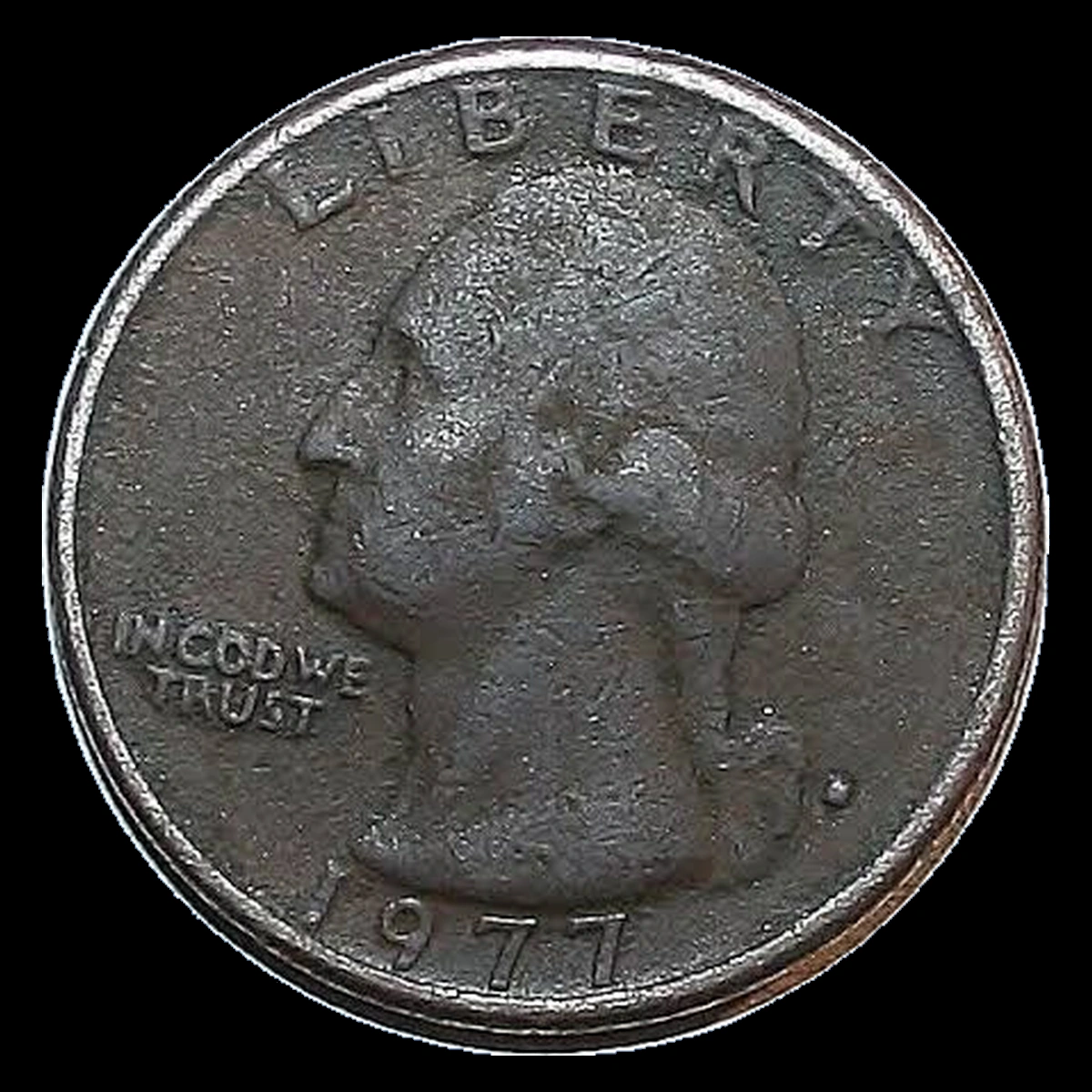
A Denver NGC MS63 quarter appears in an auction record as improperly annealed. Annealing is the heating treatment used to prepare metal for striking.
The record does not establish a single required color pattern. Dirt, environmental exposure, and later heating can also darken a quarter.
How to Identify
View the whole surface under neutral light, including protected spaces beside letters. Check for pitting, deposits, or roughness that may explain the color differently.
Compare the edge and both faces with a normal coin in the same light. Original shine can help the examination but does not prove a heating error by itself.
Leave the color intact for inspection. Cleaning it away may remove evidence of how it formed.
What It’s Worth
$20–$250 is the estimate for a confirmed 1977-D annealing error. A secondary auction index records the NGC MS63 example at $69 in December 2022.
Keep that attributed specimen and grade attached to the price. A dark ordinary quarter is not automatically the same error.
6. 1977 Quarter Washington Struck Directly on Copper: Missing Front Layer Error
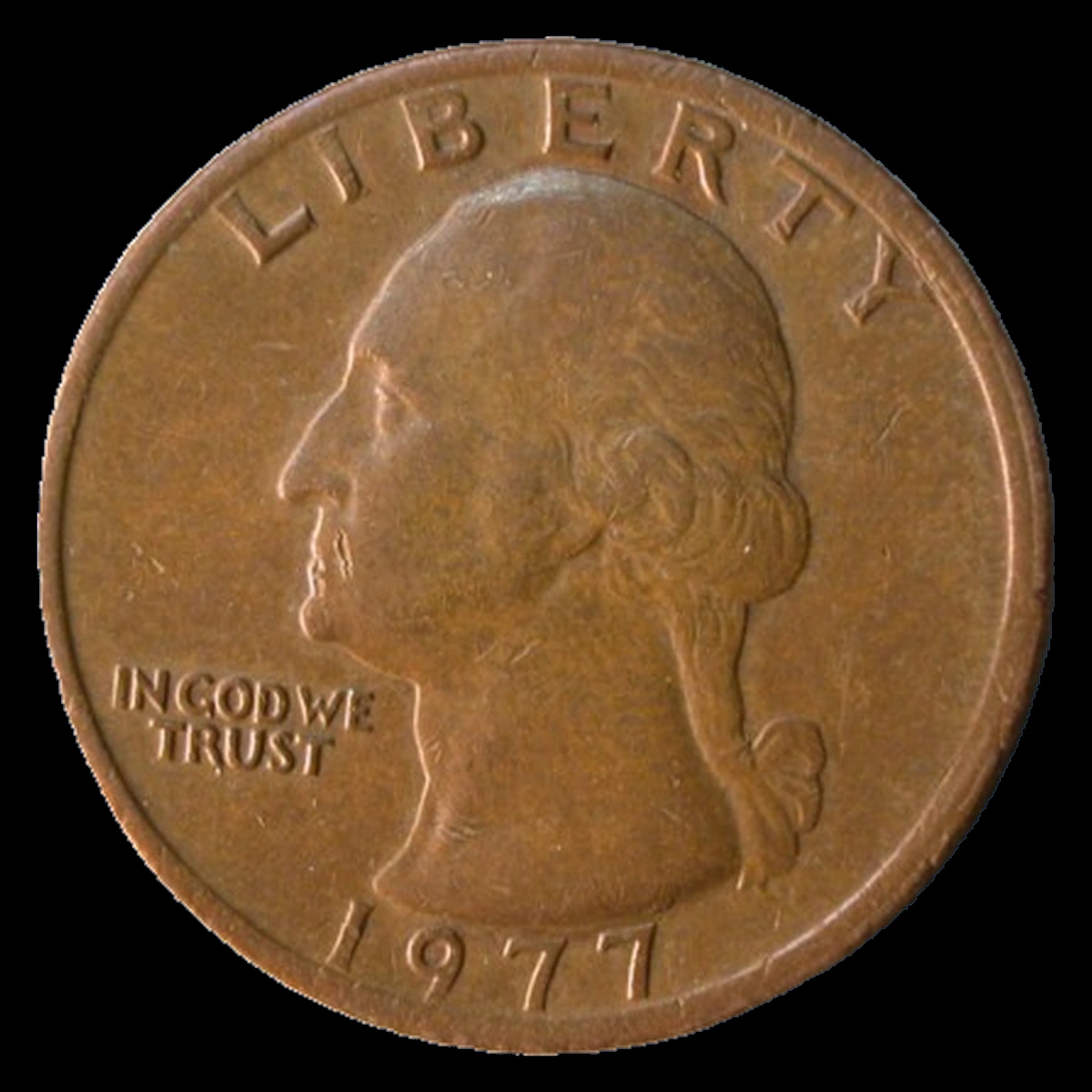
A documented Philadelphia quarter lost its front outer layer before striking. Washington’s design formed on the exposed copper, while the reverse retained its pale covering.
The coin weighs 4.70 grams, compared with about 5.67 grams for a normal clad quarter. Its unusual surface is more than a brown stain.
How to Identify
Examine how the portrait formed on the exposed metal, then compare the intact back and layered edge. A scrape through a finished portrait does not show the same production sequence.
The pre-strike missing-layer example supplies the surface comparison. Weight loss alone cannot establish whether the layer separated before striking or was removed later.
What It’s Worth
$50–$1,500 is the estimate for an authenticated pre-strike missing-front-layer quarter. A clear original portrait on copper is more informative than an unexplained colored patch.
Preservation and the visible missing-layer evidence determine the useful comparison. Chemical alteration or scraping must be distinguished from the genuine loss.
7. 1977 Quarter A Step That Changes around the Edge: Tilted Partial Collar Error
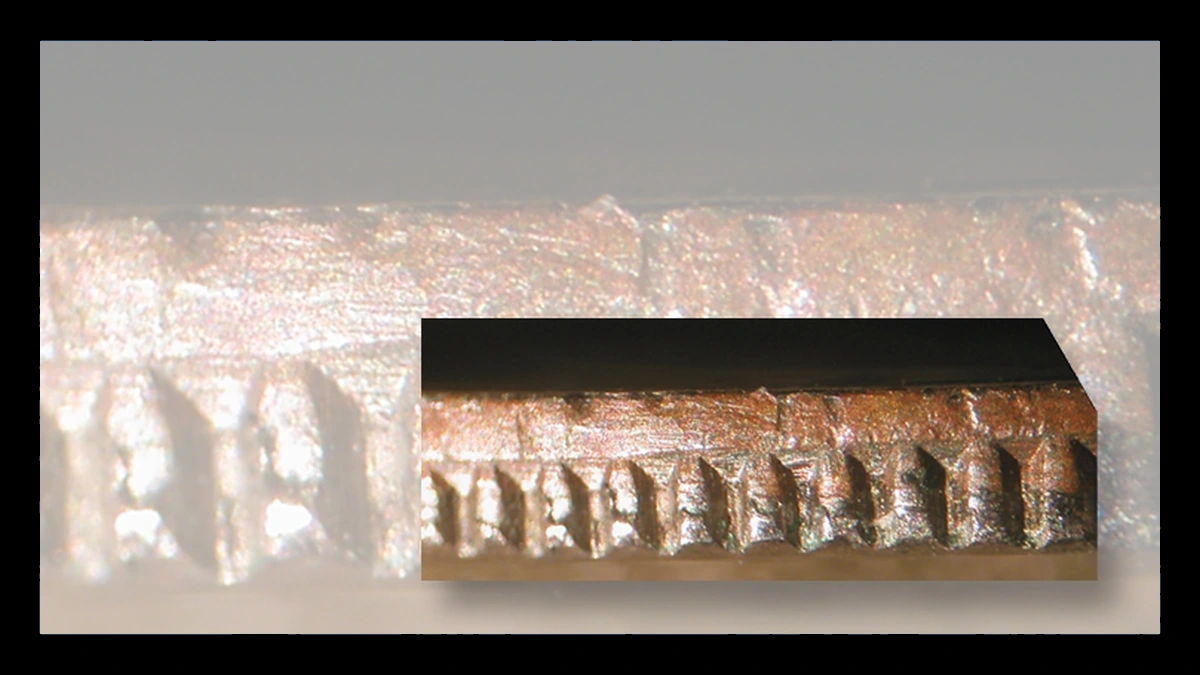
The documented 1977 example has a stepped edge around roughly three-quarters of its circumference. The lower part has grooves and the upper part is smooth.
The remaining quarter of the edge is entirely plain. A tilted early-stage blank met the collar, the restraining ring, unevenly around its outline.
How to Identify
Take overlapping edge photographs through a full turn. Follow the step for about 270 degrees and preserve the separate plain section of about 90 degrees in the sequence.
Compare the two-level profile with the original edge examination. A continuous slope is a different structure from the described step.
Look for grinding or squeezing that could have altered the edge later. One smooth patch cannot show the full tilted-collar relationship.
What It’s Worth
$50–$600 is the estimate for a genuine comparable tilted partial-collar quarter. Clear grooves, a distinct step, and complete edge views help demonstrate the error.
The percentages describe the documented edge, not a rule for every partial-collar coin.
8. 1977 Quarter Full Designs on Expanded Metal: Broadstrike Error
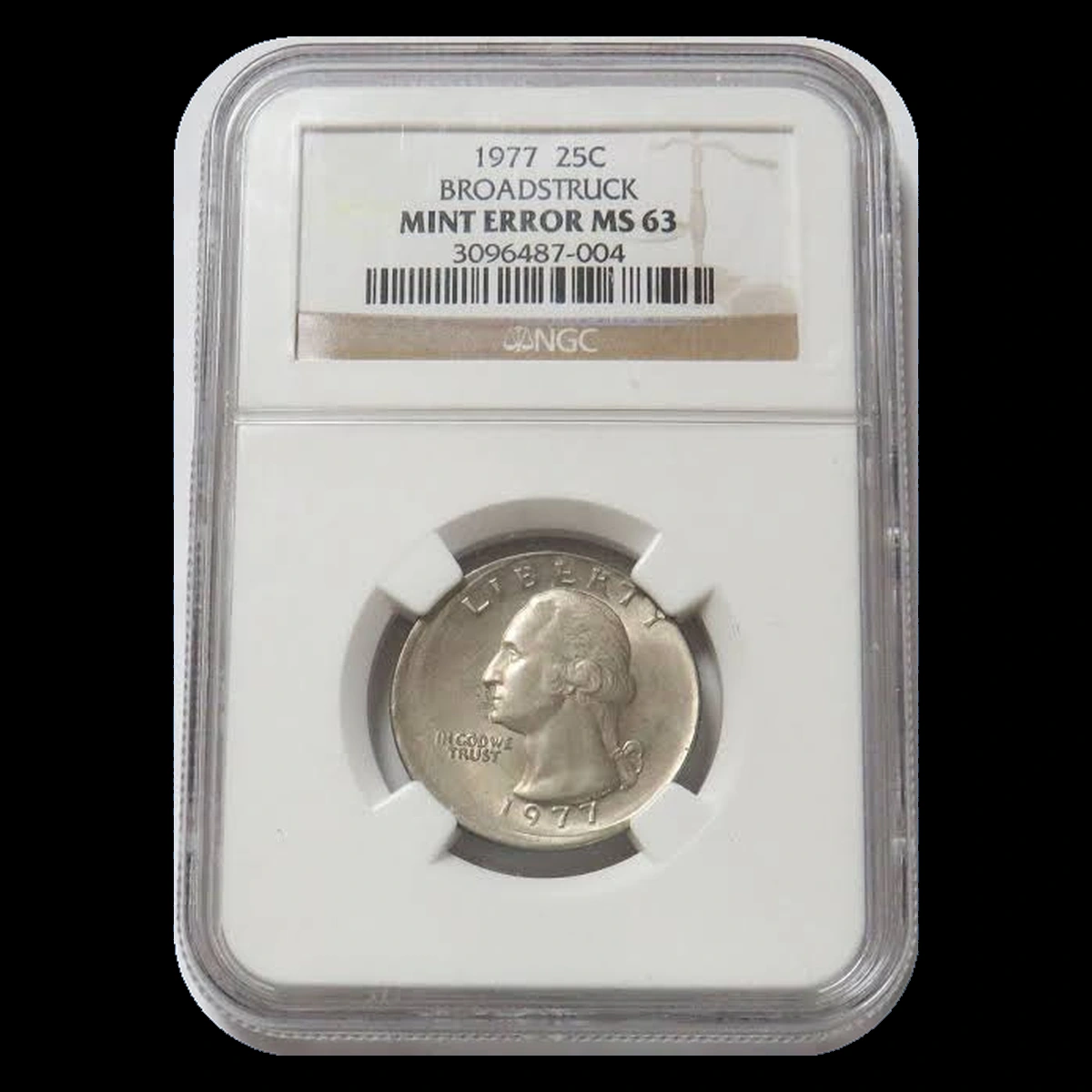
A broadstrike occurs when the collar does not contain the blank during striking. The metal spreads beyond its usual outline while the full design stays on the coin.
Philadelphia and Denver examples are reported, including a Philadelphia NGC MS66 coin. The wider border need not be even on every side.
How to Identify
Trace all the outer lettering on both faces to check for completeness. The normal lack of a Philadelphia mintmark does not count as missing design.
Compare the border and edge with the normal diameter of about 24.3 millimeters. Natural expansion should fit the strike, without crushed letters or grinding that merely removed the grooves.
What It’s Worth
$25–$750 is the estimated range for genuine 1977 broadstrikes. A wide original border surrounding an attractive full design usually gives a clearer display.
Broadstrikes combined with clips also need their missing-metal features assessed. Later flattening can widen a coin without producing the same error.
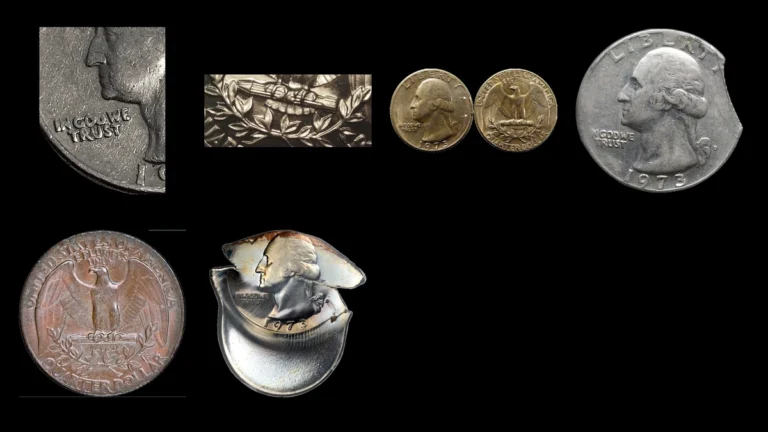
9. 1977 Quarter A Curved Bite or Two Gaps: Clipped Blanks Error
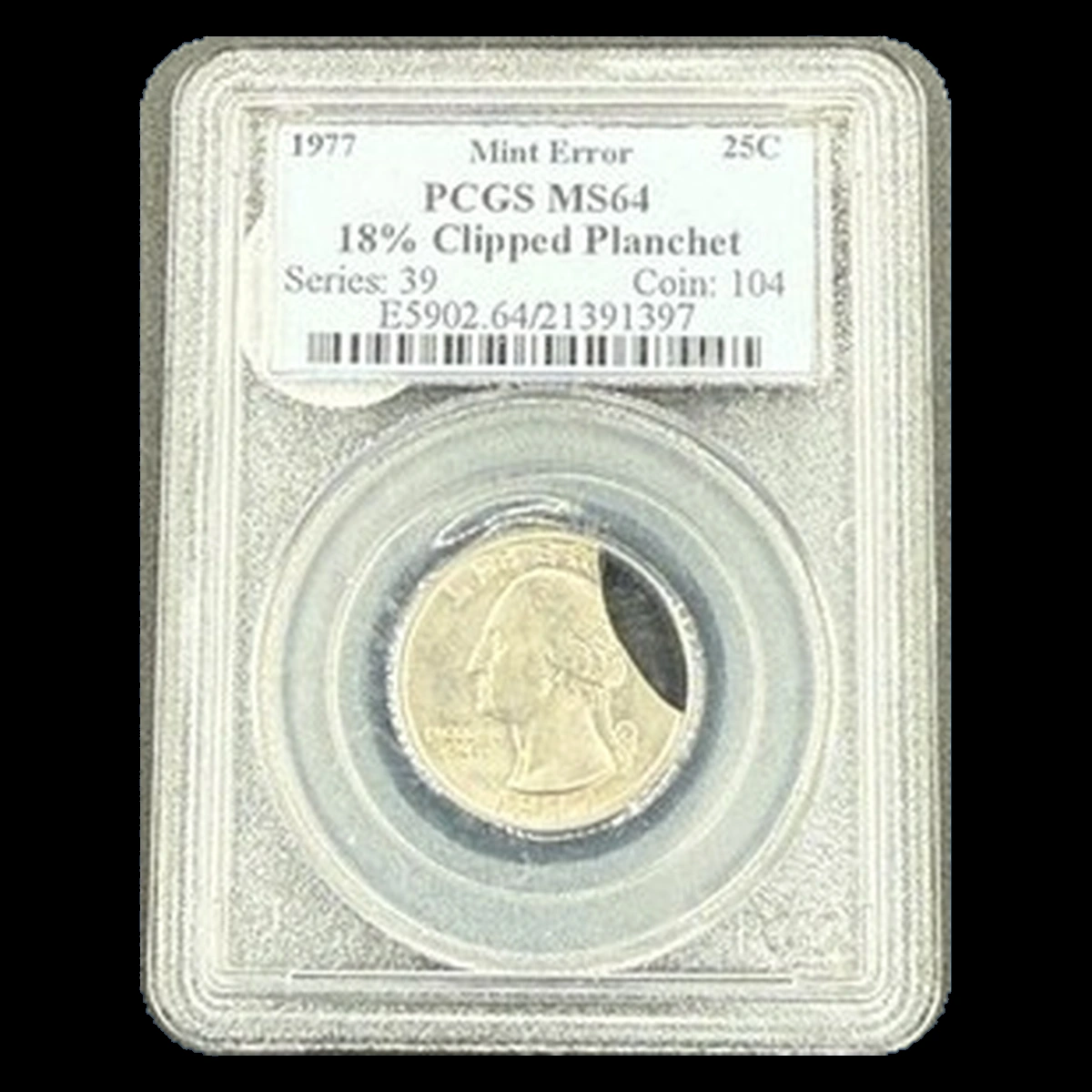
One Philadelphia quarter has a large curve missing from about two o’clock to five-thirty. It weighs 63.6 grains, or about 4.12 grams.
A separate PCGS MS67 example has a 25% double clip and was also broadstruck. Another curved-clip broadstrike has no stated percentage, and Denver clips require their own photographs.
How to Identify
Inspect both points where a gap meets the rim. The nearby strike and natural transitions can show that the blank was already incomplete.
For the double-clip example, keep both gaps visible. Outward spread and missing metal are two physical features of the same coin, not interchangeable descriptions.
Look inside each opening for saw marks, filing, or burrs. Reduced weight alone cannot establish an original clip because later cutting removes metal too.
What It’s Worth
$10–$1,000 is the estimate across genuine clips of different sizes and combinations. Condition and the original struck boundaries matter alongside the amount missing.
The separate NGC MS66 curved-clip broadstrike sold for $52 on August 18, 2015. It is not the PCGS MS67 double-clip specimen.
10. 1977 Quarter Most of the Blank Missed the Design: Off-Center Strike Error
A documented Denver quarter was struck 70% off-center toward eleven o’clock and graded ANACS MS63. Much of its original blank remained outside the dies.
Philadelphia off-center examples are also reported, but they do not share one established percentage or direction. Each needs its own surviving date evidence.
How to Identify
Locate any readable date and mintmark before assigning a year or mint. Keep Washington upright when comparing the direction of the documented Denver strike.
Both faces should fit the same misplaced blank and unstruck area. A front-only shift belongs with die misalignment instead.
Inspect the bare metal for grinding or flattened remnants of an earlier complete design. Do not reconstruct missing digits in the photograph.
What It’s Worth
$25–$2,500 is the estimated range for genuine 1977 off-center quarters. A dramatic shift with clear identity generally attracts more attention than a small displacement.
A large empty area is not enough to establish a valuable dated example if the year is missing. The surviving design and attribution must support the comparison.
11. 1977 Quarter The Quarter Design on Smaller Stock: Wrong Blank Error
1977 reports include quarter designs on cent, nickel, and dime blanks. These discs had not yet received their intended denomination’s design.
A Denver cent-blank example graded NGC MS63 Red-Brown weighs 3.07 grams. A separate Philadelphia nickel-blank quarter was graded NGC AU55, meaning lightly worn.
How to Identify
Check how the quarter’s outer words fit the smaller metal. Then record a loose candidate’s width, weight, and edge appearance.
The 3.07-gram measurement belongs to the documented cent-blank coin. Five grams is a normal nickel-blank standard, not a measured weight supplied for the AU55 specimen.
Look for older Lincoln, Jefferson, or building details. Such traces would point toward a finished host coin rather than an unused blank.
Dime-blank reports need their own metal and measurement confirmation. Some unusual blanks can acquire edge grooves through collar contact, so one edge feature should not decide the entire attribution.
What It’s Worth
$100–$4,000 is the estimate across authenticated cent-, nickel-, and dime-blank quarters. The precise blank and surviving design determine the relevant comparison.
The Denver 3.07-gram cent-blank MS63 sold for $600 in January 2018. The Philadelphia nickel-blank AU55 brought $134.40 in November 2020.
The dime-blank entries have conditional estimates within the range, not invented sale records.
12. 1977 Quarter Nickel Details beneath Washington: Double Denomination Error
A finished Jefferson nickel can enter the quarter press and receive a second denomination’s design. The Washington and eagle impressions then overlap traces of Jefferson and Monticello.
A documented Philadelphia example was graded PCGS MS64. Its surviving nickel artwork separates it from a quarter struck on an unused nickel blank.
How to Identify
Find a connected piece of Jefferson or Monticello rather than naming one isolated line. Compare it with a normal nickel while keeping the later quarter design visible.
Inspect both faces for how the second strike covered or flattened the older picture. Those relationships should explain two genuine sets of struck details.
Later pressing of finished coins can transfer misleading marks. An error specialist should confirm the overlap, and the host nickel’s date or mint should remain unspecified unless actually established.
What It’s Worth
$500–$6,000 is the estimate for authenticated comparable double-denomination coins. Strong host details beneath a recognizable quarter make the combination easier to appreciate.
The PCGS MS64 quarter-over-nickel sold for $2,100 on September 20, 2020. That price belongs to a finished-coin overstrike, not the unused nickel-blank example above.
13. 1977 Quarter Confirmed Silver-Bearing Metal: The 40%-Silver Blank Error
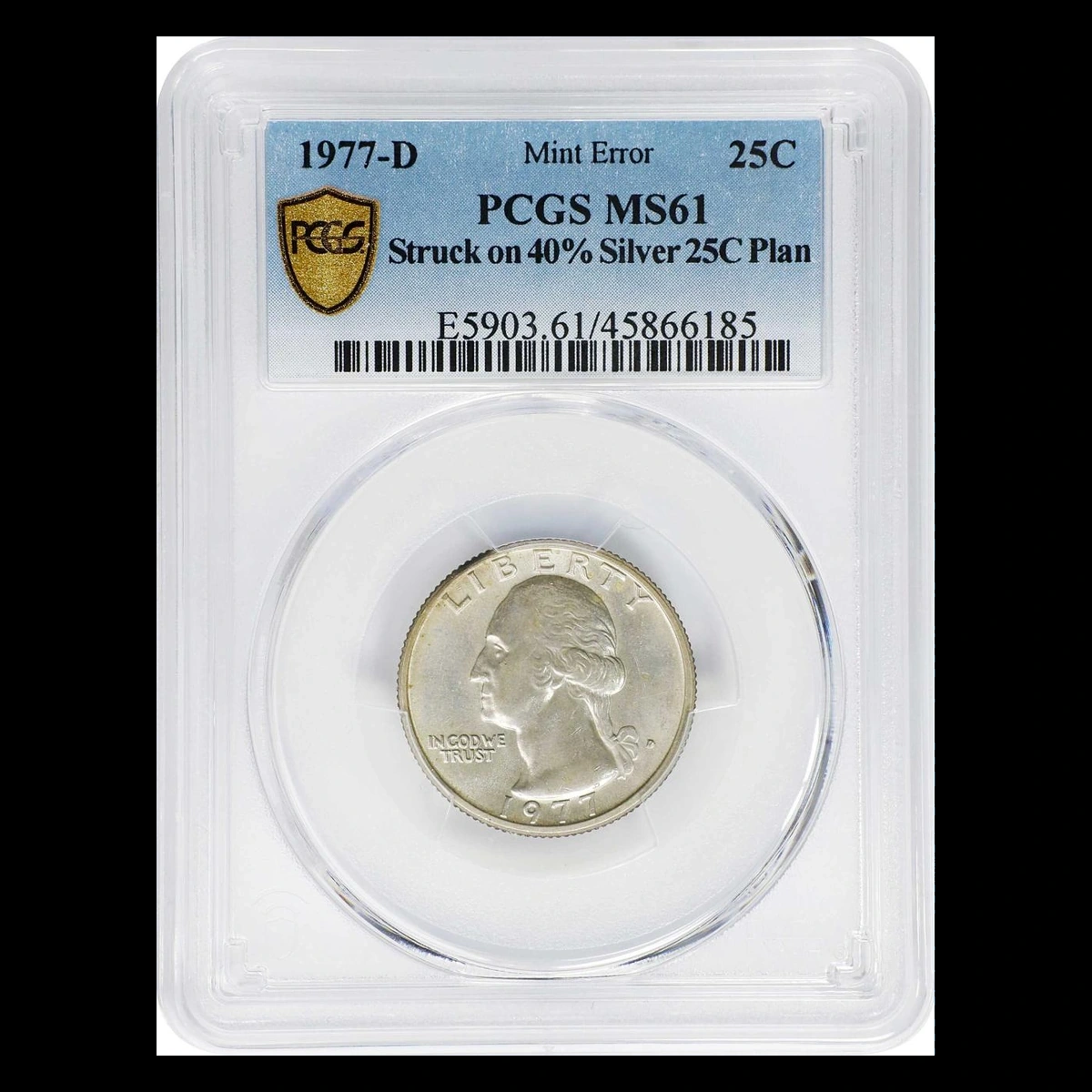
The documented 1977-D silver-blank quarter weighs 5.7 grams and lacks the usual red copper band at the edge. NGC identified 40%-silver stock and assigned an XF Details assessment for wear and improper cleaning.
This is different from the 90%-silver alloy of earlier circulating quarters. The reference links the blank type with Bicentennial silver coinage without establishing how it reached Denver.
How to Identify
Read 1977 and the D, then inspect the edge. The recorded 5.7 grams is close to ordinary clad weight, so a scale alone is not a reliable test.
A missing copper band gives a reason for composition testing, not proof of silver. Plating and other surface changes need to be ruled out without scratching or acid tests.
Confirm 40% silver specifically. Do not attach the older 6.25-gram, 90%-silver quarter standard to this specimen.
What It’s Worth
$3,000–$15,000 is the estimated range for an authenticated 1977-D 40%-silver-blank quarter. Preservation and demand influence the whole-coin value.
The cleaned XF Details example brought $4,935 on January 6, 2016. Keep that cleaning qualification attached to the sale rather than treating it as a problem-free coin.
Conclusion
The blank, the dies, and the edge collar can each leave different clues on a 1977 quarter. Start with the visible feature and check whether the rest of the coin supports the same explanation.
Keep measurements and grades tied to their individual specimens, especially with clips and wrong-metal coins. A clear photo of both faces and the edge helps separate real mint errors from later cutting, plating, or crushing.