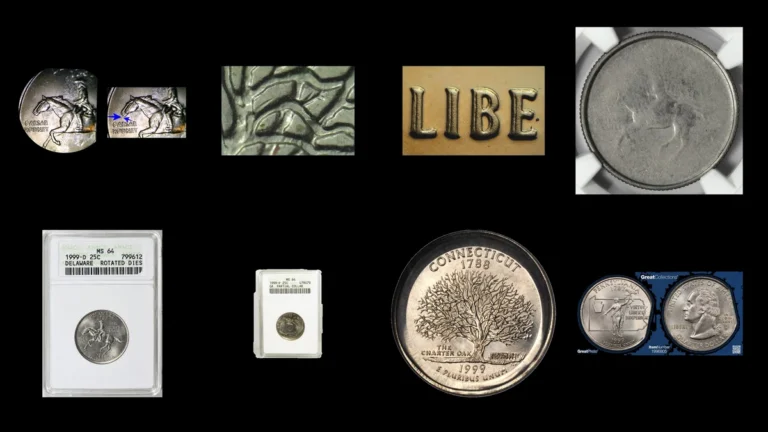
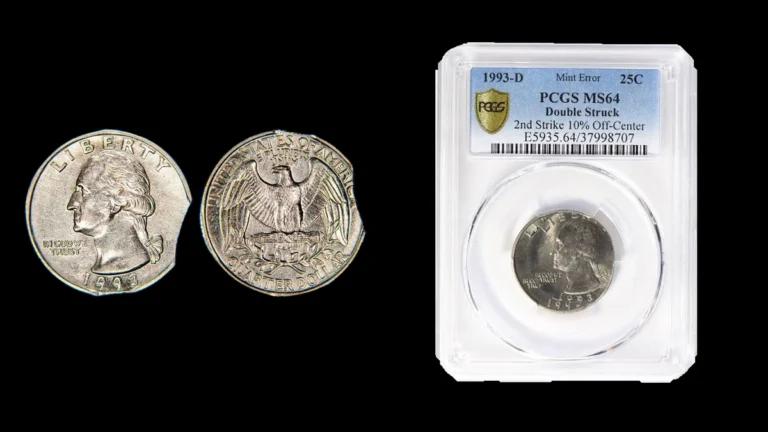
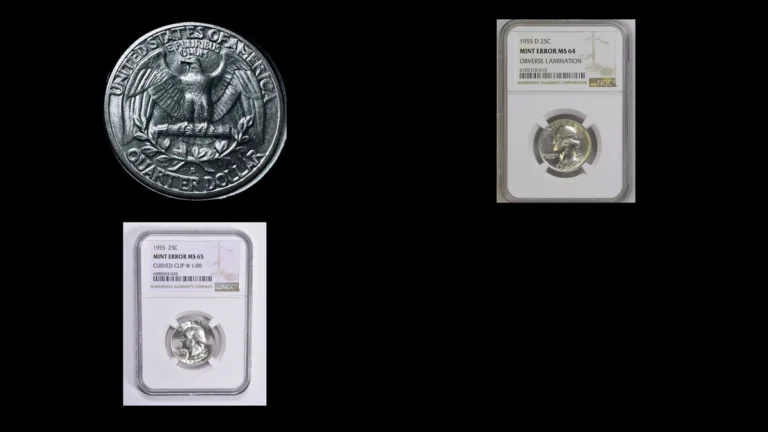
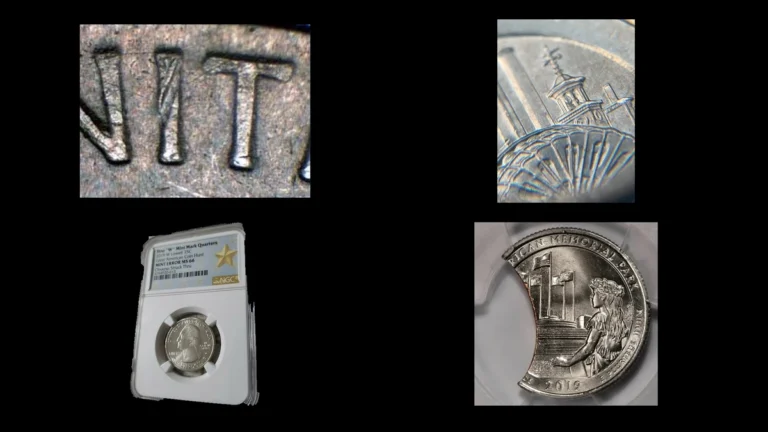
Rare 2023 Quarter Errors (List & Pictures)
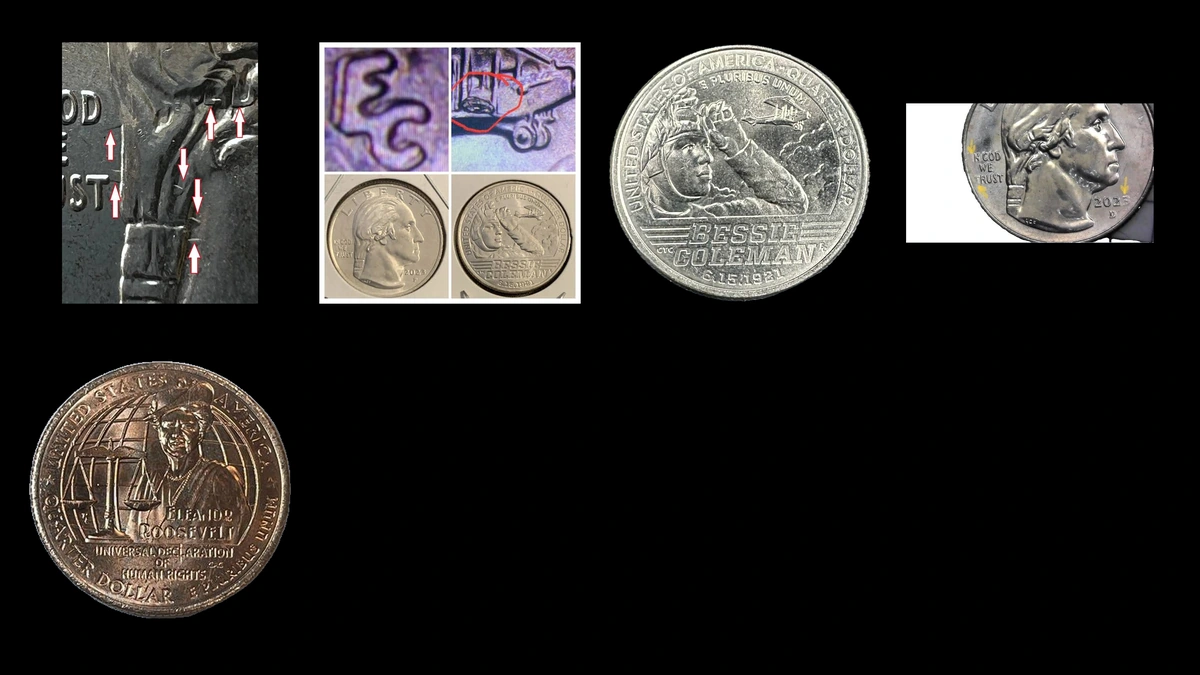
A struck-through Edith Kanaka’ole quarter sold for $99 in June 2026. Estimated values across 2023 quarter errors range from $2–$5,000, with small die flaws at one end and dramatic striking mistakes at the other.
This guide explains what the five American Women designs can show and where an individual report still needs confirmation.
| What looks unusual? | Possible category | Estimated value |
|---|---|---|
| Extra line, outline, or lump | Clash, doubling, or die break | $2–$300 |
| Peeling surface or missing section | Lamination or clip | $15–$250 |
| Interrupted detail | Struck-through material | $10–$350 |
| Shifted or expanded design | Misalignment, broadstrike, or off-center strike | $10–$750 |
| Reverse at an unusual angle | Rotation | $25–$400 |
| Original copper face | Missing clad layer | $300–$2,500 |
| Overlapping or sunken reversed image | Multiple strike or brockage | $300–$5,000 |
1. 2023 Quarter Lamination or Peeling Metal Error
A thin flap on a Maria Tallchief quarter may belong to the reported lamination category. A broader 2023 report also mentions peeling metal without identifying the reverse design.
Lamination involves separation along a weak layer in the metal. A localized flap or shallow opening differs from the loss of an entire outer clad sheet.
How to Identify
Inspect the junction between the disturbed metal and the intact design. An attached layer may retain original struck detail, so leave it in place rather than lifting it.
An ordinary clad quarter normally weighs 5.67 grams and measures 24.26 millimeters across. Small retained flaws may barely affect weight; the boundary is usually more informative than a rough-looking patch alone.
What It’s Worth
Genuine small laminations have estimated values of $20–$150. This range concerns localized peeling rather than a whole copper face exposed by missing clad metal.
Scratches or corrosion near the flaw can reduce appeal. An intact layer that clearly shows the separation is easier to explain than an uncertain rough area.
2. 2023 Quarter Misaligned Front or Reverse Die Error
A design pushed toward the edge on just one face can indicate a shifted die. The blank may still have occupied its normal position beneath the tools.
Kanaka’ole and Tallchief quarters appear in year reports for this feature. The reports do not establish a shared direction or amount of movement.
How to Identify
Take straight-on photographs of both faces and compare the border widths. A narrow border on one side and wide border opposite it should chiefly affect the displaced face.
If both images miss part of the blank and leave an unstruck crescent, investigate an off-center strike instead. Rim damage and a tilted camera can also make centering look misleading.
What It’s Worth
Clear modest misalignments have estimated values of $10–$150. Tiny uneven borders often add little when the design stays comfortably inside the rim.
The useful comparison shows an obvious shifted face paired with a centered one. These are estimates for genuine errors, not confirmed sales of every reported design.
3. 2023 Quarter Clashed Opposing Designs Error
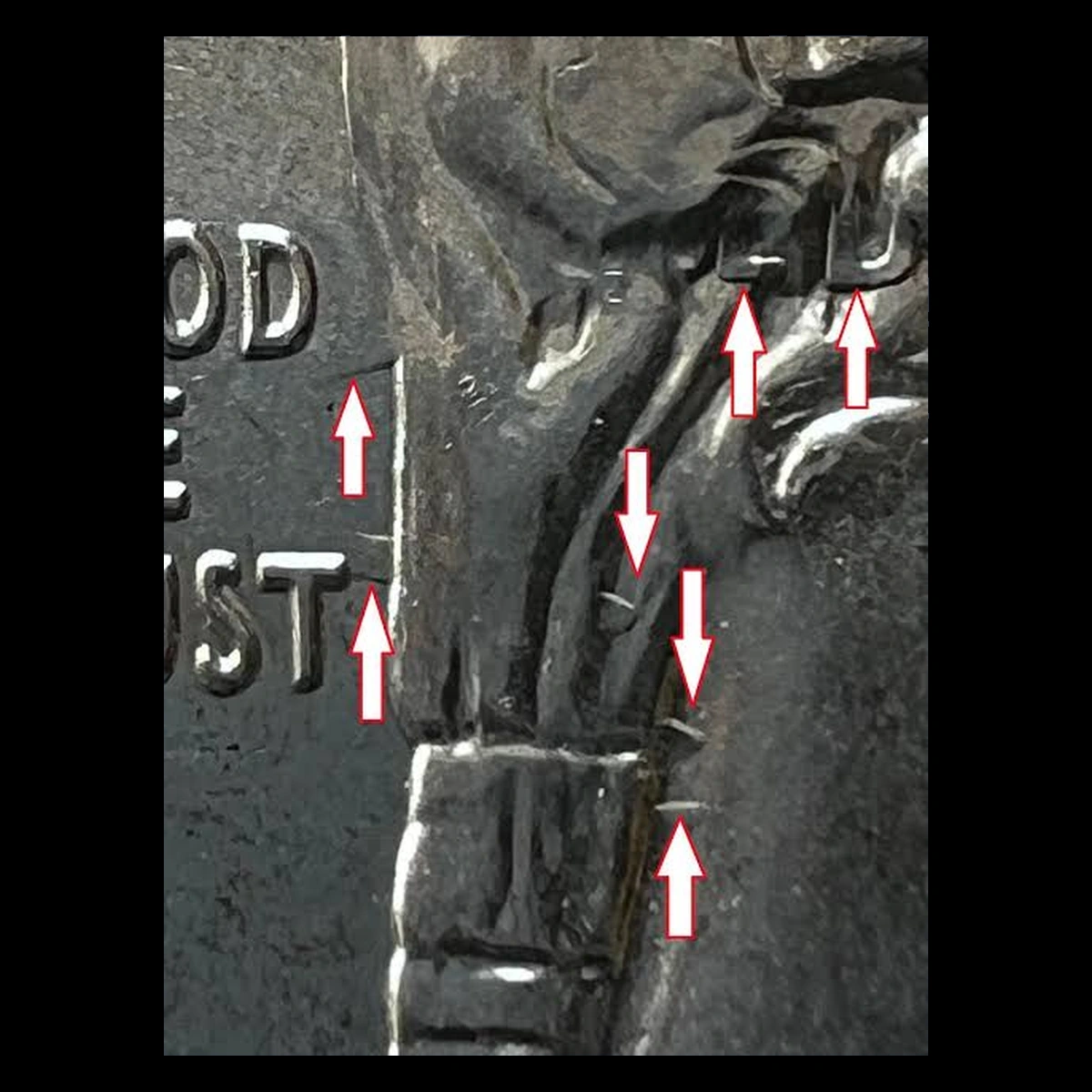
Parts of EDITH near Washington’s ear offer a specific clue on a Philadelphia Kanaka’ole quarter. Collector photographs show traces related to the reverse lettering.
Such marks can originate when the dies meet without a blank between them. Later coins reproduce the resulting marks on the tools.
How to Identify
Compare the faint shapes near the ear with EDITH on the reverse, allowing for reversed orientation. The T is a useful landmark, and several connected features are stronger evidence than one stray line.
Also inspect the reverse for corresponding Washington-related traces. Coleman and Tallchief clash reports must fit their own reverse artwork, rather than borrowing the EDITH pattern.
What It’s Worth
Recognizable clashes on ordinary quarters have estimated values of $10–$150. Clear letters or connected shapes generally offer better comparisons than faint traces obscured by scratches.
The Kanaka’ole photographs demonstrate a pattern. They do not establish a fixed price for every clash on another 2023 design.
4. 2023 Quarter Doubled Designs and Lettering Error
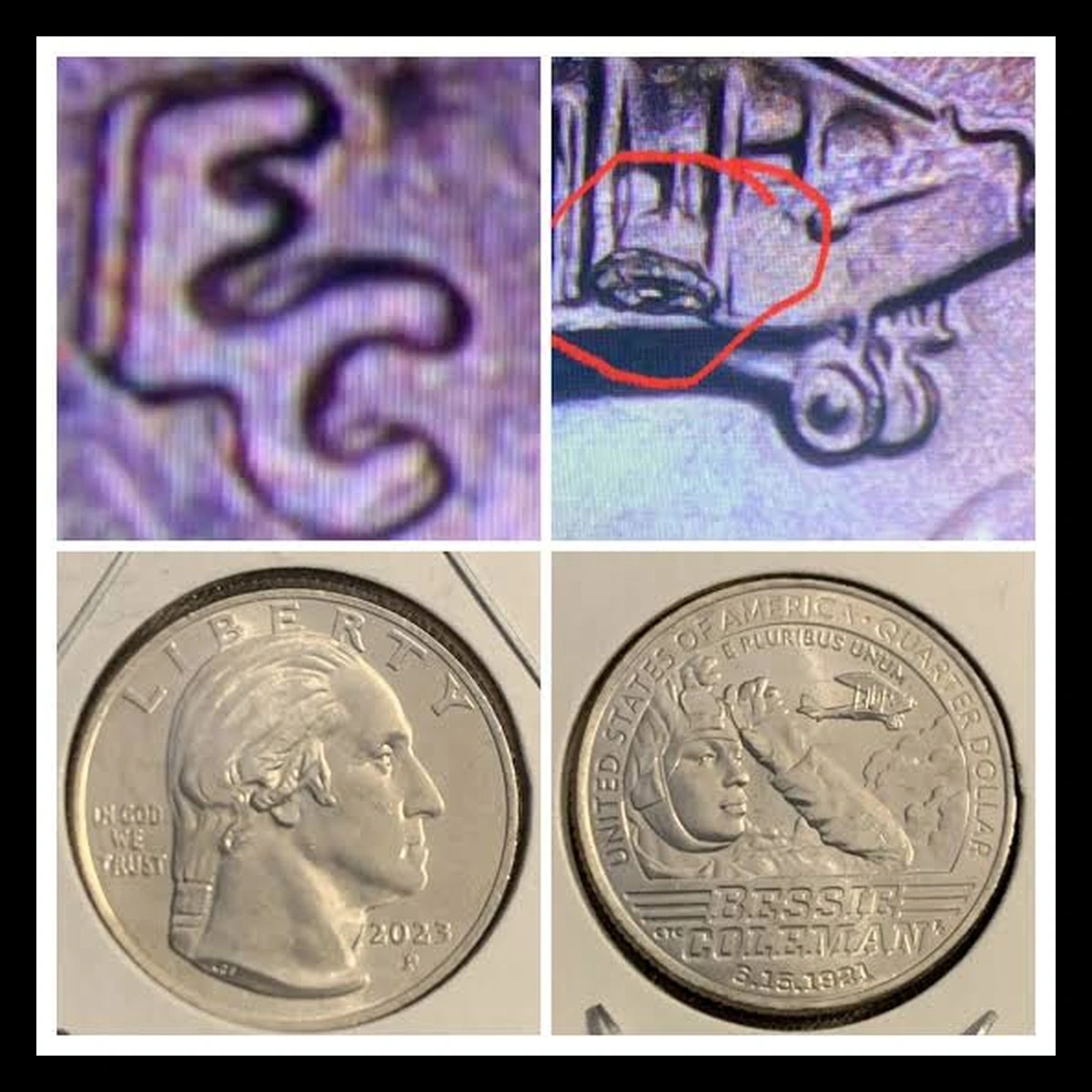
Philadelphia Coleman varieties include repeated nose and lip detail toward the right. Wexler also lists Philadelphia Roosevelt reverse features at the scale and name, plus a separate front variety involving lettering and Washington’s hair.
A doubled die carries the repeated image in the tool itself. Shared features originating earlier in tool production may be widespread and provide little or no premium.
How to Identify
Use the Coleman variety photographs to match the actual face detail. Wider shared doubling can involve her face, goggles, gloves, and airplane, so visible doubling alone does not establish rarity.
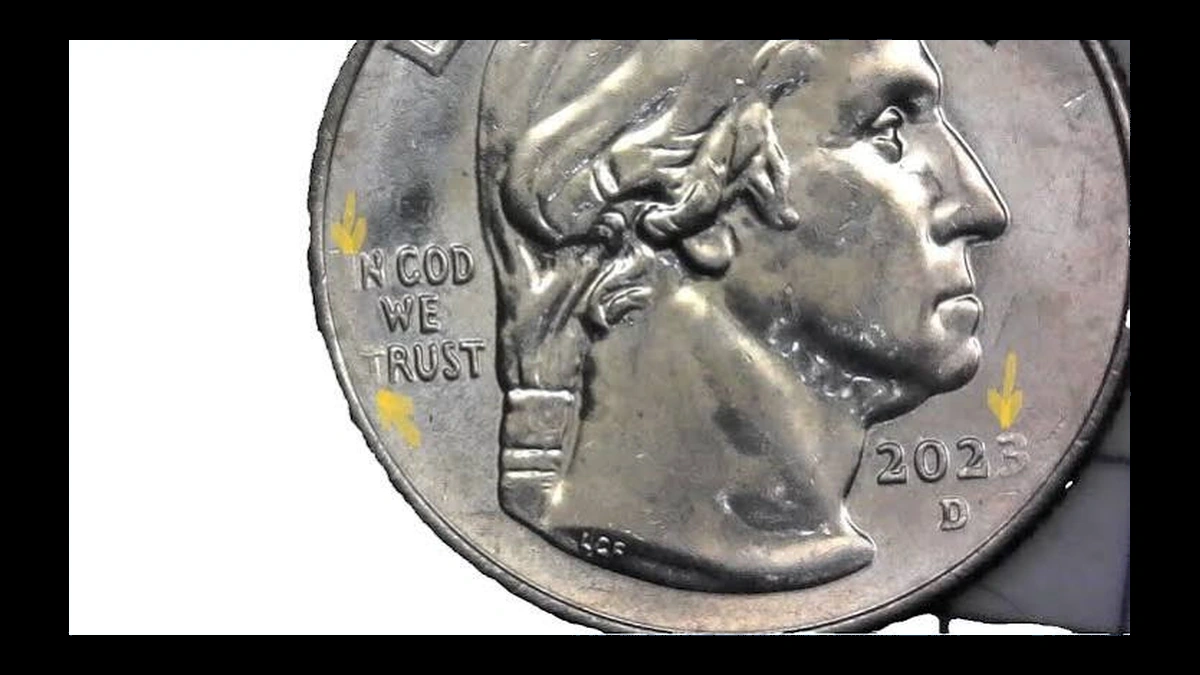
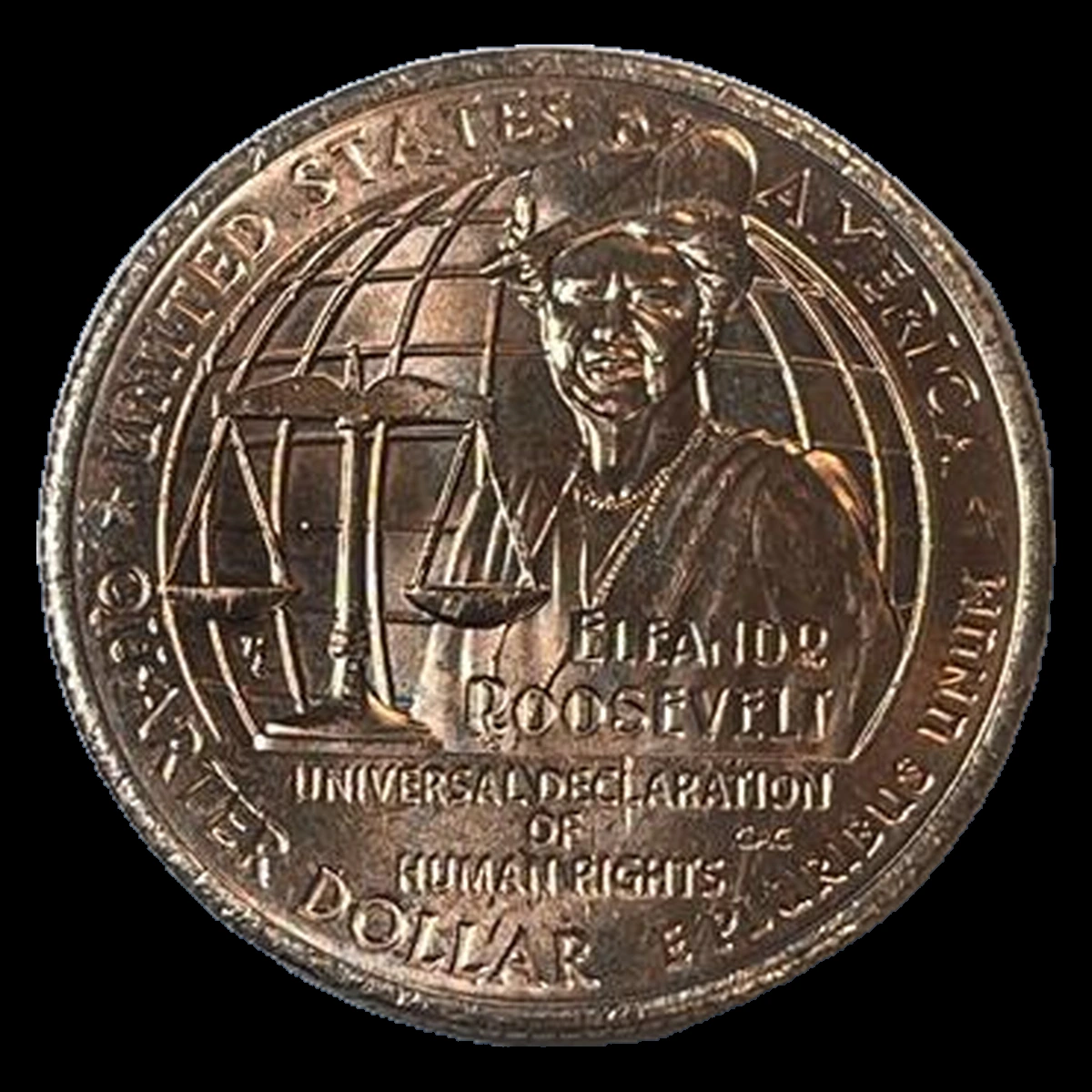
For Philadelphia Roosevelt, inspect OD in GOD, the last T in TRUST, and hair for the front variety. Reverse checks include the scale pole and strings, EL in ELEANOR, and RO in ROOSEVELT.
Idar reverse lettering remains a report needing a matched pattern, and Coleman front doubling remains a candidate. The airplane and designer initials are on Coleman’s reverse and cannot prove front doubling.
What It’s Worth
Clearly matched minor varieties have estimated values of $5–$200. Rounded separation that persists under changing light is more useful than a flat shelf or simple thickening.
Wexler notes widespread Denver Roosevelt scale doubling and shared Philadelphia eye features. An ordinary coin showing only a common shared feature may retain just its normal value.
5. 2023 Quarter Clipped Blanks and Small Rim Clips Error
Tallchief clips and small Philadelphia Idar rim clips appear in reports for this year. Their actual sizes and directions are not fixed by those descriptions.
A blank can be incomplete when cutting overlaps an earlier hole or the edge of the metal strip. The subsequent strike forms its design around the existing gap.
How to Identify
Inspect both ends of the gap for original metal flow into the surrounding rim. Fresh cuts, burrs, or saw marks point toward removal after striking.
Possible rim weakness opposite the gap can support the identification, while weight helps document the amount missing. Keep the complete reverse visible so the clip remains tied to its actual design.
What It’s Worth
Small genuine rim clips have estimated values of $15–$75. Larger clear clips with attractive surviving details may fall around $50–$250.
Readable identity and an original boundary matter alongside size. A notch cut into a finished quarter does not receive the same error premium.
6. 2023 Quarter Die Cracks, Chips, and Rim Breaks Error
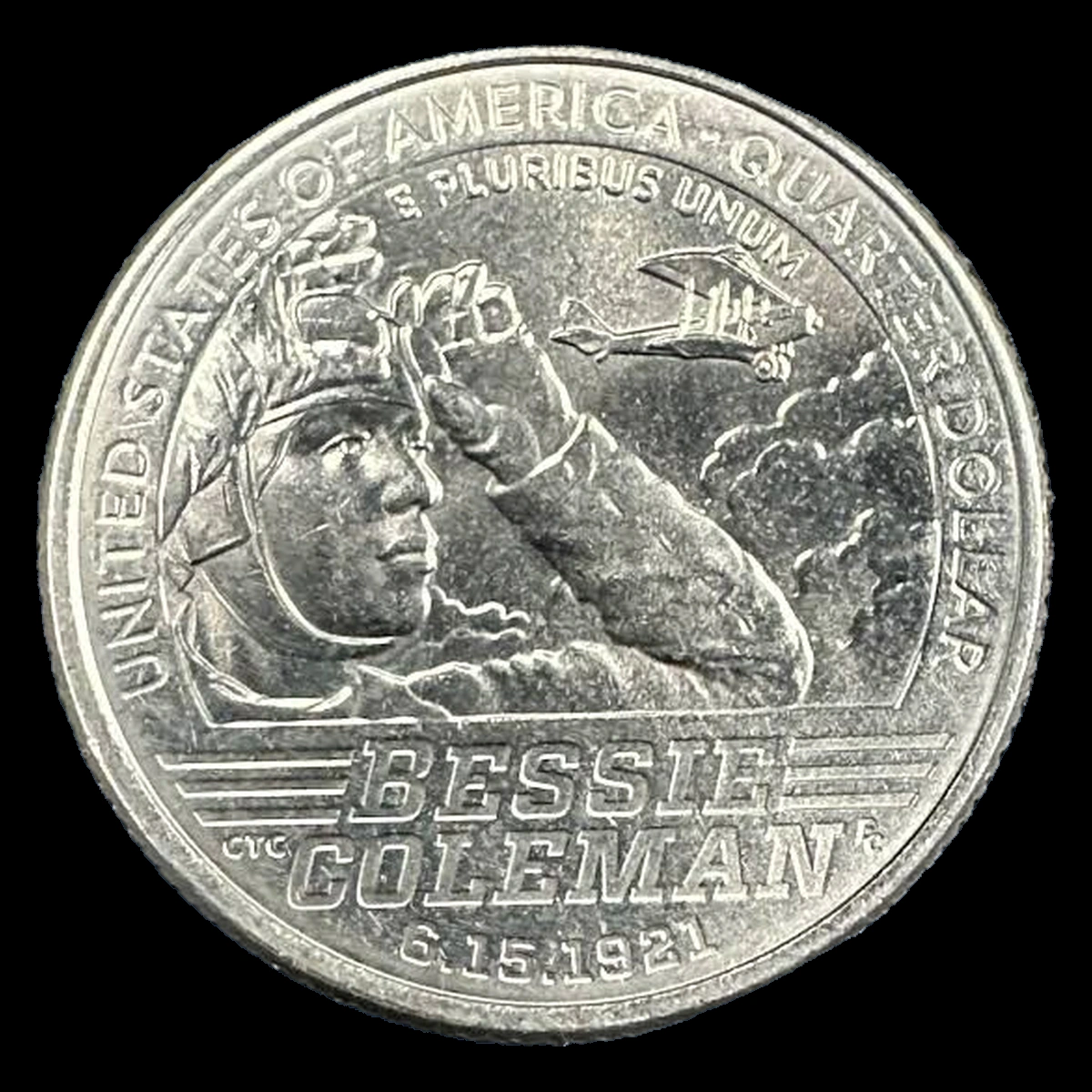
Small raised flaws occur in reports for all five designs. Examples include Coleman’s plane-wing bump and letter cracks, Roosevelt nose or cheek lines and a chip in the V of ROOSEVELT, and Idar forehead or clothing-letter features.
Tallchief’s “extra feather” and “broken arm” names refer to reported tool flaws rather than alternate artwork. Kanaka’ole cracks and separate rim-break candidates also require their own examination.
How to Identify
Follow the raised feature under side lighting, checking for a hollow or impact mark beside it. A scratch can have a raised lip that resembles a die crack in one photograph.
A cud must connect to the rim. The Roosevelt retained-break report near the globe, between twelve and two o’clock, requires a visible broken boundary with possible design remaining inside it.
Do not assign that location to Coleman or Tallchief rim-break reports. An isolated internal chip cannot establish the same larger break.
What It’s Worth
Small recognizable cracks and chips have estimated values of $2–$40. Larger original rim-connected breaks have an estimated range of $40–$300.
The dimensions and clear boundaries determine the useful comparison. A colorful nickname or a tiny nose bump does not make the feature equivalent to a large die break.
7. 2023 Quarter Struck-Through Material and Filled Detail Error
A certified Philadelphia Kanaka’ole quarter provides a documented front strike-through example. Material between the die and blank interrupted part of the normal impression.
Other reports describe a depressed line across LE in COLEMAN, Idar interruptions on both faces, and a seller’s proposed dropped-letter impression. Those descriptions do not establish one material or one shared cause for every weak area.
How to Identify
Examine where sharp adjacent detail meets the depression or weak patch. Later cuts, pushed-up impact edges, and general wear call for different explanations.
The normally open background around Idar’s letter-covered body is intentional design. A dropped-letter claim needs an impressed letter-shaped object, not a normal letter already present in her clothing.
For Coleman, the line crossing LE does not identify grease, wire, or another object by itself. A weak T in TRUST likewise needs examination of the surrounding original surface.
What It’s Worth
Modest filled-detail effects have estimated values of $10–$75, while clear debris impressions have a comparison range of $50–$350. The shape and extent of the interruption matter.
The NGC-certified Kanaka’ole front strike-through, described as unworn, sold for $99 in June 2026. That sale does not price every weak-looking quarter at the same amount.
8. 2023 Quarter Rotated Reverse Error
A 2023 rotation report does not identify the woman, mint, or angle of its candidate. The key evidence therefore lies in the measured relationship between the actual coin’s faces.
A rotated die can leave complete, sharp images at the wrong angle to each other. Turning a normal coin sideways can imitate an error if the expected alignment is misunderstood.
How to Identify
Hold Washington upright and flip the coin from top to bottom without twisting sideways. Compare the reverse with its own normal upright position.
Repeat the flip with fixed reference lines and record both the angle and direction. Do not independently straighten the two photographs, since that removes the evidence being tested.
What It’s Worth
Clearly demonstrated rotations have estimated values of $25–$400. Small departures can attract little interest, while larger angles are easier to display.
This is a comparison range for ordinary modern quarters. It is not an auction result for an identified 2023 rotation.
9. 2023 Quarter Broadstrikes Error
Kanaka’ole and Tallchief broadstrikes appear in year reports without precise measurements. Their metal is described as spreading outward because the surrounding collar did not contain it normally during striking.
A broadstrike can retain the main designs inside an uneven expanded border. It differs from an off-center strike that carries some of the intended image beyond the available metal.
How to Identify
Examine the complete designs, edge grooves, and outward spread together. On a loose coin, measurements in several directions can document the expanded outline.
Flattening after minting can enlarge a quarter while crushing its details. Original design and metal flow must support the collar-failure explanation.
What It’s Worth
Genuine ordinary-strike broadstrikes have estimated values of $75–$500. Substantial visible expansion and attractive surfaces support stronger comparisons.
A slightly uneven border does not automatically qualify for the upper end. An altered edge or incomplete picture may point to another process.
10. 2023 Quarter Off-Center Strikes Error
Coleman, Kanaka’ole, Idar, and Tallchief quarters have off-center reports. None establishes a single percentage, direction, or mint to apply across those designs.
An off-center blank receives only part of both intended images. Original unstruck metal remains beside the displaced design.
How to Identify
Look for design running off the blank opposite an unstruck area, then check the other face for matching displacement. A shift limited to one face may be a misaligned die instead.
The issue date is 2023 on Washington’s side. Coleman’s reverse inscription 6.15.1921 commemorates her pilot’s license and is not evidence of an older host coin.
What It’s Worth
Genuine dated examples have estimated values of $50–$750. Larger clear displacements can be more appealing, but identity, condition, and surface damage still affect the total.
The amount claimed in a listing should agree with the missing image and blank area. A complete but misplaced blank may retain normal weight.
11. 2023 Quarter Missing Outer Clad Layers Error
Two graded Philadelphia quarters document missing reverse layers: a Coleman weighing 4.8 grams and an Idar weighing 4.7 grams. Their exposed copper received the reverse designs.
A Denver Coleman dealer example has about ninety-five percent of its reverse layer missing. Roosevelt and Tallchief reports do not establish their mint or affected face.
How to Identify
Inspect the copper surface and remaining layer boundary for original struck detail. Brown toning, added copper plating, scraping, and chemical damage can produce misleading appearances.
The Coleman record identifies an NGC MS64 coin and records its weight. The 4.7-gram figure belongs to the separate Idar example.
Silver Proofs of this year contain .999 silver and have no clad sheet to lose. Establish the coin’s composition before interpreting an unusual edge.
What It’s Worth
Confirmed missing-layer clad quarters have estimated values of $300–$2,500. Original exposed copper, the amount absent, and preservation affect the comparison.
The Coleman and Idar auction pages show $1,760 starting bids, with completed prices hidden from public view. Those starting figures must not be described as final sales.
12. 2023 Quarter Multiple Strikes Error
The Tallchief year guide reports multiple strikes without specifying a specimen’s mint, movement, or overlap. A candidate must show a coherent second impression rather than merely one doubled-looking letter.
A coin can receive another blow after shifting, leaving parts of its first image visible underneath. Properly aligned repeated blows during normal Proof manufacture do not create this same error.
How to Identify
Trace a second portrait edge or part of Tallchief’s figure together with nearby letters belonging to that image. Related features should move together as one displaced design.
Examine both faces and the edge for later squeezing or flattening. A second strike need not affect both faces equally, so avoid assuming a symmetrical pattern.
What It’s Worth
A confirmed ordinary-strike Tallchief quarter with displaced repeated impressions has an estimated range of $300–$3,000. The reported category does not supply a verified transaction.
A readable date and understandable overlap can increase interest. Damage caused by pressing finished coins together does not qualify for the same comparison.
13. 2023 Quarter Brockage or Sunken Mirror Image Error
A brockage combines two important clues: the transferred design is reversed and lies below the surface. It can form when an already struck coin contacts a new blank inside the press.
The 2023 report does not identify a particular woman, mint, or affected face. Those details must be established from the candidate itself.
How to Identify
Choose an easily recognizable letter and check both its backward orientation and depth. Follow several connected letters or portrait features instead of relying on one ambiguous dent.
The normally struck face helps establish the date and design. Examine both surfaces and the edge for later squeezing, since two finished coins can be pressed together to imitate parts of the effect.
What It’s Worth
Genuine modern-quarter brockages have an estimated comparison range of $500–$5,000. This range is conditional on identifying an original 2023 striking error.
A complete, clear sunken image offers a different comparison from a vague partial mark. Digitally reversing a picture or finding a raised clash line cannot establish brockage.
Conclusion
Match the woman on the reverse and the mint before borrowing another coin’s diagnostic details. A Coleman date inscription, Idar’s open background, and shared doubling can all look unusual without proving a rare mistake.
For a stronger candidate, preserve the original surface and show both faces plus the relevant edge. Clear evidence of the manufacturing process makes price comparisons more useful than a nickname, a copper color, or an undisclosed auction outcome.