Rare 1979 Half Dollar Errors (List & Pictures)
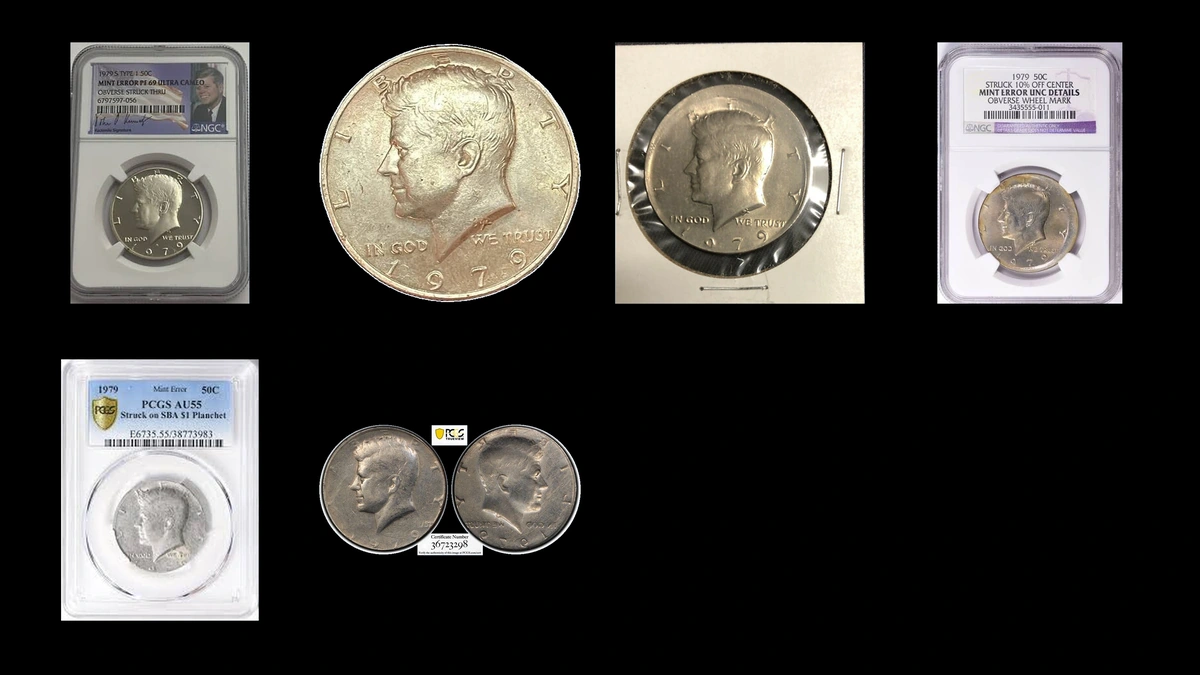
A matching pair and a single multiple-strike coin are different purchases. Among 1979 half dollar errors, the pair reaches an estimated $10,000, while small surface flaws can begin around $5.
The largest supplied completed-sale comparison is $2,400 for a 1989-P multiple strike, not the 1979 pair. A dated 1979 coin struck 12% off center brought $1,680 in July 2021.
Compare the surface and layers first, then the outline, alignment, and any transferred or repeated designs.
| Visible clue | Category | Estimated value |
|---|---|---|
| Local peeling sheet | Lamination | $5–$150 |
| Red surface with intact layers | Improper annealing | $50–$300 |
| Broad copper obverse | Missing clad layer | $200–$800 |
| Design blocked by material | Struck through | $5–$1,500 |
| Added ridge or rim patch | Die crack or cud | $5–$500 |
| Repeated detail or opposing-design trace | Doubled die and reported clash | $20–$450 |
| Missing rim portion | Clip | $25–$400 |
| Expanded full design | Broadstrike | $50–$650 |
| Unstruck crescent | Off-center strike | $75–$2,500 |
| Near-upside-down reverse after flip | Reported rotation | $50–$350 |
| Design on smaller dollar metal | Susan B. Anthony blank | $500–$3,000 |
| Sunken mirror image | First-strike brockage | $500–$4,000 |
| Repeated impressions or linked pair | Multiple strikes | $300–$10,000 |
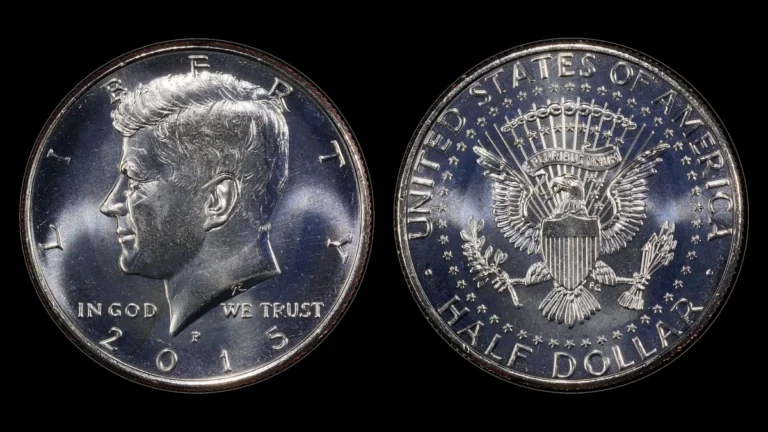
All regular and Proof 1979 halves normally weigh 11.34 grams and measure 30.61 millimeters with grooved edges. Philadelphia halves do not have a P mintmark this year, so its absence is normal.
1. 1979 Half Dollar A thin sheet peels locally: Lamination Error
The year report describes peeling without identifying a specific mint or face. A local weakness in the metal can allow a thin sheet to lift or detach while most of the coin remains intact.
How to Identify
Leave attached metal alone and photograph the boundary from above and at a shallow angle. Look for a separated layer meeting original design rather than a deep gouge with pushed-up edges.
Weight may remain normal while the flap stays attached. Corrosion, prying, and scraping need to be distinguished from the original internal separation.
What It’s Worth
The estimate is $5–$150, with the year guide suggesting $5–$15 for minor peeling and $20–$40 or more for larger losses. These are guide figures rather than recorded 1979 auction results.
An attached flap can clarify the mechanism, but damage or unattractive surfaces can reduce interest. A whole missing outer layer is a separate comparison.
2. 1979 Half Dollar The surface is copper-red but layers remain: Improper Annealing Error
The documented Denver NGC MS65 has a copper-red appearance with its outer layers intact. Annealing is the heating process used to soften blanks, and improper conditions can alter surface color before striking.
How to Identify
Inspect both outer layers and the edge before interpreting color. Broad exposed core metal with substantial loss of weight raises a different question.
Use neutral light to compare original surface texture, without scraping or chemical testing. An experienced examination is needed to distinguish mint heating from later heat, chemicals, and ordinary toning.
What It’s Worth
Identified examples have an estimated $50–$300 range. PCGS’s auction archive records $89 in September 2012 for the NGC MS65.
A different-year 1974-D in NGC MS66 brought $139 in June 2023. Reliable identification and attractive original surfaces matter more than red color alone.
3. 1979 Half Dollar An entire face exposes the copper core: Missing Obverse Clad Layer Error
The reported ANACS MS62 lacks its front layer, while another collector account discusses a 1979 example alongside other denominations. Neither establishes a mint or measured weight for that specific half.
How to Identify
Compare the copper face with the surviving reverse layer and the edge’s physical structure. Full layer loss removes real metal, unlike a colored surface that retains its normal layers.
Check for grinding, corrosion, stripping, or added plating, and do not scrape the exposed copper. Low weight supports missing metal but cannot establish its cause alone.
What It’s Worth
The estimated range is $200–$800. A secondary account places the ANACS MS62 around $300, a reported value rather than a verified auction result.
A 1974-D NGC MS64 missing-layer coin sold for $432 in March 2023 at a recorded 9.34 grams. That weight belongs only to the comparison specimen.
4. 1979 Half Dollar An obstruction leaves a hollow or weak design: Struck Through Error
The Philadelphia PCGS MS64 had roughly three quarters of its obverse blocked by loose clad coin metal. A separate NGC MS64 has a smaller affected area, while other reports concern weak reverse detail attributed to grease.
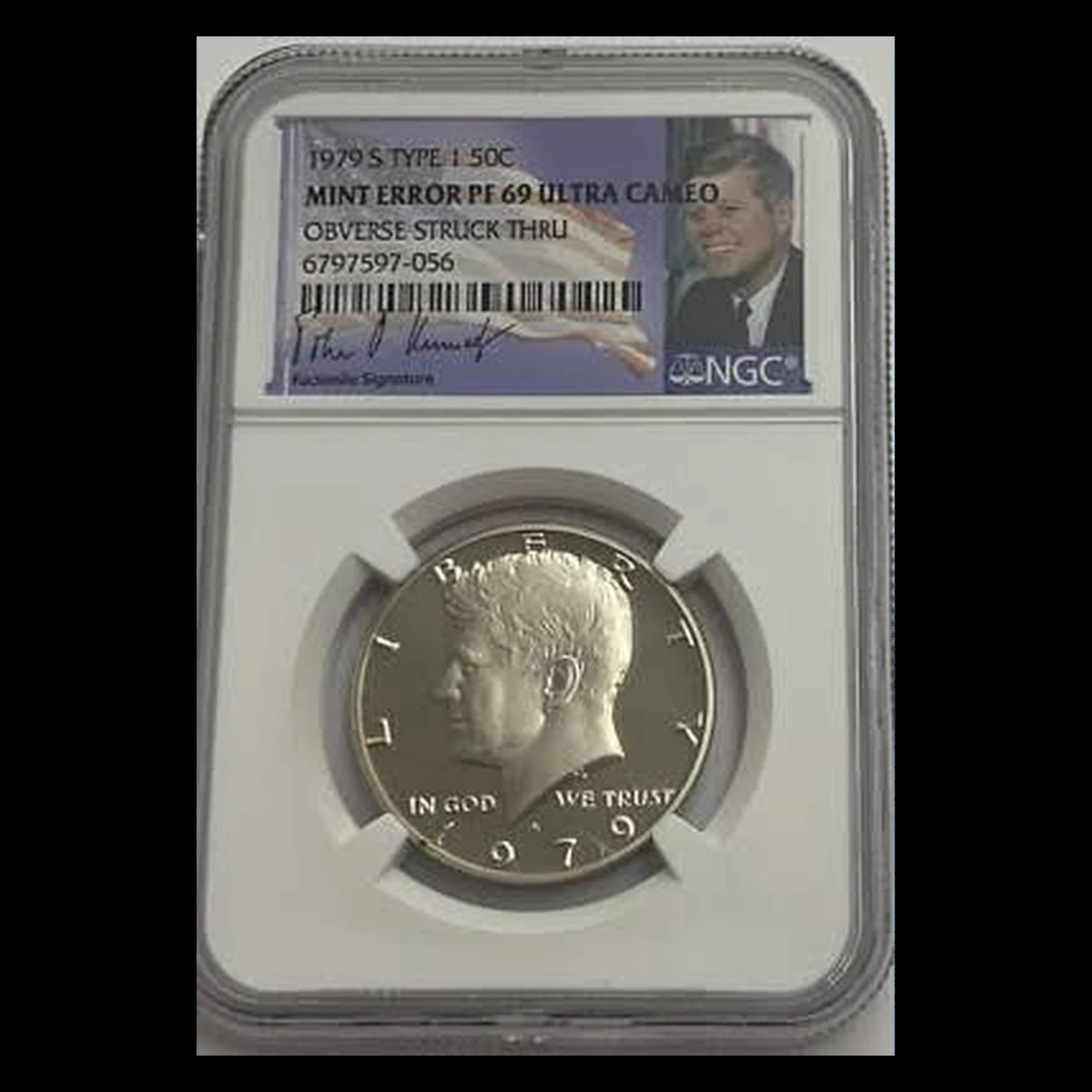
A 1979-S Type 1 Proof in PF69 Ultra Cameo is reported with an unidentified object impression. Its collector finish and strong frosted-to-mirrored contrast belong to that distinct coin.
How to Identify
Inspect the boundary where normal design meets the affected area. A firm object may leave a clear shape, while softer blockage can cause fading detail.
Do not assume the object remains attached, and do not confuse loose metal struck into the coin with loss of its own layer. Compare both faces and the edge for the relationship that fits the actual mark.
What It’s Worth
Estimates span $5–$1,500: about $5–$75 for light grease weakness, $250–$1,000 for loose-metal impressions, and $150–$1,500 for the reported Proof. These describe different effects and finishes.
The smaller NGC MS64 struck through partial clad metal sold for $504 in October 2021. That result is not the price of the larger PCGS example.
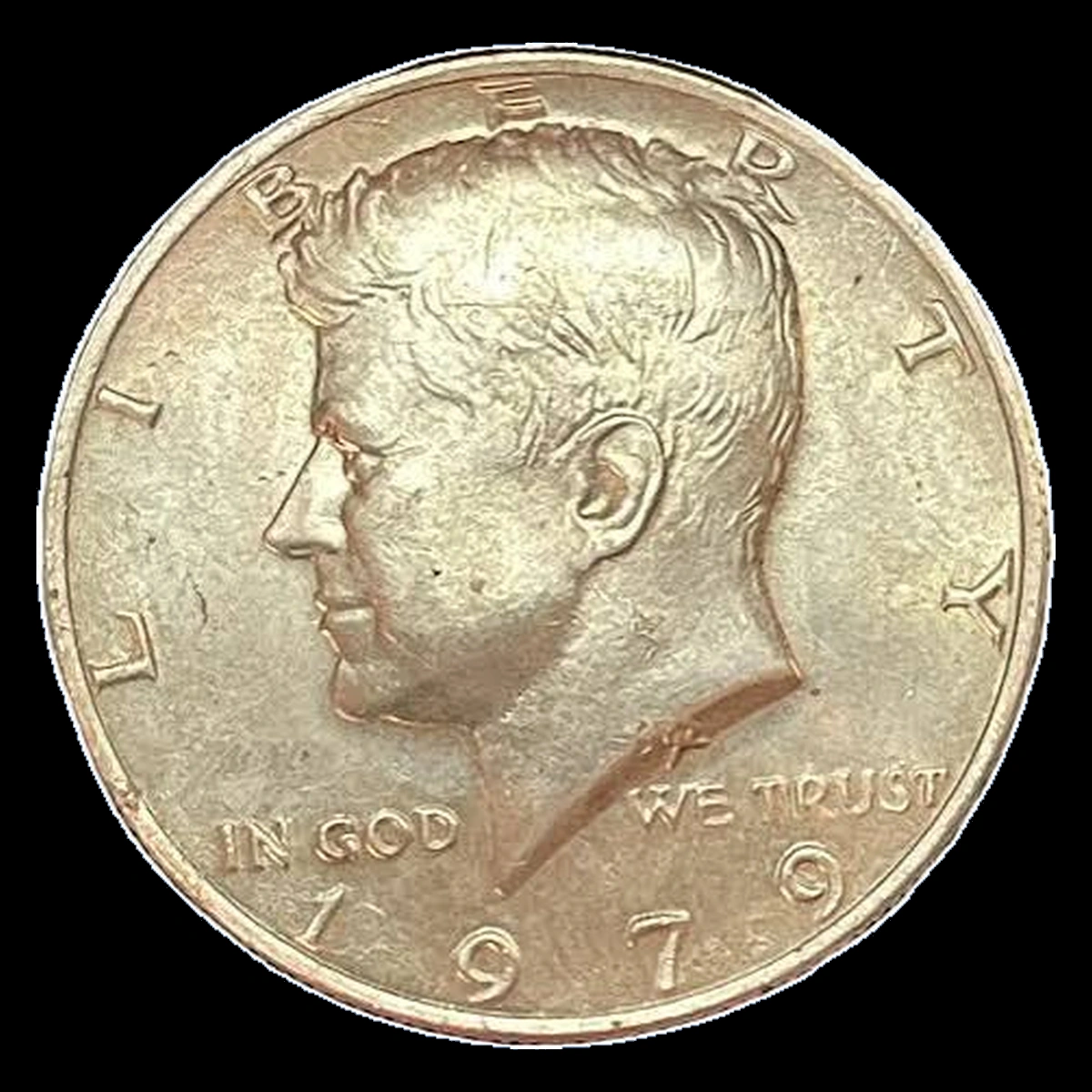
5. 1979 Half Dollar A raised line or rim-connected patch appears: Die Cracks and Cuds Error
Metal entering a fracture in a die produces a raised ridge. A larger missing die piece at the edge can instead leave a cud, a raised patch joined to the coin’s rim.
The 1979 reports provide no exact route or cud shape. The actual candidate must show the necessary height and connection.
How to Identify
Follow a suspected line continuously through nearby design under side light. A scratch generally cuts inward, though a raised lip beside it can be misleading.
For a cud, trace integral metal to the rim where intended design is replaced. A deposit, soldered blob, or crushed edge does not demonstrate a missing die portion.
What It’s Worth
The estimate is $5–$500, from small ridges to large clear rim breaks. General guide figures around $15–$100 or more are not sales of identified 1979 coins.
A 1976-D with a reverse die break in NGC MS65 sold for $256 in June 2026. It is a different-year comparison for the mechanism.
6. 1979 Half Dollar Added outlines or a foreign design trace repeat: Doubled Dies and Reported Clash Error
Reports cover both faces without establishing one catalog variety shared by all 1979 examples. Another account combines doubling and clashing, two different sources of extra detail.
Doubling originates in a repeated die design; a clash records contact between opposing dies without a blank. A transferred eagle fragment is therefore not simply another doubled letter.
How to Identify
Inspect lettering, date, and portrait or eagle detail as search areas, not universal diagnostics. Seek rounded extra contours or split corners matching a reliably identified example.
Flat shelves can arise during striking, while suspected clash shapes must fit the opposite design. Test each proposed mechanism independently on the reported combination.
What It’s Worth
Genuine clearly visible doubling has an estimated $20–$450 range. A 1974-D doubled die in ANACS MS64 sold for $49 in May 2026.
No matching 1979 auction result for a confirmed catalog variety is supplied. That other-year sale cannot establish either the reported pattern or an added clash premium.
7. 1979 Half Dollar A curved gap interrupts the rim: Clipped Planchet Error
The recorded Denver ANACS AU58 weighs 11.0 grams and has a curved clip. A separate Philadelphia seller report does not establish its gap shape.
A curved clip can form when a blanking punch overlaps an earlier hole, leaving an incomplete disc to receive the design. It differs from a notch cut through the finished coin.
How to Identify
Compare the gap’s boundary with intact rim and grooves, looking for original formation rather than saw marks, sharp walls, or freshly displaced metal. Opposite-rim weakness is supporting evidence, not an absolute requirement.
Keep the 11.0-gram measurement with the Denver specimen. Philadelphia’s normal lack of P should not be counted as an additional error.
What It’s Worth
Clips have an estimated $25–$400 range according to visibility and preservation. The December 2024 Denver AU58 listing has no available sale amount used here.
A 1993-D curved clip in ANACS MS64 sold for $34.74 including fees in August 2025. That other-year result supplies price context only.
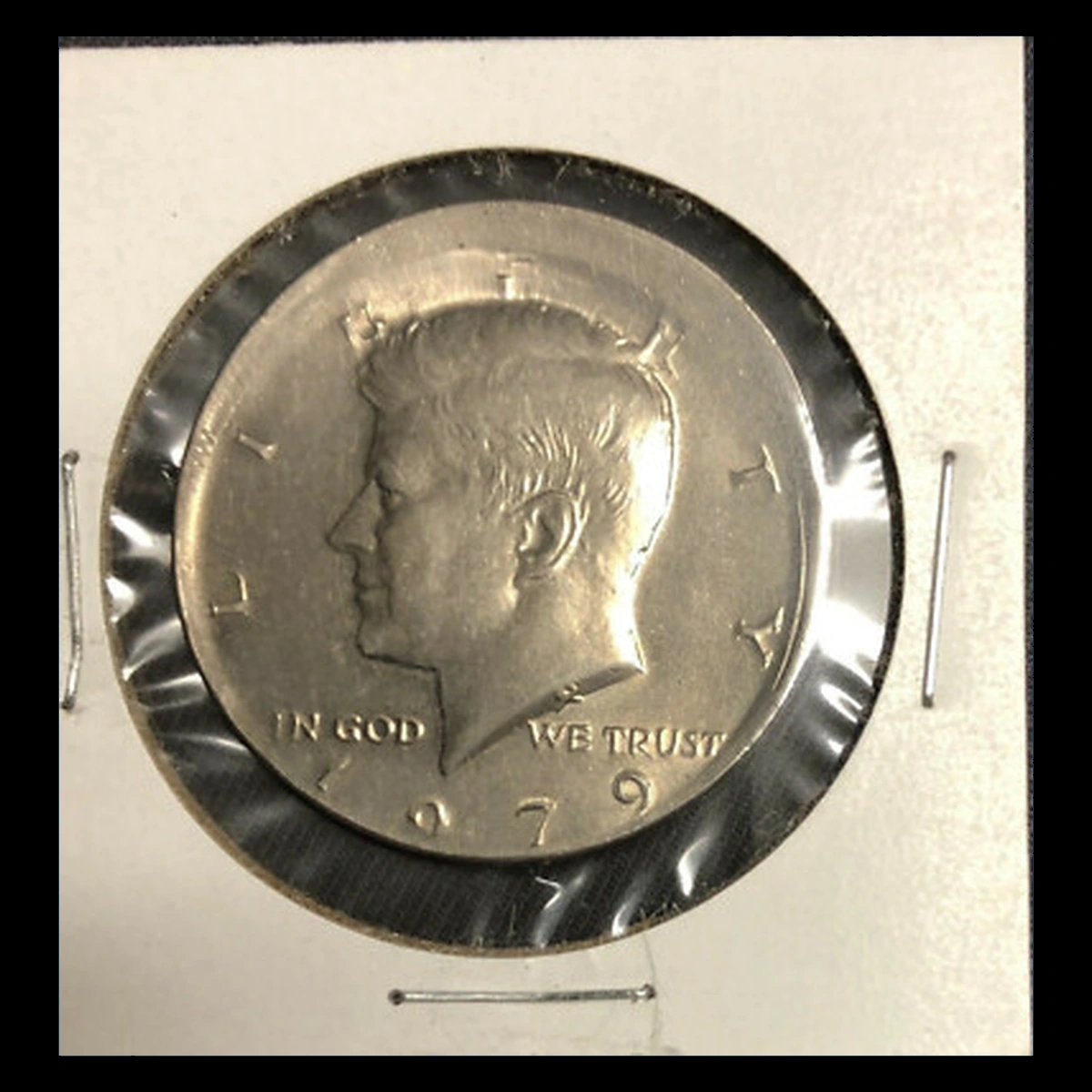
8. 1979 Half Dollar The full design sits within expanded metal: Broadstrike Error
A Philadelphia PCGS MS63 appeared in June 2014 as an uncentered broadstrike. The collar failed to restrain the blank, allowing an unevenly placed but complete design within a wider outline.
General reports also include Denver. They do not establish the same error on a San Francisco Proof.
How to Identify
Follow the whole design before measuring its distance from the edge. Complete design on spread metal differs from off-centering that loses part of the intended picture.
Inspect the margin and edge grooves for original flow rather than crushed details from hammering. Measure several widths because expansion can be uneven.
What It’s Worth
The estimated range is $50–$650. No realized price is assigned to the June 2014 Philadelphia listing.
A 1990-P broadstrike in ANACS MS61 brought $192 in March 2025. Its different date and lower preservation need to remain part of the comparison.
9. 1979 Half Dollar A shifted design leaves genuine blank metal: Off-Center Strike Error
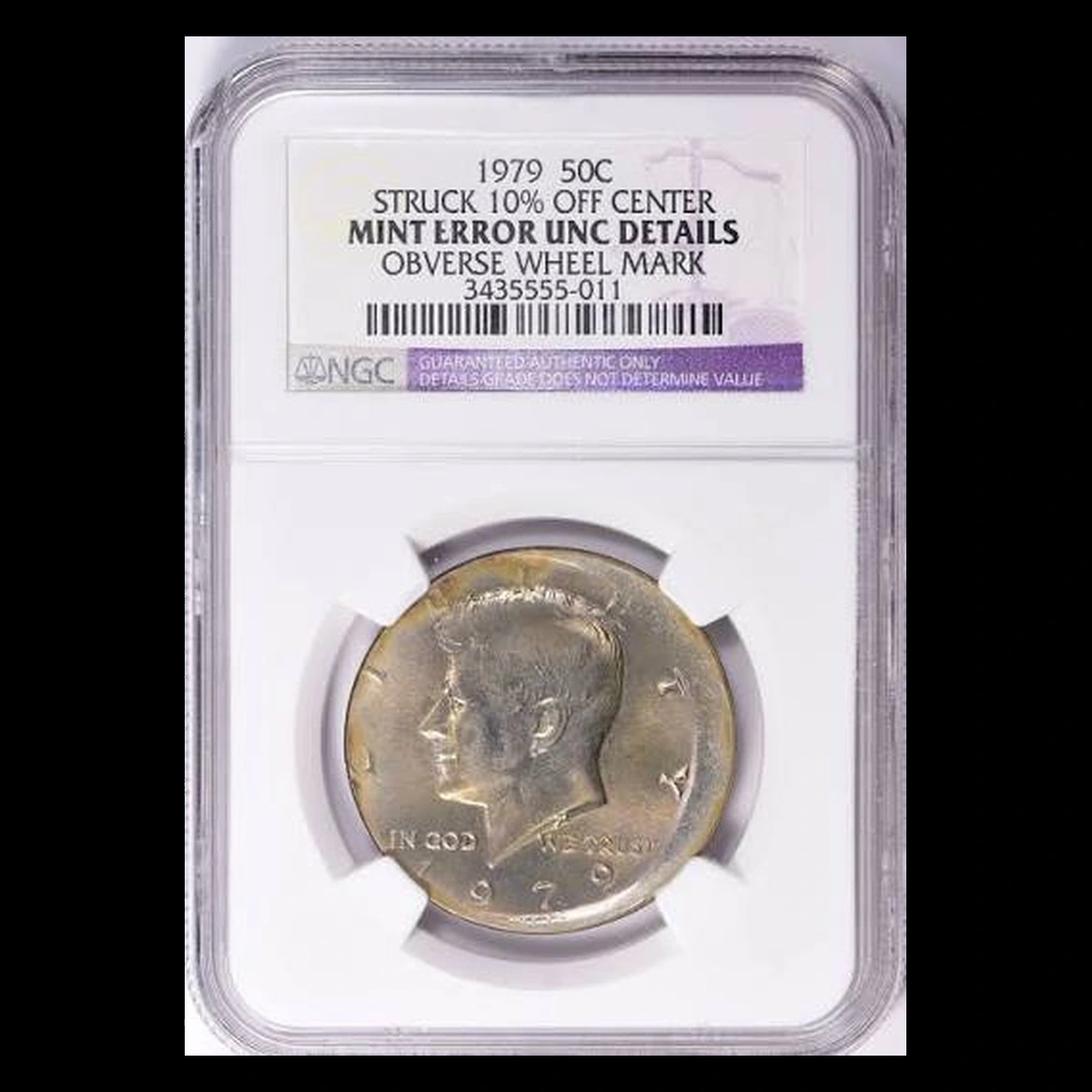
The Philadelphia PCGS MS62 is 10% off center toward 4 o’clock; a separate PCGS MS65 is 12% off center. An NGC MS67 with a readable date is 80% off center toward 12 o’clock, but its mint is not established.
How to Identify
Find unstruck metal opposite the design lost beyond the blank and compare both faces. An uneven broadstrike retains its complete intended design.
Inspect the apparent blank area for cutting or flattening and read the surviving date before attribution. Lack of visible mint lettering does not establish Philadelphia for the severely displaced example.
What It’s Worth
The estimate is $75–$2,500. The 12% PCGS MS65 sold for $1,680 in July 2021.
A 1990-P at 10% off center in NGC MS66 brought $198 in September 2025. The large difference illustrates why condition, appearance, and the actual transaction matter more than percentage alone.
10. 1979 Half Dollar The eagle nearly reverses after a controlled flip: Reported Rotated Dies Error
The specialist listing describes a 1979-D with 178 degrees clockwise reverse rotation, almost a half turn. It is marked as awaiting CONECA verification and should retain that reported status.
How to Identify
Set Kennedy upright against a fixed reference and flip top to bottom without twisting. A genuine near-178-degree rotation should consistently leave the reverse nearly upside down.
Film the turn or preserve orientation in a holder instead of relying on separately straightened photographs. Inspect the edge for seams suggesting joined coin halves.
What It’s Worth
A clear genuine rotation of this size has an estimated $50–$350 range. A 2000-P with 75-degree rotation in PCGS MS61 sold for $79 in March 2025.
Two 1988-P examples with roughly half-turn alignment brought $288 together in July 2021. That combined lot price is not a result for one 1979-D or evidence of CONECA approval.
11. 1979 Half Dollar Kennedy’s design crowds a dollar-sized blank: Susan B. Anthony Planchet Error
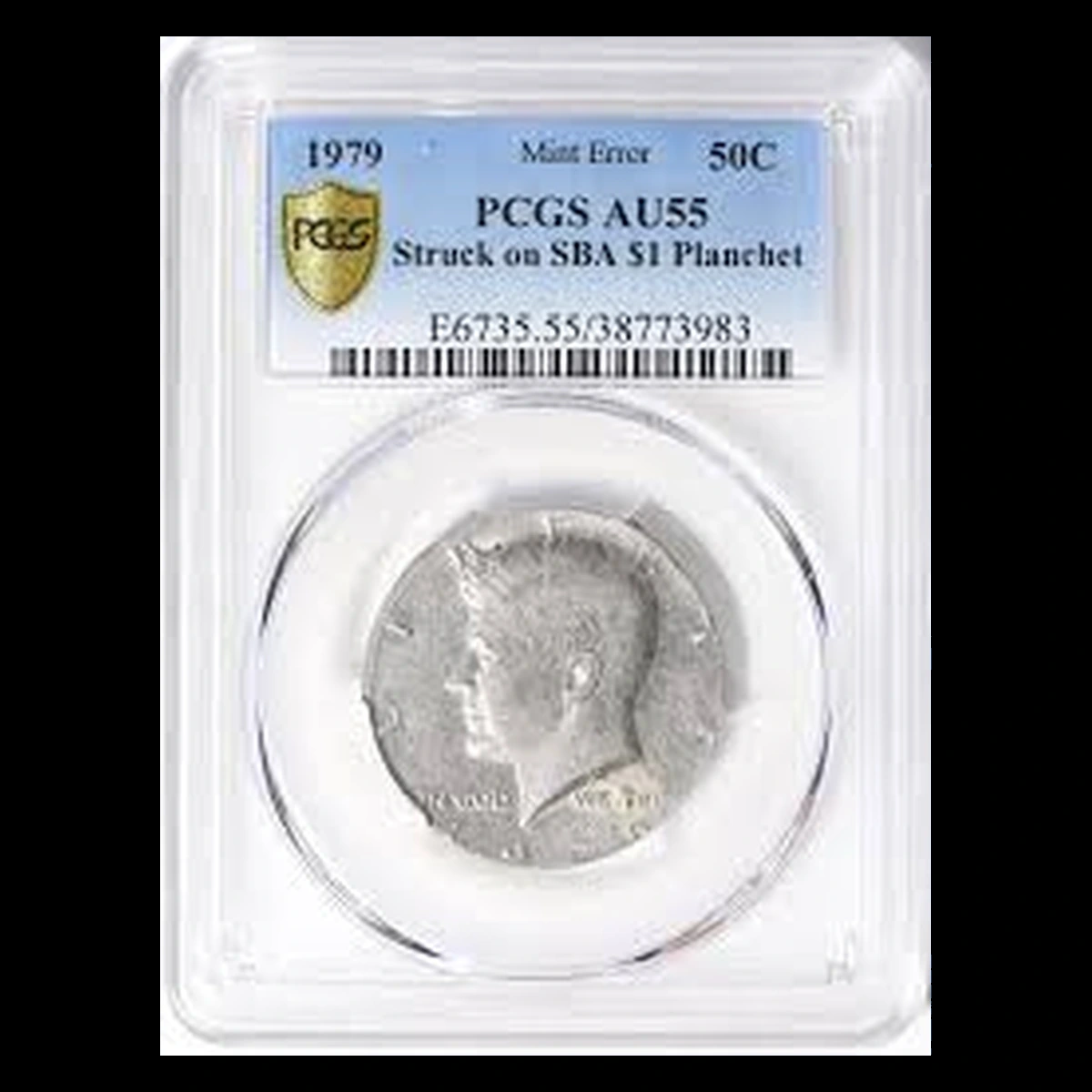
The Philadelphia NGC AU58 is recorded at 8.1 grams on a blank intended for a Susan B. Anthony dollar. A Denver example is separately reported in an exhibit account and does not inherit that grade or measurement.
These were blank metal discs rather than finished Anthony dollars. An underlying Anthony portrait is not required.
How to Identify
Compare weight with the dollar blank’s 8.1-gram standard and starting diameter around 26.5 millimeters. Striking may expand it, so the starting width is not an exact final measurement.
Inspect original edges and clad layers for trimming, and check that oversized half-dollar details end naturally at the smaller boundary. Philadelphia’s missing P is normal and does not itself identify the blank.
What It’s Worth
The estimated range is $500–$3,000. A 1979 example in PCGS AU55 sold for $630 in September 2025, separately from the recorded NGC AU58.
A 1980-P on the same blank type in NGC MS66 brought $1,920 in December 2024. Its different date and much higher preservation qualify that comparison.
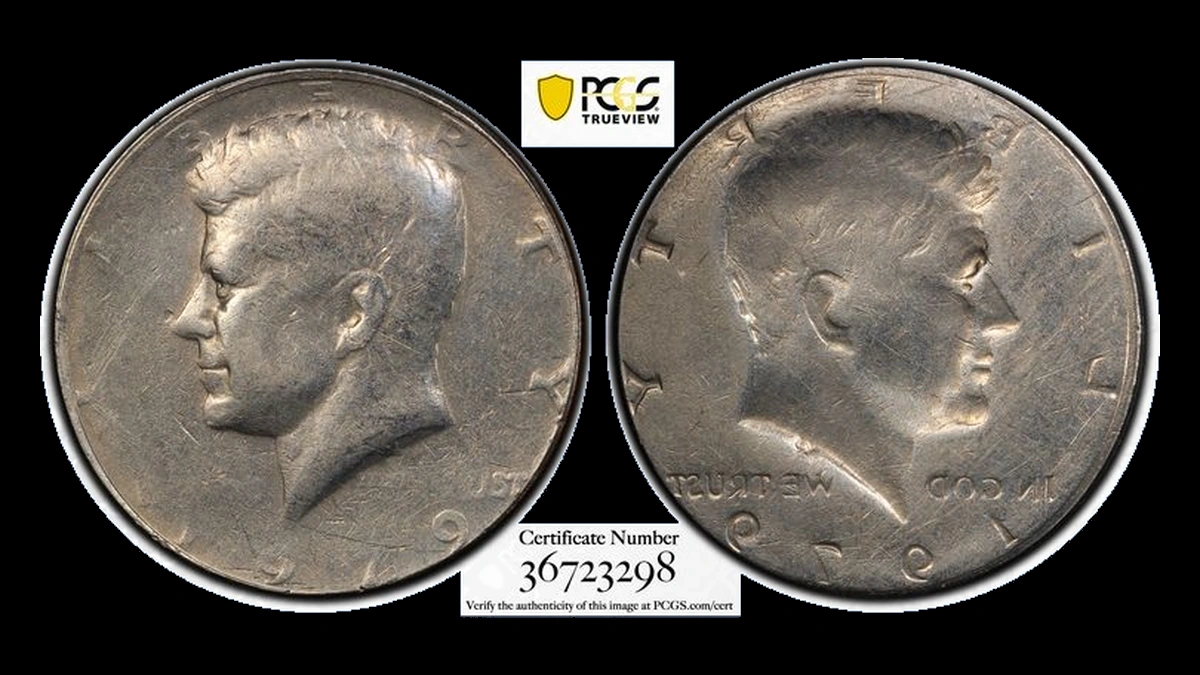
12. 1979 Half Dollar One portrait is recessed and backward: First-Strike Brockage Error
The PCGS XF45 example is described as a first-strike brockage, preserving a transferred image from early contact before repeated blows could distort it. A previously struck coin impressed its raised design into the next blank.
How to Identify
Confirm both reversed orientation and recessed relief under changing light. Two ordinary raised portraits do not demonstrate brockage.
Inspect the edge for seams, filing, or glue, and compare the normal and transferred faces together. Normal dimensions cannot by themselves rule out joined pieces or later pressure transfers.
What It’s Worth
The estimate is $500–$4,000, with broad readable images providing stronger comparisons than tiny partial impressions. The XF45’s April 2019 appearance supplies no realized amount here.
A 1989-P with only 4% partial brockage plus a partial collar brought $119 in March 2025. That smaller combined error is not equivalent to a broad first-strike brockage.
13. 1979 Half Dollar Separate impressions survive on a coin or matching pair: Multiple Strikes Error
Both PCGS MS64 labels on the mated 1979 pair say double struck, while a published explanation proposes three blows for one piece and two for the other. The pair has linked reversed impressions and a final strike 50% off center toward 2:30.
Separate records describe a Philadelphia MS63 with a 65%-off-center second strike, an ANACS net MS60 with an 80% second strike and blank obverse area, and a reported Denver MS64 with its second strike toward 2 o’clock. Their features should not be merged.
How to Identify
Trace separate design positions across several related details rather than treating one doubled outline as another full blow. The ANACS net grade is an adjusted condition assessment, not a change to the reported strike count.
For the pair, compare linked impressions through photographs and preserve the shared history without stacking or pressing the coins together. Inspect and measure each piece individually.
What It’s Worth
Individual multiple strikes are estimated at $300–$3,000 and the matching pair at $4,000–$10,000. A published $7,500 book value is a historical valuation for both coins, not an auction result.
A 1989-P with its second strike 65% off center sold for $2,400 in July 2022. That single other-year coin must not become a sale of the 1979 pair or a value independently assigned to each companion.
Conclusion
Peeling, missing cladding, heating-related color, and material impressed during striking can look alike at first but leave different structural evidence. Keep both faces and the edge connected to the same coin’s identity.
The most complex records require equal care: the rotation awaits the stated verification, the 80% offset has no established mint, and the mated pair carries a historical whole-set valuation. None of those missing details should be filled by borrowing from another specimen.