Rare 1828 Half Dollar Errors (List & Pictures)
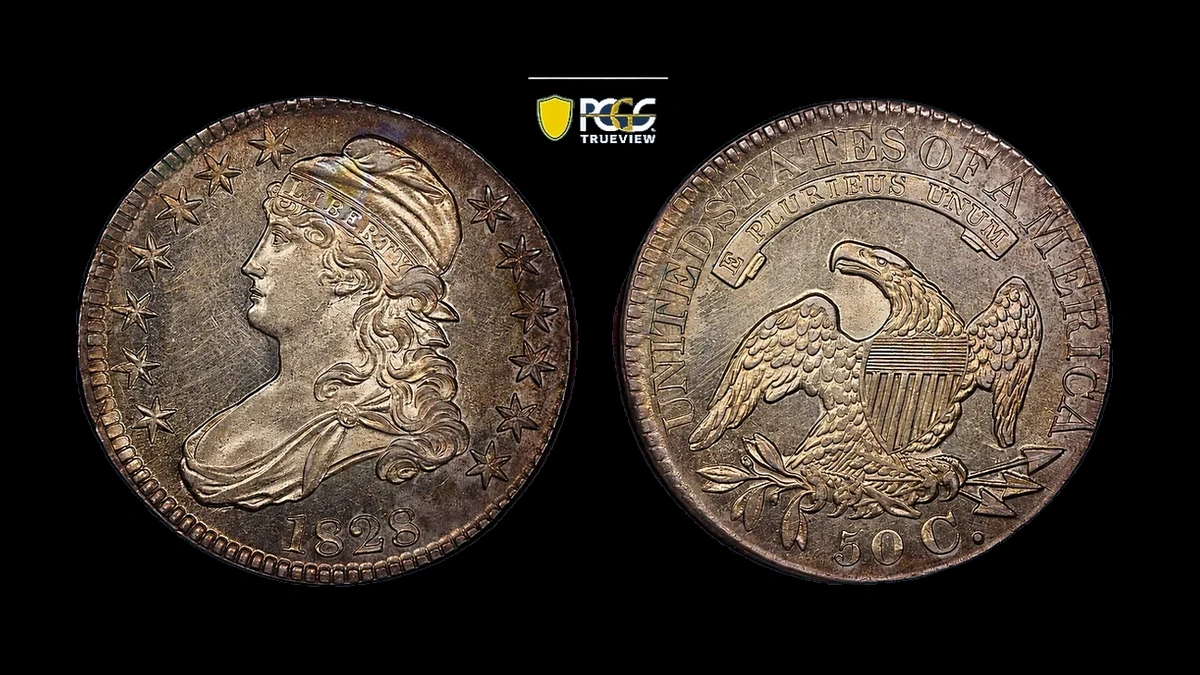
Inspect the edge as well as the two faces when checking 1828 half dollar errors. A coin with repeated edge words reached $3,840 in November 2019, while smaller clues include neck bumps and an altered letter beneath the eagle.
The estimated whole-coin range is $100–$4,000. Start at Liberty’s neck, turn to the reverse lettering, and finish with a careful record of the edge inscription.
| Clue | Location | Error | Estimated value |
|---|---|---|---|
| Small raised grains | Liberty’s neck on O-110 | Die rust | $150–$1,500 |
| Extra detail on C | 50 C below the eagle | Recut denomination | $150–$2,300 |
| A long ridge along letter tops | Outer reverse inscription | Die crack | $100–$2,200 |
| Overlapping words | Lettered edge | Doubled edge lettering | $250–$4,000 |
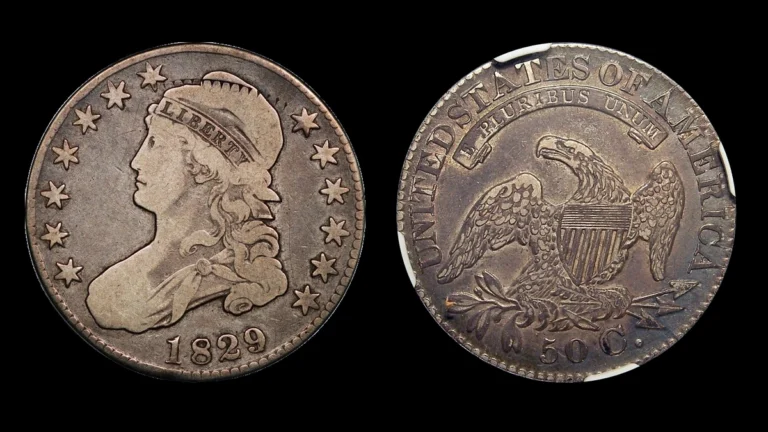
The O-numbers below identify different die varieties, meaning coins made with particular pairs of stamping tools. Normal size is roughly 32.5 mm and normal unworn weight about 13.48 grams; the edge has words rather than grooves.
1. 1828 Half Dollar Tiny Bumps Cover the Neck: Die Rust Error
Roughness on Liberty’s neck can be raised rather than eaten into the silver. The reported O-110 pattern consists of small grains copied from a rust-pitted die.
A die is the steel tool that stamps the design. When rust creates hollows in its surface, coin metal can enter those hollows and emerge as bumps.
How to Identify
Light the neck from a low angle and inspect the grains with a magnifier. Their height matters: corrosion attacking the coin itself tends to leave pits rather than this raised texture.
The collector discussion of 1828 varieties provides the reported O-110 comparison. Match the arrangement across the neck instead of treating a color change as evidence of rough metal.
A separate O-101 report mentions a defect inside F in OF. It is a different observation on a different variety and should not be used to explain every neck bump.
Stuck debris, solder, or displaced metal from a hit can stand above a surface too. Consider the outline of the whole patch and its correspondence with the documented variety.
What It’s Worth
Estimated range: $150–$1,500 for worn through selected lower-grade unworn coins. An O-110 graded MS63 sold for $1,320 in February 2020.
MS63 indicates an unworn coin with visible surface marks. That transaction values the whole coin rather than assigning a separate premium to its neck texture.
An O-101 sold for $240 in June 2025 with slight wear and a cleaning problem. Its lower result illustrates why a small unusual feature does not cancel the effect of impaired surfaces.
2. 1828 Half Dollar The Top of C Has an Extra Outline: Recut Denomination Error
Beneath the eagle, locate the denomination 50 C. On O-117, the upper end of C retains additional detail from recutting the letter in the die.
Parts of an earlier letter shape remained after that work. The resulting outline could appear on many coins made with the tool.
How to Identify
Compare C’s upper end with the documented O-117 image. Keep 50 and the neighboring surface visible so the correct letter and location stay clear.
The target is a surviving piece of the letter’s earlier shape. A flat shelf alongside a character, caused by movement during striking, does not establish recutting.
Inspect for fresh cuts or other signs of later work. Polishing the area to reveal it would remove useful surface evidence rather than improve the identification.
The same die family can also carry the later crack described next. The recut letter and crack are separate features on one complete coin.
What It’s Worth
Estimated range: $150–$2,300 from ordinary worn coins through selected high-grade examples. An O-117 in MS64, an unworn grade, sold for $2,040 in August 2023.
The value depends on the coin’s preservation and variety as a whole. A scratched later-state O-117a brought only $216, so the extra C outline does not guarantee the stronger end of the range.
3. 1828 Half Dollar A Ridge Follows the Reverse Lettering: Die Crack Error
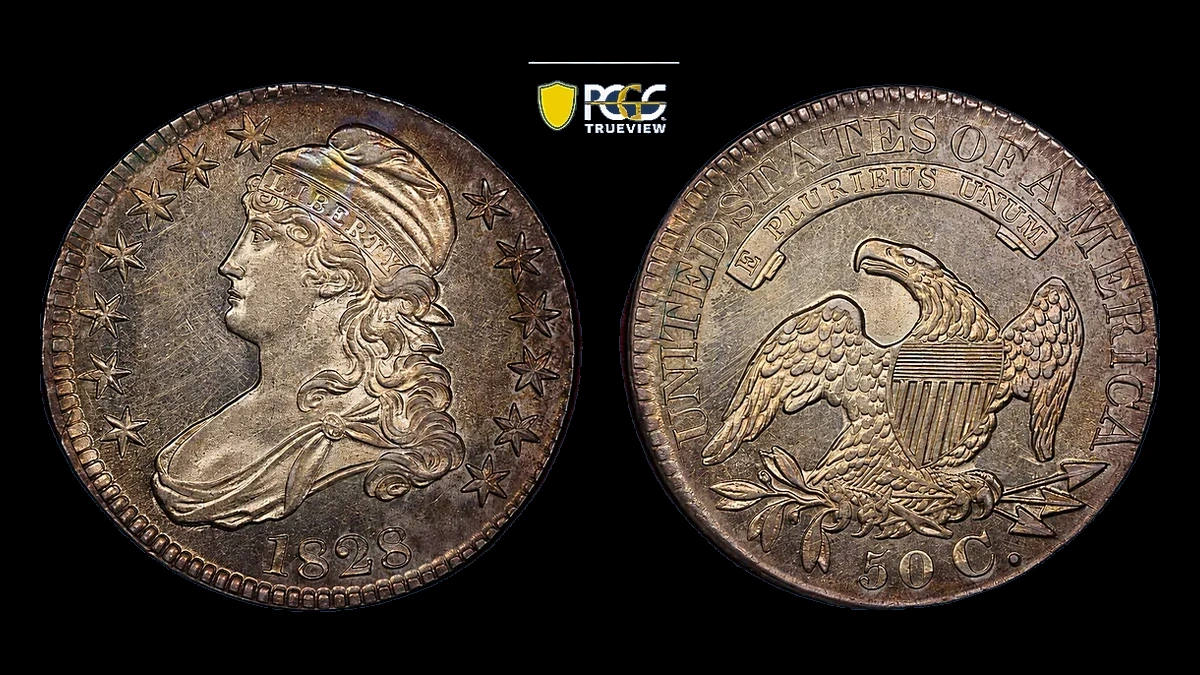
On O-117a, the path begins beneath the eagle’s left wing and continues along the tops of UNITED STATES OF A. It reaches the border above M.
This long raised line records a fracture in the reverse die. Silver entered the opening during striking, leaving a ridge rather than a cut in the finished coin.
How to Identify
First choose the correct design combination: a square-based 2, small 8s, and large reverse letters. These normal design details help identify O-117a and are not extra errors themselves.
Follow the line continuously from the wing through the letter tops. Some stretches may be weak because the crack developed over time or because later wear softened the ridge.
Inspect under side lighting to distinguish raised metal from a scratch. A few separate marks near the inscription do not substitute for the complete matching route.
What It’s Worth
Estimated range: $100–$2,200 for circulated coins through selected MS62 examples. An unworn MS62 O-117a sold for $1,980 in August 2019.
A scratched XF Details example brought $216 in August 2025. XF indicates substantial remaining detail, while Details flags the condition problem preventing a normal numeric grade.
These results concern different-quality whole coins. Do not add a recut-denomination estimate to a crack estimate when both features belong to your single example.
4. 1828 Half Dollar The Edge Words Repeat: Doubled Edge Lettering Error
FIFTY CENTS OR HALF A DOLLAR was intended to appear once around the edge. Some 1828 coins have overlapping impressions produced during the separate lettering step.
The edge received its words before the portrait and eagle were struck. Repeated edge text therefore does not by itself mean either face was struck twice.
How to Identify
Read around the actual edge and mark your starting position in the photographic record. Overlapping photographs can repeat a section even when the metal does not.
Seek a second impression that crosses or duplicates part of the first lettering. Ordinary spacing at the join, or an inscription facing the opposite reading direction, does not prove doubled lettering.
Keep both faces with the edge photographs to preserve the date and variety identification. Check crowded areas for filing, jewelry damage, or letters punched into the edge later.
An illustrated O-114 and an auctioned O-123a both show this category. Their separate variety names remain relevant even though both have repeated words.
What It’s Worth
Estimated range: $250–$4,000. One XF45 O-123a sold for $3,840 in November 2019 and $1,920 in January 2025.
Those are two transactions for the same worn coin with strong remaining detail. Its scarce variety and ownership history contribute to the comparison.
An O-114 with doubled words needs its own condition and rarity assessment. The shared edge error does not make it equivalent to that O-123a.
Conclusion
An 1828 half dollar rewards inspection at three scales: tiny neck grains, connected reverse details, and the full edge inscription. Keep the variety identification attached to each close-up.
The estimated $100–$4,000 span includes very different surfaces and grades. The recut C and later crack may belong together, while repeated sales of one doubled-edge coin demonstrate how a historical result can change over time.