Rare 1990 Half Dollar Errors (List & Pictures)
A half dollar missing its obverse clad layer sold for $432 in March 2023. That coin was a 1974-D, providing a different-year comparison for the reported 1990 category.
Estimated 1990 half dollar errors values span $10–$850. Start with missing or weak details, then compare the edge and positions of the designs.
Normal specifications are 11.34 grams and approximately 30.61 millimeters, with a reeded edge. Regular 1990 halves, including S proofs, have copper-nickel outer layers around a copper core.
| Clue | Possible explanation | Estimated whole-coin value |
|---|---|---|
| Weak portrait base | Reported grease strike-through | $10–$150 |
| Absent reverse initials | No FG | $50–$150 unworn |
| Copper-colored face and low weight | Missing clad layer | $150–$600 |
| Gap in the outline | Clipped planchet | $25–$250 |
| Full designs inside spread metal | Broadstrike | $100–$500 |
| Overlapping designs plus spreading | Double strike with broadstrike | $90–$800 |
| Displaced design and blank crescent | Off-center strike | $75–$850 |
| Repeated letter contours | Reported doubled obverse | $25–$300 |
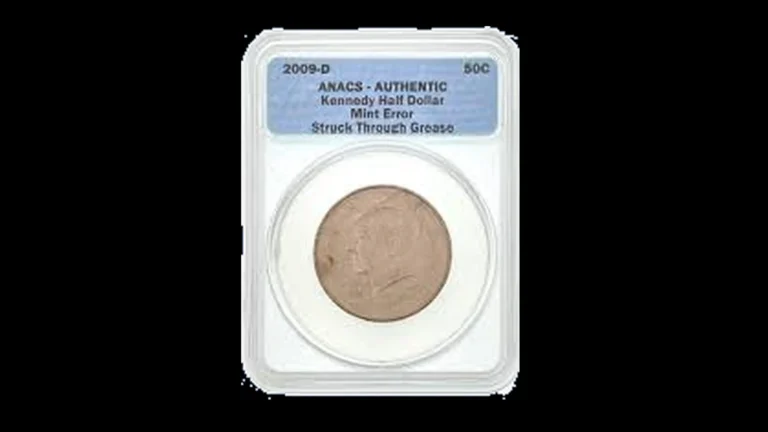
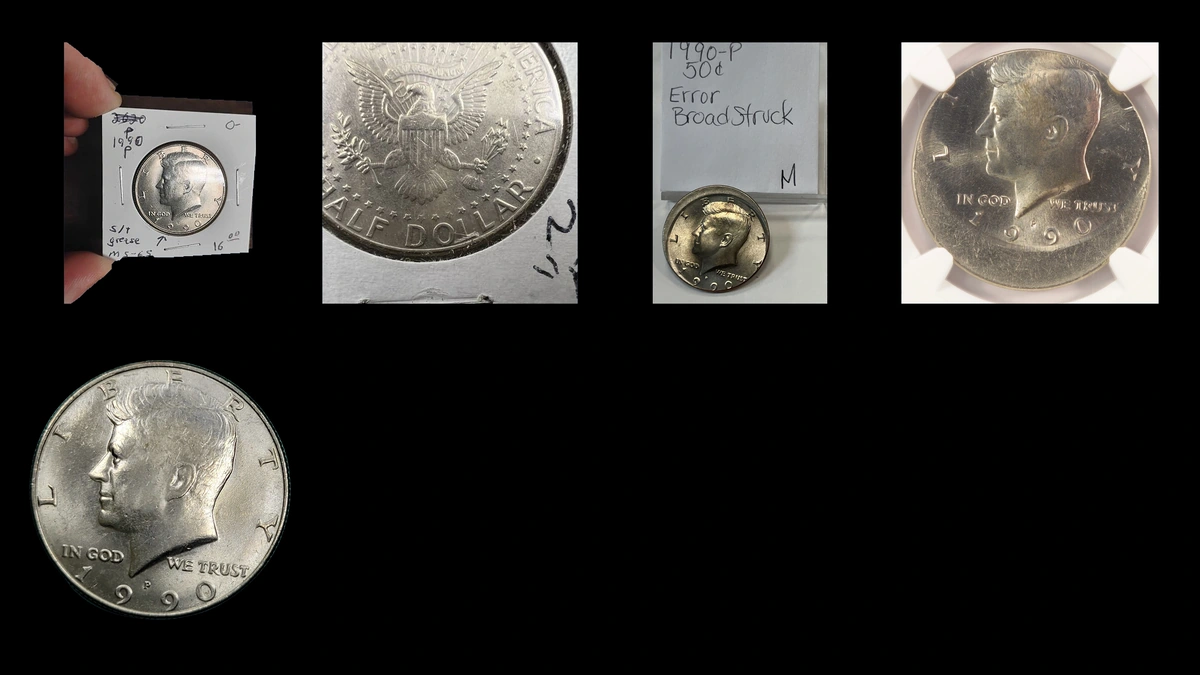
1. 1990 Half Dollar The Base of Kennedy’s Portrait Is Weak: Reported Grease Strike-Through Error
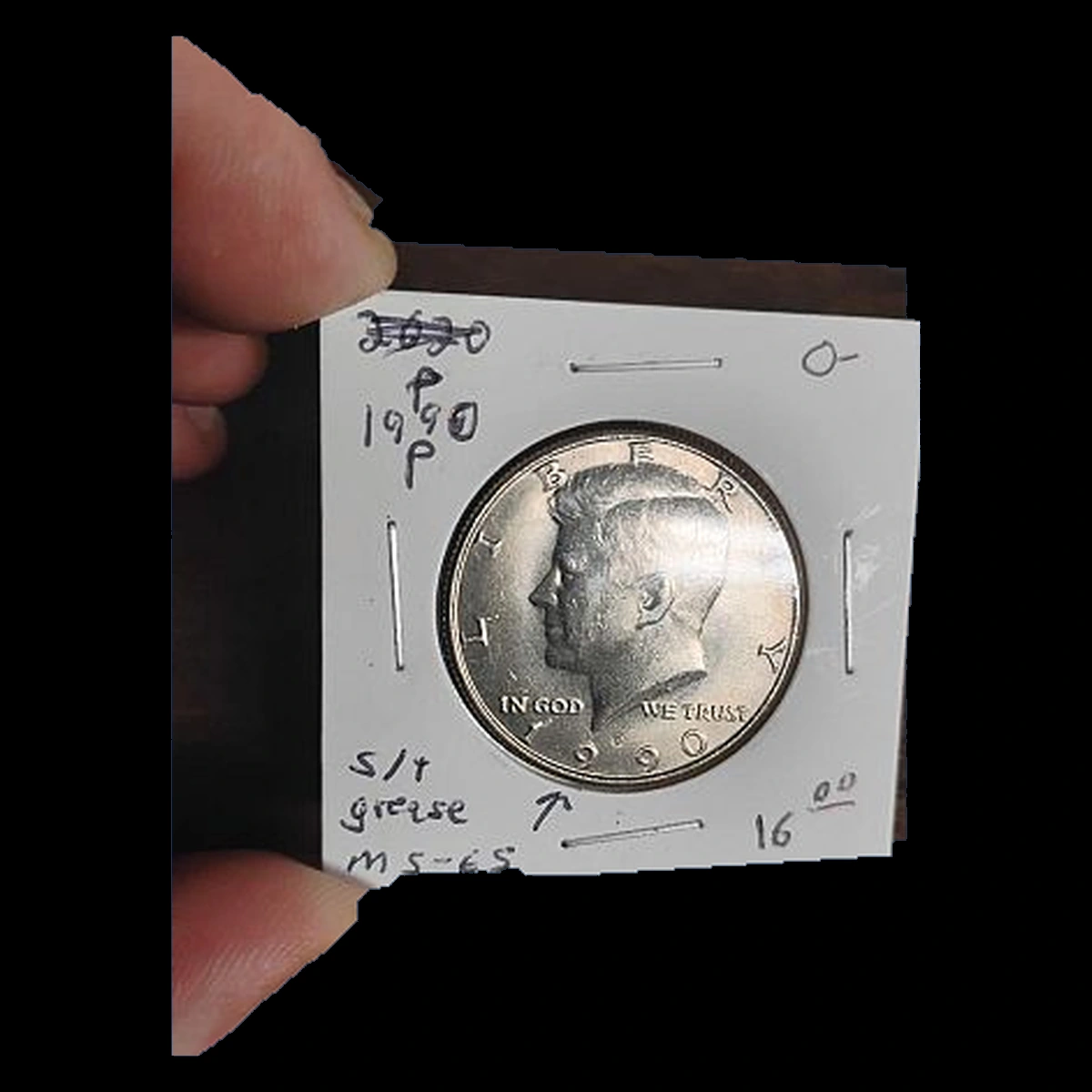
A seller describes a 1990-P with weakness at the base of the bust as struck through grease. Material clogging recesses in a die can prevent the blank’s metal from filling those parts of the design.
The result can be localized missing detail while nearby areas remain sharp. The source offers a seller’s diagnosis and MS65 opinion, not an independent grading-service assessment.
How to Identify
Compare the weak portrait base with Kennedy’s hair and face. Widespread smoothing of exposed high points would favor normal wear over one blocked area.
Look for polishing lines or abrasion crossing the affected patch. Local weakness is most useful when the adjacent detail and original surface remain intact.
Confirm the date and P before matching this report. A normal edge and weight help document the coin but cannot identify grease as the cause.
What It’s Worth
Confirmed minor through clearly visible grease-related weakness has an estimated $10–$150 range. The amount of interrupted design and surface condition affect interest.
The reported 1990-P is offered for $9.99 before shipping. That asking price and the seller’s MS65 grade should not be presented as a completed sale or certified condition.
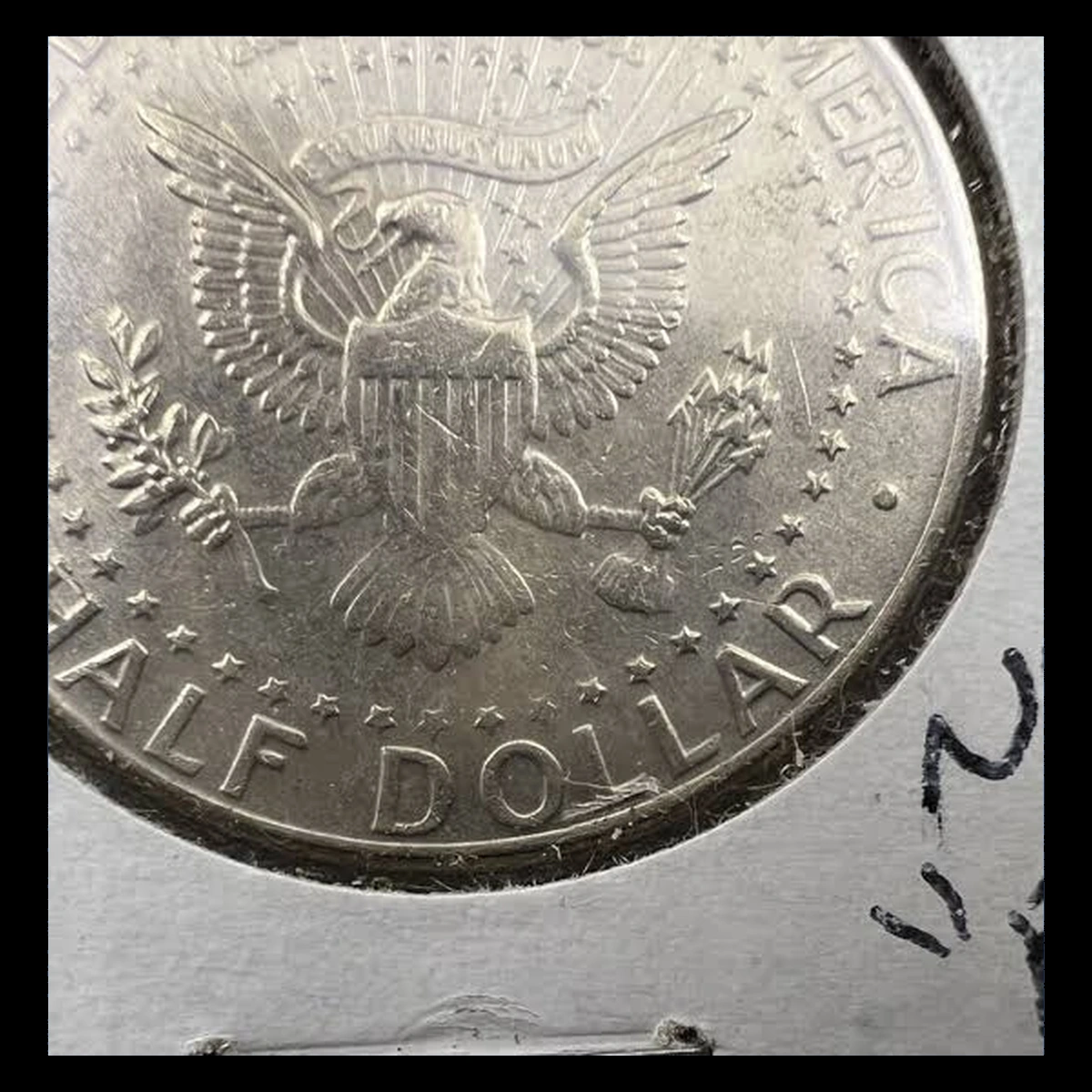
2. 1990 Half Dollar The Initials beside the Tail Are Empty: Missing FG Error
FG identifies reverse designer Frank Gasparro. Reported 1990-P No FG coins require complete absence of those letters, rather than merely weak strokes.
Die polishing can remove shallow details before striking, but wear, residue, and rubbing can hide them afterward. The neighboring eagle detail and surface therefore matter as much as the initials’ location.
How to Identify
Locate FG on a normal Kennedy half, then inspect the same area on the candidate through several light angles. One hidden surviving stroke can change a No FG claim to weak initials.
Compare the tail and nearby leg for wear and inspect the small field for rubbing or a dull patch. Do not clean the area to search for letters.
Clear surrounding detail supports further investigation but does not by itself establish die polishing. Record the whole reverse alongside the closeup.
What It’s Worth
The year guide estimates $50–$150 for unworn No FG examples. No verified sale of a particular 1990 coin is supplied for that range.
Original surfaces and fully absent initials are essential to the comparison. Faint letters or a rubbed patch should not automatically receive the same premium.
3. 1990 Half Dollar One Face Exposes Copper: Missing Clad Layer Error
A copper-colored face becomes more significant if one outer layer is physically absent. Separation during production can expose the core while leaving an original struck design on that face.
The supplied 1990 report establishes no specific mint, affected side, or measured weight. Heat, chemicals, plating, and scraping can also change color, so appearance alone is insufficient.
How to Identify
Weigh the coin, then inspect the layer arrangement at the edge. Loss of a layer should reduce weight while leaving diameter near the normal half-dollar size.
Examine the exposed face for undamaged struck detail and compare it with the remaining clad face. Scraping may expose copper and reduce weight, but it also removes or damages the finished surface.
A silver-proof explanation does not fit 1990’s regular construction. Evaluate the missing layer itself rather than assigning an unsupported metal issue from color.
What It’s Worth
The broader comparison-based estimate is $150–$600, while the year guide lists $150–$300. Completeness of the missing layer and attractive original surfaces influence the comparison.
A 1974-D missing its front layer sold at Heritage for $432 in March 2023, graded NGC MS64 and recorded at 9.34 grams. That weight belongs to the 1974-D specimen and is not a measurement of a 1990 coin.
4. 1990 Half Dollar A Section Was Missing before Striking: Clipped Planchet Error
A clipped planchet is an incomplete prepared blank. Its rim and designs form around metal that was already missing.
The 1990 category has no specified mint, gap shape, or position in the supplied material. Curved and straight gaps can reflect different blank-cutting circumstances, while later cutting can imitate either outline.
How to Identify
Inspect both ends of the gap and the exposed layers within it. Original rim and nearby lettering should approach the opening naturally rather than show a clean slice through completed details.
Look for burrs, saw marks, or filing in the remaining edge grooves. Opposite-rim weakness may support the diagnosis but is not obvious on every clip.
Measure an intact width and compare missing weight with the amount of absent metal. A larger gap is not automatically more desirable if important identifying details are lost.
What It’s Worth
Ordinary genuine clips have an estimated $25–$250 value. Visibility, original surfaces, and overall preservation help narrow it.
A 1993-D curved clip graded ANACS MS64 sold for $34.74 including the buyer’s fee in August 2025. It offers a nearby-year comparison without establishing a 1990 sale.
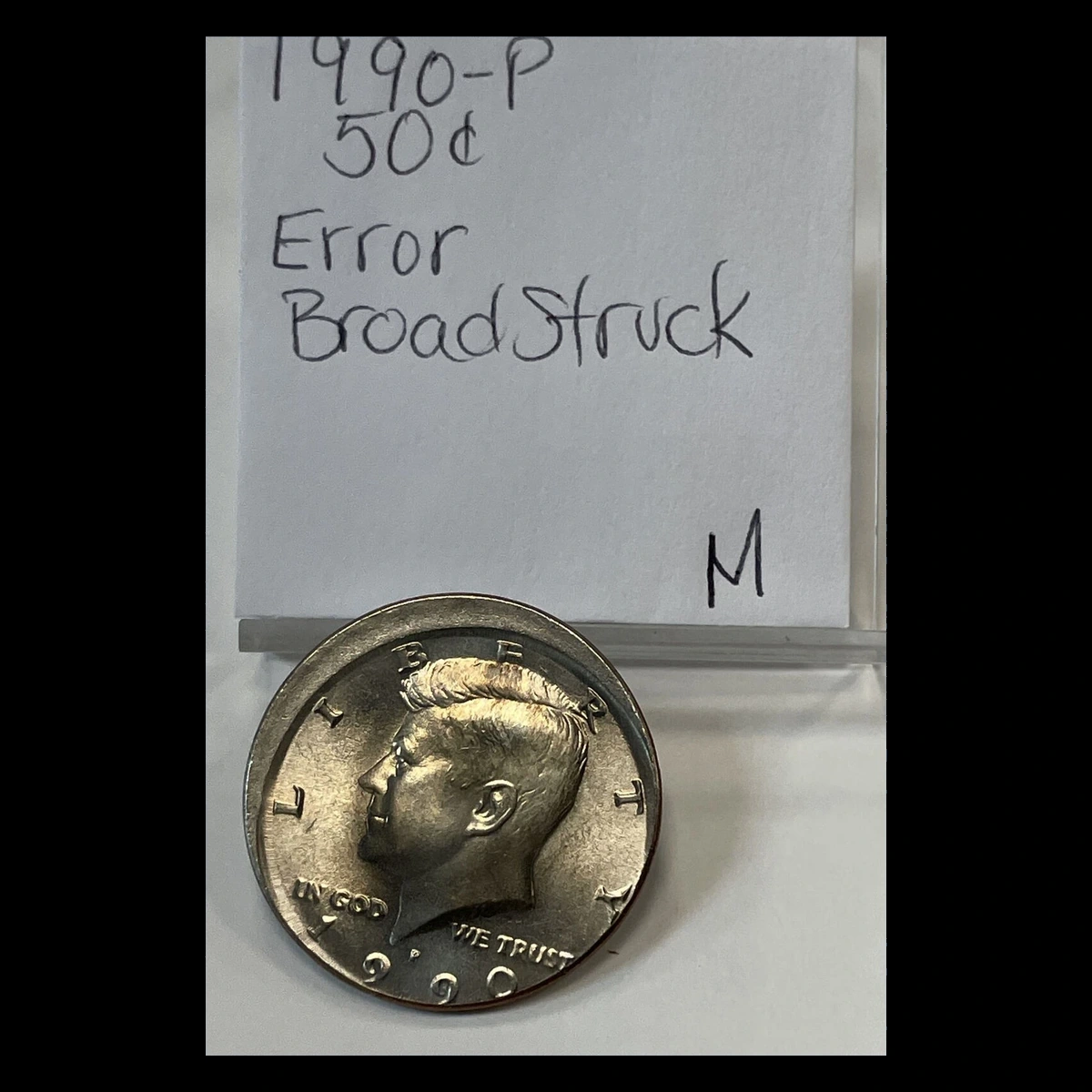
5. 1990 Half Dollar The Full Design Fits inside an Expanded Border: Broadstrike Error
The confirmed 1990-P broadstrike category includes an ANACS MS61 example. Its metal spread because the collar, the ring that normally limits the blank’s width, did not provide normal restraint.
The design can sit unevenly inside the spread metal while remaining complete. That appearance differs from an off-center strike that loses part of the design.
How to Identify
Check all outer lettering and design elements on both faces. Then measure several widths and inspect where edge grooves end or fail to form.
Spreading by itself removes no metal, so weight should stay compatible with the normal blank. Examine the surfaces for later hammering or grinding that could create a misleading wide outline.
Also search for repeated impressions, but treat them as a separate question. A plain broadstrike does not automatically share the double strike discussed next.
What It’s Worth
Similar genuine broadstrikes have an estimated $100–$500 range. Spread, visual appeal, and surface condition all contribute.
The ANACS MS61 1990-P sold for $192 at Heritage on March 31, 2025, while another graded MS65 brought $119 in January 2023. Their differing prices show why grade alone does not rank the appeal of individual errors.
6. 1990 Half Dollar Close Impressions Overlap within a Wide Outline: Double Strike with Broadstrike Error
The known PCGS MS62 1990-P preserves two close impressions and outward spreading. One feature records repeated striking, while the other records lack of normal collar restraint.
A large separate portrait is unnecessary when the coin moved only slightly between blows. The catalog gives no exact angle or displacement percentage for this specimen.
How to Identify
Follow remnants of one impression beside or under the other across several design elements. They should agree on a coherent movement rather than consist of one flat shelf beside a letter.
Compare the Stack’s Bowers close-overlap example, then inspect its broadened edge separately. Do not derive an unsupported angle from the general error name.
Record expansion with calipers and examine edge reeding for evidence of the striking sequence. A second blow adds no metal, although later damage can complicate both shape and weight.
What It’s Worth
The combination has an estimated $90–$800 range. Its clarity and preservation determine the usefulness of another coin as a comparison.
A different 1990-P with both strikes broadened sold for $94 in December 2009. A 1998-P double strike with a broadened second impression, graded CACG MS64, sold for $317.20 in June 2026.
Those examples do not establish a supplied realized price for the PCGS MS62 close-overlap coin. The two features on one piece should be valued together.
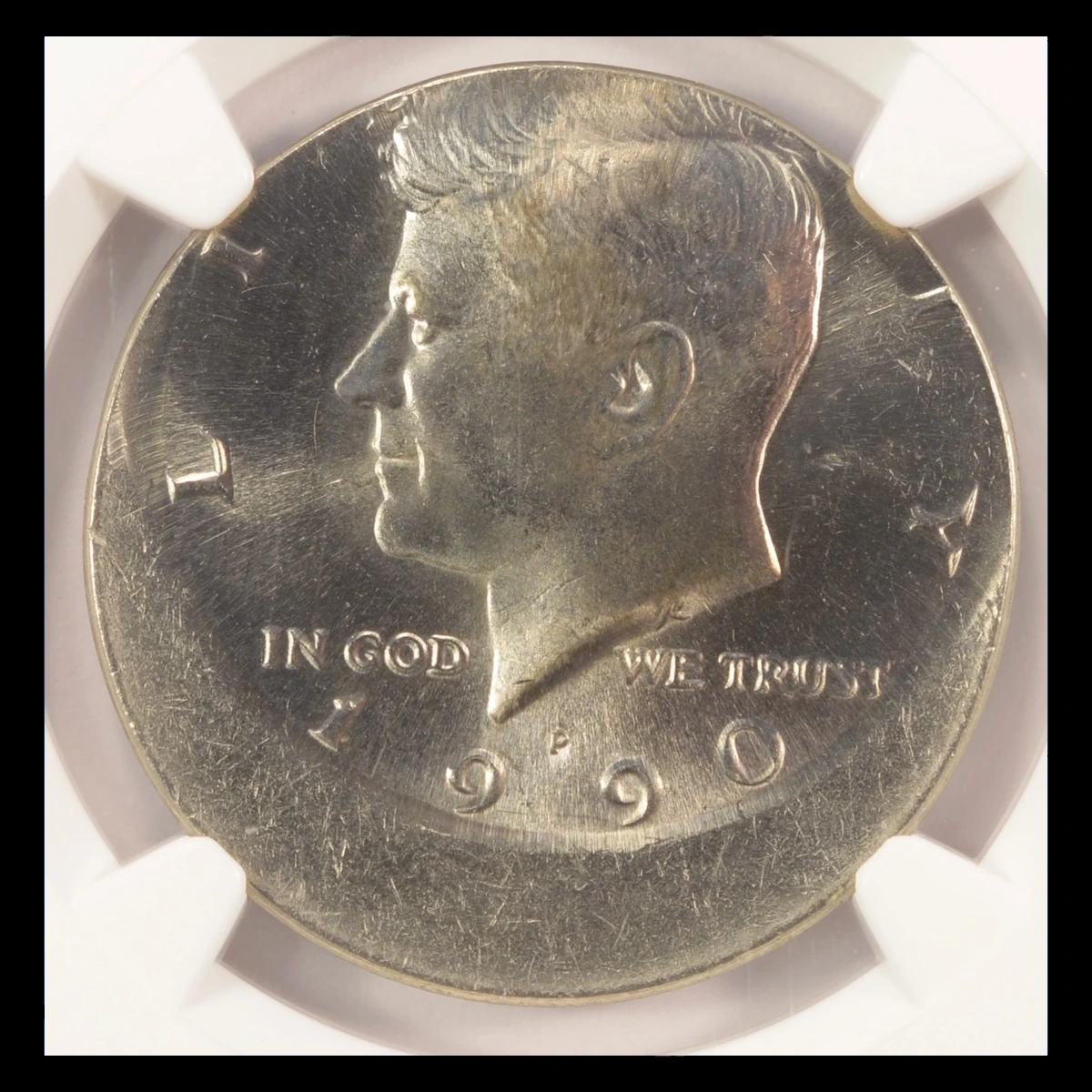
7. 1990 Half Dollar Untouched Metal Sits beside a Shifted Design: Off-Center Strike Error
A blank partly outside the dies receives only part of the intended image. The opposite area remains unstruck, creating a relationship between missing outer detail and plain metal.
One cataloged 1990-P is described as fifteen percent off center, while other examples have different displacements. The percentage belongs to an individual coin rather than the year as a whole.
How to Identify
Read the date and mintmark before estimating the shift. Compare the design-to-blank boundary on both faces and make sure the missing details fit that position.
Inspect the plain area and edge for cutting or filing. A wide border on only one side may reflect die misalignment rather than an off-center blank.
Measure the actual outline without assuming all examples match the fifteen-percent catalog description. Preserve complete photographs for assessing the balance of struck and blank metal.
What It’s Worth
Estimated values are $75–$850 across modest shifts and more striking attractive examples. The amount of displacement is only one factor.
A ten-percent-off-center 1990-P graded NGC MS66 sold for $198 in September 2025 according to Heritage’s record. Its date visibility, preservation, and particular appearance make it a more useful comparison than an unsupported high-price claim.
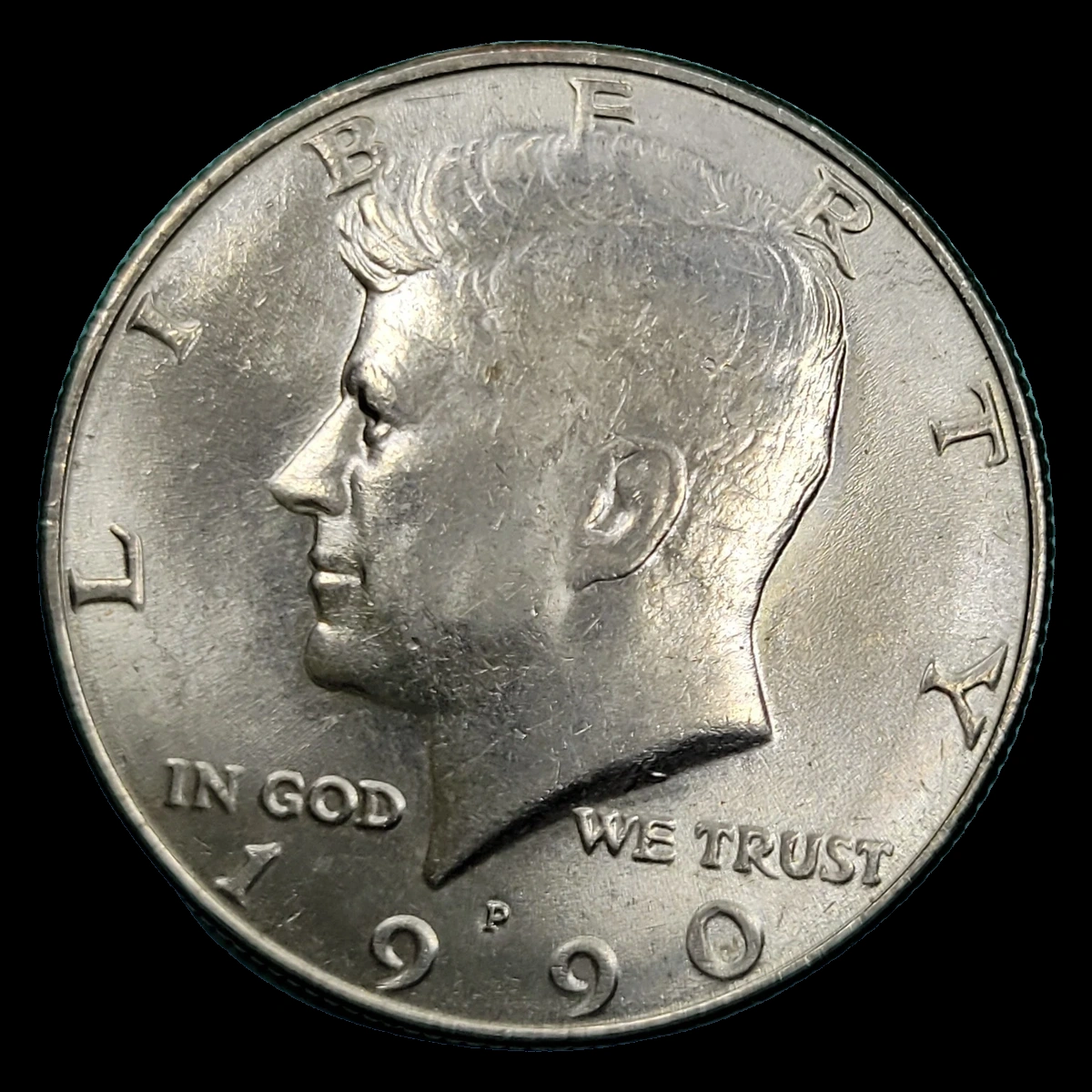
8. 1990 Half Dollar Front Letters Show Rounded Repetition: Reported Doubled Die Obverse Error
After checking large striking changes, examine small repeated contours in the front lettering and date. A doubled die carries repeated detail in the steel tool before striking and can reproduce that pattern across multiple coins.
No numbered 1990 variety is established in the supplied material. The date and inscriptions are search areas, not a statement that every part doubles together.
How to Identify
Compare a normal coin from the same mint under similar light. Inspect several letters, particularly where strokes meet, for consistent extra contours or small splits.
A thin flat shelf can result from movement during striking, while reflections can make a numeral look thicker. Neither is enough to establish a die variety.
Record the date and actual mintmark with the full obverse. A positive attribution needs a reliably identified repeating pattern, not a cropped image of one broad digit.
What It’s Worth
A confirmed minor doubled-die variety on an ordinary collector coin has a provisional estimated $25–$300 range. The stronger values require a clear pattern and reliable identification.
A 1974-D FS-101 graded ANACS MS64 sold for $49 at Heritage in May 2026. That different-year result provides context but establishes neither a variety name nor a transaction for 1990.
Conclusion
A weak portrait base, empty initials area, and copper-colored face may all suggest missing detail, but they require different evidence. Examine the actual surface and metal before choosing a category.
For altered outlines, distinguish a complete design inside spread metal from a displaced design beside blank metal. Keep seller opinions, guide estimates, and completed sales separate, and price combined errors as features of one complete coin.