Rare 1995 Half Dollar Errors (List & Pictures)
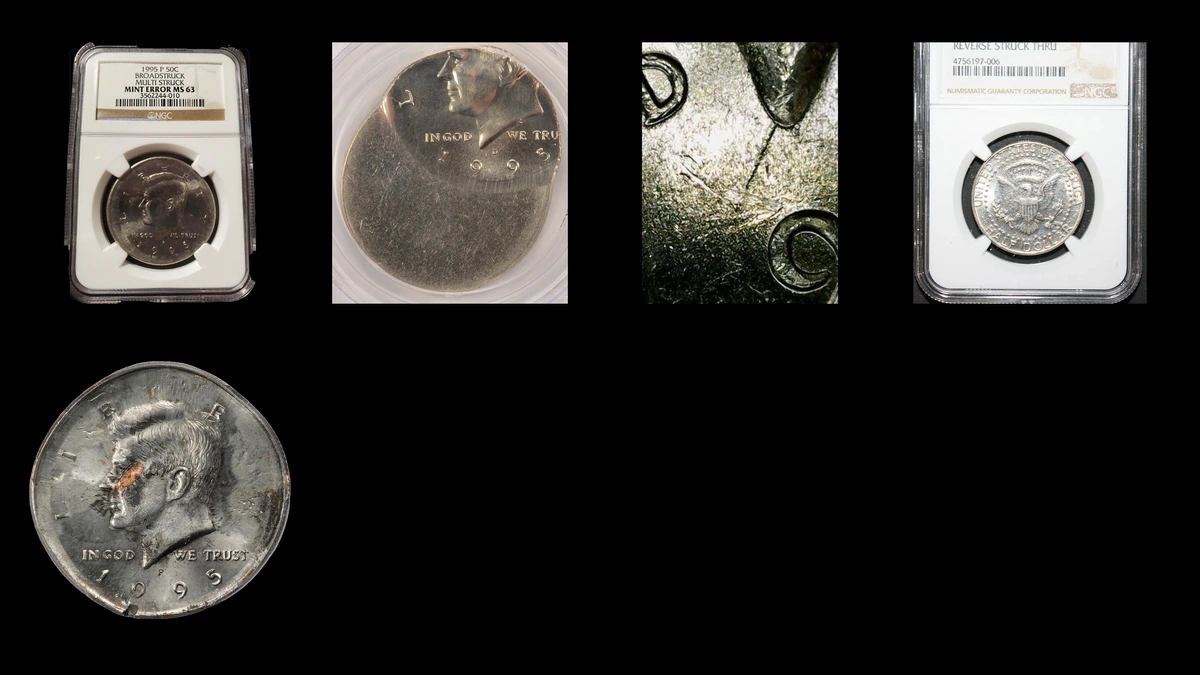
Copper color on a Kennedy half may reveal exposed core metal, trapped fragments, or a claim about the entire blank. Those are different questions, even when the photographs look similar.
Estimated values for 1995 half dollar errors run from $5 to $3,000. A documented 1995-P struck on a quarter blank sold for $1,680 in July 2022, providing a comparison rather than proof of an all-copper candidate.
Start with the outline, then inspect surface height, layers, and evidence of repeated striking.
| Visible feature | Error | Estimated value |
|---|---|---|
| Two missing rim sections | Double clip | $40–$200 |
| Complete design on spread metal | Broadstrike | $150–$600 |
| Blank crescent opposite lost design | Off-center strike | $75–$450 |
| Raised patch connected to rim | Cud | $25–$150 |
| Small ridge or internal bump | Die crack or chip | $5–$20 |
| Fixed repeated contour | Reported doubled die | $20–$100 |
| Locally absent detail | Struck through or filled die | $10–$250 |
| Peeling outer metal | Layer separation | $50–$400 |
| Separate design positions | Double strike and compound errors | $150–$1,500 |
| Claimed copper throughout | Copper-planchet candidate | $500–$3,000 if confirmed |
A standard clad half weighs 11.34 grams and has copper-nickel outer layers bonded to a copper core. A 1995-S 90% silver Proof weighs 12.50 grams and has different construction; both are about 30.61 millimeters wide with grooved edges.
1. 1995 Half Dollar Two gaps interrupt the perimeter: Double Clipped Planchet Error
A seller reported a 1995-D double clip without specifying the gaps’ shapes, positions, or total percentage. The two missing sections must therefore be examined rather than reconstructed from the label.
A clipped blank lacked metal before receiving the design. Striking then shaped the borders beside the existing spaces, unlike later cuts through a finished coin.
How to Identify
Inspect each opening separately where the normal rim and edge grooves approach it. File marks, sharp cuts, and compressed metal may reveal alteration.
One convincing gap cannot authenticate the other. Opposite-rim weakness can be harder to interpret with two missing areas, so concentrate on how the design formed beside both boundaries.
What It’s Worth
Genuine examples in ordinary collector condition have an estimated $40–$200 range. Clear original edges and a readable attractive coin support stronger comparisons.
A different 1971-D in PCGS MS64 with one 10% clip has a $90 dealer asking price. That offer is neither a sale nor evidence of the 1995-D’s two-gap arrangement.
2. 1995 Half Dollar The whole design remains on an expanded coin: Broadstrike Error
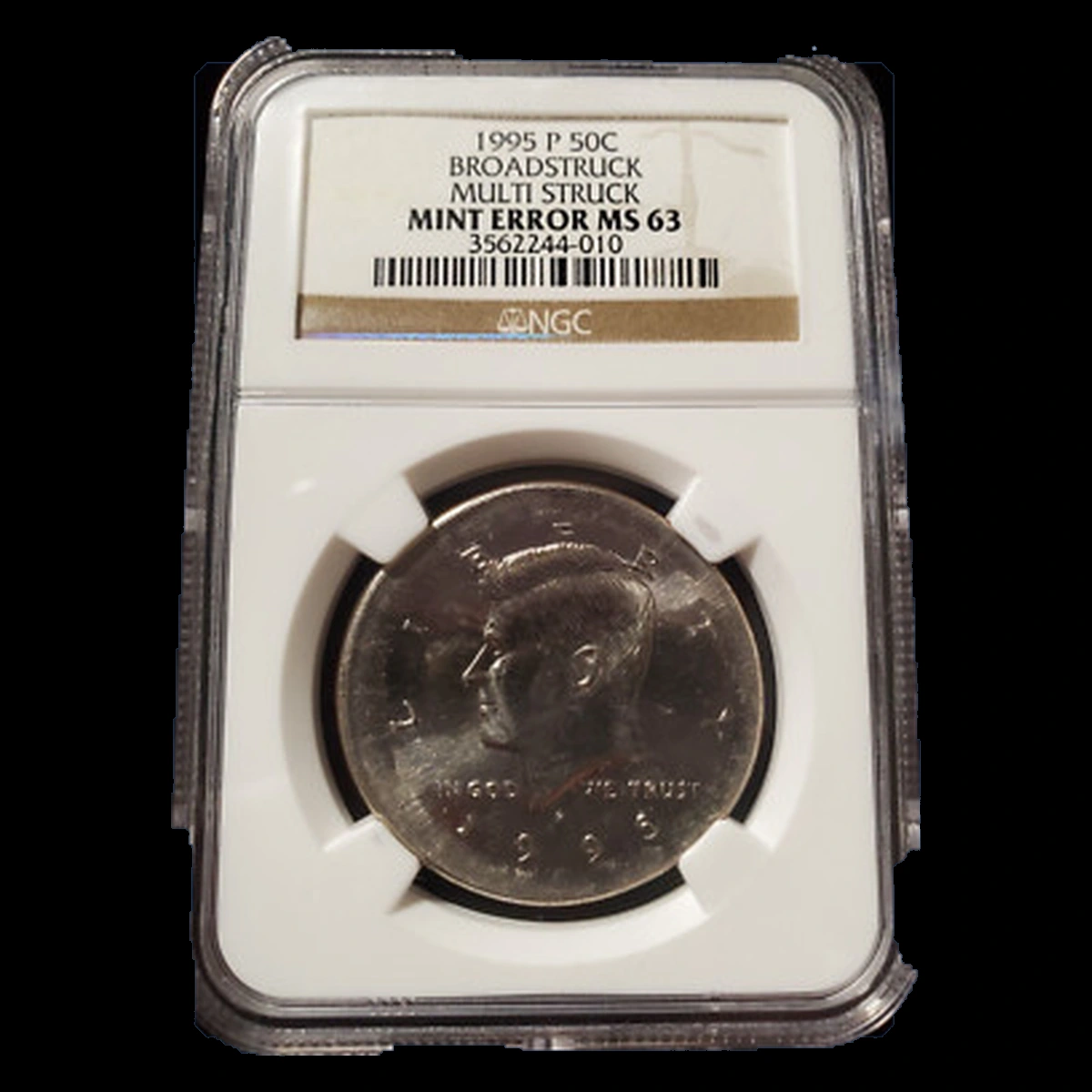
The known 1995-P PCGS MS64 broadstrike spread outward while retaining its complete design. The collar, a ring controlling the coin’s diameter during striking, failed to restrain the metal normally.
This specimen has no specified second strike. Its wider outline should not borrow a repeated portrait or date from another 1995 coin.
How to Identify
Measure the outline in several directions and follow all outer design elements on both faces. A complete picture inside naturally spread metal is the useful combination.
Inspect the wider margin and edge for incomplete grooves and original striking texture. Later flattening may also enlarge a coin while crushing its already finished details.
What It’s Worth
The estimated range is $150–$600. Greysheet’s auction index records $312 for the large PCGS MS64 in July 2021 and $432 for a separate ANACS MS64 broadstrike in January 2023.
Those prices belong to different specimens. The visibility of spreading and preservation of the design influence the whole-coin comparison.
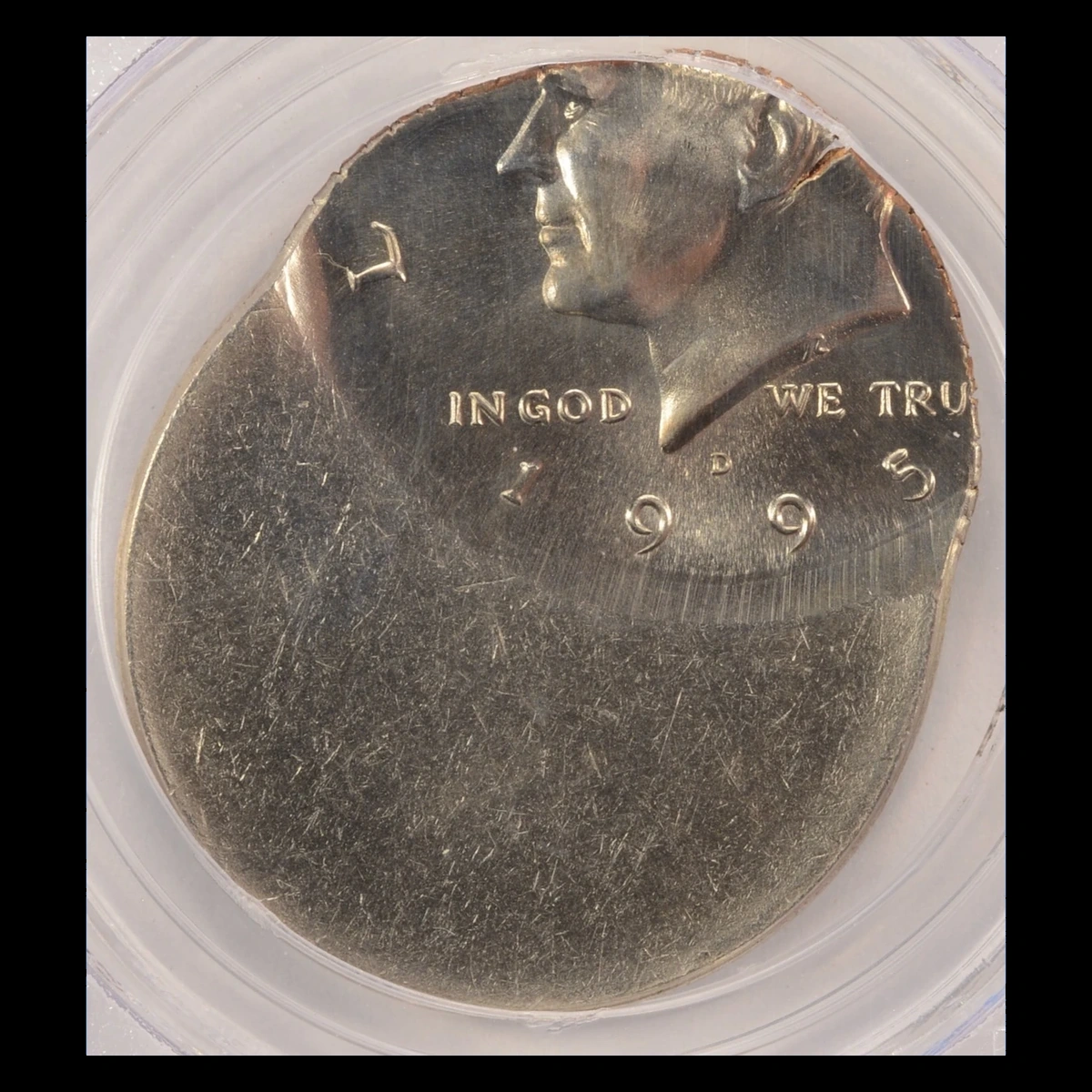
3. 1995 Half Dollar A blank crescent sits opposite an incomplete design: Off-Center Strike Error
A known Philadelphia NGC MS64 was struck about 10% off center. Its blank was displaced, leaving some intended design beyond the metal while another portion remained unstruck.
The percentage describes the shift rather than metal loss. This single off-center strike is also separate from the much more displaced second impression on a double-struck example discussed later.
How to Identify
Compare displacement on both faces and inspect the untouched crescent for an original surface. A filed-flat area does not become unstruck metal merely because design is absent.
One shifted die can crowd only one face, while a displaced blank affects the relationship on both. Keep the actual date and P in the record and check for remnants of any additional strike.
What It’s Worth
Comparable through more obvious examples with readable dates have an estimated $75–$450 range. The 10% off-center MS64 is indexed near $94 from a December 2009 Heritage sale.
Dealer comparisons include a 1983-P 10% off-center MS64 at $225 and a 1976 MS65 at $350. These are other-year asking prices, not fresh realized results for the 1995 specimen.
4. 1995 Half Dollar A raised patch joins the rim: Cud Error
A cud forms when part of a die breaks away at its edge, allowing coin metal to rise into the missing area. It replaces intended detail near the border and differs from an isolated interior chip.
One 1995 report places a feature near 8 o’clock without establishing mint or finish. Another describes two reverse breaks on a Philadelphia coin, without borrowing the first example’s position.
How to Identify
View the edge connection and follow the raised patch’s boundary into the face. It should occupy space where normal detail failed to form, rather than be a bent rim covering finished design.
Inspect nearby grooves for bending or crushing. On the reported Philadelphia pair, examine each patch separately rather than accepting two ordinary dents as two cuds.
What It’s Worth
Modest through obvious rim-connected breaks have an estimated $25–$150 range on ordinary clad halves. The guide’s $25–$75 discussion informs the smaller end.
The upper allowance considers a larger patch or clear pair of breaks. No completed sale for either reported 1995 coin is supplied.
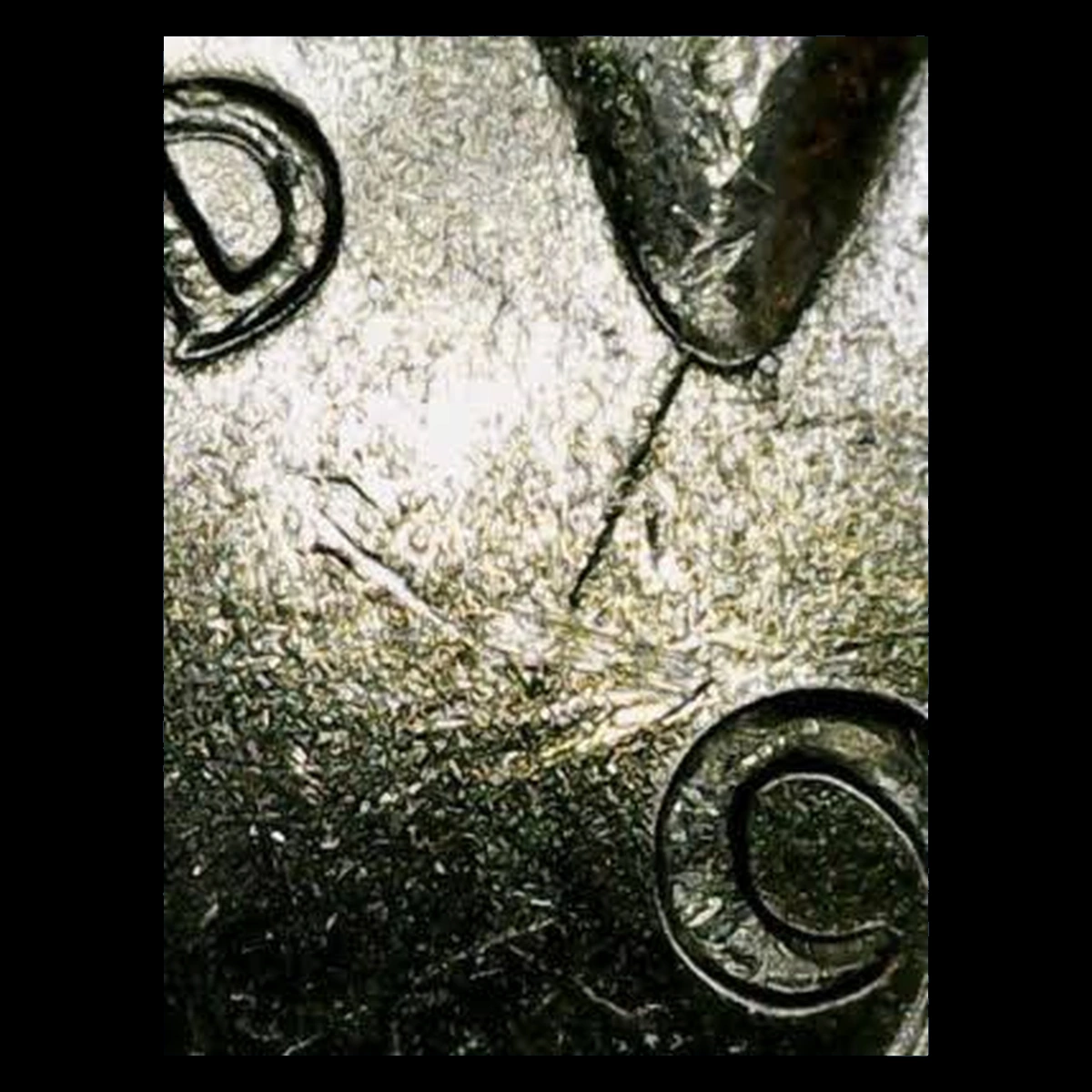
5. 1995 Half Dollar A fine ridge or compact bump appears inside the face: Die Cracks and Chips Error
A small fracture in a die can leave a raised ridge when coin metal enters it. A compact missing portion of the tool can similarly produce a small lump within the design.
The 1995 reports provide no exact crack path, mint, or finish. Ordinary eagle-feather lines should be compared with a normal coin before being treated as added detail.
How to Identify
Use low light to determine whether the feature rises above the intended design. A scratch, deposit, or nearby impact can offer another explanation.
Compare the same area on a normal same-finish half. The useful difference is original extra metal absent from the normal picture, rather than any unfamiliar line.
What It’s Worth
A readily visible minor example has an estimated $5–$20 range, informed by the guide’s small-crack premiums around $5–$15. Faint marks among many contacts generally make weaker comparisons.
These modest figures do not cover a large rim-connected break or an exceptionally preserved underlying coin. Those need their own valuation evidence.
6. 1995 Half Dollar An added raised contour repeats consistently: Reported Doubled Die Error
The year list names doubled dies without establishing a particular mint, finish, face, or cataloged pattern. No exact doubled date digit or portrait feature can therefore be inferred from the report.
A true doubled die carries repeated design before striking, so coins it produces may share the same contour. That mechanism differs from the individual coin receiving two separate blows.
How to Identify
Identify mint and finish, then compare the extra relief with another matching example. Its shape and position matter more than the apparent width of a letter.
Reflections move with the light, and flat shelves from striking movement can reduce a normal letter’s outline. A stable raised second contour needs a repeatable match before it becomes a variety attribution.
What It’s Worth
The estimate is $20–$100 for a minor clearly matched variety on an ordinary clad example. It uses modest modern Kennedy varieties as context rather than a realized 1995 sale.
The upper comparison requires visible added relief and a reliable pattern. Glare or thick worn-looking letters do not support the same allowance.
7. 1995 Half Dollar Letters fade beside sharp nearby detail: Struck Through or Filled Die Error
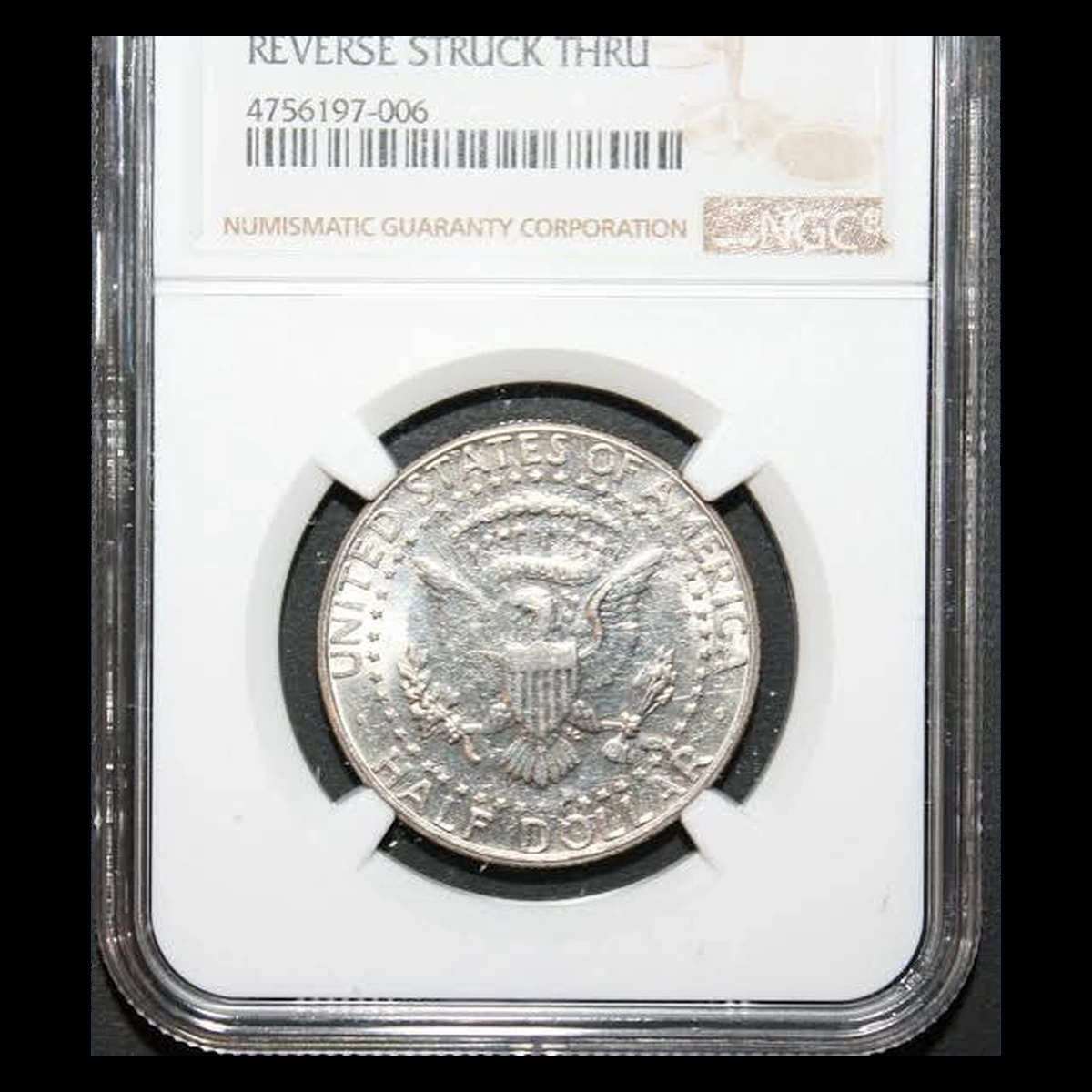
A blocked recess in the die may fail to form its intended letter, while a solid object can leave a more definite impression. The 1995 reports suggest inspecting LIBERTY and the motto for local interruptions.
Weakness by itself does not identify grease or another material. Wear and a generally weak strike can also soften words.
How to Identify
Compare the affected letters with neighboring design and the exposed high parts of Kennedy’s portrait. Local blockage may sit beside sharp detail, while wear follows exposed surfaces.
Inspect for an object-shaped depression, original surrounding texture, or scraping trails through the finished picture. A rubbed-down patch needs a different explanation.
What It’s Worth
Modest blocked-letter weakness is estimated at $10–$50, with clearer object impressions at $50–$250. Their visibility and the coin’s preservation govern the comparison.
An undated Kennedy in PCGS AU58 with strike-throughs on both faces has a $125 dealer asking price. It is not a 1995 sale, and the separate trapped-copper compound error should not set the price for every weak word.
8. 1995 Half Dollar An outer layer peels to expose copper: Layer Separation Error
On an ordinary clad 1995 half, a failed bond can let copper-nickel outer metal lift or detach from the copper core. The broad report supplies no measurements establishing the extent or timing of separation.
A loose flap does not prove that the blank split into two complete pieces. The silver Proof uses a different alloy construction and requires a different material explanation.
How to Identify
Leave the flap untouched and inspect its remaining attachment and any exposed core. Look for a physical layer boundary meeting original design rather than a flat brown stain.
Scraping can cut across finished details and leave repeated tracks. Attached metal still contributes to the weight, so a nearly normal reading does not rule out a visible separation.
What It’s Worth
Genuine separation on ordinary clad coins has an estimated $50–$400 range. A plainly missing outer layer may provide a stronger comparison than a tiny lifting patch.
A documented 1967 missing-layer MS63 had a $250 dealer asking price. That older coin uses a 40% silver layered construction, so it is related context rather than an exact-metal 1995 transaction.
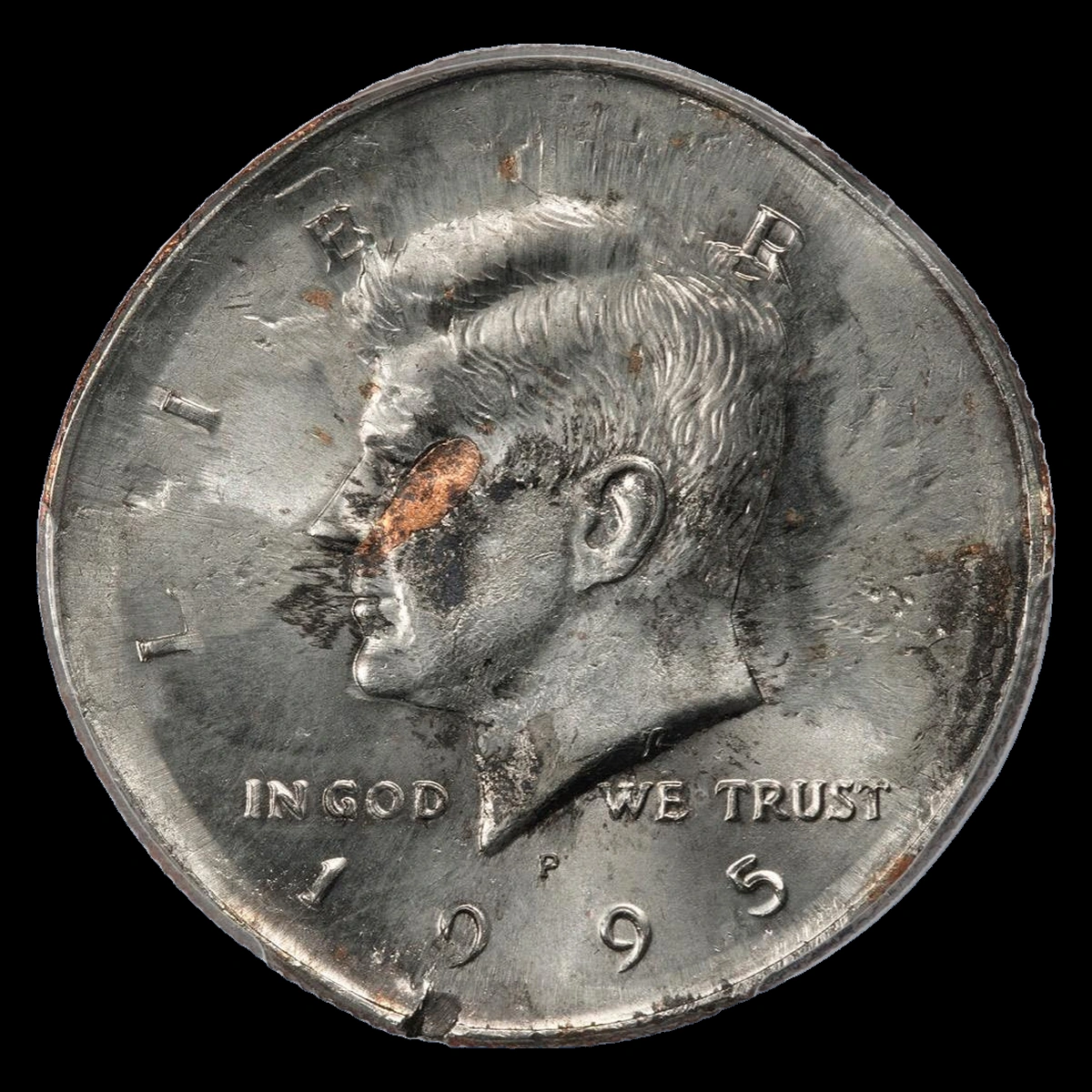
9. 1995 Half Dollar Two design positions survive, sometimes with other effects: Double Strikes Error
Three separate coins illustrate the category: a Philadelphia MS67 combines double striking with spreading, an MS64 has its second strike 80% off center, and another PCGS MS64 combines two strikes, spreading, and copper fragments. The last account does not establish its mint.
Christopher Frank describes the fragment-bearing coin and suggests an additional reverse strike-through as a possibility. Its trapped pieces do not make the entire blank copper.
How to Identify
Find several surviving parts of two design placements across the date, portrait, lettering, or reverse. A second blow may flatten earlier detail while adding another image.
Fine doubling along one letter is insufficient to reconstruct two strikes. On the documented trapped-fragment coin, leave copper pieces undisturbed and inspect how they meet original struck details.
What It’s Worth
The comparative estimate is $150–$1,500 for collectible examples, including more complex combinations. Widely separated images and preserved fragments can increase visual interest.
The 80%-off-center second strike brought $660 in July 2022, while PCGS indexes the separate MS67 double broadstrike near $127 in December 2009. No sale price is quoted for the third, fragment-bearing specimen.
10. 1995 Half Dollar The entire blank is claimed to be copper: Copper-Planchet Candidate Error
The published 1995-P copper-blank claim requires evidence throughout the metal, unlike fragments attached to a normal coin. Neither the compound error above nor a brown surface authenticates that claim.
Missing outer layers, plating, and coatings can each change a clad half’s color. The existence of normal silver Proofs also says nothing about whether an all-copper candidate is genuine.
How to Identify
Obtain composition testing and an actual weight, then examine thickness, diameter, and edge layers. Check for stripping, plating, trimming, or an intact normal clad structure beneath the color.
The design must support an original 1995-P strike on the candidate’s own metal disc. Small embedded copper pieces are local obstructions and cannot establish uniform copper composition.
What It’s Worth
A confirmed copper wrong-blank error has a provisional $500–$3,000 comparison range. It does not apply to an untested brown half dollar.
A separate 1995-P struck on a quarter blank in NGC MS67 sold for $1,680 in July 2022. That genuine wrong-blank sale concerns layered quarter metal and does not prove the copper candidate’s composition or history.
Conclusion
Let the physical boundary guide the explanation: missing edge metal, an exposed copper core, and trapped copper fragments record different events. An all-copper blank claim needs its own composition evidence.
The three double-struck examples also remain three separate coins with separate prices and reported features. Keeping those identities intact makes the estimates useful without turning a shared year or similar appearance into a false match.