Rare 2001 Nickel Errors (List & Pictures)
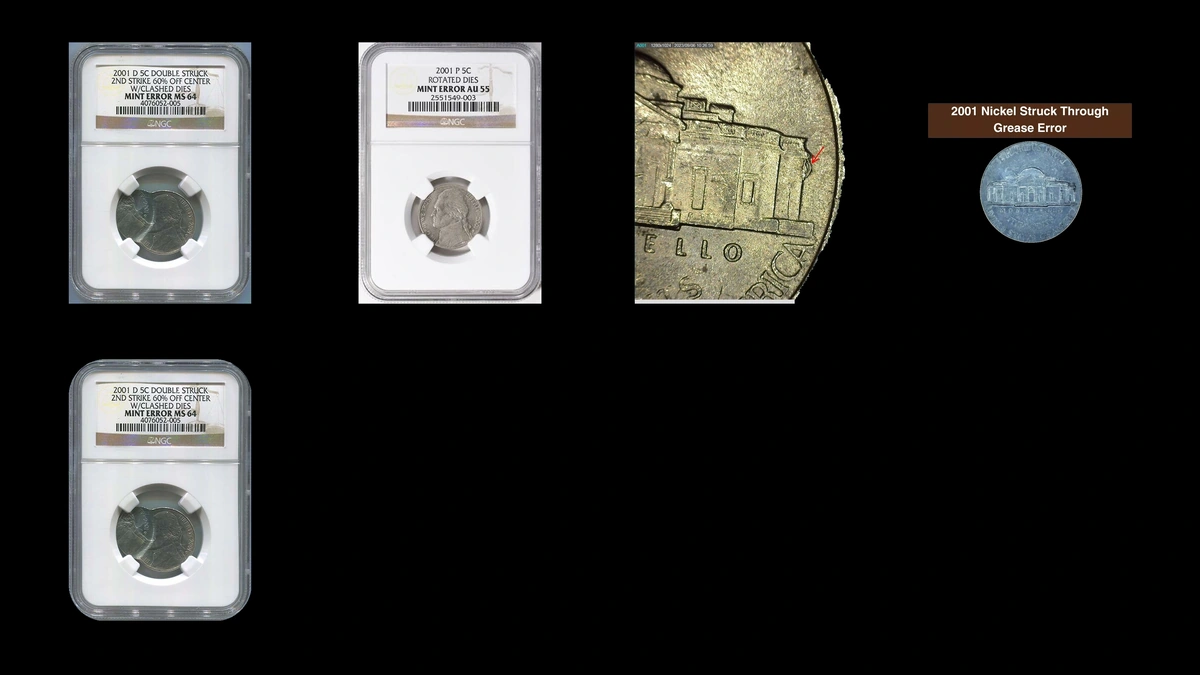
A 2001-D nickel over a Lincoln cent sold for $600 in December 2024, but identifying it requires surviving cent details, not merely a copper color. Other 2001 nickel errors change the edge, alignment, or number of visible designs.
The supplied estimates span $5–$1,500. Examine the full outline and edge first, then compare both faces before interpreting small extra lines or a weak patch.
1. 2001 Nickel An Oval Outline Has Missing Metal: Elliptical Clip Error
The recorded 2001-D elliptical clip weighs 4.06 grams and was graded NGC MS63. Its incomplete blank gives the coin an oval-looking shape rather than the full round outline of an ordinary nickel.
How to Identify
Photograph the shape and design together before concentrating on the edge. A portrait stretched in the same direction as the disc may indicate rolling or squeezing instead of a design struck on an incomplete blank.
A standard nickel weighs 5 grams and measures about 21.21 millimeters, with a plain edge. Record the long and short spans of an oval candidate rather than requiring every dimension to match the normal diameter.
Reduced weight supports missing metal only when the boundaries also fit original striking. Saw cuts or filing can explain a light, reshaped coin without a mint error.
What It’s Worth
$60–$300 is the supplied estimate for a clearly identified example. Greysheet’s record of the David Lawrence sale lists $104 in August 2006 for the 4.06-gram NGC MS63 coin.
That older result concerns an unworn example with noticeable marks. Its original edge and readable identity matter more than oval shape alone.
2. 2001 Nickel The Edge Has Two Distinct Levels: Partial Collar Error
A step in the edge can form when only part of the blank remains inside the collar during striking. The collar confines one portion while the other spreads farther outward.
The supplied report concerns a Denver nickel. Because nickels normally have plain edges, the diagnostic is the two-level profile rather than missing grooves.
How to Identify
View the edge straight on and follow the step as the coin turns. The confined part can remain near normal diameter while the expanded section projects beyond it.
Inspect the ledge for scrapes, dents, and battered metal that could create a later lip. A face-only photograph or wide rim does not show the edge structure clearly enough by itself.
What It’s Worth
$50–$350 is the working estimate for a clear Denver partial-collar strike. A defined step around a substantial part of the edge is more informative than vague unevenness.
Fred Weinberg offered a 2001-S Proof partial collar for $375. That was an asking price for a specially made collector coin, not a completed Denver sale.
3. 2001 Nickel One Face Sits Closer to the Rim: Misaligned Die Error
A die can move out of position while the opposite die remains centered. The resulting nickel may have a wide border on one side of a face and a narrow border opposite it.
The year guide reports this on a Philadelphia coin. Uneven spacing is a starting observation, not sufficient proof on its own.
How to Identify
Photograph the nickel flat and directly from above to avoid perspective distortion. Compare spacing around Jefferson with spacing around Monticello, looking for one displaced face and a substantially centered other face.
A similar displacement on both faces suggests the blank moved instead. Inspect the narrow rim for impacts, filing, or squeezing that could alter its apparent position.
What It’s Worth
$5–$75 is the estimate for a clear mint-made shift. Very small border differences can attract little additional interest, particularly on worn coins.
A high price claimed in the year guide lacks enough original transaction detail for a close comparison. The supplied range is based on the visible displacement, not that unsupported figure.
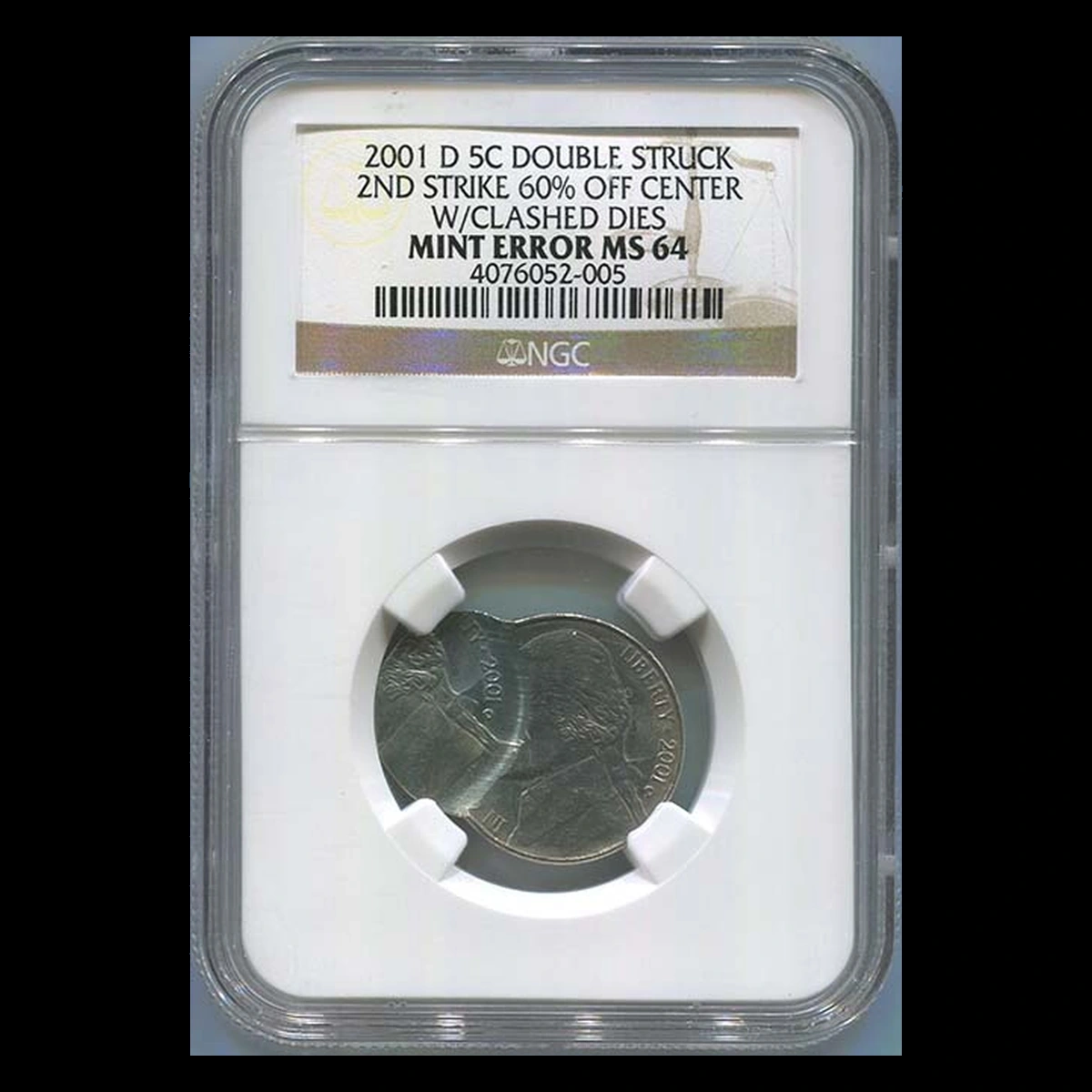
4. 2001 Nickel An Unstruck Crescent Adjoins a Partial Design: Off-Center Strike Error
The documented Denver example was struck 60% off center toward 11 o’clock. A large area of metal remained outside the dies’ effective contact while part of the design missed the blank.
A separate Philadelphia example is reported as 20% off center. The Denver direction should not be assigned to it or to every 2001 off-center nickel.
How to Identify
Read the remaining date and compare the division between struck and blank metal on both faces. They should reflect the same misplaced blank, unlike a one-face die misalignment.
The unused crescent still contains metal, which distinguishes it from a clipped opening. Examine it for original surface rather than grinding or flattened letters left by later damage.
What It’s Worth
$30–$400 is the estimate for dated examples, depending on displacement, preservation, and visible design. The 60% Denver coin was in a two-coin lot that brought $63 at Heritage in January 2022.
That payment also bought a 2003-P off-center nickel. It cannot be treated as the 2001 coin’s individual price or divided into an assumed equal share.
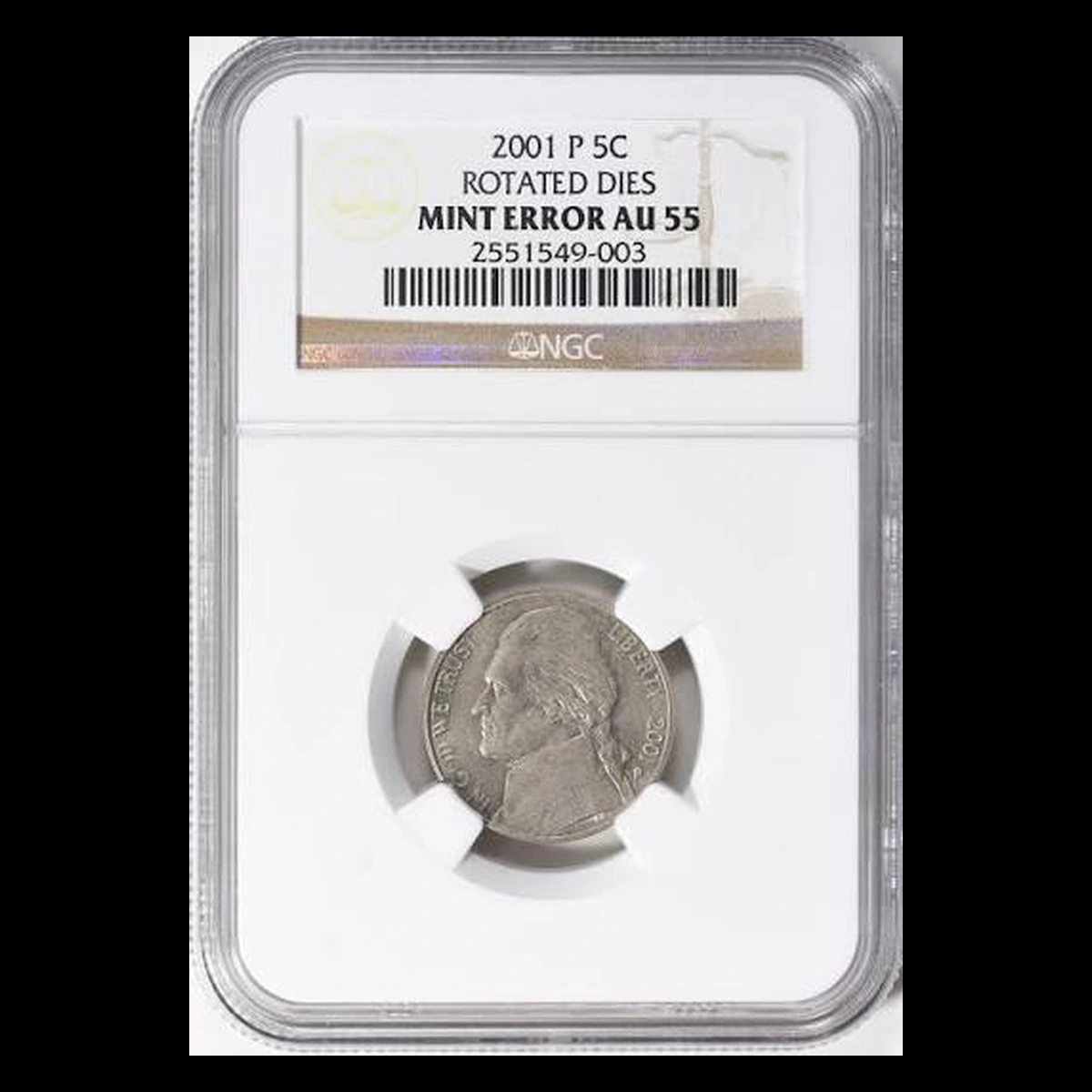
5. 2001 Nickel Monticello Tilts After a Top-to-Bottom Flip: Rotated Dies Error
Collector records show several 2001-P rotations, including about 45 degrees counterclockwise and larger clockwise turns on different coins. These are distinct specimens, not different views of one rotation.
A Denver rotation appears in the year guide as a separate report. Philadelphia photographs do not establish its mint or angle.
How to Identify
Hold Jefferson upright and flip the coin top to bottom without a sideways twist. Measure the reverse’s tilt against the upright position expected on an ordinary nickel.
A continuous recording or a controlled turn of the whole holder preserves the relationship better than separately rotated photographs. The illustrated collector records provide specimen-specific comparisons.
What It’s Worth
$25–$250 is the supplied estimate for a clearly demonstrated rotation. Larger turns and attractive surfaces generally make more persuasive examples than a slight departure.
A lightly worn Philadelphia coin sold through GreatCollections in April 2020, but the public record supplies no displayed price. This estimate is not a claim about that transaction’s amount.
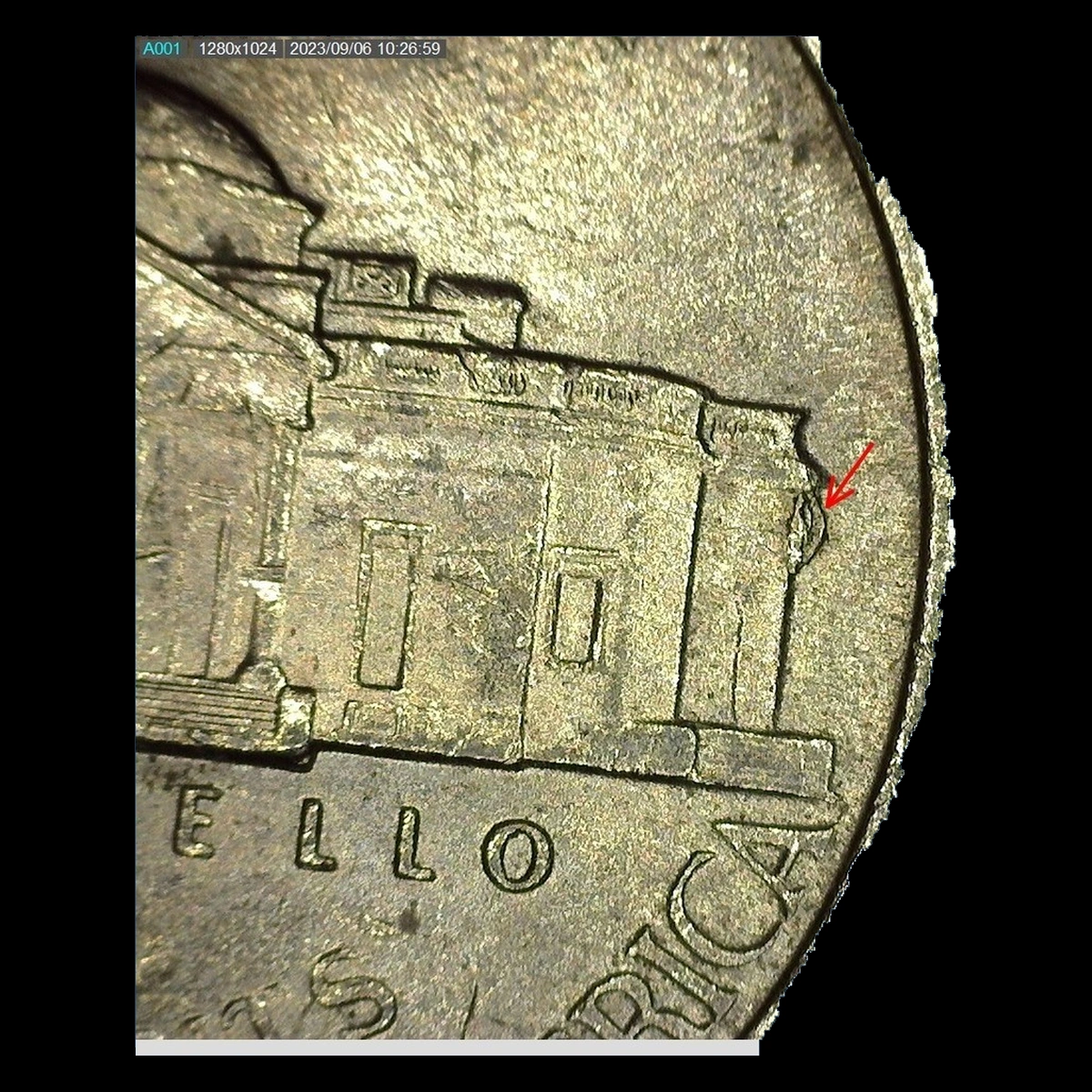
6. 2001 Nickel Faint Ridges Run Across the Design: Die Cracks Error
Copper-nickel metal entering a crack in a die leaves a raised trace on the coin. The die may continue working, producing several coins with the same pattern as its damage develops.
The supplied Philadelphia report describes cracks on both faces without establishing precise paths. No particular window or letter can therefore be treated as a required marker here.
How to Identify
Move a low lamp across the suspected line to determine whether it is raised or cut into the surface. Compare normal hair and building details before calling a fine ridge unusual.
Photograph entire paths and any branches rather than isolated bright close-ups. A separate seam or coating along a line may indicate added material instead of copper-nickel entering a cracked die.
What It’s Worth
$5–$100 is the estimate for readily visible cracks. Larger coherent networks on clean coins tend to be more appealing than faint lines requiring difficult lighting.
The guide’s much higher top-grade claim lacks a closely matched original transaction. It does not establish a price for an ordinary cracked 2001 nickel.
7. 2001 Nickel Opposite-Design Fragments Appear in the Fields: Die Clash Error
The recorded Denver clash example also has a second strike 60% off center. Its clash marks came from contact between the dies without a blank, while the displaced impression came from another blow to the coin.
Those are separate features on the same object. The full displaced design should not be mistaken for a large clash trace.
How to Identify
Match small unexpected fragments with Jefferson or Monticello on the opposite face. A clash ordinarily preserves pieces among the normal design rather than a complete second building in a new position.
Follow several matching shapes together and inspect for squeezing or an edge seam. An isolated scratch or recessed line cannot establish tool contact by itself.
What It’s Worth
$20–$150 is the estimate for recognizable clashes on otherwise ordinary 2001 nickels. Clarity and surface quality guide the comparison.
The Denver combination brought $360 in January 2018. That whole-coin result includes its dramatic double strike and must not be assigned to the clash alone or counted again as an additional value.
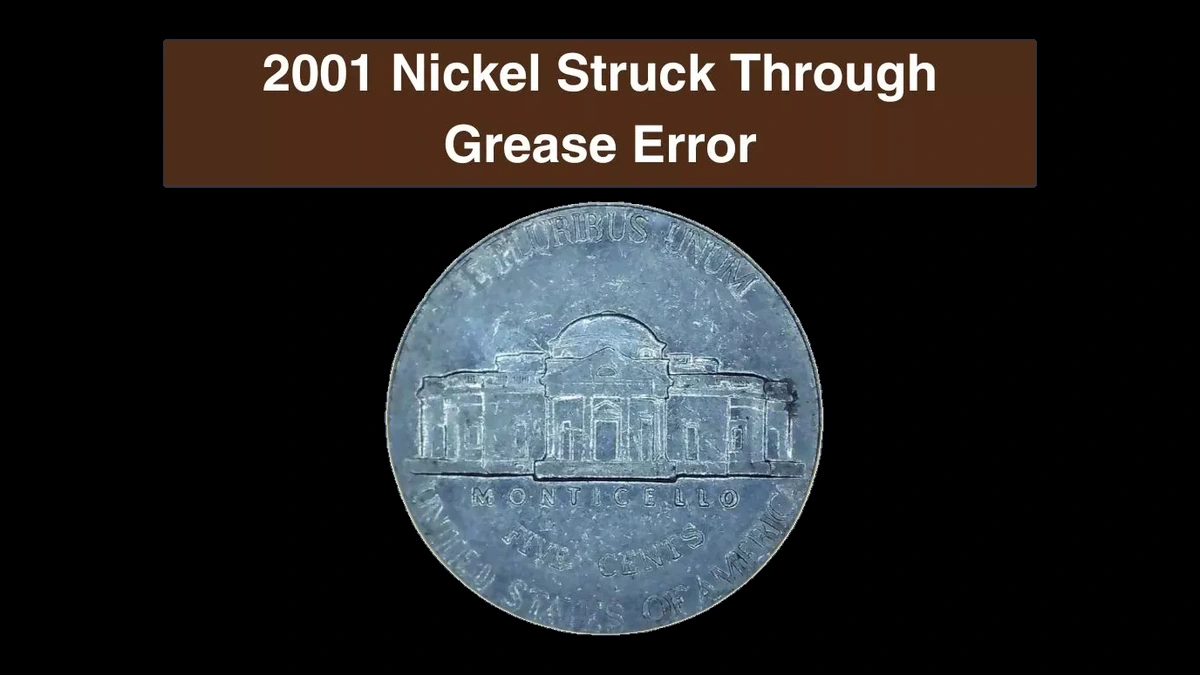
8. 2001 Nickel Part of Monticello Is Soft on a Proof: Reported Grease Strike-Through Error
An obstruction in the die can prevent part of Monticello from forming while nearby details remain sharp. The supplied report attributes such weakness to grease on a San Francisco Proof.
Its listed grade conflicts with the stated finish. The original label and complete coin therefore need to establish the specimen’s identity before its reported price is used.
How to Identify
Confirm the S and the specially made collector finish, then compare the weak area with neighboring columns and lettering. Shine alone is insufficient because polishing can make a damaged coin reflective.
Look for scraping or removed surface across the missing design. A normal weight may exclude major metal removal, but it cannot prove that grease caused the weakness.
What It’s Worth
$50–$500 is the estimate for a genuine 2001-S Proof with a clearly blocked area and original surfaces. The guide’s $750 claim is not a reliable direct comparison while its grade and finish conflict remains unresolved.
An obvious local interruption is more useful than slight softness in one small detail. General wear or polishing requires a different explanation.
9. 2001 Nickel Lincoln Details Remain Under Jefferson: Double Denomination Error
A cent already bearing Lincoln and the Memorial can receive a nickel design in the wrong press. The recorded Denver MS64 Red example retains a faint inverted cent date across the bridge of Jefferson’s nose.
Its nickel date, mintmark, and LIBERTY remain readable while much outer lettering is incomplete. Other Denver and Philadelphia overstrikes have their own surviving orientations and details.
How to Identify
Find recognizable portions of the earlier cent before relying on copper color. A nickel struck on an unused cent blank would not have that underlying design.
The nose position of the inverted date belongs to the described MS64 Red coin, not every overstrike. Keep the older cent date separate from the nickel date when recording what remains.
A modern cent begins near 2.5 grams and 19.05 millimeters before any spreading from the later blow. These are starting standards, not a supplied actual measurement for each recorded coin.
What It’s Worth
$400–$1,000 is the estimate for comparable clear overstrikes. A Denver PCGS MS63 example sold for $600 at Heritage in December 2024.
The separate MS64 Red piece with the inverted date brought $576 in September 2019. Both were unworn, but the two results concern different coins and do not value ordinary copper-colored nickels.
10. 2001 Nickel Complete Design Portions Repeat: Multiple Strikes Error
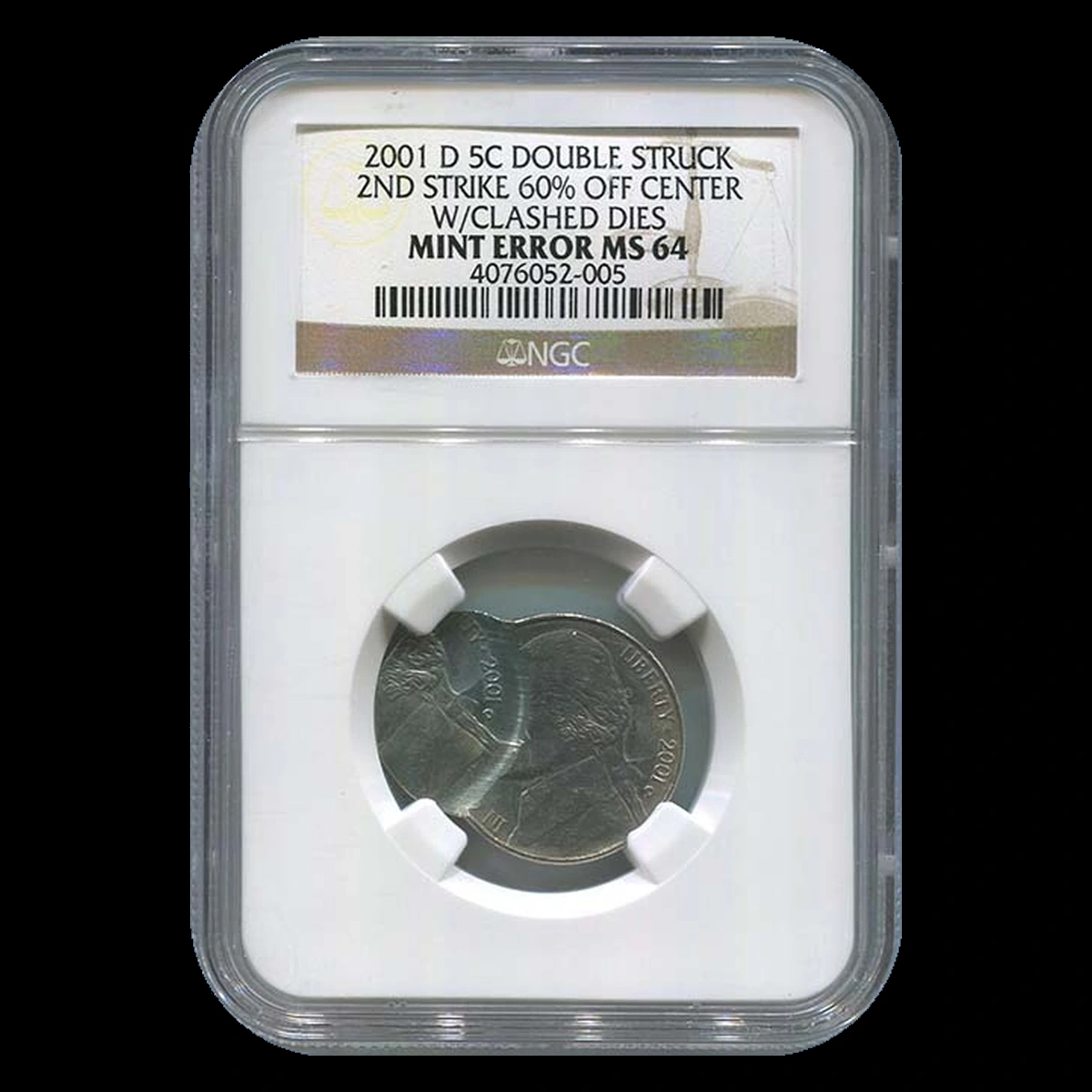
The supplied Denver examples include a double strike with a second blow 60% off center and a separate three-strike sequence. One blow in the latter involved a shifted front die while the blank remained within the collar.
A San Francisco Proof overlap is also reported with a grade-and-finish conflict. Proofs normally receive repeated pressure, so repetition alone is insufficient without an unintended displaced impression.
How to Identify
Map recognizable design positions before counting strikes. A repeated date, portrait boundary, or building is stronger evidence than a narrow shelf alongside one letter.
Mike Diamond’s three-strike explanation describes the front die shifting right during a second blow and a later off-center impression. Compare both faces to distinguish die movement from movement of the whole blank.
For the reported Proof, first resolve its manufacture and then locate genuine displacement. Repeated aligned blows are part of normal Proof production.
What It’s Worth
$150–$600 for clear ordinary multiple strikes and $500–$1,500 for a correctly identified displaced Proof strike are the estimates. The Proof figure is conditional, not a verified sale of the conflicting report.
The Denver double strike with clash marks brought $360 in January 2018; another double strike realized $307.44 in June 2026. A separate triple strike sold for $192 in October 2022, showing that strike count alone does not determine price.
11. 2001 Nickel The Coin Curves Around a Die: Die Cap Error
A nickel that remains attached to a die can spread into a cup while the press continues operating. The trapped coin is the cap itself; pieces struck underneath it may have distorted designs without becoming caps.
The year guide reports a 2001-D cap without establishing which face stayed against the die. Its exact orientation must come from the specimen rather than a different example.
How to Identify
Support the cup gently and photograph its interior, outer wall, and other face. Follow how the design stretches into the curved metal rather than stopping at a sharp forced fold.
Do not flatten the edge or squeeze the walls to take measurements. Local crushing or tool marks may indicate later bending, which does not explain a genuine cap’s overall metal flow.
What It’s Worth
$300–$1,200 is the supplied estimate for a genuine 2001-D cap with a clear shape. Remaining identification and the amount of spreading affect the comparison.
A 1977-D front cap graded NGC MS67 brought $487.20 in July 2021. That is a different-year auction example, not a transaction for the reported 2001 cap.
Conclusion
The shape of a 2001 nickel gives a useful starting point, but both faces and the edge explain what happened. An oval clip, stepped collar strike, and displaced design each require different evidence.
Keep compound errors together when discussing value, especially the double strike that also has clash marks. Preserve older cent details and original surfaces, and leave conflicting Proof descriptions unresolved until the coin and its label can be matched.