Rare 1839 Liberty Seated Half Dollar Errors (List & Pictures)
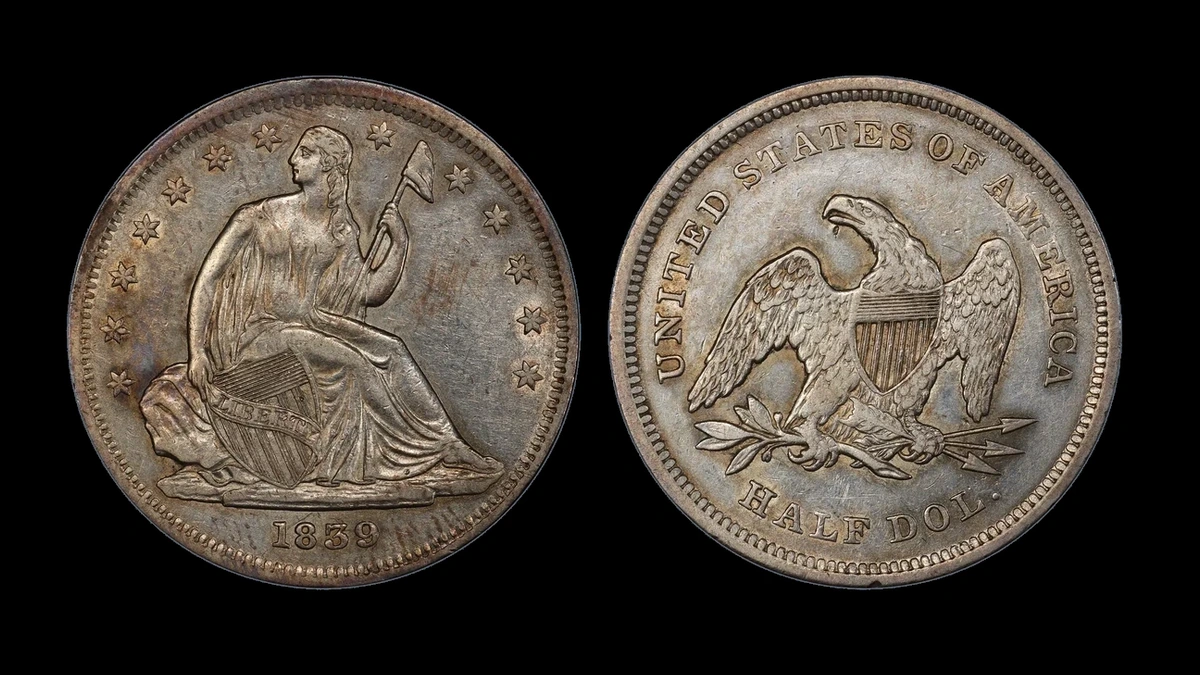
An extra line beneath Liberty’s elbow can mislead you about the design of an 1839 half dollar. These 1839 Liberty Seated half dollar errors include that false fold, raised cracks, and a small rotation.
Estimated whole-coin values of $7,000–$20,000 concern well-preserved examples, with a slightly rotated MS63 coin bringing $18,000 in January 2025. Check Liberty’s rock and gown before moving to surface marks and the alignment of the two faces.
| Visible feature | Inspection area | Error | Estimated value |
|---|---|---|---|
| A faint fold-like or misplaced design trace | Below the elbow or near the back shield | Die clash | $7,000–$11,000 at AU58 |
| Raised lines beneath the lettering | HALF DOL. and the lower-left back | Die cracks | $7,000–$10,000 at AU58 |
| The eagle leans after a straight flip | Relationship between both faces | Rotated dies | $16,000–$20,000 around MS63 |
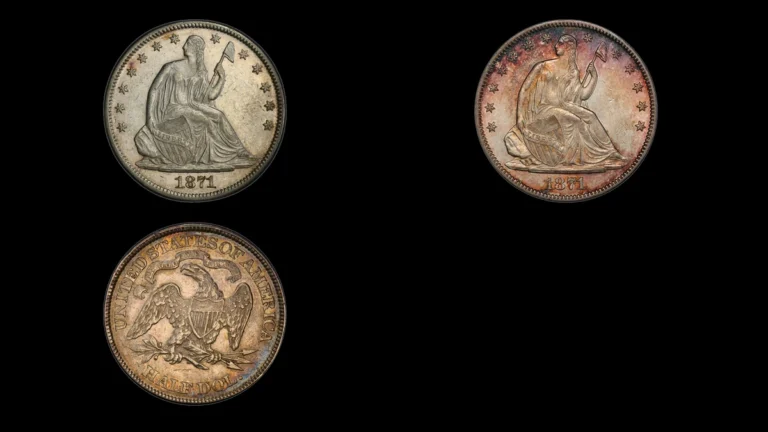
This article concerns the Seated Liberty design, not the different Capped Bust halves also dated 1839. No Drapery identifies the original Seated version without the added cloth fold below Liberty’s elbow.
1. 1839 Half Dollar A False Fold Below the Elbow: Die Clash Error
Do not identify the design from one elbow mark. A No Drapery half can acquire a faint trace in that area that resembles the fold on the later With Drapery design.
A collision between the dies, the steel tools that stamp both faces, can transfer parts of one design to the other tool. Later coins may carry those unwanted traces even though they were struck normally.
How to Identify
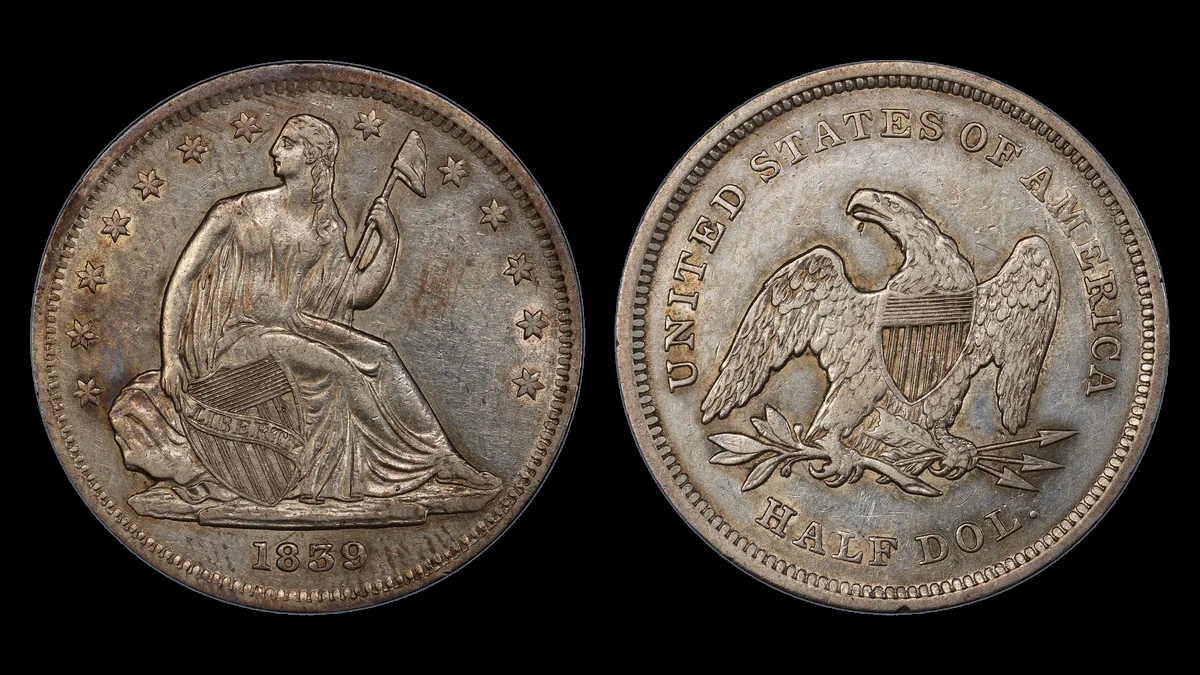
Look at the larger forms first: the rock and Liberty’s gown. The original No Drapery rock extends nearer the first star, while the later design changes more than the small elbow area.
Bill Bugert’s reference discusses the misleading clash trace. Use a confirmed example to compare the mark after you have established the underlying design.
A separate auction description places clash evidence near the lower-right part of the shield on the back. Inspect that area on its own terms rather than assuming every coin with an elbow trace must have the same reverse marks.
A convincing trace should fit part of the opposite design in the correct position. A scratch or an ordinary shield line may look unusual without making that match.
What It’s Worth
Estimated range: $7,000–$11,000 for an attractive AU58 No Drapery coin with confirmed clash detail. AU58 means the coin has only slight circulation wear.
A January 2025 Heritage AU58 brought $9,000 and provides a same-design, same-grade comparison. Its description records cracks, so that result does not establish that the sold coin had the clash features discussed here.
The estimate concerns the complete coin in comparable preservation. It does not isolate a premium for the copied trace.
2. 1839 Half Dollar Ridges Follow HALF DOL.: Die Cracks Error
The lower portion of the back provides two routes to inspect. One line follows the bottoms of HALF DOL., and another travels from the rim near seven o’clock toward an olive leaf.
Both are described for a No Drapery AU58 in a PCGS collector-registry record. The metal entered fractures in the reverse die, producing ridges on the struck coin.
How to Identify
Frame the whole lower reverse before enlarging the lines. The letters, rim, and olive leaf give fixed landmarks for following their paths.
Under side lighting, check that the marks stand above the surface. They are records of cracks in the tool, not necessarily splits in the silver half dollar.
A scratch may pass through the same general area but usually cuts into the surface. Compare the complete route and endpoints rather than relying on one bright segment.
For a loose specimen, normal unworn specifications are about 13.36 grams and 30.6 mm across, with a grooved edge. Those checks do not replace the front-design identification or the reverse pattern match.
What It’s Worth
Estimated range: $7,000–$10,000 for well-preserved AU58 examples with the cracked reverse. A NumisBids archive records $9,000 for the Heritage January 2025 coin described with heavy reverse cracks.
The value includes the No Drapery design, slight wear, and overall surface quality. A visibly cracked but heavily worn coin needs a lower-grade comparison instead of this AU58 estimate.
3. 1839 Half Dollar The Eagle Leans After a Flip: Rotated Dies Error
A small error in the angle between the dies can leave both designs complete while changing their relationship. Heritage described a slight counterclockwise reverse rotation on a Philadelphia No Drapery half graded PCGS MS63.
No measured angle was supplied for that example. The description supports a slight leftward lean, not a dramatic quarter-turn or half-turn.
How to Identify
Place the upright seated figure against a vertical reference line, ideally in a transparent holder. Turn top over bottom without allowing the holder to swing sideways.
A normally aligned eagle will finish upright. For the reported feature, it should repeatedly finish slightly left of that position.
Repeat the movement to exclude an accidental twist of the hand. Two photographs straightened independently would hide the very relationship you are trying to measure.
Keep the full dated front and the edge available for examination. An unexpected seam or other sign of alteration needs investigation before the tilt is accepted as a mint-made feature.
What It’s Worth
Estimated range: $16,000–$20,000 for comparable No Drapery halves around MS63, an unworn grade with noticeable marks. The January 2025 auction archive records $18,000 for the slightly rotated PCGS MS63 example.
The first-year Seated design and its preservation contribute heavily to that total. The result does not establish an $18,000 bonus for a reverse that leans.
Conclusion
Design identification comes before error identification on these halves. Confirm No Drapery from the larger rock and gown shapes, then compare a transferred trace, a raised crack route, or a repeatable rotation.
The estimated $7,000–$20,000 span describes AU58 and MS63 comparisons with little or no wear. Carry the complete coin’s design and condition into the valuation instead of pricing an isolated elbow mark or slanted eagle.