Rare 1871 Half Dollar Errors (List & Pictures)
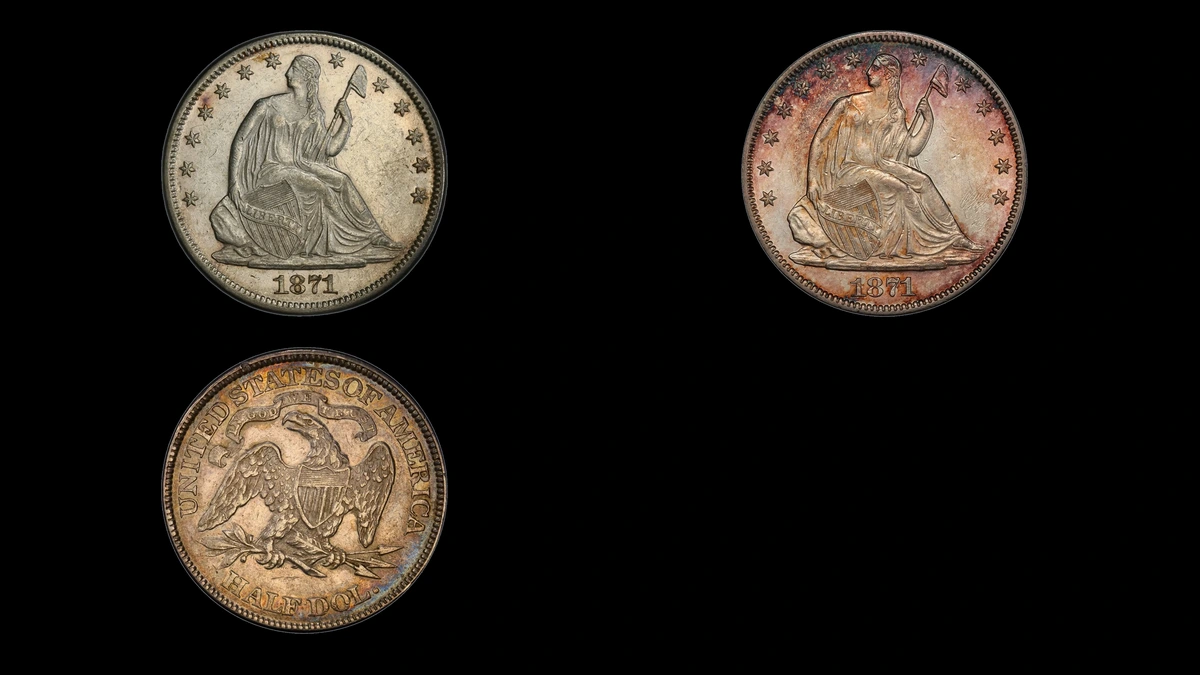
An 1871-S half dollar with a weak S mintmark and a doubled shield sold for $7,200 in May 2025. Both features appeared on the same coin.
This guide to 1871 half dollar errors covers estimated values from $75 to $7,500, depending on the mint, condition, and error. Start with the date and shield, then turn the coin over to check the mintmark and eagle.
| What you notice | Where to look | Error type | Estimated value |
|---|---|---|---|
| Extra strokes beside the date | The date on the front | Repunched date | $150–$5,000 |
| A number fragment away from the date | The rock below the shield | Misplaced date | $250–$2,500 |
| Repeated shield lines | Liberty’s shield on an S coin | Doubled die obverse | $150–$7,500 |
| A partly missing S | Below the eagle | Incomplete S mintmark | $100–$7,500 |
| A raised line | The back, with different paths by mint | Die crack | $75–$3,500 |
| Faint shapes from the opposite side | The shield or the area above Liberty’s knee | Clashed dies | $75–$3,500 |
| A repeated part of the back design | The back of a Philadelphia coin | Doubled die reverse | $200–$1,200 |
These ranges cover different grades and mints. A price for a coin with two errors still values one coin; do not add the two ranges together.
Before You Start
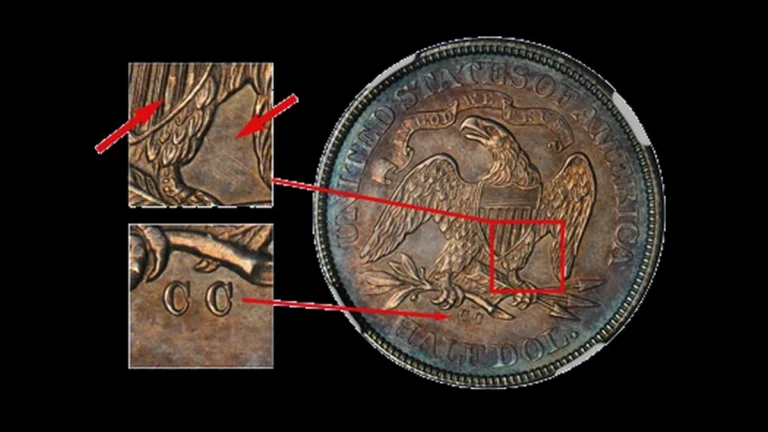
Read the mintmark below the eagle: S means San Francisco, and CC means Carson City. Philadelphia coins have no mintmark, though a very weak S can be easy to miss.
Use a 10× magnifier and a lamp you can move. A die is the steel tool that stamps a design onto a coin; damage or repeated detail in that tool can appear on many coins.
A normal 1871 half dollar was made at about 12.44 grams and 30.6 mm across, with grooves around its edge. A scale and calipers can help check the basic coin, but those measurements alone cannot identify the errors below.
1. 1871 Half Dollar Extra Strokes Around the Date: Repunched Date Error
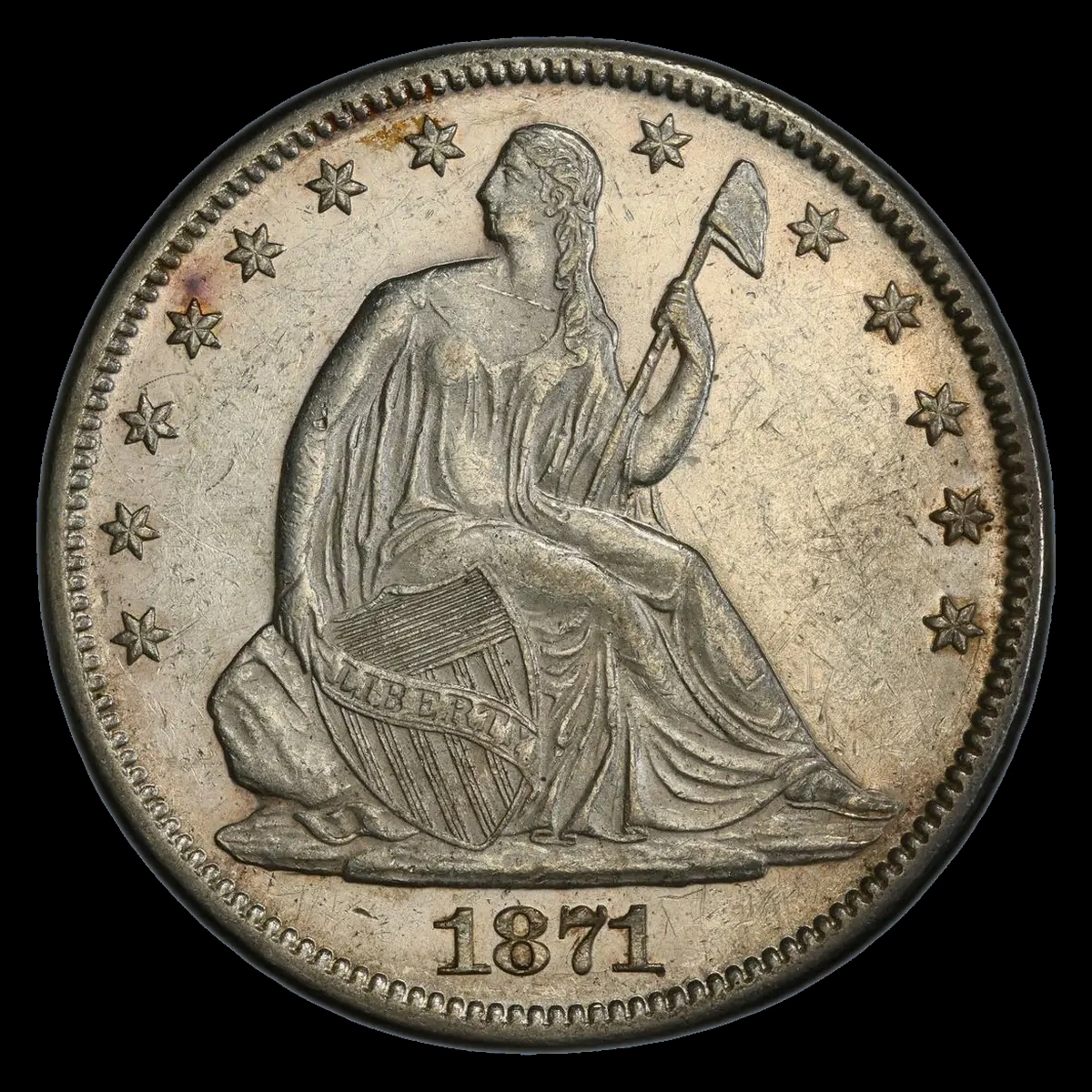
Look closely at the 7 and last 1 on an 1871-CC half dollar. Earlier digit strokes can appear above the final date.
The worker stamped the date into the die more than once, in slightly different positions. The coin picked up parts of both impressions.
How to Identify
First confirm the CC mintmark on the back, then return to the date. Look for small pieces of recognizable numbers, rather than a thick edge around every digit.
A dent can push metal beside a number and look like an extra stroke. Follow the shape under changing light and compare it with a documented repunched-date example.
Philadelphia also has a recorded repunched-date variety. Its date needs its own comparison picture; the CC positions described here do not identify it.
What It’s Worth
Estimated range: $150–$5,000. The lower end covers worn Philadelphia examples, while the upper end includes scarcer Carson City coins.
Recorded 1871-CC sales include $3,600 for an NGC VF35 WB-4 in October 2025 and $4,920 for an NGC AU53 WB-3 in March 2023. AU53 has less wear than VF35, and both prices include the value of the scarce CC coin.
2. 1871 Half Dollar A Stray Number in the Rock: Misplaced Date Error
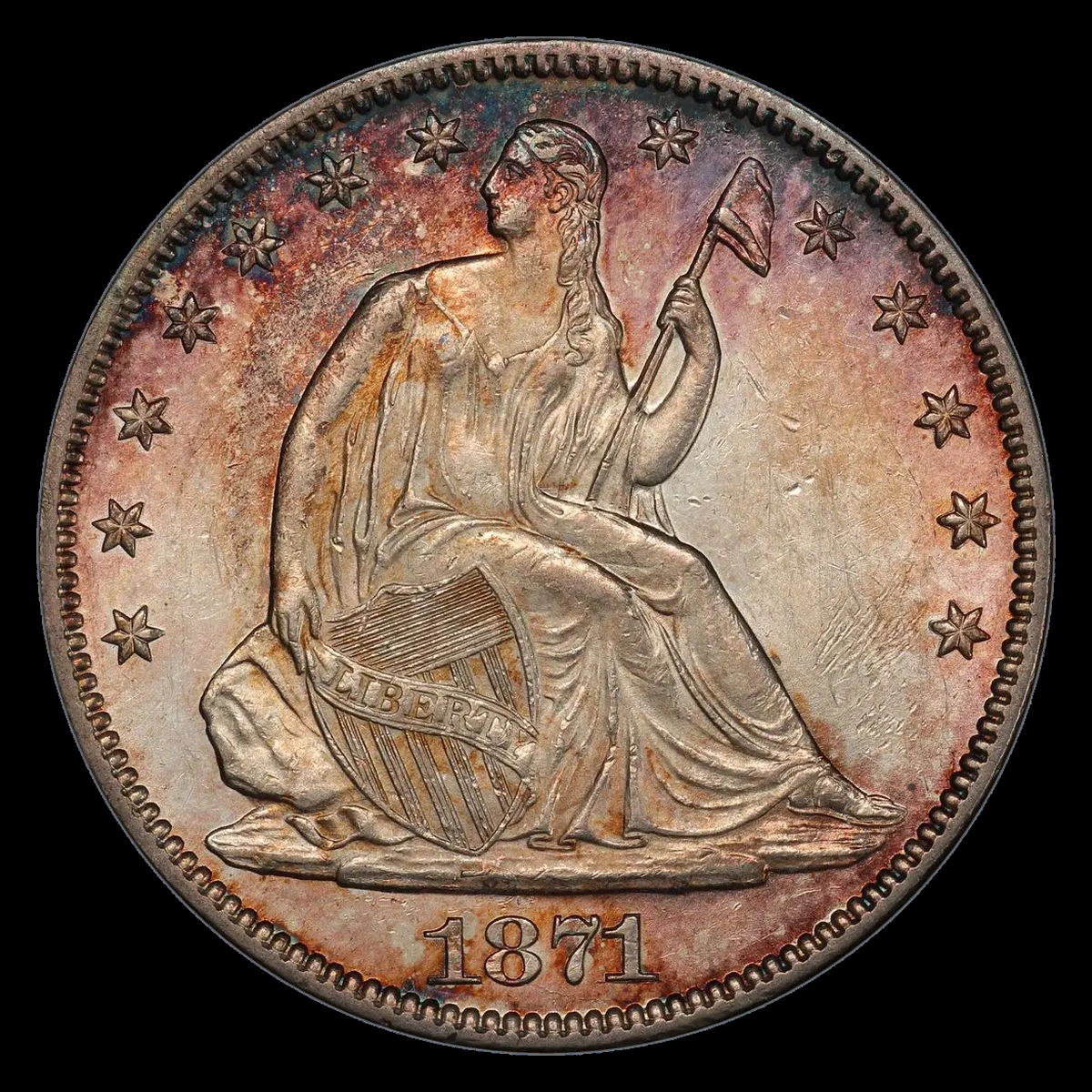
The mark to find is above the date, inside the rock below Liberty’s shield. Only the base of an extra 1 may show.
How to Identify
Find the pointed bottom of the shield, then move into the rock directly below it. Keep the normal date in view so you can see that the extra mark sits outside the date area.
Compare the fragment with the 1871 WB-102 example described by Stack’s Bowers. You are looking for the surviving base of a numeral, not a complete extra digit.
The rock already contains many lines, so an unusual line by itself is not enough. A misplaced date comes from a date punch applied in the wrong place on the die; a repunched date overlaps the normal digits.
What It’s Worth
Estimated range: $250–$2,500 for worn examples through lower-grade coins without circulation wear. Stack’s Bowers listed an 1871 example graded PCGS MS62+ in March 2020.
For price context, an 1857-O misplaced-date half graded NGC MS65 sold for $5,280 in May 2025. That was a different year and a better-preserved coin, so its result is not an 1871 sale price.
3. 1871 Half Dollar Repeated Shield Lines: Doubled Die Obverse Error
On the 1871-S example, the front of the coin has slight doubling in Liberty’s shield. Check its vertical lines and outer border.
This is called a doubled die obverse: “obverse” means the front. The extra outlines were in the die itself and repeated on coins made with it.
How to Identify
Light the shield from the side and look for a second raised outline. Then move the lamp to make sure a shadow is not creating the apparent second line.
A flat ledge beside the design can come from movement during striking. It is not enough to identify this doubled die; the shield details must match the known 1871-S example.
Turn the coin over and check for the Incomplete S described next. That weak mintmark helps match the variety, but you still need to see the doubled shield.
What It’s Worth
Estimated range: $150–$7,500, from worn examples to high-grade coins without circulation wear. PCGS records a $7,200 sale for a PCGS MS65 example in May 2025.
That coin had both the doubled shield and Incomplete S. The sale does not tell us a separate price for each feature.
4. 1871 Half Dollar A Weak or Nearly Missing S: Incomplete Mintmark Error
A faint mintmark can change how you identify the whole coin. On this 1871-S variety, the top of the S is weak and may be hard to recognize.
How to Identify
Look below the eagle and compare the upper and lower parts of the S. Include the nearby coin surface in your view, rather than judging the letter alone.
If the surrounding detail is also heavily worn, ordinary wear may explain the weak letter. Scratches, a hollow spot, or disturbed metal can point to later damage or removal.
Check Liberty’s shield on the front for the associated doubling. An almost invisible S does not automatically make the coin a Philadelphia issue.
The name “Incomplete S” describes the feature you can see. It does not, by itself, establish that a mintmark punch broke.
What It’s Worth
Estimated range: $100–$7,500 for identified examples, depending heavily on wear and surface condition. The $7,200 MS65 sale above is also the reference for this mintmark.
It is the same sale, not a second coin. A worn half dollar with a faint S should be compared with worn examples, not priced as an MS65.
5. 1871 Half Dollar Raised Lines on the Back: Die Cracks Error
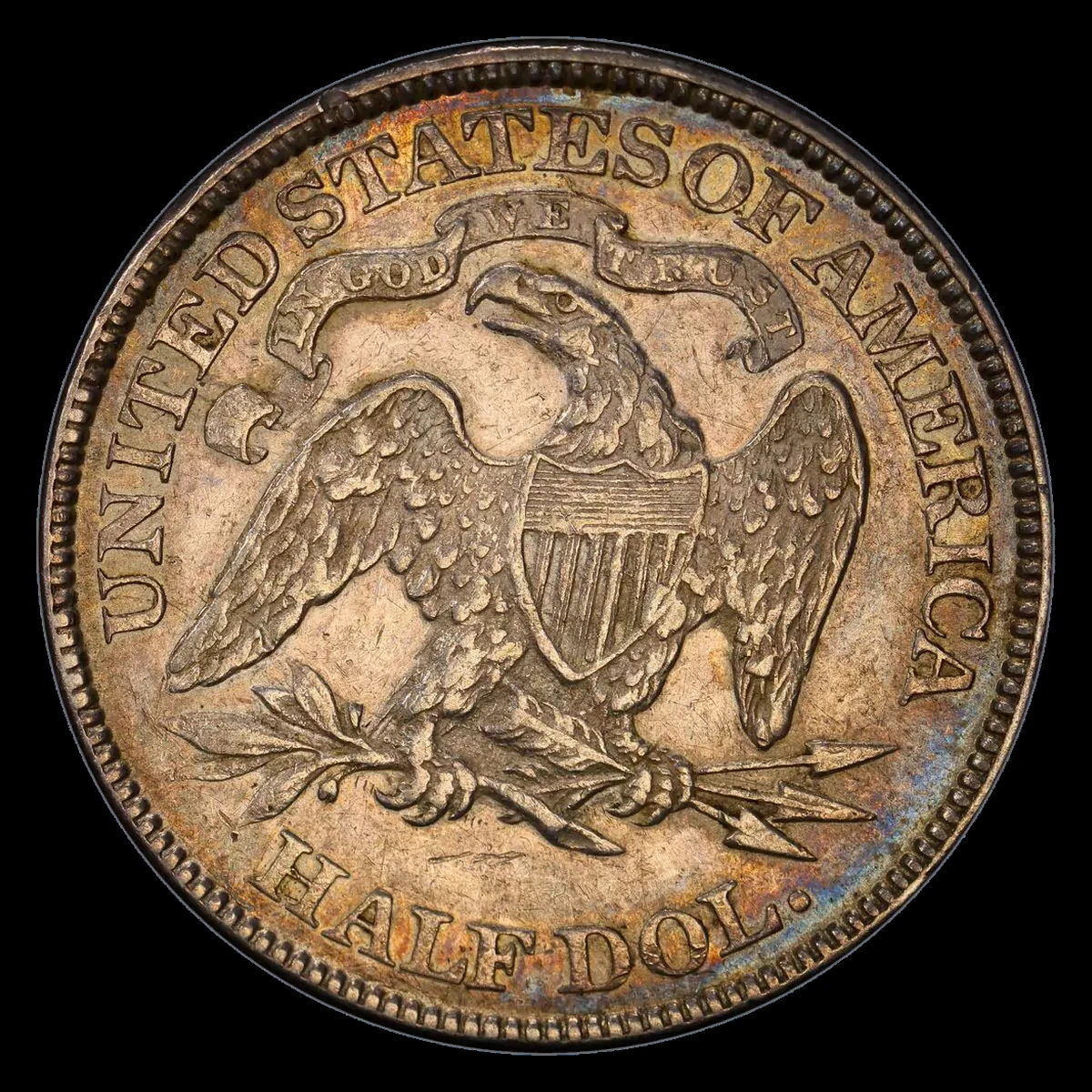
A die crack leaves a thin ridge above the coin’s surface. Metal flowed into a split in the steel die during the strike.
How to Identify
Read the mintmark before tracing the line. The 1871-CC reference has a crack through MER in AMERICA; a separate San Francisco report describes a path from AMERICA toward the right wing.
Under side lighting, follow the ridge across the design. A scratch is a cut into the surface, although metal pushed up beside a scratch can catch the light.
The Carson City die reference helps you compare the full crack path. Match the date and mint as well as the line; dies could be used across more than one year.
What It’s Worth
Estimated range: $75–$3,500 across worn San Francisco coins and scarcer Carson City examples. A cleaned 1871-CC WB-1 graded PCGS VF35 Details sold for $1,920 in March 2026.
“Details” means the coin has a problem, in this case cleaning. The price also reflects the scarce date and mint, so it cannot be treated as a $1,920 payment for the crack alone.
6. 1871 Half Dollar Faint Shapes That Seem Out of Place: Clashed Dies Error
Sometimes the two dies hit each other with no blank coin between them. They pick up marks from each other, which can then appear on later coins.
Those marks are called die clashes. Look for a faint piece of the opposite design, rather than a second complete image.
How to Identify
For the Carson City example, inspect the lower-right part of the shield on the back. On the San Francisco example, look above Liberty’s knee on the front.
Compare the extra shape with the design on the coin’s other face. A random scratch or polishing line will not have that same shape and placement.
Try several lighting angles, because clash marks can be shallow. Several overlapping traces can result from repeated die clashes; they do not mean the coin itself was struck several times.
What It’s Worth
Estimated range: $75–$3,500 for worn examples, with the scarce Carson City coins generally at the higher end. The $1,920 cleaned 1871-CC WB-1 mentioned in the crack section provides a comparison.
That coin is relevant to both sections. Do not add a full die-crack price to a full die-clash price when valuing one example.
7. 1871 Half Dollar Repeated Detail on the Back: Doubled Die Reverse Error
“Reverse” means the back of the coin. A collector registry records an 1871 Philadelphia doubled-die reverse example graded PCGS AU55, a grade showing light wear.
How to Identify
Use the registered 1871 example as your starting reference. Its listing does not specify one particular doubled letter, so a random thick letter is not a match.
Compare a clear view of the whole back and a close-up of the repeated detail. Look for raised duplicate shapes, and check them under more than one lighting angle.
This reference is a Philadelphia coin with no mintmark. The doubled shield on the front of the San Francisco variety is a separate feature.
What It’s Worth
Estimated range: $200–$1,200 for worn through lightly worn examples of the reported Philadelphia variety. The AU55 registry entry is an identification reference, not a recorded sale.
For comparison, an 1853 Arrows and Rays doubled-die reverse half graded PCGS AU50 sold for $1,020 in August 2025. That different-year result provides price context; it is not a confirmed 1871 transaction.
Conclusion
Estimated values for these 1871 half dollar errors range from $75 to $7,500. Start with the location of the unusual mark, then match its shape and mintmark before comparing prices.
A weak S and doubled shield can belong to one coin, as can a crack and clash. Judge that complete coin by its wear, surfaces, and matching features instead of adding separate error prices together.