Rare 1821 Half Dollar Errors (List & Pictures)
The words on the edge can matter as much as the portrait when checking 1821 half dollar errors. A doubled inscription, a flawed blank, and cracks in a die leave very different evidence.
Estimated values across these examples run from $40–$8,000; a well-preserved O-103a sold for $7,800 in January 2025. Follow the front’s raised lines, examine an irregular reverse patch, and finish by reading the edge.
| Clue | Location | Possible explanation | Estimated value |
|---|---|---|---|
| A ridge below the date and curls | Front, with a branch toward star 10 | Die crack | $150–$8,000 |
| An irregular patch in the silver | Back | Planchet flaw | $40–$100 |
| Overlapping letter sequences | Edge | Doubled edge lettering | $150–$350 |
For a loose coin, the unworn reference figures are approximately 13.48 grams and 32.5 mm. Its edge should carry lettering; measurements help assess the basic coin but cannot identify these features by themselves.
1. 1821 Half Dollar A Ridge Winding Past the Date: Die Crack Error
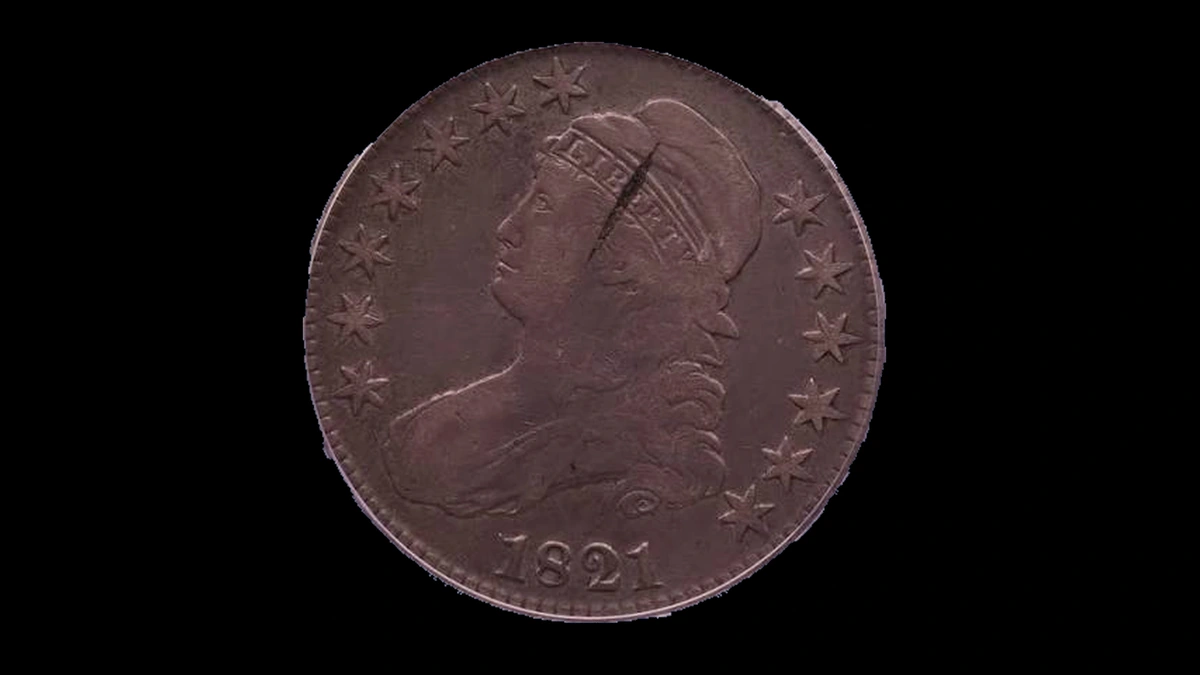
On O-103a, one line begins beneath the 8, passes the small foot of the last 1, and runs under Liberty’s curls toward the rear of her cap. A second branch connects the ribbon tip with star 10.
The pair of routes describes a developed stage of cracking in the front die. Earlier coins from those tools can have a less extensive pattern.
Here the steel tool had narrow splits that admitted silver under pressure. The resulting lines rise above the coin because metal filled spaces in the damaged die.
How to Identify
Begin below the date and follow the route through each landmark before looking for the branch. A complete pattern is more informative than a short line beside the 8.
Once the main route is located, check from the ribbon toward star 10. Compare both with an O-103a photographed at a similar stage of die wear and cracking.
Under side lighting, inspect whether the line forms a ridge or a cut. Scratches can look dark in photographs and may raise metal at their edges, so the surface shape is essential.
What It’s Worth
Estimated range: $150–$8,000 spans worn examples through well-preserved coins without circulation wear. The top of the range is tied to MS64 condition, not to the mere presence of a crack.
A PCGS MS64 O-103a sold for $7,800 in January 2025. Another MS64, carrying CAC approval, brought $7,050 in June 2013.
Those sales combine variety interest with strong preservation. A lower-grade coin may display the same route clearly while remaining much less valuable.
2. 1821 Half Dollar An Uneven Patch on the Back: Planchet Flaw Error
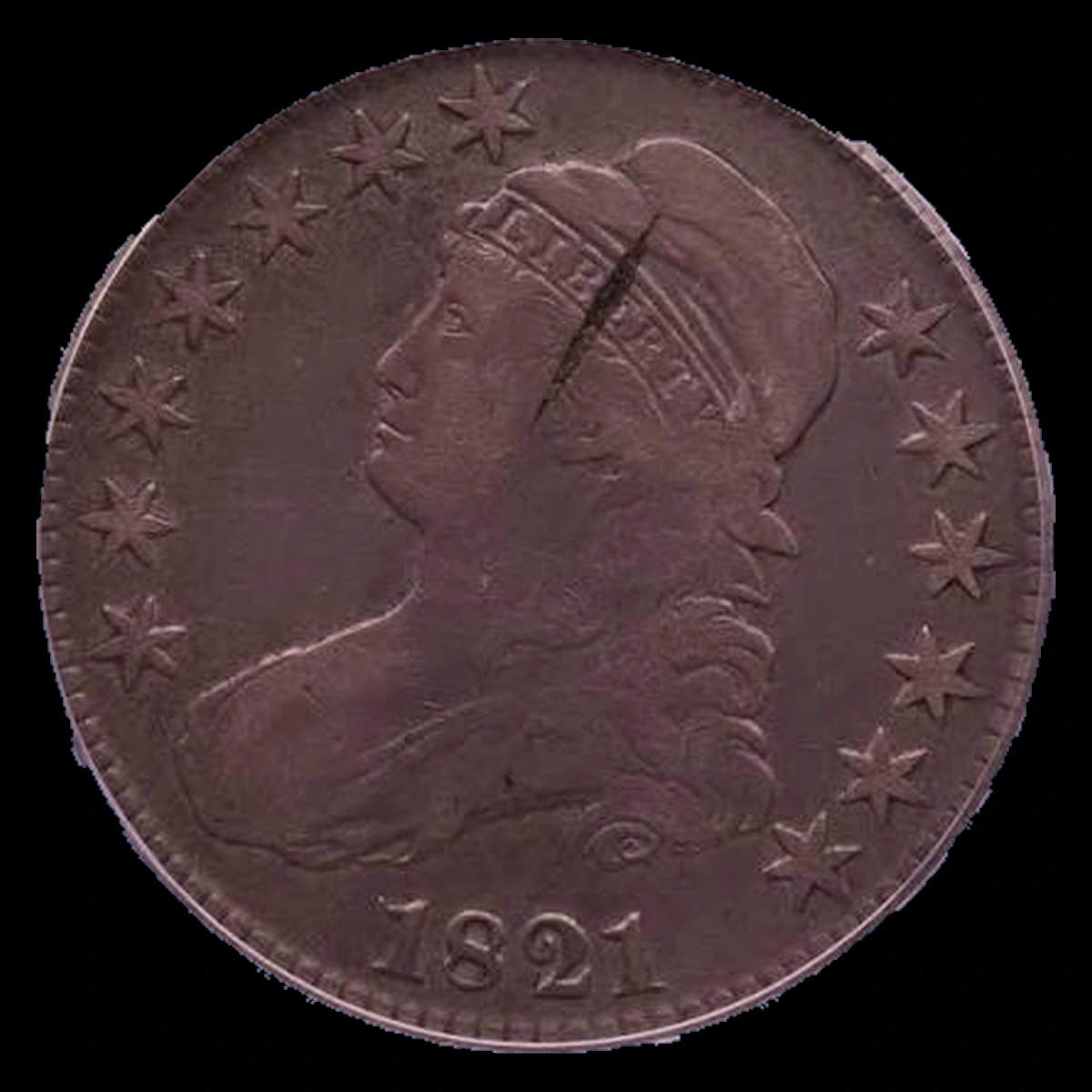
One heavily worn 1821 half dollar was cataloged with a reverse planchet flaw. “Planchet” means the metal blank that receives the design, so the description points to a problem in the silver before or during minting.
The report came from a three-coin lot that also contained halves dated 1830 and 1832. It identifies the affected face but does not establish a particular kind of peeling, split, or missing metal.
How to Identify
First connect the reverse photograph with the correct dated front. This is especially useful for a group lot, where several similar coins may be shown together.
Inspect the patch boundary and any design that crosses it. Struck detail interacting with the irregular area can help show that the defect was present when the die impressed the coin.
A fresh gouge may have a sharp channel and displaced metal, while corrosion can leave pits. A rough patch alone does not reveal when or how it formed.
Keep the broad term “planchet flaw” unless the visible evidence supports a narrower description. Calling it a clipped blank or a peeling layer would add a diagnosis the supplied catalog does not provide.
What It’s Worth
Estimated range: $40–$100 for a similarly worn 1821 half with a modest original flaw. The December 2021 Dutch Country Auctions catalog estimated $80–$115 for the entire three-coin lot.
That group estimate supplies neither a completed sale nor an individual value for the 1821 coin. The narrower estimate here is a whole-coin comparison allowing for heavy wear and the modest feature.
3. 1821 Half Dollar Two Sets of Words Sharing the Edge: Doubled Edge Lettering Error
Read beyond the first crowded letter to see whether parts of a second inscription continue around the edge. An 1821 O-104a dealer listing describes doubled edge lettering, but the feature needs to be visible on the coin.
The lettering equipment acted on the edge before the front and back were struck. An error in that separate operation could leave overlapping impressions without doubling the designs on either face.
How to Identify
Use overlapping photographs to follow several consecutive words. Seek two recognizable sets of strokes whose overlap continues beyond a single cramped letter.
The orientation of the inscription is a different matter. Words that read upside down when one face is upright do not, by themselves, show repeated lettering.
Check for edge flattening or later added cuts that could distort the original strokes. If a holder blocks the view, do not remove the coin solely to inspect the edge.
Read the actual grading label separately from the dealer’s heading. The listing’s “MS92” wording uses a condition-problem code; it does not mean a grade of 92 or establish that the service certified doubled lettering.
What It’s Worth
Estimated range: $150–$350 for a worn or problem-designated example with clear repetition. The Eye Appealing Coins listing shows $230 and is marked out of stock.
That is a posted retail figure rather than a published auction result. It should not be used as evidence for the value of an undamaged Mint State coin, whose surfaces belong to a different comparison group.
Conclusion
An 1821 half dollar asks for more than one kind of inspection: a route match for cracks, surface evidence for a blank flaw, and a continuing repeated sequence for edge lettering. Each test addresses a different stage of production.
The $40–$8,000 estimates also rest on different evidence. Keep the group-lot estimate and dealer listing distinct from completed MS64 auction sales when valuing the complete coin.