Rare 1863 Half Dollar Errors (List & Pictures)
The shape of the mark matters when sorting 1863 half dollar errors: a missing letter segment, faint extra design, raised ridge, and separated metal layer have different explanations. Estimated values here span $200–$1,500.
The supplied lamination record shows $925 in January 2018, with uncertainty about whether the displayed result includes the buyer’s fee. Check the mintmark first, then compare the surface feature with the relevant section below.
| Appearance | Inspection area | Category | Estimated value |
|---|---|---|---|
| Top of S partly missing | Below the eagle | Incomplete Small S | $200–$500 around XF |
| Faint extra outlines | Liberty’s knee and right forearm | San Francisco die clash | $200–$400 around XF |
| A thin raised line | Philadelphia coin surfaces | Die crack | $250–$600 around XF |
| A flap or shallow layer boundary | Location must be established from the coin | Lamination | $800–$1,500 for a comparable example |
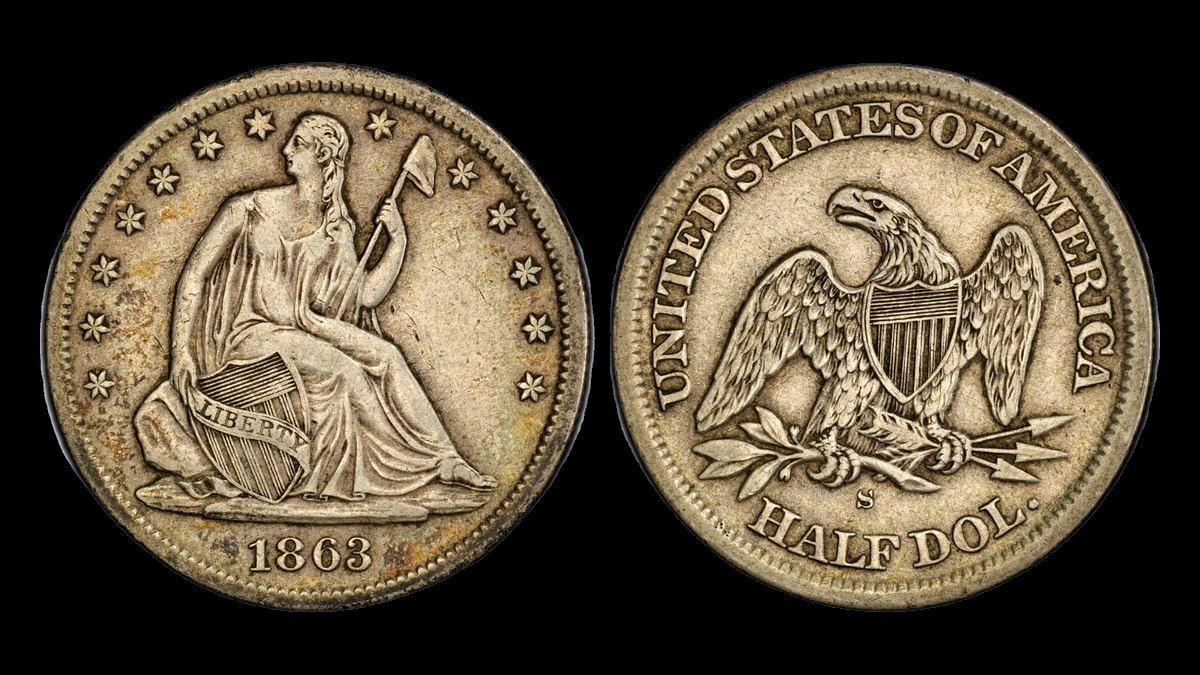
The S identifies San Francisco, while Philadelphia has no mintmark. An unworn half dollar has a normal weight of 12.44 grams, a diameter around 30.6 mm, and a grooved edge.
1. 1863 Half Dollar Only Part of the S Remains: Incomplete Small S Error
Keep the bottom of the mintmark visible as you examine the top. On cataloged 1863-S shapes, part or all of the upper portion can be absent while the lower curve still identifies San Francisco.
The description “Incomplete Small S” refers to that recognizable surviving outline. It does not establish that a punch broke while the coin itself was being struck.
How to Identify
Compare a normal small S and the suspected incomplete shape at equal magnification. Both the remaining lower curve and the boundary of the missing top should be clear.
If the whole letter is blurred, the photograph may not preserve enough information to identify the variety. Check neighboring eagle and lettering detail for a similar amount of wear.
Look for cuts, polishing, or a covered area where the top should be. General wear or an obscured mintmark can create the appearance of missing design.
Match the surviving shape without cleaning the area. The lower S also prevents a weakly marked San Francisco coin from being mistaken for Philadelphia.
What It’s Worth
Estimated range: $200–$500 for circulated examples around XF detail. XF describes light wear with much of the design still visible.
A regular 1863-S ANACS XF45 Details sold at Heritage for $216 on March 12, 2025. Its label noted cleaning and its catalog did not identify an incomplete S.
The result is a same-date, same-mint condition comparison. It does not establish a transaction or a separate premium for the cataloged mintmark shape.
2. 1863 Half Dollar Light Traces Near the Knee: Die Clash Error
On a San Francisco coin, move to Liberty’s knee and right forearm on the front. The WB-4 reference identifies faint clash marks in both locations.
The two dies, or steel stamping tools, had contacted each other without a blank in place. Traces transferred in that contact could appear on coins struck afterward.
How to Identify
Use low side lighting to search both areas without losing their position within the portrait. Because the traces are light, several views may be needed to show their shapes.
The WB-4 illustration in Bugert’s reference supplies the comparison. Clash shapes should relate to the opposite design, unlike random scratches around the knee.
Record a complete front photograph with the close-ups. Agreement at the knee and forearm is more useful for this variety than one unexplained line.
What It’s Worth
Estimated range: $200–$400 for circulated examples around XF with visible clashes. Attractive, undamaged surfaces can make a clearer comparison at the upper end.
The cleaned XF45 Details San Francisco coin sold for $216 in March 2025 provides the condition context here too. It was not identified as WB-4 with clash marks, so the estimate is not a quoted clash sale.
3. 1863 Half Dollar A Fine Line Standing Above the Silver: Die Crack Error
For Philadelphia, the reported feature is a raised line from a cracked die. PCGS discusses die cracks on the 1863 Philadelphia issue without specifying one route for every coin.
Silver pressed into a narrow opening in the tool and formed a ridge. That added height distinguishes the feature from a cut into the finished coin.
How to Identify
Establish the mint before comparing the line’s position. A route documented on an S-mint die cannot identify a Philadelphia coin from different tools.
Rotate the coin through a narrow beam of light and inspect the line’s center. A scratch may have raised edges but still contains a recessed groove.
Branching or uneven thickness can occur, but neither is required for a die crack. Examine the whole coin for bending, splits, or other damage that might explain the mark instead.
What It’s Worth
Estimated range: $250–$600 for lightly worn Philadelphia examples with visible raised cracks. The quality of the surfaces and clarity of the feature affect the comparison.
An ordinary 1863 graded NGC XF Details brought $312 at Heritage on February 14, 2023, with cleaning noted. The supplied record does not identify a specific crack or price its premium.
4. 1863 Half Dollar Metal Separating in a Thin Layer: Lamination Error
A peeling flap or shallow missing layer directs attention to the metal blank itself. Lamination means separation within that metal, rather than an extra feature in the die.
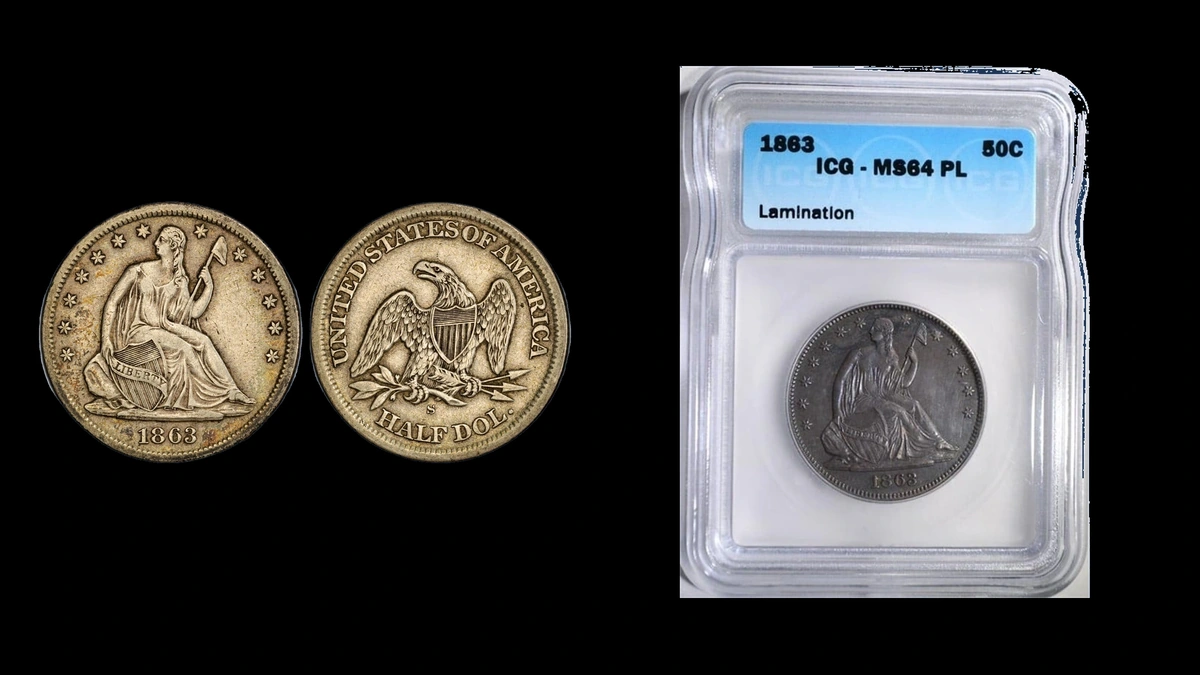
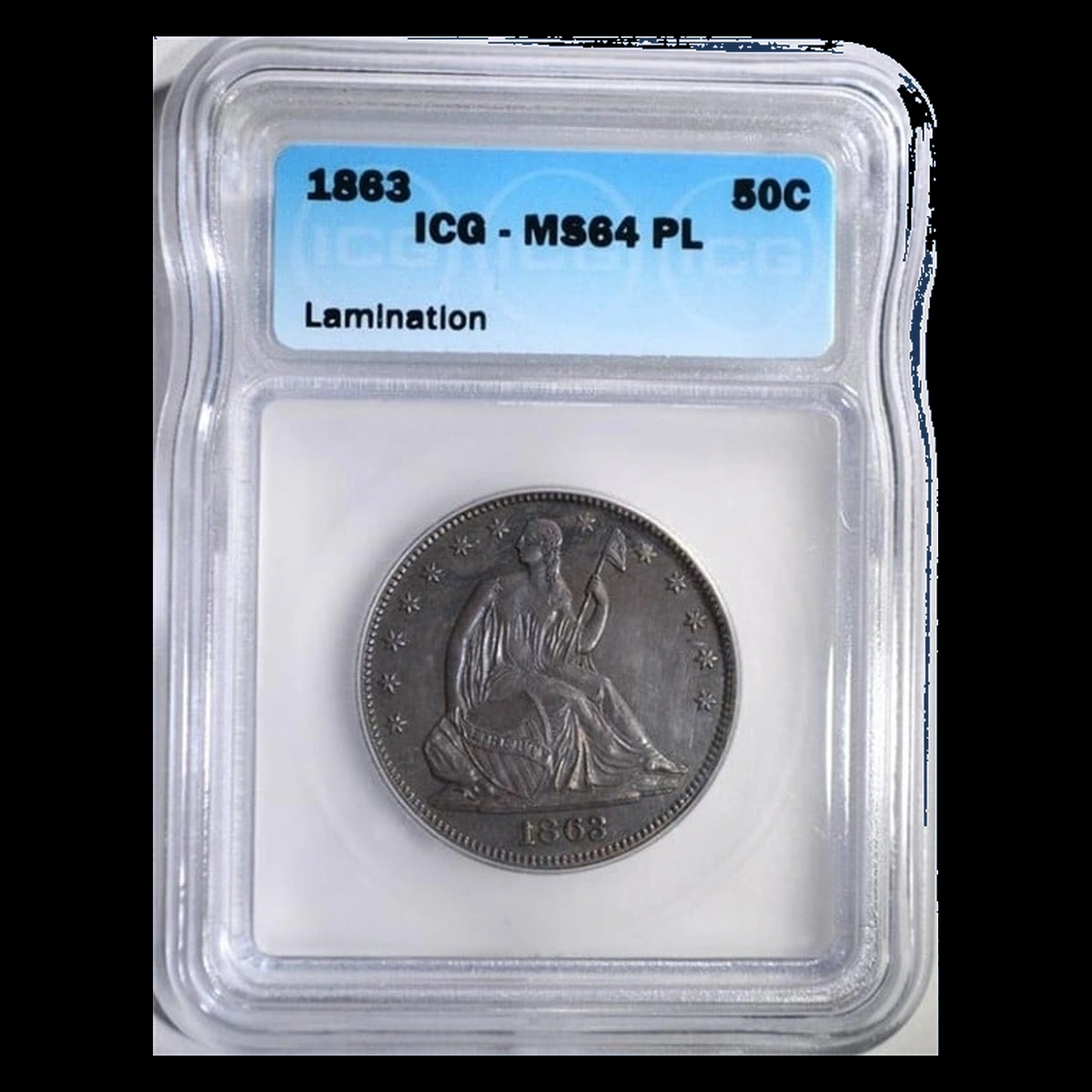
Silver City Auctions described an 1863 half with lamination in an ICG MS64 Prooflike holder in January 2018. The brief entry does not locate the affected face or area.
Prooflike describes reflective surfaces on this unworn coin. It is not the same as Proof, the term for a specially produced collector coin.
How to Identify
Look for the boundary between layers under side lighting. A shallow separation or attached flap should be assessed as a structure in the metal, not simply as a dark patch.
Keep any loose flap undisturbed. Lifting or scraping it changes the evidence and can remove part of the coin.
Corrosion and gouges can also leave missing metal. Photograph both faces, the edge, and the holder so the suspected layer can be placed on the complete example despite the catalog’s limited description.
What It’s Worth
Estimated range: $800–$1,500 for a comparable example. The grade, reflective appearance, and extent of separation all enter that comparison.
The January 23, 2018 auction entry records $925, while its presale estimate was $2,500–$3,500. It lists a 17.5% buyer’s fee separately without establishing whether that fee is included in the displayed result.
The recorded result is the useful historical reference. The higher presale prediction does not show what a buyer actually paid.
Conclusion
Let the mintmark and physical shape direct the inspection. A surviving lower S, an extra design trace, a raised ridge, and a separating layer each require different evidence.
Estimates range from $200 to $1,500 for the examples described. Ordinary cleaned-coin sales supply context for several categories, while the lamination has its own $925 record with an unresolved buyer’s-fee detail.