Rare 1836 Half Dollar Errors (List & Pictures)
The edge is the best place to begin with 1836 half dollar errors. Two designs appeared that year: an older version with edge words and a smaller version with edge grooves.
Estimated values here span $120–$85,000, with the top bracket reserved for rare Proofs. One Proof with a corrected value inscription sold for $84,000 in May 2022.
Identify the version first, then check the edge, date, reverse value, and any repeated face design.
| Area | Feature | Estimated comparison |
|---|---|---|
| Edge | Repeated words | $200–$500 when worn |
| Inside the date’s 8 | 1836/1336 corrected date | $120–$650 worn; $1,500–$6,000 unworn |
| Value below the eagle | 50 over 00 | $200–$2,000 worn; rare Proofs $60,000–$85,000 |
| Front and back designs | Double strike | $1,200–$2,500 for comparable worn lettered-edge coins |
The lettered-edge version is about 32.5 millimeters wide and reads 50 C. below the eagle. The smaller grooved-edge version is about 30 millimeters wide and reads 50 CENTS; both use a nominal 13.48-gram weight for 1836.
1. 1836 Half Dollar Words Repeated Around the Edge: Doubled Edge Lettering Error
The faces can look normal while part of the edge inscription appears twice. Workers applied those words before striking the front and back.
A slip or another pass through the lettering equipment could leave overlapping letters. This is separate from a second strike on the coin’s faces.
NGC illustrates an O-114 example in a holder that permits viewing the edge. O-114 is the catalog label for that coin’s variety.
How to Identify
Read the full inscription as you turn the coin. Take overlapping edge photographs so each stretch of lettering connects with the next.
Compare repeated whole letters or words with the NGC illustrated example. A single damaged stroke does not establish doubled lettering.
Keep the dated front and reverse with the edge views. A grooved-edge 1836 has no edge words by design, so their absence on that version is normal.
What It’s Worth
Estimated range: $200–$500 for worn 1836 lettered-edge coins with clear overlap. Finer examples need comparisons in their own grades.
An 1834 with doubled edge lettering sold for $220 in July 2026, according to Greysheet. ANACS described it as Fine Details with cleaning, meaning wear plus a surface problem.
This is a different-year comparison for the same error type. It is not a recorded price for NGC’s illustrated 1836 coin.
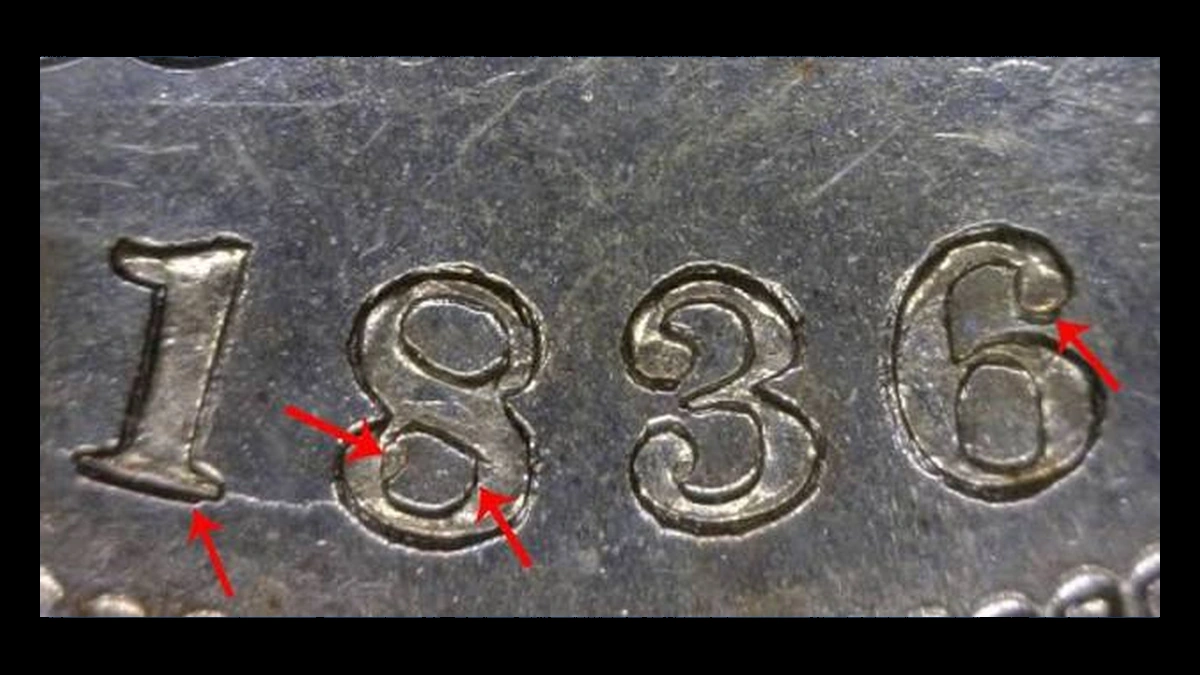
2. 1836 Half Dollar An Extra Shape Inside the 8: 1836/1336 Corrected Date Error
The unusual 1836/1336 name refers to a mark traditionally read as part of a 3 beneath the 8. The most useful area to examine is the 8’s lower interior.
It does not mean the coin was made in 1336. The name concerns an earlier number associated with preparing the die, the steel tool that stamps the design.
This variety belongs to the lettered-edge series. A matching internal shape is more useful than the general impression of a messy or doubled-looking number.
How to Identify
Place a normal 1836 date beside a confirmed variety photograph at the same size. Compare the lower part inside the 8 before checking the rest of the date.
Use a magnifier and light from two directions to judge the shape. Dirt, a scratch, or a shadow can create a misleading extra line.
Confirm the lettered edge and older design. The catalog name alone is not evidence if the actual internal detail does not match.
What It’s Worth
Estimated range: $120–$650 for worn examples, using the USA Coin Book retail guide from G4 through AU50. Those grades run from heavy to light wear.
Unworn coins have a separate estimated range of $1,500–$6,000. An NGC MS64+ from the Newman collection sold for $5,581 in November 2013.
The guide figures and the auction sale are different kinds of price evidence. Use the grade and surfaces with the date pattern when choosing between them.
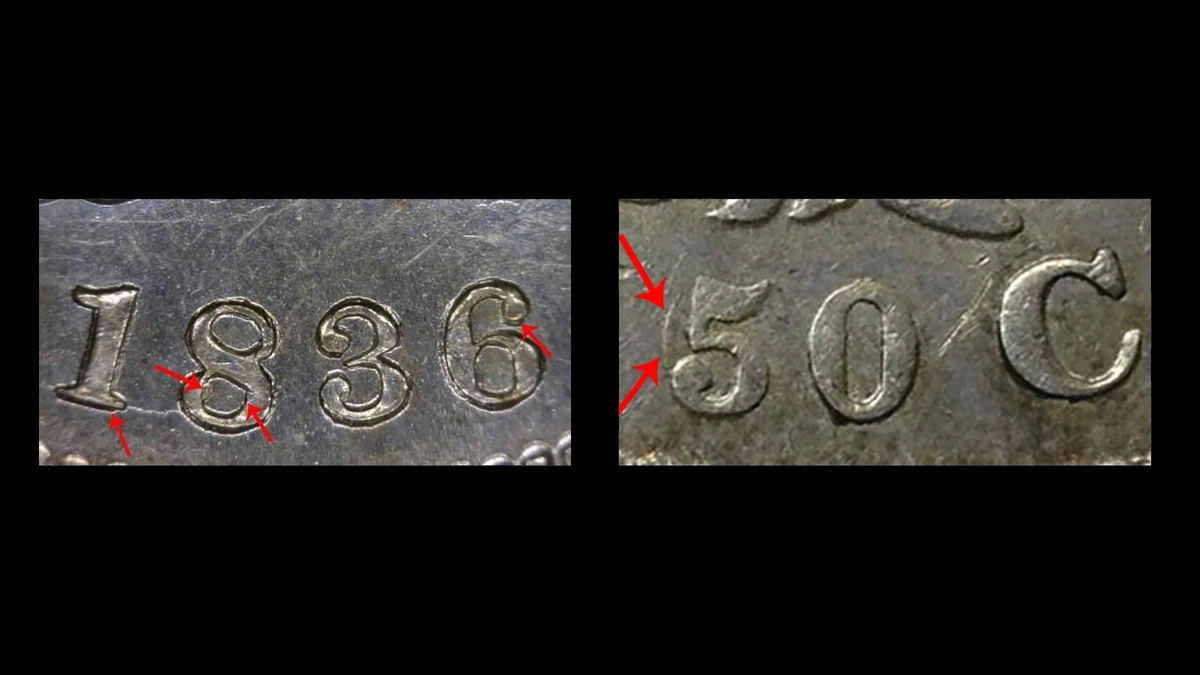
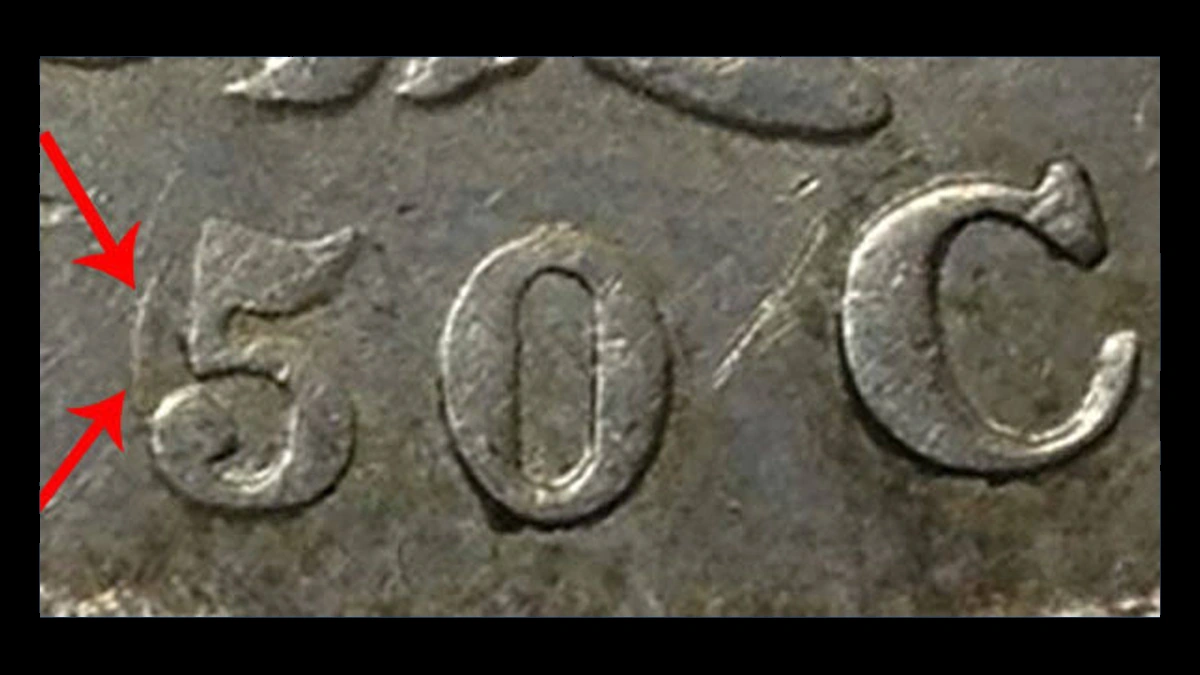
3. 1836 Half Dollar A Zero Beneath the 5: 50/00 Denomination Error
Turn to the value below the eagle and inspect the 5 in 50 C. A curved remnant of a zero survives beneath it on this corrected-denomination variety.
The correction was made in the die. Coins struck from that tool could inherit the earlier curve.
Both regular coins and rare Proofs show the feature. Proofs were specially made for collectors, so the extra curve alone does not establish Proof status.
How to Identify
Enlarge the complete value inscription rather than cropping the 5 alone. Compare the remnant’s shape and position with a confirmed 50/00 example.
A scratch through the number or a bright reflection is not enough. Move the light and make sure the physical curve stays in the same place.
The correct version has edge words and reads 50 C. The smaller 1836 design with edge grooves reads 50 CENTS instead.
Assess Proof status separately from the number. Polishing can make a regular coin shiny without changing how it was manufactured.
What It’s Worth
Estimated range: $200–$2,000 for worn regular examples. Exceptional unworn pieces around MS64–MS66 have a separate estimate of $10,000–$20,000.
The published regular-coin record is $18,975 for an MS66 in July 2005. That is a different market from rare Proofs.
A PR64 Proof sold for $84,000 in May 2022. Comparable rare Proofs have an estimated $60,000–$85,000 range.
The large gap reflects manufacture, rarity, and preservation. Sharing the corrected number does not put an ordinary worn coin in the Proof bracket.
4. 1836 Half Dollar Parts of Two Face Designs: Double Strike Error
A second blow after a coin moves can leave pieces of its earlier impression beside the new one. Look for repeated portrait, border, or lettering details on the faces.
The John Reich Journal has an illustrated report of an 1836 example. Its index alone does not specify the edge version or the amount of displacement.
Repeated edge words do not prove this error. Edge lettering occurred at a different stage from striking the two faces.
How to Identify
Establish the edge type first, using the design and measurements above. This keeps a smaller grooved-edge coin out of a price comparison intended for lettered-edge halves.
Follow several repeated details with a magnifier. They should fit a coherent second impression rather than one stray line beside the portrait.
The John Reich Journal index points to the illustrated article. Consult the actual pictured coin before assigning the reported example an edge type or shift direction.
Include full views of both faces and the edge in your own record. This separates a double strike from doubled edge lettering and from a small repeated mark already present in a die.
What It’s Worth
Estimated range: $1,200–$2,500 for a worn lettered-edge example with clearly separated impressions. The smaller grooved-edge issue needs its own market comparison.
An 1832 NGC XF40 double strike was listed at a $1,450 floor price in April 2008. That worn example also showed rotation on the reverse.
This is another year’s historical floor figure, not a recent 1836 sale. The clarity of the second impression and the coin’s surfaces both matter when applying it.
Conclusion
Let the edge identify the version before studying unusual words or numbers. Then check whether the feature concerns edge lettering, a corrected die detail, or a second impression on the faces.
The $120–$85,000 span crosses very different grades and manufacturing methods. The rare Proof price is a separate comparison, even when a regular coin shares the same corrected value inscription.