Rare 1938 Half Dollar Errors (List & Pictures)
A missing piece of rim, an extra outline, and a peeling surface point to very different 1938 half dollar errors. The reported categories below span roughly $50–$12,000, although a scarce Denver coin’s ordinary value can account for much of its price.
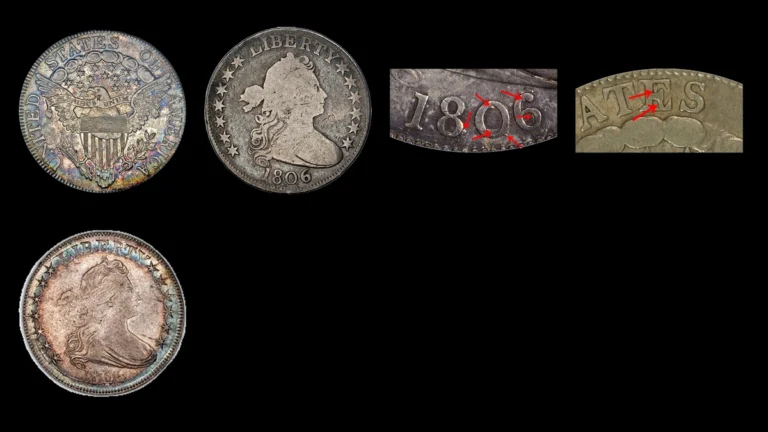
A related 1918 off-center half brought $10,575 in 2013; that is a different-year comparison, not a recorded 1938 sale. Work around the coin’s outline first, then examine its surface, date side, and eagle side.
| Visible clue | Possible explanation | Approximate whole-coin range |
|---|---|---|
| A bite out of the rim | Clipped planchet | $75–$800 |
| Wide coin with complete designs | Broadstrike | $3,000–$7,000 |
| Blank crescent and missing design | Off-center strike | $500–$12,000 |
| A lifting surface layer | Lamination | $60–$400 |
| Extra front-side outlines | Doubled die obverse | $75–$2,500 |
| An extra part of the D | Repunched mintmark | $150–$1,500 |
| A raised line near the eagle | Die crack | $50–$200 |
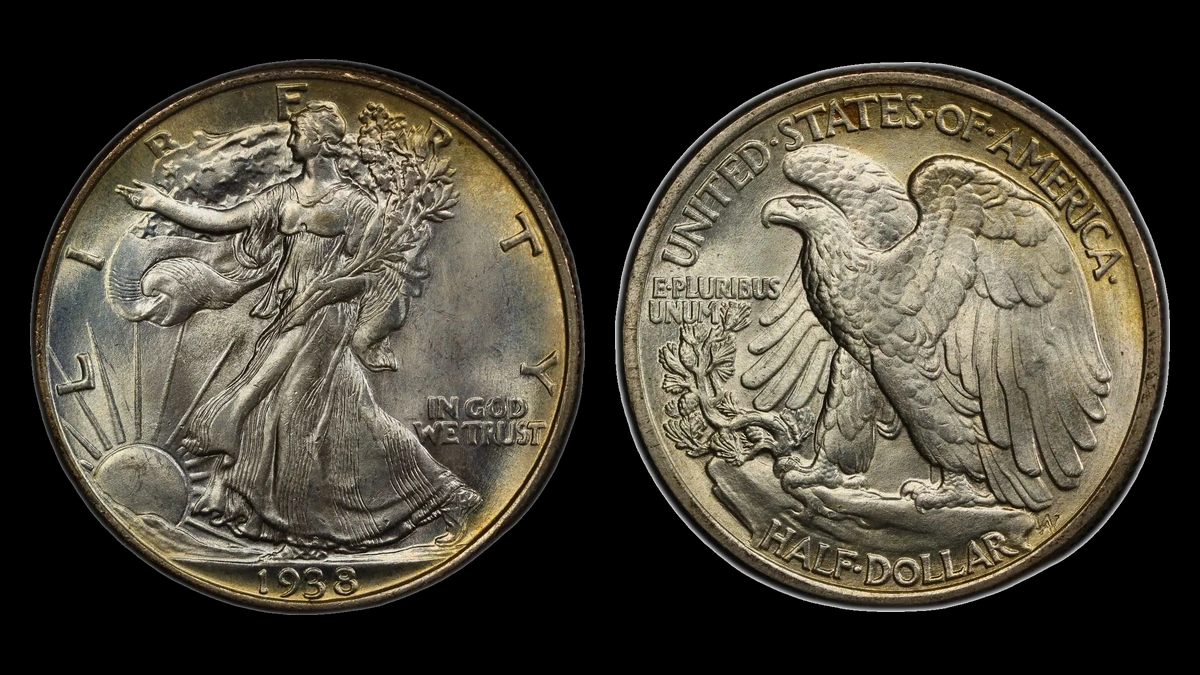
A normal 1938 Walking Liberty half contains 90% silver, weighs 12.50 grams, and measures about 30.6 millimeters across. Its edge has regular grooves; measurements and edge photographs are especially useful when investigating an unusual outline.
1. 1938 Half Dollar A curved piece missing from the rim: Clipped planchet Error
A smooth inward curve interrupting the circular outline may have existed before the coin was struck. It can form when the blanking punch overlaps a hole already cut in the metal strip; a strip-edge overlap can instead produce a straight clip.
How to Identify
Inspect the ends of the missing section for a border shaped during striking, rather than fresh saw marks, sharp burrs, or filing. A weak rim opposite the gap can support a genuine clip, though it need not be obvious on every example.
Missing metal should also reduce weight. A uniformly smaller coin calls for a different explanation, such as later trimming, rather than a localized blanking error.
What It’s Worth
About $75–$800 covers the supplied estimates for circulated to modestly unworn Philadelphia examples, with more substantial clips toward $300–$800. Denver coins require a separate allowance for the scarcer date-and-mint combination.
A 1942-S rim clip graded ANACS MS62 sold for $81.90 including fees through Pristine in May 2025. That comparison illustrates how an authentic but small clip can remain relatively affordable; it does not establish a sale price for a 1938 coin.
2. 1938 Half Dollar An enlarged coin with the designs intact: Broadstrike Error
Check whether Liberty, the eagle, and the surrounding lettering fit on a coin that seems unusually wide. A broadstrike occurs when the collar, the ring that limits expansion and forms the edge grooves, fails to contain the blank during the strike.
How to Identify
Complete designs distinguish a broadstrike from the off-center category below. The expanded perimeter should agree with an abnormal edge rather than ordinary, continuous collar grooves.
Measure across several directions and inspect both faces for the effects of later flattening. A genuine broadstrike can spread outward without losing metal, so a large diameter does not by itself imply a low weight.
What It’s Worth
The supplied series guide suggests roughly $3,000–$7,000 for authenticated, lightly worn to unworn Walking Liberty broadstrikes. Its July 2025 figures place smaller examples around $3,000 in extremely fine or about uncirculated condition and $5,000 unworn, versus $4,000 and $7,000 for larger examples.
These are series-level estimates, not an identified 1938 auction result. The supplied report names neither a certified 1938 specimen nor an established Denver example.
3. 1938 Half Dollar A blank crescent beside a cut-off design: Off-center strike Error
An off-center half presents two linked clues: part of the blank escaped the dies, and some intended design fell beyond its edge. This happens when the blank is out of position when struck.
How to Identify
Look for corresponding displacement on both faces, with an unstruck crescent on one side of the coin. A single face with an uneven border needs closer examination before it can be called an off-center strike.
The date must remain readable to identify a 1938 example. If the mintmark area was never struck, a missing D cannot establish Philadelphia manufacture.
What It’s Worth
Roughly $500–$12,000 is the broad supplied estimate, stretching from modest offsets to exceptional certified coins. The amount of displacement, readable date, condition, and retained design all affect where an example belongs.
Heritage sold a 1918 half struck 10% off center, graded PCGS MS65, for $10,575 in April 2013. No comparably identified 1938 sale accompanies the reported category.
4. 1938 Half Dollar A flap or peeled patch on the surface: Lamination Error
A surface layer that lifts from the coin may reflect a weakness within the original silver alloy. This is a lamination error, not the separation of a modern copper-nickel outer layer.
How to Identify
Trace the boundary of the affected area and look for a thin attached flap or a shallow separation plane. The supplied report does not specify one face, location, or mint, so there is no single patch shape to match.
A gouge cuts into the surface, while corrosion can eat irregular holes into it. Leave any attached layer in place because lifting it removes evidence of the original defect.
What It’s Worth
About $60–$400 is the supplied whole-coin range for circulated Philadelphia examples, depending on the extent and visibility of the separation. A Denver coin may exceed that range because of its underlying collector value.
No identified 1938 lamination sale supports a more precise figure. A small flake and a broad retained flap should not be priced as equivalent errors.
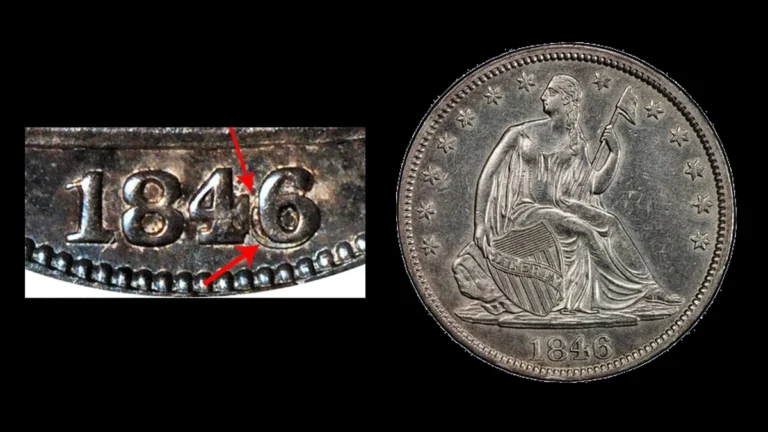
5. 1938 Half Dollar Repeated outlines on Liberty’s side: Doubled die obverse Error
Extra rounded contours on the front can come from a die that received a doubled design while it was being made. Minor doubled-die obverse reports exist for both Philadelphia and Denver, but the supplied evidence gives no catalog number or fixed diagnostic location.
How to Identify
Inspect letters and distinct design edges under magnification, looking for separated contours or notched corners. Liberty’s clothing and the flag already contain many close lines, so complexity alone is not doubling.
Flat, shelf-like extensions can result from movement during striking. A variety attribution needs a match to specific repeated features, not simply a thick-looking date or letter.
What It’s Worth
Typical minor Philadelphia reports carry estimates of $75–$500, while the supplied Denver range runs from $150–$2,500 across worn to stronger unworn examples. Much of a Denver coin’s price may reflect its normal scarcity.
A 1939-D FS-101 example graded NGC MS67+ brought $2,160 at Stack’s Bowers in April 2025. That exceptionally preserved, attributed coin is a different-year comparison, not evidence that any doubled-looking 1938 half is worth the same amount.
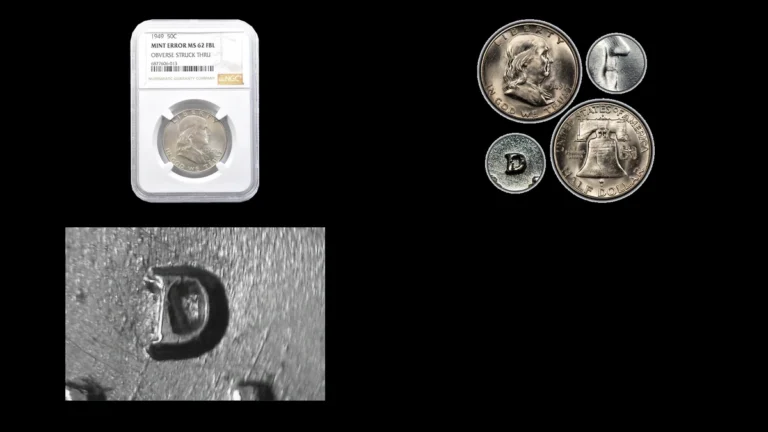
6. 1938 Half Dollar An extra fragment beside the D: Repunched mintmark Error
Find the small D below the branch on the lower-left reverse. A surviving piece of an earlier mintmark punch can appear beside the finished letter when the die was punched more than once.
How to Identify
A useful clue is an additional D-shaped edge that follows the letter’s construction. A stain, random nick, or broadly thickened mintmark does not establish a repunched mintmark.
The supplied 1938-D report gives no reliable overlap direction or certified reference coin. Also examine the surrounding surface for signs that a D was added or altered after minting.
What It’s Worth
The supplied whole-coin estimate is $150–$1,500 for circulated through lower unworn examples. It includes the value of a scarce 1938-D half and should not be read as the mintmark premium alone.
A documented 1939-D/D graded PCGS MS64+ sold for $1,292.50 through Kagin’s in September 2017. Its different date and established attribution limit its use to comparison.
7. 1938 Half Dollar A raised line around the eagle: Die crack Error
Reported cracks run near the eagle’s wings and outer lettering, although no single path is documented for all 1938 examples. Metal entering a narrow split in the die leaves a raised ridge on the coin.
How to Identify
Tilt the reverse under a light and check whether the line rises above the surrounding field. A scratch is cut into the coin, and an attached deposit may have a different color or texture.
Follow the line through nearby design elements without assuming it must reach a particular letter or feather. The supplied evidence does not establish a mint-specific crack map.
What It’s Worth
Circulated Philadelphia examples are estimated around $50–$200 as whole coins. The suggested added premium for a visible crack is only about $25–$75, which explains why ordinary coin value remains important.
A Denver example can cost more even with an equally small crack. No particular 1938 crack sale is supplied to justify a higher error premium.
Conclusion
Separate three questions when examining a 1938 half: what changed during manufacture, whether the coin is Philadelphia or Denver, and how much wear it has. The last two can influence value as strongly as a small error.
Preserve loose surface layers and record both faces and the edge. For the less firmly documented categories, a clear physical diagnosis matters more than assigning a dramatic name or borrowing a price from another date.