Rare 2005 Penny Errors (List & Pictures)
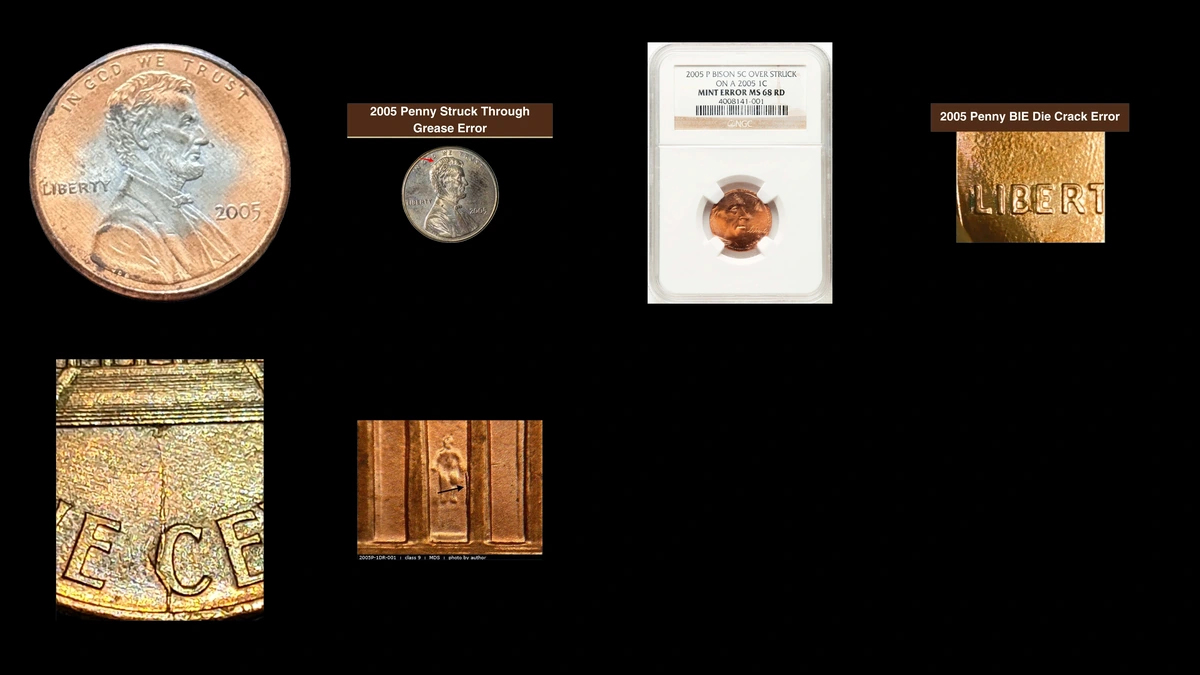
A penny can leave the Mint carrying more than Lincoln and the Memorial. One 2005 cent received a Bison nickel design and sold for $26,400 in September 2025.
The twelve groups of 2005 penny errors span estimated values of $5–$30,000, from a small edge step to that exceptional two-denomination combination. Check the outline and metal first, then compare unusual impressions and the smallest letter details.
| Where to look | Possible error | Estimated value |
|---|---|---|
| A step along the edge | Partial collar | $5–$35 |
| Uneven expanded border, full design | Uncentered broadstrike | $15–$200 |
| Plain metal beside incomplete designs | Off-center strike | $20–$350 |
| Gray zinc at the surface | Missing copper plating | $50–$800 |
| Interrupted front detail | Strike-through | $15–$900 |
| Two denominations overlap | Overstrike | $1,500–$30,000 |
| Portrait and Memorial share a face | Flip-over double strike | $300–$1,500 |
| Backward, sunken impression | Brockage | $100–$1,200 |
| Bar between B and E | BIE chip | $5–$50 |
| Ridge across the Memorial | Die crack | $5–$150 |
| Extra front contour | Doubled front design | $10–$100 |
| Repeated column or statue detail | Doubled Memorial | $10–$125 |
A normal 2005 cent is copper-plated zinc, weighs 2.50 g, and measures 19.05 mm across a plain edge. Satin-finish set coins need a matching finish comparison rather than being treated as errors because they look different.
A scale, gentle caliper measurements, and a 10× magnifier help document accessible coins. Keep sealed examples in their holders and use photographs or recorded measurements instead.
1. 2005 Penny Two Levels along the Edge: 2005 Partial Collar Strike Error
An edge step can show that only part of the blank sat inside the collar when struck. The exposed portion spread farther than the confined part.
Fred Weinberg’s historical inventory separately lists 2005 partial-collar cents. They are not the same offering as his broadstrikes with off-center-looking borders.
How to Identify
View the edge from the side and follow the width change around it. A consistent struck step differs from an isolated dent or metal squeezed by a later impact.
Compare the narrow and wide levels without pressing the coin. Pennies normally lack edge grooves, so absent reeding cannot identify a partial collar here.
What It’s Worth
Identifiable examples have an estimated $5–$35 range. Stronger edge steps and undamaged surfaces can make better collector pieces.
Weinberg’s historical price was a $5 asking price for a choice brilliant uncirculated example. That describes an attractive unworn coin offered for sale, not a completed auction.
2. 2005 Penny A Lopsided Border around Complete Designs: 2005 Uncentered Broadstrike Error
Not every penny with more blank border on one side is off center. If the full design remains within an expanded outline, the coin may be an uncentered broadstrike.
The blank spread without normal collar support, but its design need not sit at the exact middle. Weinberg explicitly described his roughly five-percent off-center-looking 2005 pieces as broadstrikes.
How to Identify
Check the portrait, Memorial, and outer lettering for completeness before measuring the wide border. Record several diameters if the spread is uneven.
Inspect high points for crushing and surfaces for pressure marks. Later flattening can enlarge a cent without producing the original outward metal flow of a broadstrike.
What It’s Worth
Comparable examples have an estimated $15–$200 range. Weinberg’s $15 historical figure was an inventory asking price.
A guide also reports a $916 example, but its original sale is not established here. That unverified high does not replace the lower working comparison for a modest uncentered broadstrike.
3. 2005 Penny Part of the Picture Runs Off the Metal: 2005 Off-Center Strike Error
An off-center blank leaves both untouched metal and an incomplete design. Unlike the broadstrike above, some intended detail misses the available metal entirely.
The year guide reports this category without fixing a mint or offset percentage. A readable date is needed to connect a particular piece confidently to 2005.
How to Identify
Find the transition from struck to unstruck metal on both faces. Corresponding design loss supports a displaced blank, while a mainly one-sided shift can involve one misaligned die.
Inspect the plain area for erased detail or grinding. Do not borrow a percentage from an uncentered broadstrike whose complete design merely looks displaced.
What It’s Worth
Identified examples have an estimated $20–$350 range, from modest shifts to stronger readable-date pieces. Original surfaces and recognizable designs support the better comparisons.
No confirmed 2005 auction amount is supplied for this group. Greater displacement can be less useful to a year collector if it removes the date.
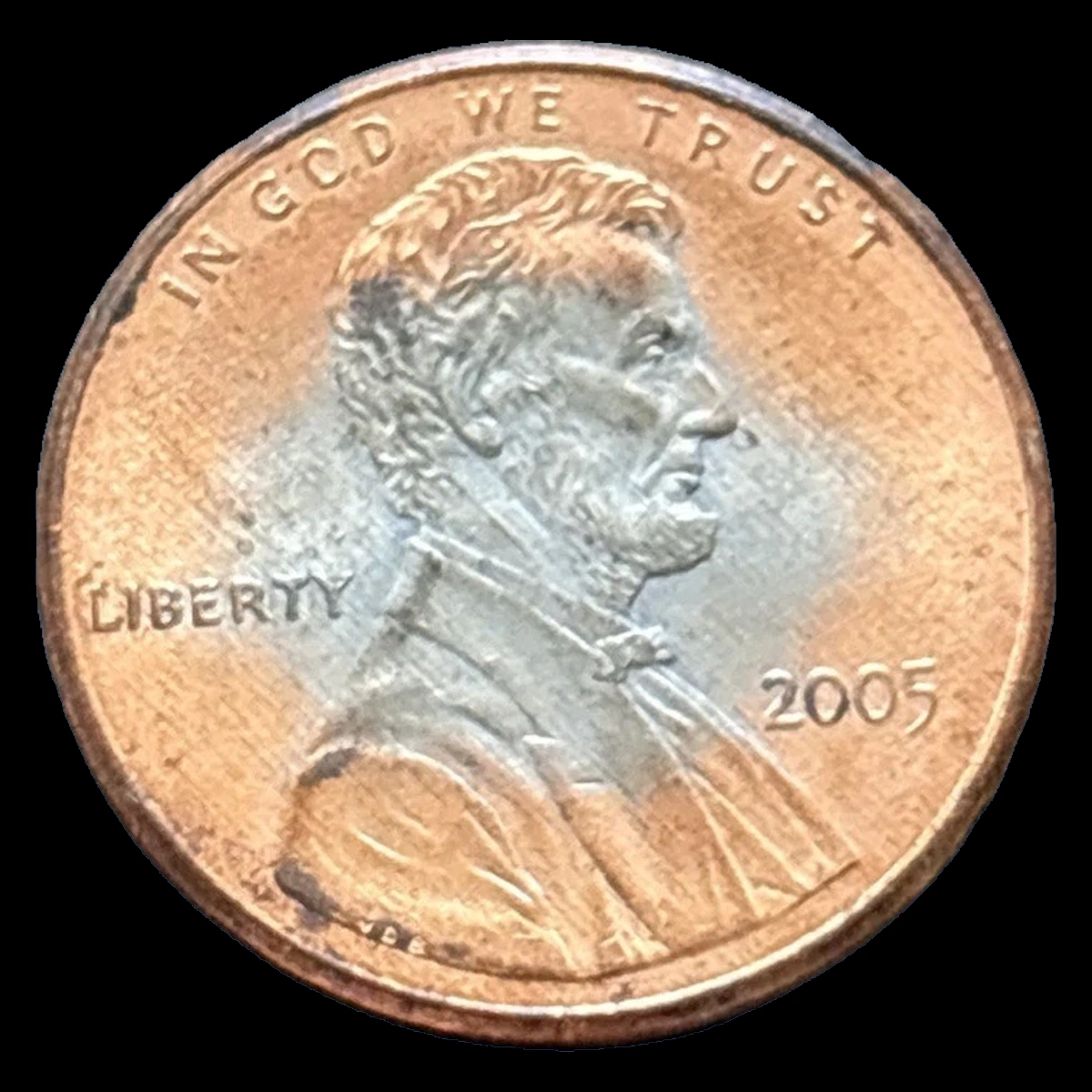
4. 2005 Penny Gray Metal without Its Copper Covering: 2005 Missing Plating Error
Zinc may be visible where a blank failed to receive its copper plating. The Philadelphia report does not establish whether the missing covering is partial or complete.
A silver-colored penny can also result from an added coating or chemicals removing normal copper. The original struck surface is therefore more useful than color alone.
How to Identify
Inspect any copper-to-zinc boundary and the design inside the gray area. Pitting, residue, and scraping may help explain later alteration instead of a plating failure.
A small weight difference cannot distinguish missing plating from chemical removal. Avoid cleaning the exposed zinc or cutting the edge, and seek specialist examination for a potentially valuable piece.
What It’s Worth
Identified missing-plating cents have an estimated $50–$800 range, depending on extent and the condition of exposed zinc. Well-preserved original surfaces support stronger comparisons.
The year guide reports $710 for an MS65 example. That reported figure is not separately established as an auction result here.
5. 2005 Penny A Blank-Looking Front Patch: 2005 Strike-Through Error
Missing portrait detail beside sharp letters can result when material blocks contact with part of the die. The obstruction prevents detail from forming in that area.
The Philadelphia report calls it grease, but weakness alone does not identify the exact substance. Its local pattern differs from a broadly weak strike across the whole coin.
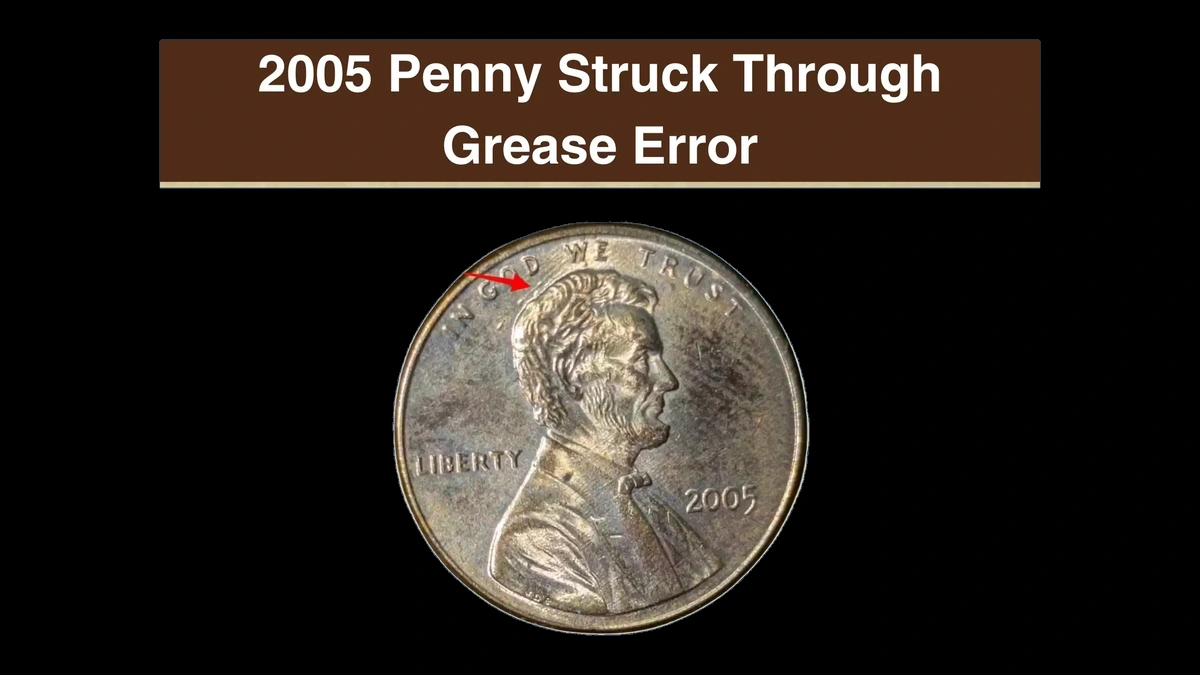
How to Identify
Trace the original surface from a sharp feature into the interrupted patch. Polishing lines, scratches, and pushed-up metal can instead reveal removal after the coin was struck.
Compare the Memorial side’s strength and preserve enough surrounding design in photographs to show the boundary. An isolated close-up of a smooth area can hide useful evidence.
What It’s Worth
The estimated working range is $15–$900, with small interruptions around $15–$50. Broad original patches on clean coins can support stronger comparisons.
The guide reports $830 for a Philadelphia example in MS63, an unworn grade with noticeable marks. That reported high is not the expected price of every weak letter.
6. 2005 Penny Two Denominations on One Coin: 2005 Overstrikes Error
Two distinct reports involve a struck coin entering another denomination’s press. One has a 2005 cent design over a dime whose year is not established.
The other reverses the cent’s role: a finished 2005 penny received the 2005-P Bison nickel design. These are already-struck hosts, not unused blanks prepared for another denomination.
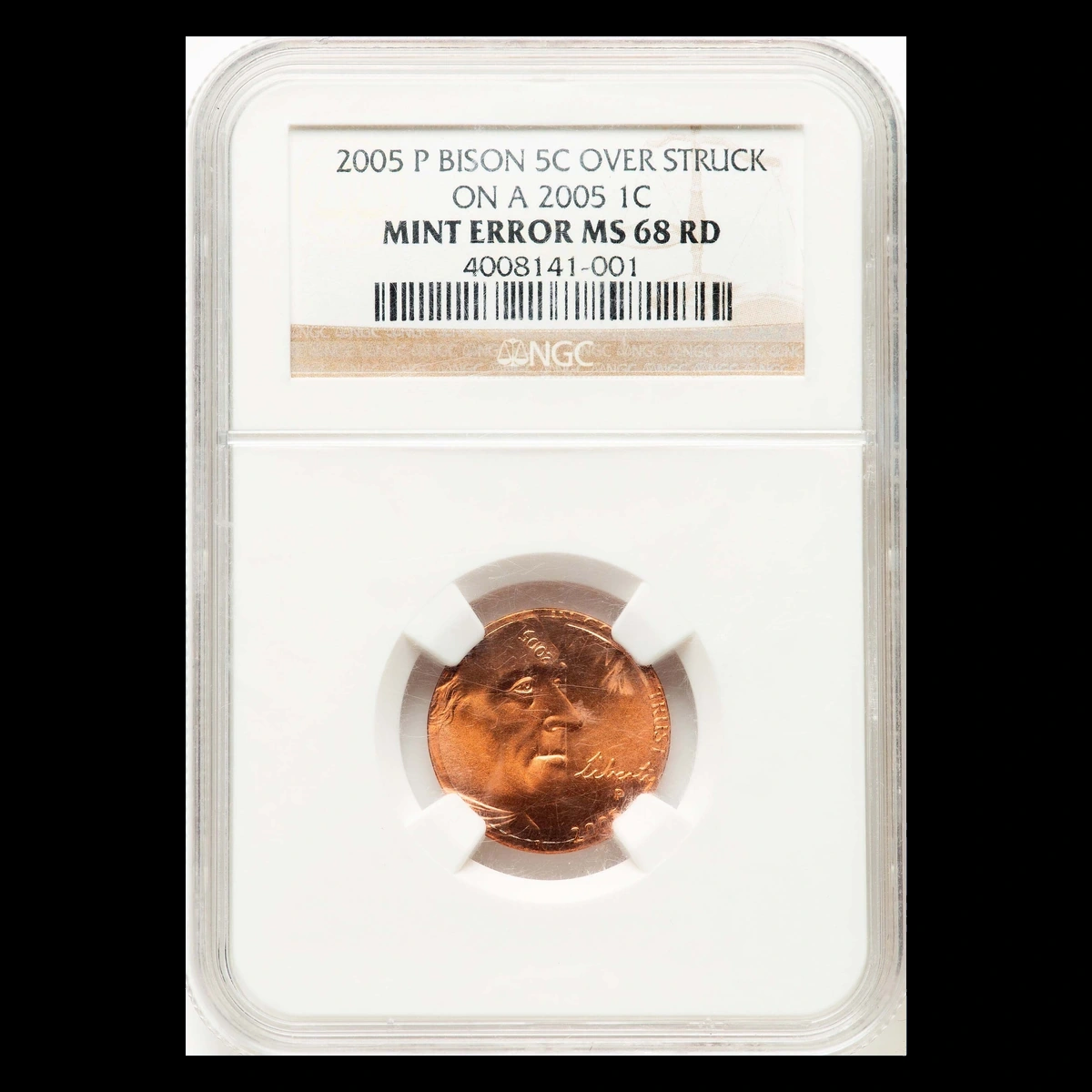
How to Identify
Locate a recognizable feature from each denomination and determine which lies over the other. On the Bison piece, surviving cent details belong beneath the nickel impression.
For the cent-over-dime report, find actual dime remnants without guessing the underlying date. The original host’s weight standard applies: normally 2.50 g for a modern cent or 2.268 g for a clad dime.
What It’s Worth
The broad estimated range is $1,500–$30,000 for these very different identified overstrikes. Denomination pairing, clarity, and preservation require individual assessment.
The Bison nickel over a 2005 cent sold for $26,400 in September 2025 in NGC MS68 Red. Its exceptional unworn preservation and red color do not supply a price for the separate cent-over-dime report.
7. 2005 Penny Lincoln and the Memorial Overlap: 2005 Flip-Over Double Strike Error
A penny turning over before another blow can receive front and back design elements on the same face. The second impression overlaps the earlier struck picture.
The reported Denver example has no securely established angle or displacement in the supplied description. Tiny extra Memorial detail from one doubled die does not demonstrate this whole-coin sequence.
How to Identify
Trace an actual portrait feature and Memorial feature through their overlap. Look for a relationship in which the second blow flattened portions of the first while leaving recognizable remnants.
Examine the other face for supporting impressions. A sunken mirrored copy made by another coin calls for a brockage assessment instead.
What It’s Worth
Identified examples with readable overlapping designs have an estimated $300–$1,500 range. A clear date and undamaged surfaces help support the upper comparisons.
The guide reports $1,200 for a 2005-D MS66, an unworn grade with few marks. Its original auction lot is not independently matched here.
8. 2005 Penny A Design Reads Backward and Sinks In: 2005 Brockage Error
A previously struck coin between a die and fresh blank can act as a temporary stamp. Its raised design creates a recessed mirror image called a brockage.
The Denver report does not securely identify the affected face or coverage. A sharp partial impression can still be recognizable without a complete portrait or Memorial.
How to Identify
Check a clear letter’s direction and height, then follow the mirrored design into neighboring detail. Coherent backward, sunken shapes differ from faint clash traces.
Inspect the normal face and surrounding metal for later squeezing. Coins pressed together outside the Mint can imitate a reversed image, so valuable candidates need professional examination.
What It’s Worth
Identified brockages have an estimated $100–$1,200 range. Worn or partial impressions usually make lower comparisons than sharp extensive ones.
The guide reports $1,010 for a 2005-D MS64, but the original lot is not established here. An unexplained depression cannot be priced as a proven brockage from that figure.
9. 2005 Penny An Upright Bar in LIBERTY: 2005 BIE Die Chip Error
An extra bar between B and E makes LIBERTY look as though another I has appeared. Metal entering a small chip in the die creates that raised shape.
The year report does not fix a mint or named die for this BIE category. Its nickname describes the location rather than an intentional design change.
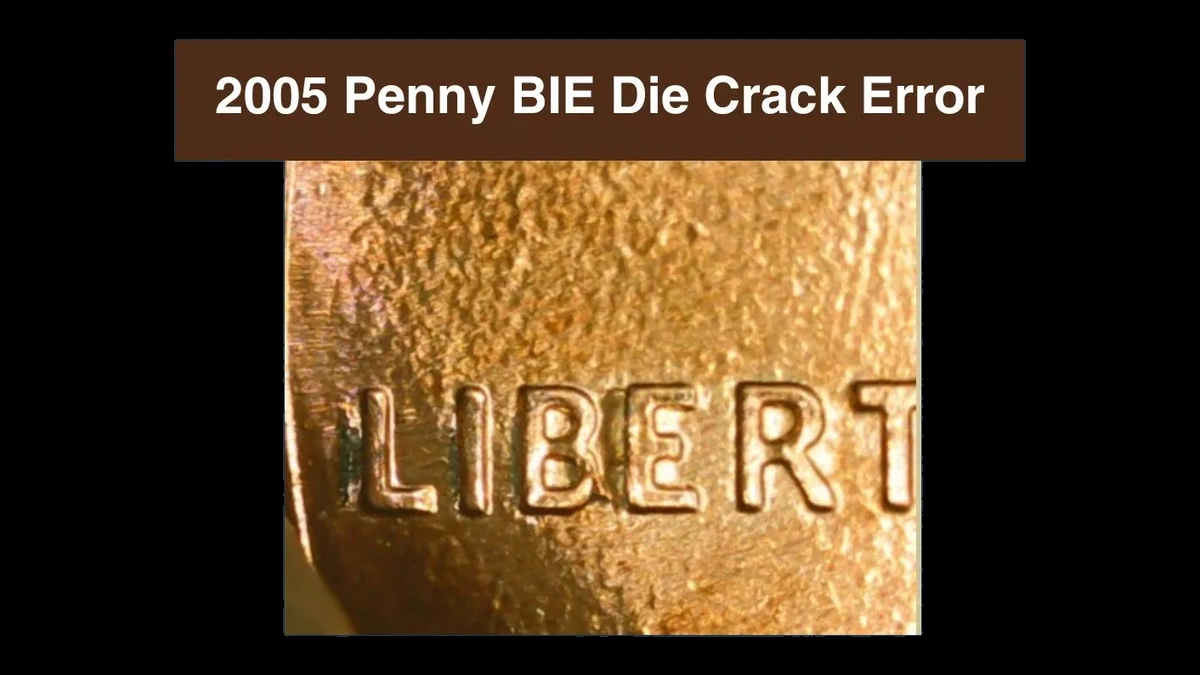
How to Identify
Inspect the B-to-E space under magnification and confirm a solid raised feature. A cut or groove is different from metal added by the die’s missing portion.
Look for a thin plating bubble or a scratch with displaced metal beside it. A mark elsewhere in LIBERTY does not match the BIE location.
What It’s Worth
Identified examples have an estimated $5–$50 range. A strong upright bar on a clean unworn coin is easier to appreciate than a tiny irregular bump.
This is a type estimate rather than an auction result for a particular 2005 die. Corrosion and scratches through the word can reduce clarity and interest.
10. 2005 Penny A Raised Line across the Memorial: 2005 Reverse Die Crack Error
A crack in the die can leave a ridge crossing back-side details. It records metal entering an opening in the tool, not a fracture through the coin itself.
The Philadelphia year report and Wexler’s identifying cracks on several tools do not establish one shared path. A line near a column must be matched to the correct example.
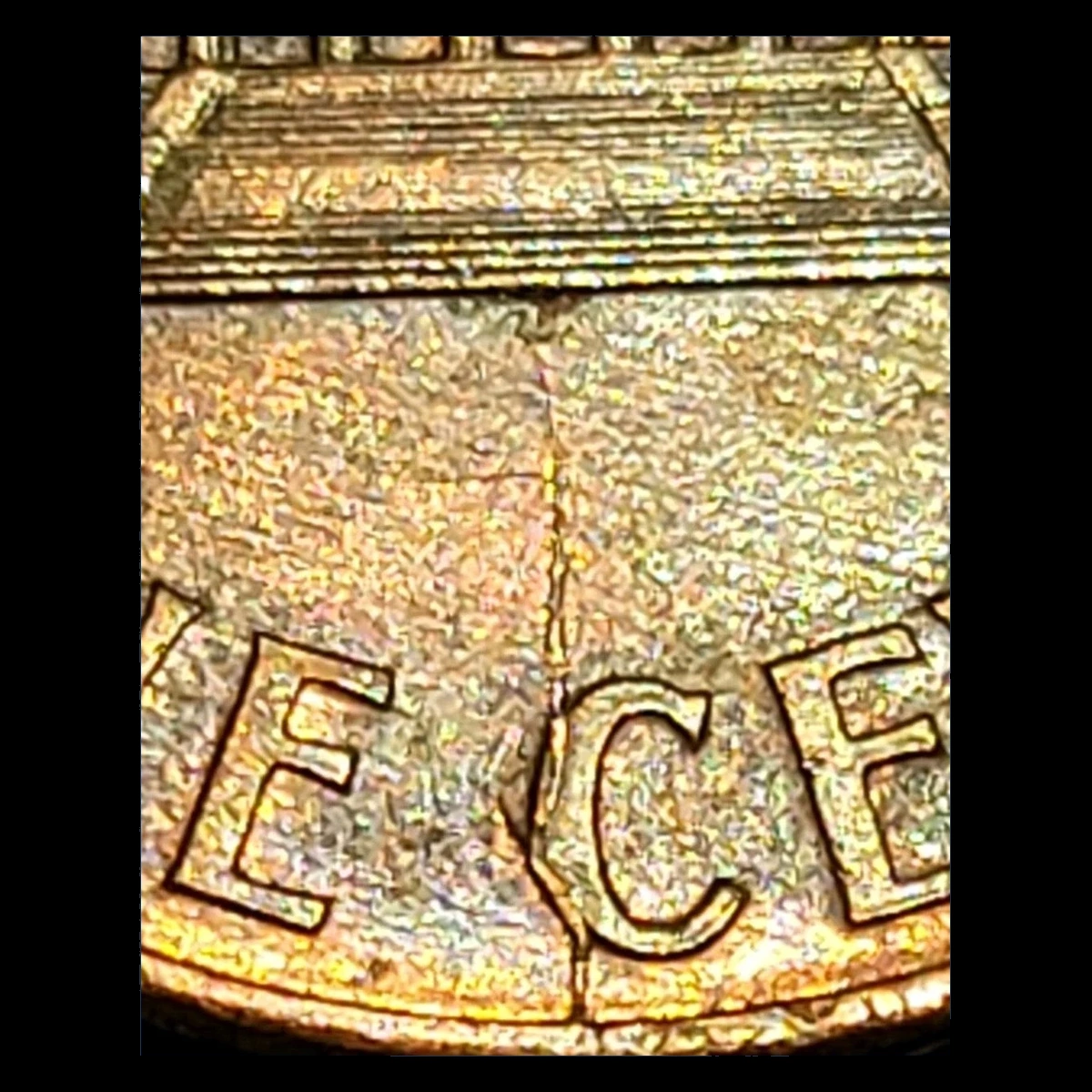
How to Identify
Follow the entire ridge with light from both sides. A scratch can push metal along one edge of a groove, so a single bright segment does not prove a die crack.
Compare matching photographs if the crack is used to identify a particular die. Do not join unrelated short marks into an imagined continuous line.
What It’s Worth
The estimated range is $5–$150, with small faint cracks usually near the lower end. A shorter strong ridge across a recognizable feature may be more appealing than a long weak one.
Value the visible coin as a whole when doubling and cracks occur together. Each minor tool mark does not add another full error premium.
11. 2005 Penny Another Contour on the Front: Reported 2005 Doubled Design Error
A doubled die carries repeated detail before it strikes the coin. It can therefore reproduce the same extra shape across multiple pennies.
The guide does not identify a numbered front variety or a fixed extra ear or date feature. A specific doubled pattern must be established rather than supplied from a generic label.
How to Identify
Record date, mint area, and finish, then photograph the clearest alleged extra feature. Compare rounded separation or a split letter corner with a reliable matching example.
A low flat shelf can arise from movement during striking, while general thickness can have other causes. The normal and extra contours should both be visible in the comparison.
What It’s Worth
A clearly identified minor front doubled die has an estimated $10–$100 range. Strong extra detail and good preservation support greater interest.
No specific specimen supplies a narrower grade-and-pattern price here. An unworn label adds little when the purported doubling cannot be distinguished.
12. 2005 Penny Extra Column and Statue Detail: 2005 Doubled Memorial Error
The supported no-mint-letter WDDR-001 has extra detail at the lower right of the sixth column and beside the statue’s right knee. These small features sit inside the Memorial.
Wexler’s updated listing replaces an older wavy-step description. Wavy steps are no longer treated as doubled-die evidence in that catalog.
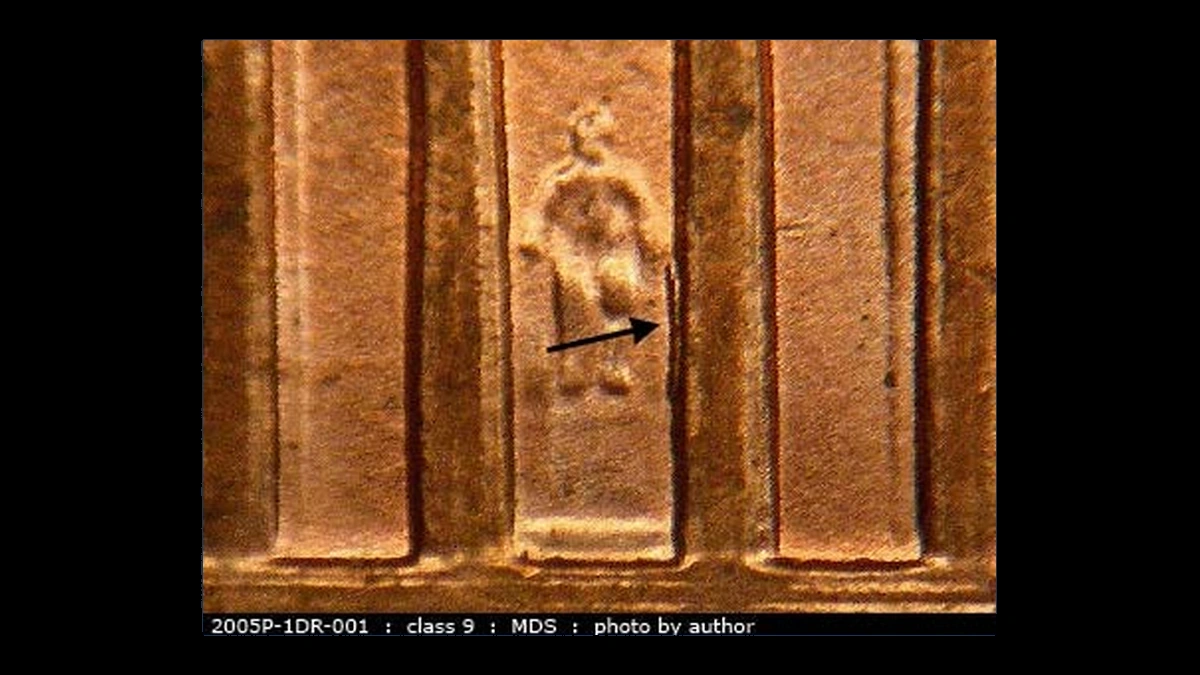
How to Identify
Count columns from the left, locate the sixth, and compare its lower-right detail alongside the statue’s legs. Then inspect the extra contour at the statue’s right knee.
Use the paired features instead of wavy steps alone. A Denver report needs its own match, and an ordinary coin should not automatically be called satin finish.
What It’s Worth
Identified Memorial doubled dies have an estimated $10–$125 range. The actual extra detail and preservation determine the useful comparison.
The guide reports an $18 June 2026 sale for an ANACS MS66 Red extra-column cent. That broader label does not by itself establish WDDR-001, despite its high unworn grade and retained red color.
Conclusion
The completeness of the design separates a lopsided broadstrike from a true off-center strike, while direction and depth help separate a flip-over impression from a brockage. Those observations are more useful than a seller’s broad label.
Across the estimated $5–$30,000 span, keep dealer asking prices, guide-reported figures, and documented auctions distinct. The exceptional Bison overstrike does not set a routine price for another denomination pairing or a small surface feature.