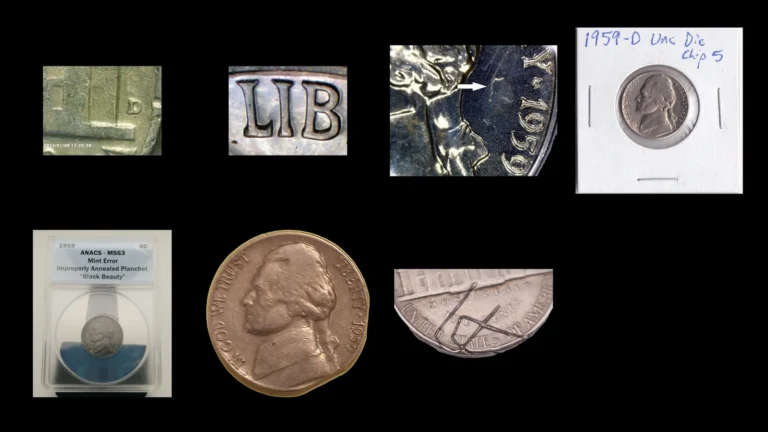
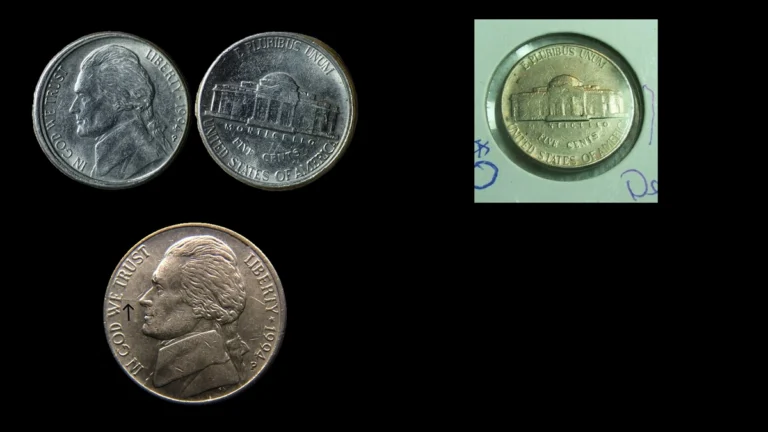
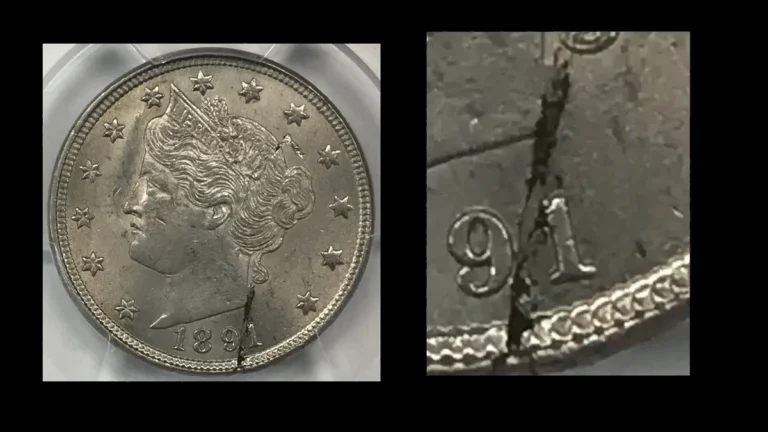
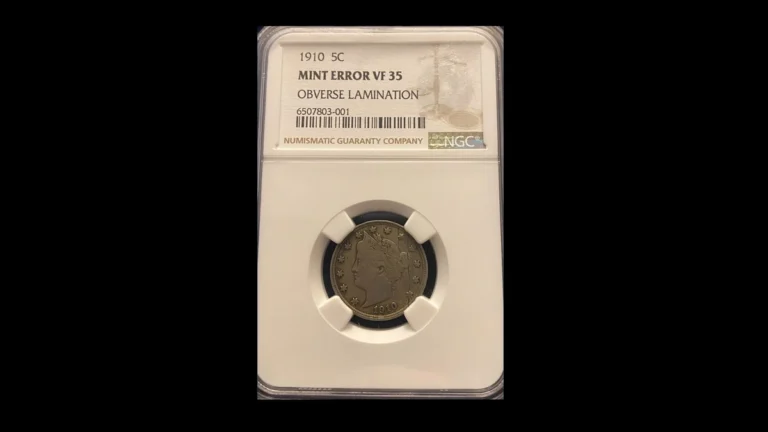
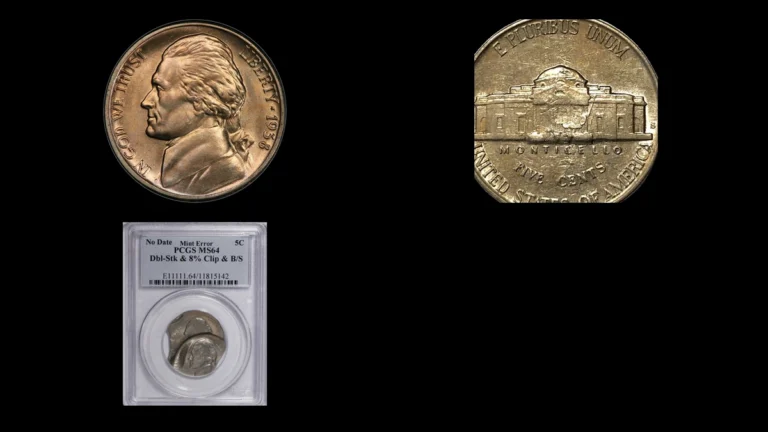
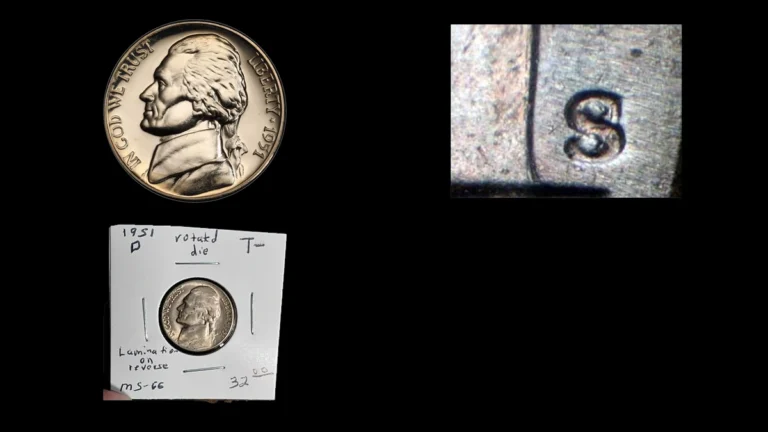
Rare 1947 Nickel Errors (List & Pictures)
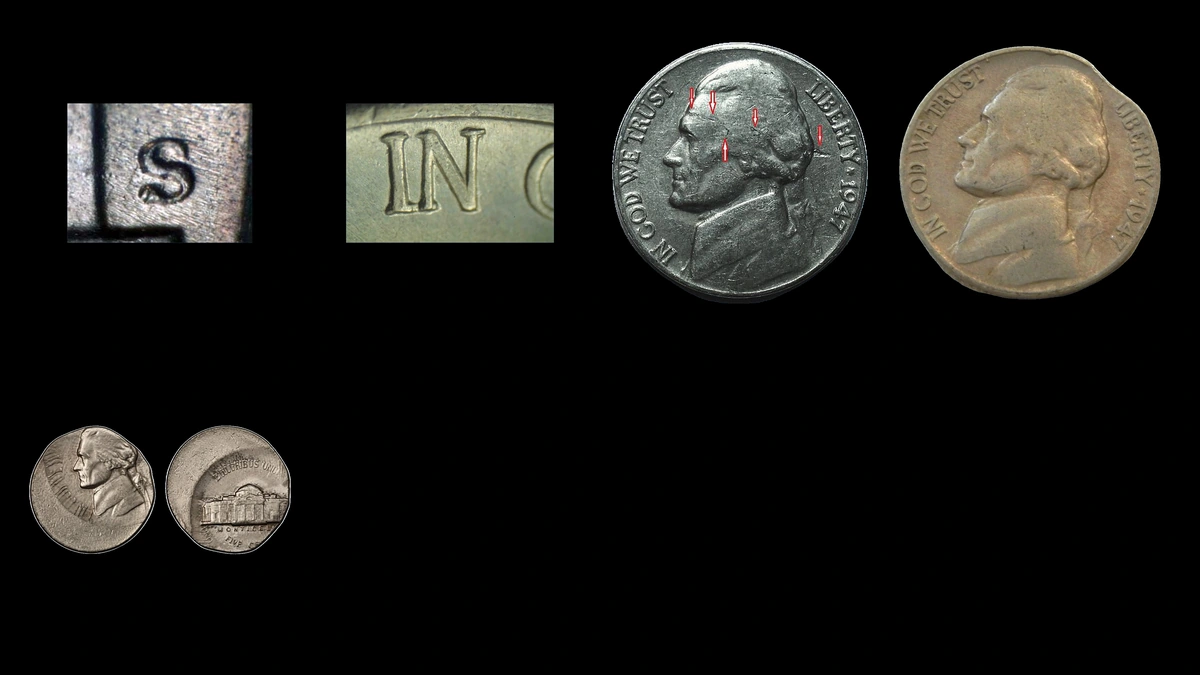
In 1947, the D or S sits to the right of Monticello, while Philadelphia nickels have no mintmark. That distinction helps sort the small varieties among 1947 Jefferson nickel errors before investigating unusual metal or strike shapes.
Estimated values range from $5 to $1,500. A scratched 1947-S struck on a cent blank sold for $564 in September 2019; follow the design details, surface and full outline to select the right comparison.
| What to examine | Error category | Estimated range |
|---|---|---|
| Added D or S curves | Repunched mintmark | $10–$150 |
| Repeated inscription outlines | Doubled or repeated die design | $10–$400 |
| Weak isolated detail | Struck through | $5–$300 |
| Raised lines or rim patch | Die crack or cud | $5–$600 |
| A surface sheet lifts | Lamination | $5–$250 |
| Matching thin halves | Split planchet | $100–$500 per pair |
| A missing edge section | Clipped planchet | $20–$300 |
| Expanded perimeter and full design | Broadstrike | $30–$350 |
| Bare metal beside missing design | Off-center strike | $30–$750 |
| Opposite-face designs overlap | Flipover double strike | $175–$750 |
| Small copper-alloy body | Cent planchet | $400–$1,500 |
1. 1947 Nickel Extra Curves around D or S: Repunched Mintmark Error
The mint letters were hand-punched into individual dies in 1947. A displaced repeat punch could leave parts of an earlier letter around the final D or S.
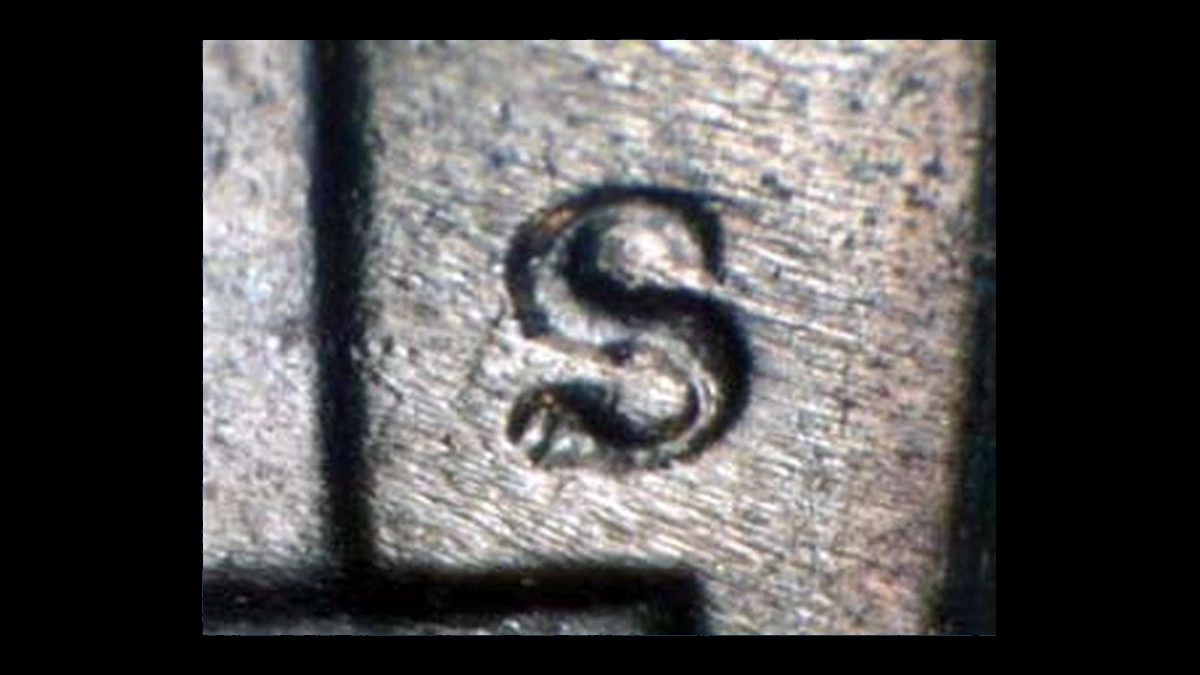
Denver WRPM-001 has an extra D below, and WRPM-002 has one above. Several San Francisco patterns have a leftward extra S, while another has one above.
How to Identify
Find the small letter beside Monticello, not above the dome, and compare its individual curves with Wexler’s 1947 mintmark references. Multiple S varieties share a broad direction, so direction alone cannot establish the catalog number.
A Philadelphia coin has no mintmark in this year. A random reverse bump on one should not be interpreted as a repunched letter simply because it is near the building.
What It’s Worth
$10–$50 is estimated for identified worn examples, with $50–$150 for clear attractive unworn pieces. These are whole-coin estimates, not realized prices for each numbered pattern.
A recognizable extra curve and clean surrounding surface make the feature easier to appreciate. Faint marks hidden by scratches can be harder to compare even when genuine.
2. 1947 Nickel Two or More Outlines beneath Letters: Repeated Die Design Error
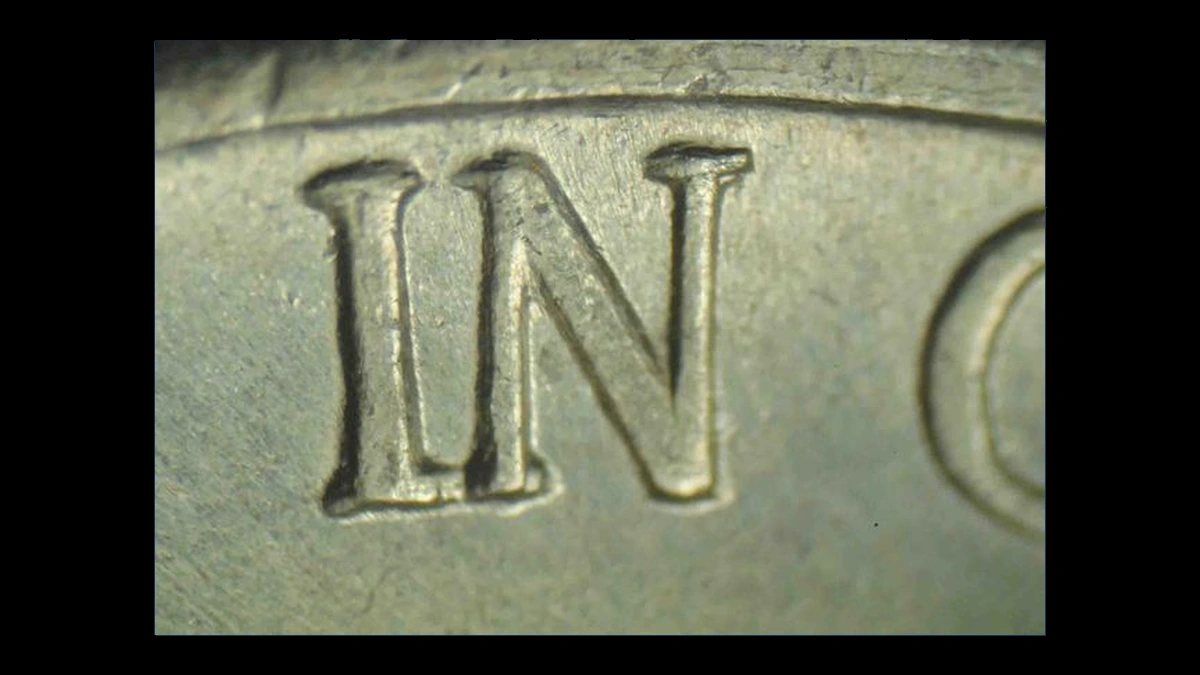
One Philadelphia reverse variety shows strong repeated outlines below UNITED STATES OF AMERICA and FIVE CENTS. Denver has reverse varieties, while San Francisco has several front and reverse patterns.
Repeated IN GOD WE TRUST can also reflect a shared master tool used to produce other dies. That common feature alone does not identify every stronger individual variety.
How to Identify
Separate no-mintmark, D and S coins before using the 1947 variety photographs. No proof nickels were made for 1947, so a shiny surface does not create a proof attribution.
For San Francisco WDDO-002, examine the date, star and LIBERTY rather than relying solely on the motto. On reverse candidates, follow several letters and distinguish separate contours from flat shelves or smeared edges.
What It’s Worth
$10–$75 is estimated for modest identified varieties, rising to $75–$400 for stronger attractive examples. A shared master-tool pattern does not automatically receive the value of a more distinctive working-die variety.
A 1963 circulation-strike nickel with strongly repeated reverse lettering brought about $277 in October 2014. It is a different-year ordinary-strike comparison, not a 1947 proof sale.
3. 1947 Nickel A Small Area Fails to Receive Detail: Struck Through Error
Grease mixed with debris can block a die recess and leave the corresponding letter or hair detail weak. This kind of interruption is reported for 1947 nickels.
Faint steps alone are insufficient because ordinary strike quality, die wear and circulation can soften Monticello too. The useful observation is a localized interruption beside normally formed detail.
How to Identify
Compare an ordinary 1947 nickel with the candidate and examine the transition between the weak patch and sharper design. If both coins show similarly soft steps, that feature adds little support.
Look for abrasion lines crossing the patch and broader wear on exposed high points. A surface that never received detail should be distinguished from one that lost it later.
What It’s Worth
$5–$40 is estimated for minor confirmed blocked detail, with $40–$300 for a larger clearly interrupted area. These figures do not apply to every weakly struck nickel.
A mostly absent word beside sharp lettering is easier to demonstrate than slightly soft steps. Readable identity and undamaged surfaces matter at the upper end.
4. 1947 Nickel A Ridge or Rim-Connected Blob: Die Crack and Cud Error
Reported 1947 die damage includes thin raised cracks and larger rim-connected breaks. Metal fills a crack or missing area in the die during striking, creating raised relief where none was intended.
The broader rim-connected patch is called a cud. No universal path or clock position is established for the year’s reported examples.
How to Identify
Follow a suspected ridge through adjacent design and check whether it rises rather than cuts into the surface. A scratch can leave raised edges without having a raised center.
For a cud, trace the patch directly into the rim and inspect for a seam or displaced metal from an impact. Opposite-face weakness can support a substantial break, but is not required for every small crack.
What It’s Worth
$5–$40 is estimated for thin cracks, with $50–$600 for clear rim-connected cuds. Serious scratches or cleaning affect the value of the complete coin.
A 1959-D cud sold for $504 in May 2021. That later substantial break is a general comparison, not a documented 1947 price.
5. 1947 Nickel A Thin Sheet Peels from the Front: Lamination Error
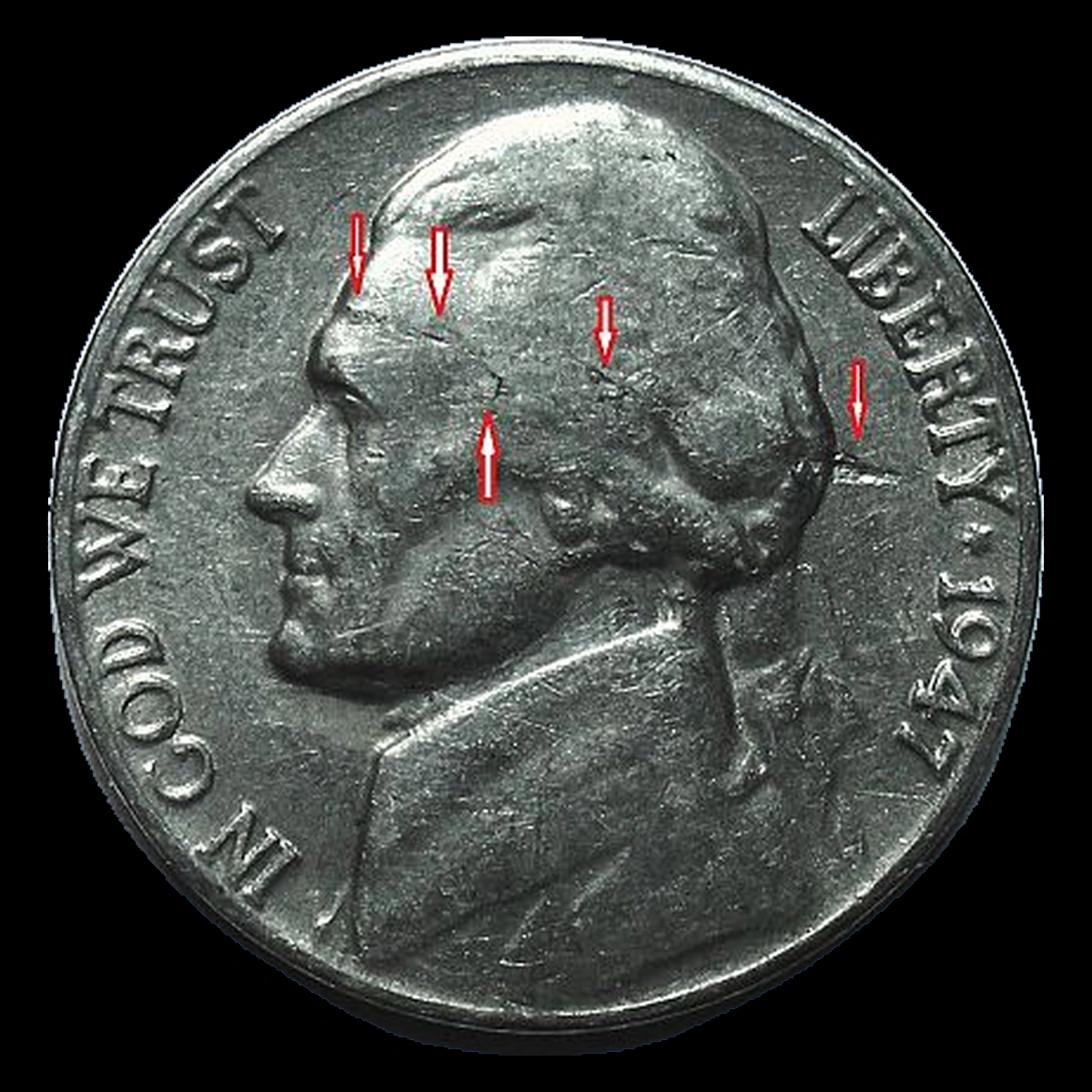
A recorded Philadelphia nickel graded MS62 has peeling metal on its obverse. Internal weakness can allow a sheet to separate locally, leaving a flap or shallow irregular opening.
The 1947 alloy contains copper and nickel throughout. It has no ordinary plated skin that should peel from a different core.
How to Identify
Use side lighting to inspect the layered boundary and its relationship to the surrounding design. Leave an attached flap in place rather than lifting it for a better view.
Normal loose nickel references are about 5 grams and 21.2 millimeters, with a plain edge. Missing metal may lower weight, but scratches, corrosion and later cutting still need to be distinguished from an internal split.
What It’s Worth
$5–$50 is estimated for small plain-looking laminations, with $50–$250 for larger clear peeling areas. A retained flap may display the defect better than a worn shallow patch.
The recorded MS62 appeared in a four-coin auction lot, so no individual price can be extracted for it here. Damage to loose metal or cleaning can reduce appeal.
6. 1947 Nickel Two Thin Pieces Match One Nickel: Split Planchet Error
The recorded 1947-S split after striking, and both halves were retained together in one grading holder. A separate Philadelphia pair is described as XF40 without establishing whether its separation happened before or after striking.
The split follows weakness within the alloy. It is not a normal boundary between separate layers of different metals.
How to Identify
Compare complementary inner surfaces, complete outer designs and the outlines of both pieces. Natural uneven separation differs from a regular sawn surface with parallel tool marks.
Keep the halves together without scraping their interiors or forcing a fit. Combined weight can be compared with a normal nickel while allowing for lost fragments, but does not settle the Philadelphia pair’s split timing.
What It’s Worth
$100–$250 is estimated for worn or less dramatic pairs, with $250–$500 for especially clear attractive examples. The 1947-S pair sold for $149.50 in August 2010.
That result covers both halves together. It is neither a price per half nor a documented sale of the separate Philadelphia XF40 pair.
7. 1947 Nickel A Section Is Missing from the Edge: Clipped Planchet Error
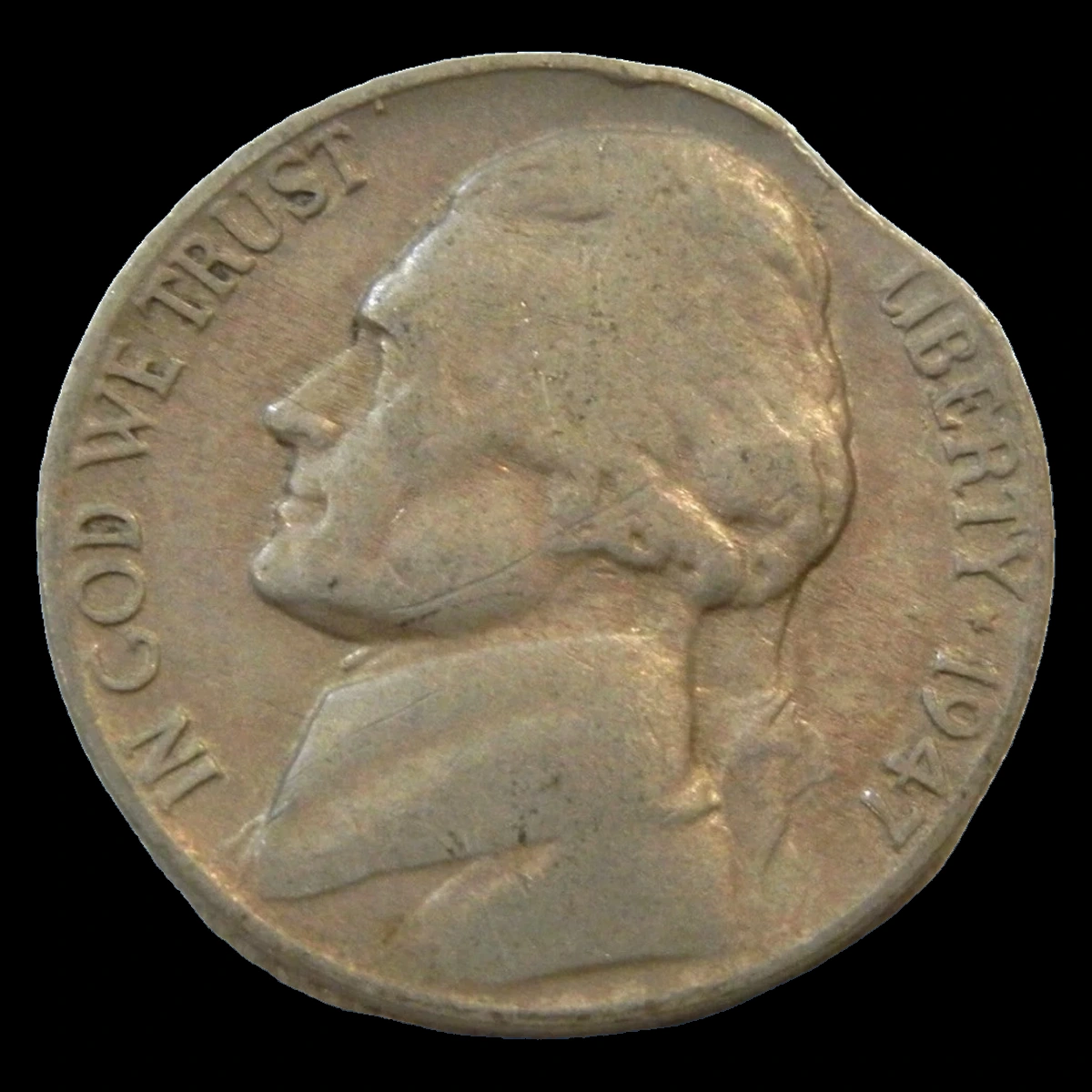
A Philadelphia example graded VF35 is described as having a 3% clip. The incomplete blank entered the press with some metal already missing.
The supplied record does not establish whether this particular gap was curved or straight. Its small percentage should not be exchanged with the much larger clips used as price comparisons.
How to Identify
Verify an actual interruption of the outside outline rather than a flattened rim. Examine the gap’s endpoints and approaching design for original striking effects instead of fresh saw lines or filing.
A weak opposite rim can help support the diagnosis, but the boundary itself remains central. Small missing areas may produce only a modest weight change.
What It’s Worth
$20–$75 is estimated for modest worn clips, with $75–$300 for larger attractive examples. An intact date and original surfaces affect the comparison alongside size.
A 1997-P nickel with a 20% clip sold for $124 in March 2025. It does not establish the value or shape of the much smaller 1947 3% clip.
8. 1947 Nickel A Wider Coin Retains All Its Detail: Broadstrike Error
A reported 1947 broadstrike would have spread outward without normal support from the collar, the ring surrounding the blank. The intended design remains complete inside the wider outline.
How to Identify
Measure the widest and narrowest spans, then trace every outer letter on both faces. Uneven expansion can still leave a complete design.
Inspect high points and the edge for hammering, grinding or compression of finished detail. No exact diameter is established for a specific 1947 specimen in the supplied report.
What It’s Worth
$30–$100 is estimated for modest broadstrikes, reaching $100–$350 for clear attractive expansion. Wear and the amount of natural spreading influence the comparison.
A 1999-P broadstrike brought $89 in March 2025. That different-year result is not a completed sale of a 1947 example.
9. 1947 Nickel Bare Metal Accompanies Missing Outer Design: Off-Center Strike Error
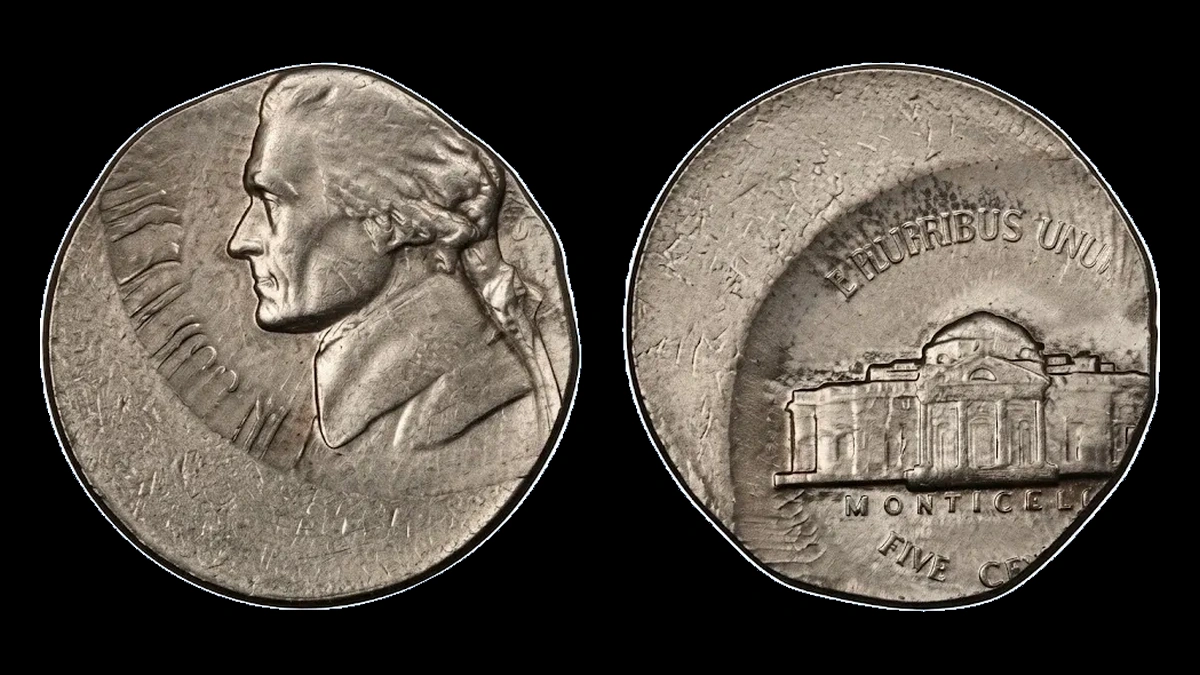
An incorrectly positioned blank receives design on only part of its surface. The reported 1947 category establishes no single mint, direction or displacement percentage.
How to Identify
Read the date and compare both faces while keeping the same blank edge as a reference. One misplaced blank should explain the bare area and design lost beyond the opposite boundary.
A shift confined to one face can have a die-alignment explanation. Inspect bare metal for original texture rather than grinding that erased finished lettering.
What It’s Worth
$30–$100 is estimated for small clear shifts, with $100–$750 for stronger examples retaining their dates. Condition and readable identity remain important even on dramatic offsets.
A 1955-D nickel struck 15% off center sold for $402.50 in October 2010. Its attractive unworn condition makes it a different comparison from a worn 1947 coin with less displacement.
10. 1947 Nickel Front and Reverse Designs Overlap: Flipover Double Strike Error
The recorded 1947 coin flipped before receiving another strike inside the collar. Portions of Jefferson and Monticello can therefore survive on the same face beneath the later impression.
Its AU55 grade indicates light wear. The collar could retain a nearly ordinary diameter despite the unusual design arrangement.
How to Identify
Pick out a recognizable feature from the opposite design and follow it across more than one isolated line. Both faces should support the same flipped sequence.
A coin pressed against another after minting may receive a recessed backward image. That differs from a consistent arrangement of earlier normal design beneath a later die strike.
What It’s Worth
$175–$400 is estimated for recognizable circulated flipovers, with $400–$750 for especially attractive examples with strong overlapping designs. The recorded AU55 1947 sold for $216 in March 2023.
The upper figure is an estimate rather than another transaction for that specimen. Readability of both designs contributes more than a confusing abundance of lines.
11. 1947 Nickel Jefferson Is Struck on Copper-Alloy Cent Metal: Wrong Planchet Error
The recorded 1947-S cent-planchet nickel weighs 3.12 grams. Its smaller copper-alloy blank provides less room for nickel detail, so outer inscriptions may run beyond the available metal.
NGC describes unworn detail with scratches on the front. Those later scratches affect preservation but do not explain the different alloy or low weight.
How to Identify
Compare measured weight and diameter with the proposed blank, which began around 19 millimeters across before any spreading. Copper color alone cannot distinguish an original wrong blank from a coated nickel.
Locate the date and reverse S, then examine the edge and cropped outer design for natural striking rather than filing. The copper-alloy body and crowded design should support the same identification.
What It’s Worth
$400–$800 is estimated for worn or impaired examples, with $800–$1,500 for cleaner well-preserved pieces. The recorded 1947-S cent-planchet nickel sold for $564 on September 10, 2019.
The price includes its scratched front. The stronger estimated range does not represent an additional documented 1947 sale.
Conclusion
Separate what the die added, what the blank lacked and what happened to the coin after striking. A second mintmark curve, a matching split pair and a copper-alloy blank each need evidence suited to that explanation.
Preserve paired halves and attached flakes, and retain condition problems in the price comparison. A recorded auction result applies to its complete specimen or pair, including the surfaces and readable details that survived.