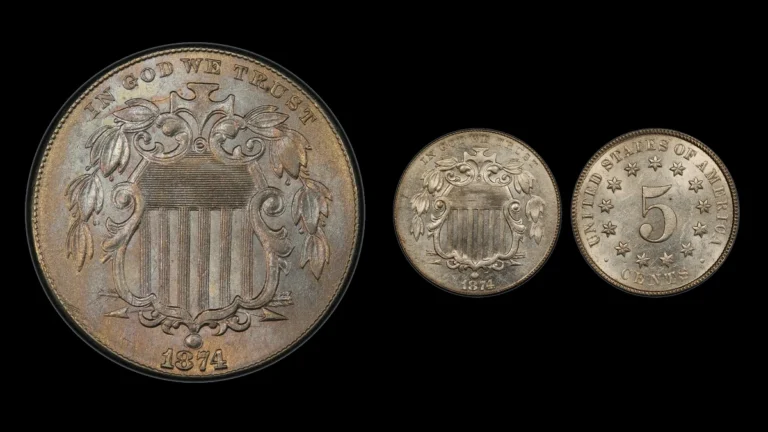
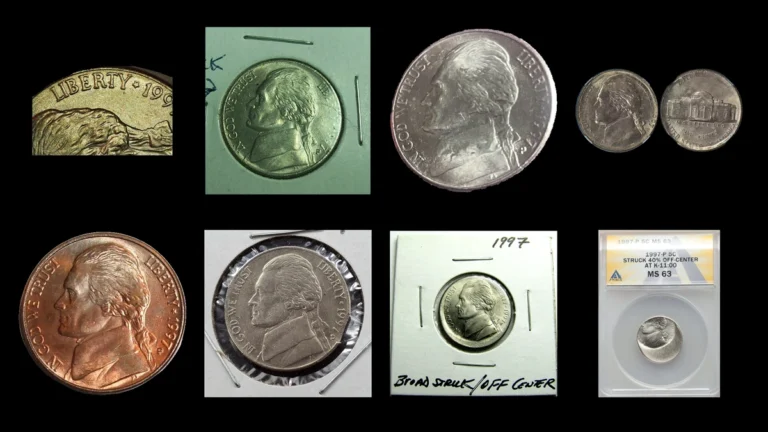
Rare 1959 Nickel Errors (List & Pictures)
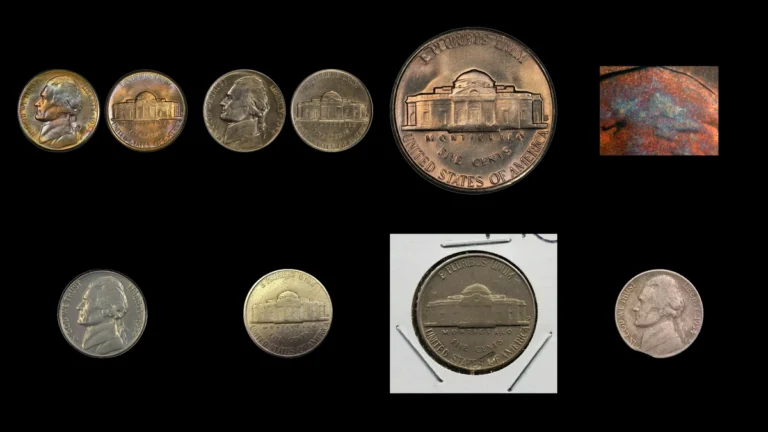
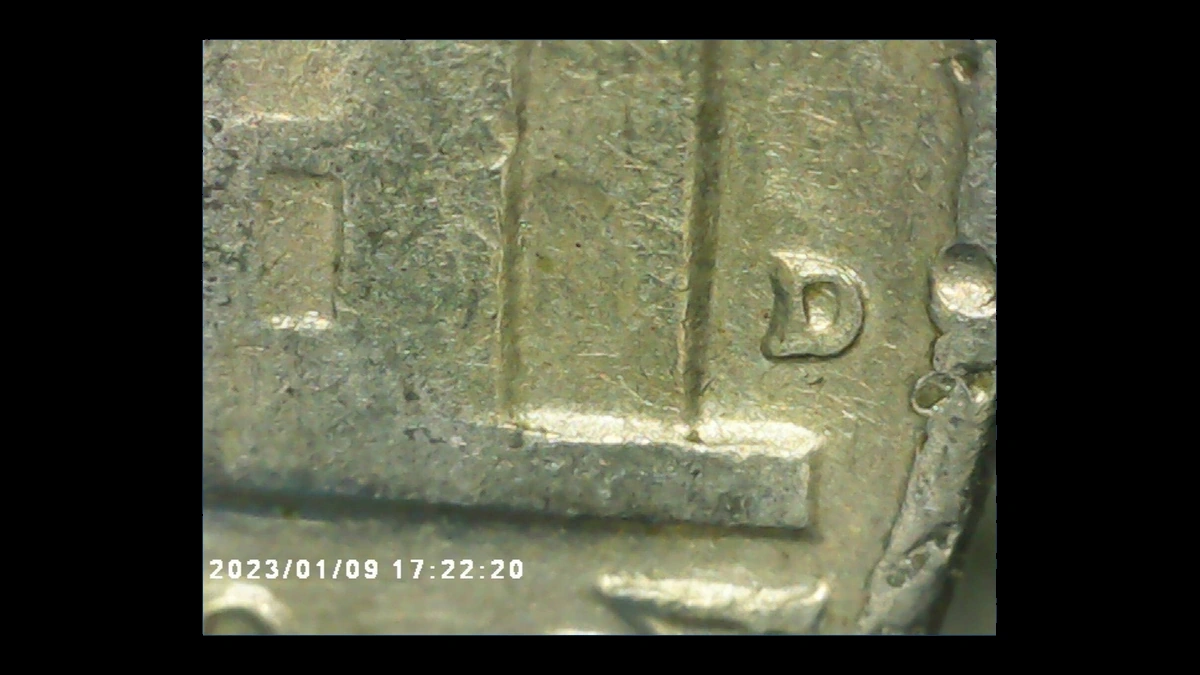
The D on a 1959 nickel belongs beside Monticello, making the reverse a useful starting point for variety checks. Reported 1959 Jefferson nickel errors also include split metal, retained objects and designs struck on the wrong denomination.
Estimated values span $5–$3,000. A 1959-D front-staple error sold for $780 in 2021; a related 1975 nickel-over-cent brought $900 in August 2022.
Inspect small design changes first, then the edge, strike layout and evidence of a different blank or host coin.
| Clue | Category | Estimated range |
|---|---|---|
| Extra D beside Monticello | Repunched mintmark | $10–$150 |
| Repeated date or lettering contours | Doubled or tripled die | $10–$400 |
| Weak local design | Filled die | $5–$100 |
| Raised line or rim-connected patch | Die crack or cud | $5–$750 |
| Dark surface | Improper annealing | $25–$300 |
| Curved or straight missing edge | Clipped planchet | $15–$300 |
| An opening through the thickness | Clamshell split | $100–$500 |
| Displaced design beside bare metal | Off-center strike | $50–$600 |
| A later impression with blocked reverse detail | Double strike | $100–$750 |
| A solid-object impression or retained material | Struck through | $50–$1,200 |
| Nickel design on cent or silver dime metal | Wrong planchet | $300–$1,500 |
| Earlier cent design remains underneath | Double denomination | $750–$3,000 |
1. 1959 Nickel Another D Appears beside Monticello: Repunched Mintmark Error
Workers added the Denver mintmark to individual dies with a hand punch. More than one placement could leave remnants of a previous D beside the final letter.
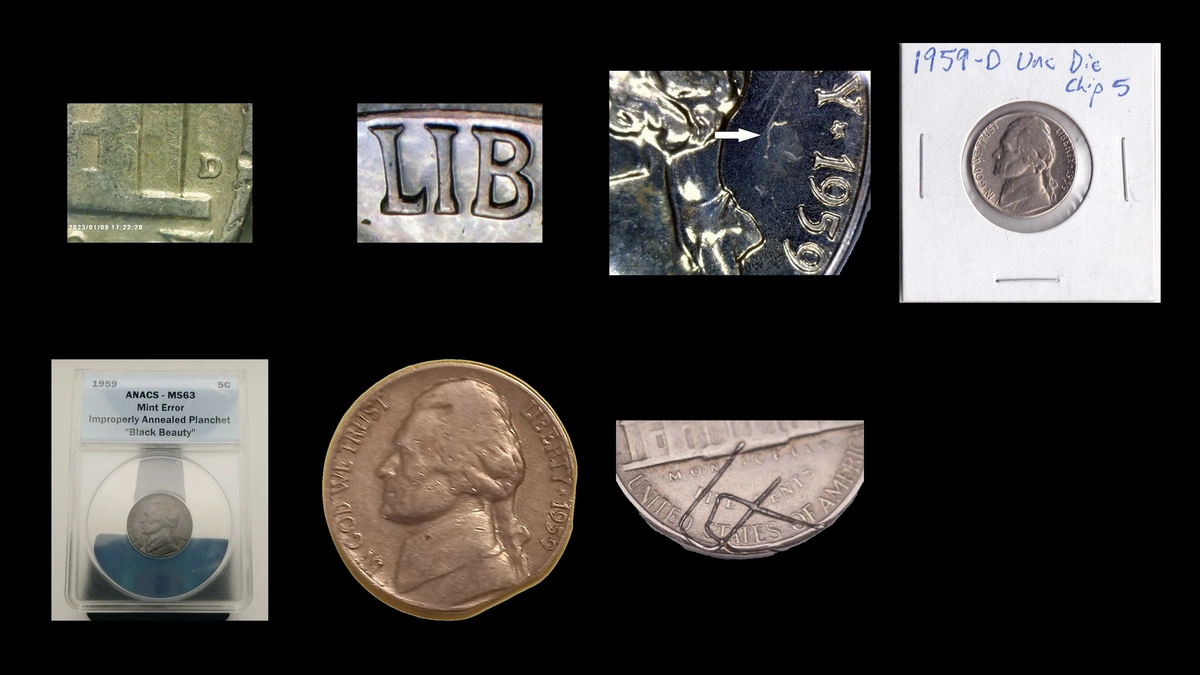
WRPM-003 and WRPM-006 have a northward extra impression, while WRPM-005 has one toward the upper left. Other recorded 1959-D varieties involve tilted impressions.
How to Identify
Examine the D to the right of Monticello, rather than looking for a modern front-side mintmark. Compare its full shape with Wexler’s 1959-D photographs.
A general direction does not settle the number when more than one variety has a northward trace. Match the actual earlier letter remnants and then the supporting nearby marks.
What It’s Worth
$10–$50 is estimated for clear worn examples, with $50–$150 for attractive unworn coins. No separate sale is assigned to every catalog number.
A visible piece of another D is more useful than a thick mintmark or unrelated scratch. The coin was not necessarily struck twice simply because the die’s mintmark was punched twice.
2. 1959 Nickel Letters or Numerals Repeat: Doubled and Tripled Die Error
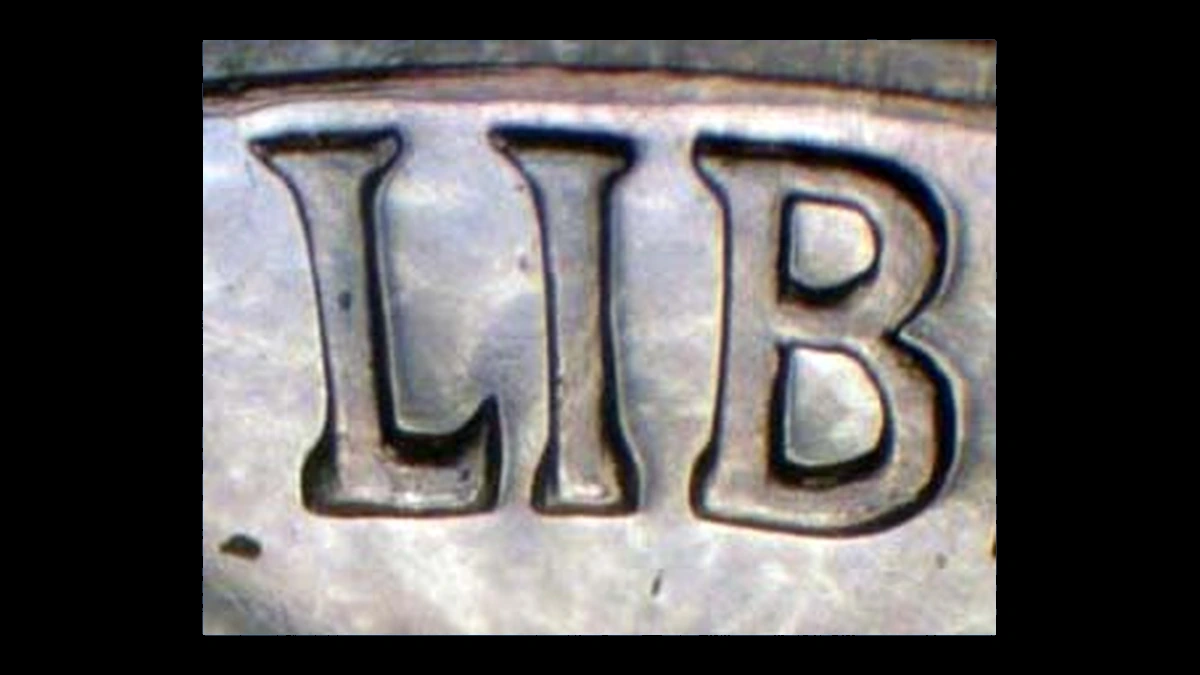
Philadelphia proof WDDO-003 has tripling at the lower part of the date’s 1 and at Y in LIBERTY. Denver reverse varieties instead include repeated detail in UNITED STATES OF AMERICA and E PLURIBUS UNUM.
Philadelphia also has reverse varieties, with ordinary and proof patterns requiring separate matches. Proofs were specially made for collectors, while both Philadelphia finishes lack a mintmark in 1959.
How to Identify
For WDDO-003, compare the lower 1 and Y together rather than judging an isolated damaged character. For a Denver reverse, follow the affected inscriptions against the same variety reference.
Rounded additional contours differ from a flat shelf made by movement during striking. Establish the finish and exact pattern before combining features from different coins.
What It’s Worth
$10–$75 is estimated for smaller identified varieties, with $75–$400 for stronger examples with pleasing surfaces. Finish and preservation contribute to the complete coin’s price.
A 1963 circulation-strike nickel with the FS-801 tripled reverse sold for about $277 in October 2014. Its different date and pattern illustrate demand for clear tripling without pricing every 1959 extra outline alike.
3. 1959 Nickel Monticello or Lettering Becomes Locally Faint: Filled Die Error
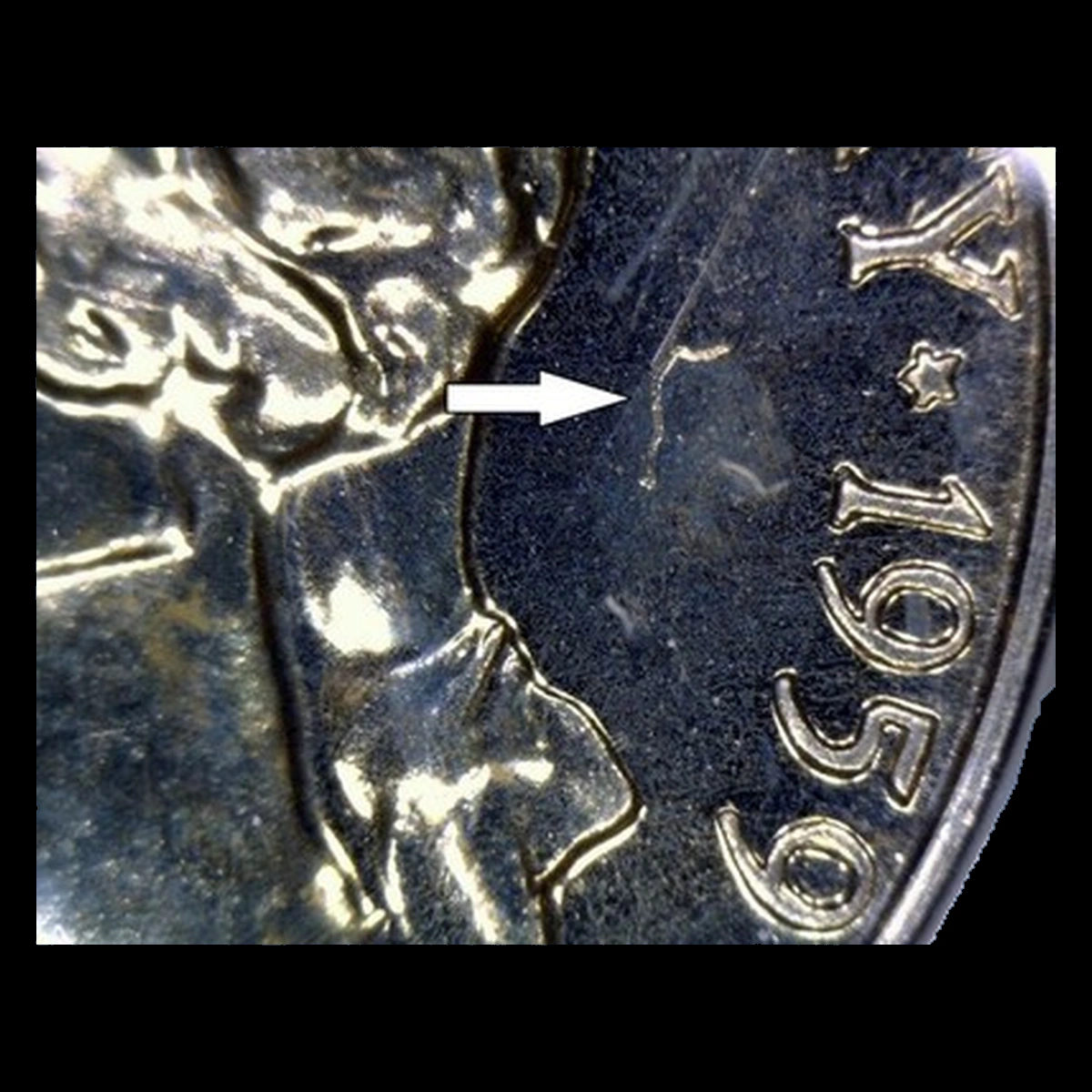
Grease or dirt packed into a die can keep its recessed details from forming the normal raised design. The resulting weak patch is often described as a filled-die or grease-struck-through effect.
Monticello’s steps can also be weak on ordinary nickels. Their absence alone cannot separate an obstruction from a soft strike or wear.
How to Identify
Compare the weak area with nearby letters and the exposed high points on Jefferson. A sharply limited interruption is more persuasive than general softness or smooth wear across both faces.
Inspect for scraping and polishing lines that may show detail removed later. Include clear surrounding design in photographs so the transition is visible.
What It’s Worth
$5–$25 is estimated for a modest confirmed filled area, rising to $25–$100 when a larger patch clearly interrupts the design. These are category estimates rather than a recorded sale of a particular 1959 specimen.
Ordinary weak steps may have no error premium. Good preservation and an obvious localized change make a blocked-strike explanation easier to assess.
4. 1959 Nickel Raised Lines or a Rim Blob: Die Crack and Cud Error
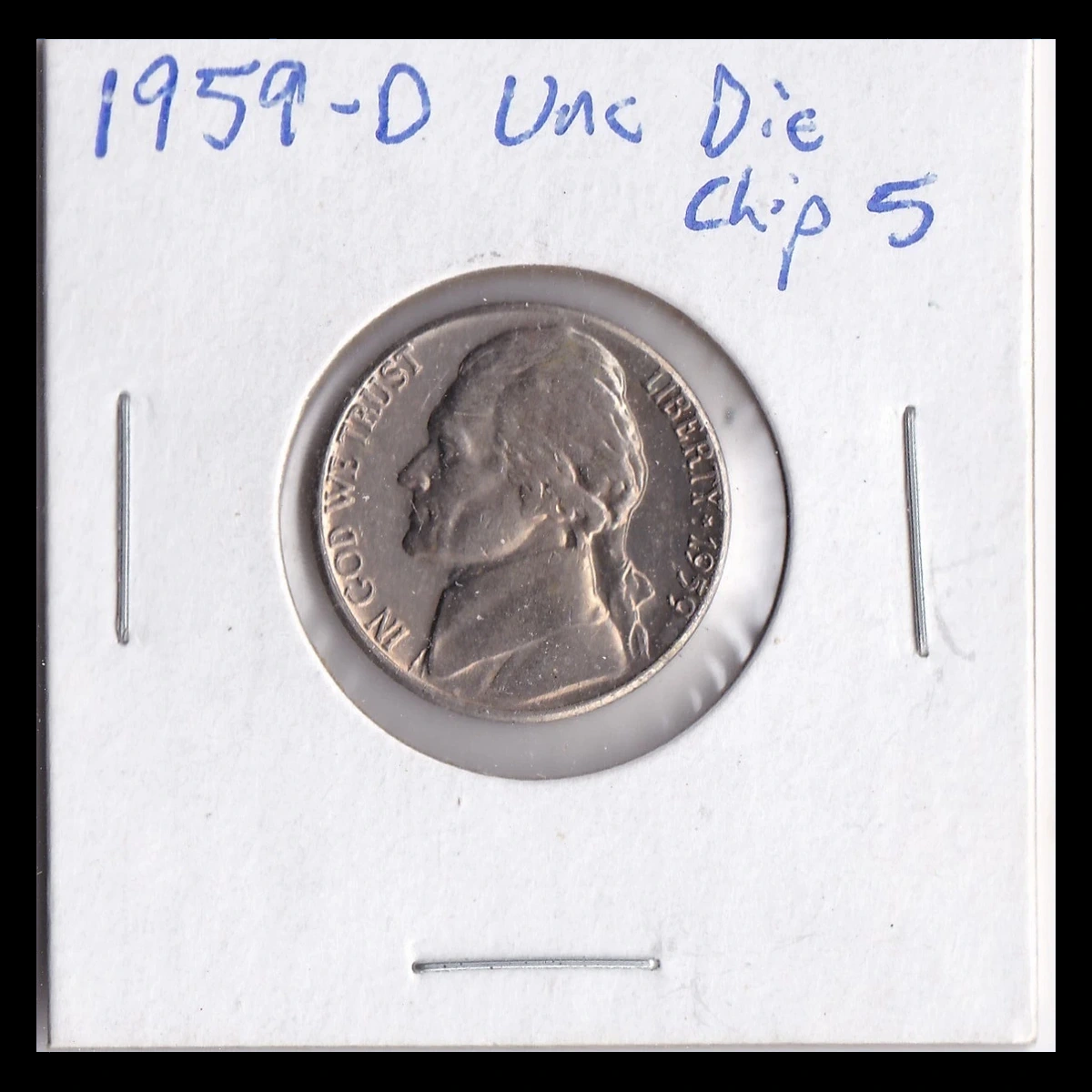
A die crack leaves a ridge where coin metal entered a narrow opening in the tool. When a larger section breaks away at the edge, it can leave a broad rim-connected patch called a cud.
The recorded Denver cud is graded PCGS MS65. Other cracks and chips are reported, but their locations need not match a line used to identify a particular repunched-mintmark variety.
How to Identify
Establish that a line rises above the surface rather than having a cut floor bordered by displaced metal. For a cud, follow the patch to the original rim and inspect the adjacent edge.
Look for an impact that folded metal inward or a join around added solder. The original surface should explain the raised feature without an attached foreign blob.
What It’s Worth
$5–$50 is estimated for small cracks or chips, with $100–$750 for larger well-preserved rim breaks. The PCGS MS65 1959-D cud sold for $504 in May 2021.
That result concerns a substantial unworn break. A faint crack should not inherit its value merely because both began in damaged dies.
5. 1959 Nickel An Unusual Dark Surface: Improper Annealing Error
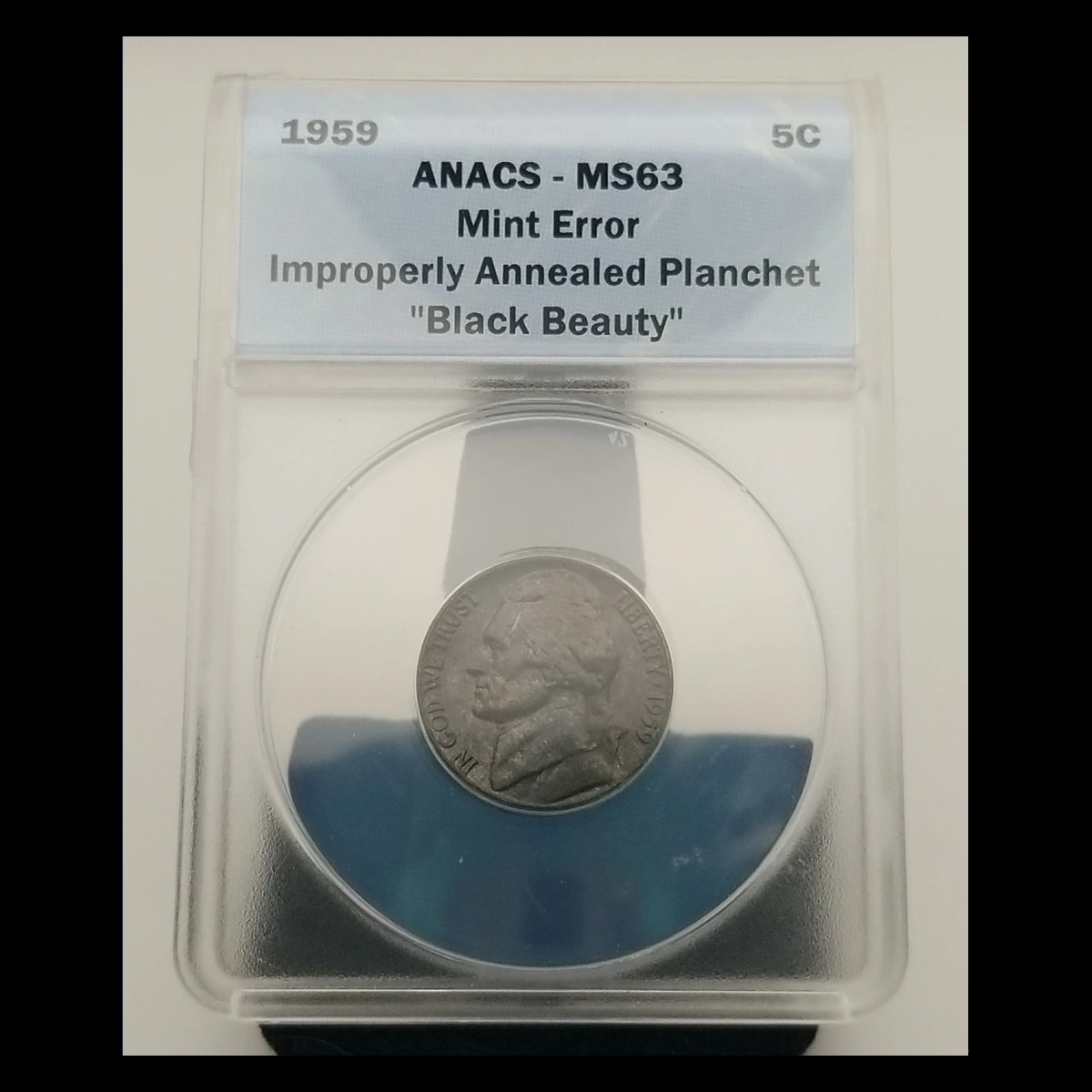
A recorded dark 1959 nickel is graded NGC MS65 for improper annealing. Annealing heats blanks to soften them, and abnormal furnace conditions can change their surfaces before striking.
Black Beauty is a common nickname for dark nickels, but appearance alone cannot establish this cause. Later heat, chemicals and storage conditions can darken finished coins too.
How to Identify
Use neutral light to inspect both faces, protected spaces near lettering and the edge for residue, pits or a covering that hides the original surface. Preserve the color without rubbing a bright test spot into it.
A normal loose nickel is about 5 grams and 21.2 millimeters across, with a plain edge and uniform copper-nickel alloy. Normal measurements and a dark shade cannot by themselves show when the change happened.
What It’s Worth
$25–$100 is estimated for genuine worn examples, with $100–$300 for attractive unworn pieces. The recorded MS65 appeared in a four-coin lot, so its group total is not an individual price.
A 1971-D improper-annealing nickel that also had a low D sold for $149 in July 2022. That different-year combined example offers context, while ordinary staining remains a separate surface condition.
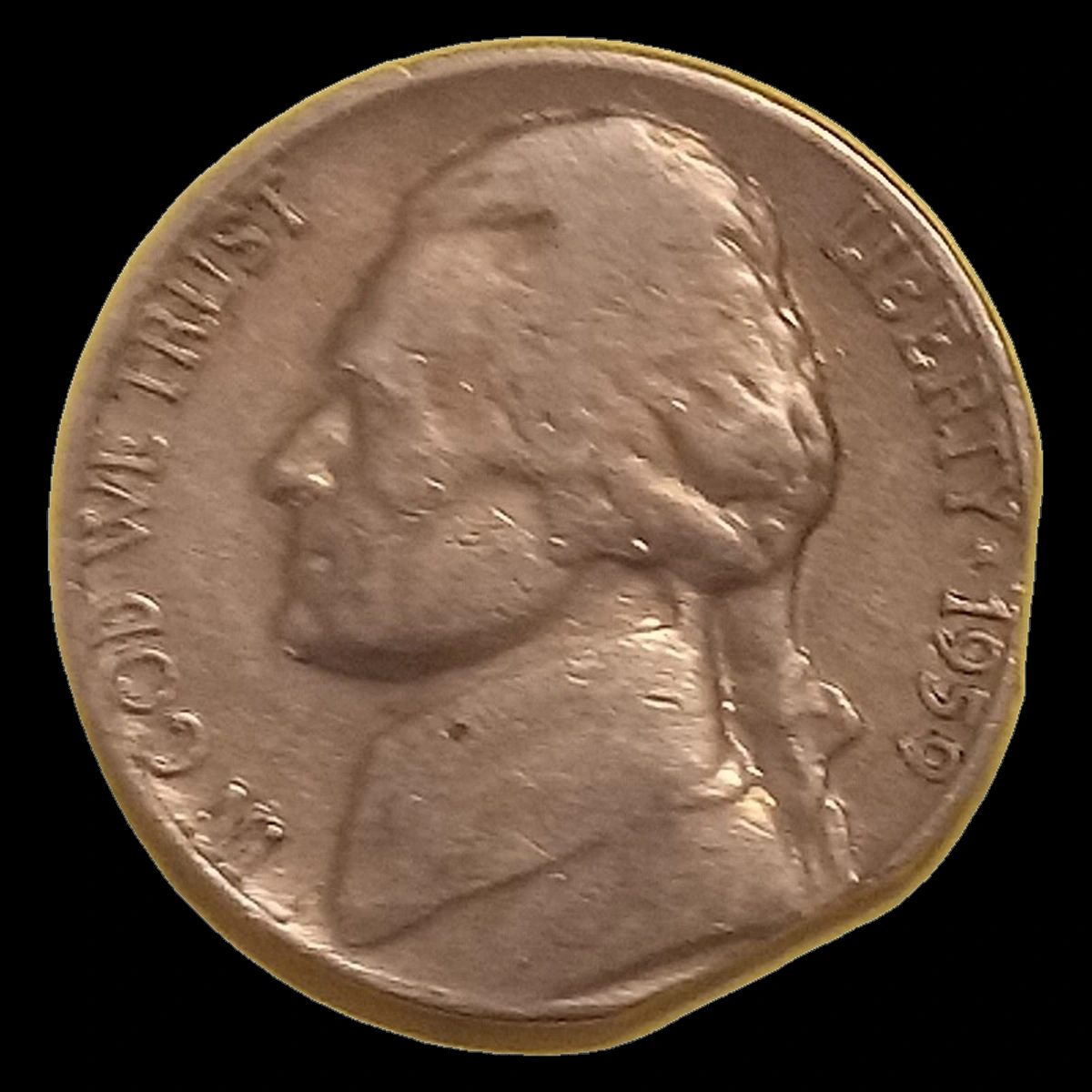
6. 1959 Nickel A Curved or Straight Edge Section Is Missing: Clipped Planchet Error
Both curved and straight clips are reported for 1959. A blank punch overlapping a prior hole can leave a curve, while a cut reaching the metal strip’s edge can leave a straight boundary.
The missing portion was absent before the remaining blank received its design. No fixed percentage or position is established for all the reported examples.
How to Identify
Trace each boundary into the nearby struck surface and examine its endpoints for original flow or softened detail. Cutting marks, burrs or sawn-through finished lettering suggest later removal.
Low weight and a weak opposite rim can support an incomplete blank but do not establish it alone. Filing also reduces weight, and not every authentic clip shows the same opposite-rim effect.
What It’s Worth
$15–$75 is estimated for modest clips, with $75–$300 for stronger examples retaining a clear date. The range covers the reported shapes without assigning an invented clip percentage.
A 1997-P nickel with a 20% clip sold for $124 in March 2025. The earlier 1959 examples require their own assessment of gap size, surface quality and readable identity.
7. 1959 Nickel The Metal Opens Like a Shell: Clamshell Split Error
The PCGS AU55 1959-D clamshell split has a recorded weight of 3.58 grams. Separation through the metal’s thickness leaves part attached like a hinge while exposing an internal surface.
How to Identify
Inspect the existing opening and attachment without pulling the halves farther apart. A natural internal separation differs from a regular saw channel with repeated tool marks.
The unusually low weight belongs to this specimen and is not a requirement for every clamshell. A raised face line from a cracked die does not represent an opening through the coin.
What It’s Worth
$100–$250 is estimated for an authenticated stable split, with $250–$500 for a stronger example retaining clear detail. The recorded AU55 Denver coin sold for $159 in June 2024.
A forced bend or enlarged opening does not improve the error. Its undisturbed hinge and original separation provide much of the useful evidence.
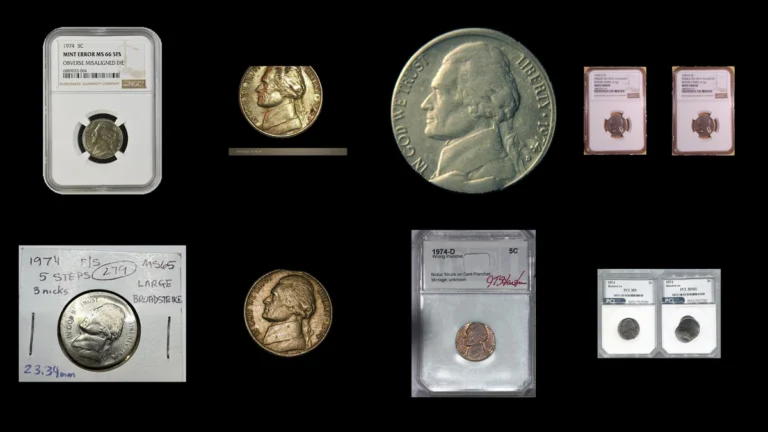
8. 1959 Nickel The Design Moves beside Unstruck Metal: Off-Center Strike Error
A Denver example is recorded in an error-auction table, and Philadelphia off-center coins are also reported. An out-of-position blank received only the portions of the designs that fell on its surface.
How to Identify
Inspect Monticello as well as Jefferson to confirm corresponding displaced design and bare metal on both faces. A shift confined to one side can reflect die misalignment instead.
Preserve the date and reverse D, when present, in the photographs. The incompletely described table entry establishes no universal offset percentage or direction.
What It’s Worth
$50–$200 is estimated for modest displacement, with $200–$600 for more dramatic shifts. Readable identifying details and attractive surfaces make the comparison stronger.
No exact price is assigned to the table’s 1959-D here. A larger offset that loses the date can be less appealing than a smaller, clearly identifiable error.
9. 1959 Nickel A Displaced Second Impression with Blocked Reverse Detail: Double Strike Error
The recorded NGC MS64 1959-D received a second strike 75% off center. Its reverse was described as uniface in the later strike area, meaning the normal second reverse impression was blocked.
Earlier reverse design may still remain there. The description does not require the entire back to be blank.
How to Identify
Trace recognizable letters or portrait fragments where the smaller later impression overlaps the first. Then inspect the corresponding reverse area to separate surviving earlier design from the missing second impression.
No exact direction or universal blocked-area extent is supplied here. Similar grades in earlier listings do not prove that two descriptions refer to the same coin.
What It’s Worth
$100–$300 is estimated for a comparable double strike, with $300–$750 for more dramatic well-preserved combinations. The NGC MS64 example sold for $129.25 in January 2016.
A 75% later displacement does not guarantee the upper range. Readable first and second impressions help collectors understand the complete sequence.
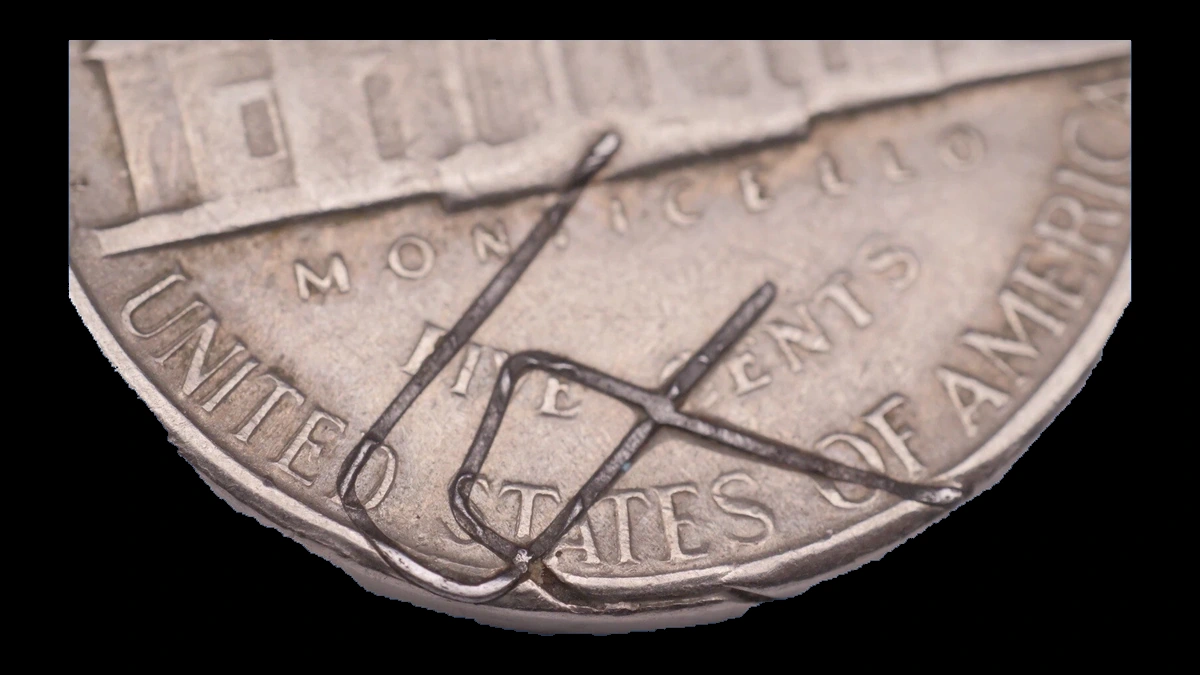
10. 1959 Nickel A Solid Object Leaves an Impression or Stays Attached: Struck Through Error
Different Denver coins have staples pressed into the front or reverse, while a separate report identifies retained wire-brush material. An ANACS MS65 listing also describes a strike through fragments.
Solid objects can leave physical depressions or remain embedded during striking. A thin wire should not automatically be called a staple, and these examples differ from softly blocked grease detail.
How to Identify
Preserve any retained object and inspect the undisturbed boundary for metal formed naturally around it. Adhesive or a gouge made afterward suggests a different history.
Identify the object’s shape and affected face before comparing records. Do not probe it with a needle or remove material to improve the photograph.
What It’s Worth
$50–$250 is estimated for smaller authenticated fragment impressions, with $300–$1,200 for clear retained objects. The front-staple NGC XF45 example sold for $780 in October 2021, and the reverse-staple NGC VF30 brought $528 in August 2020.
These are different coins with different degrees of wear. The wire-brush report cannot borrow either staple specimen’s exact price solely because its retained material is thin.
11. 1959 Nickel Nickel Design Appears on Cent or Silver Dime Metal: Wrong Planchet Error
The Denver cent-planchet example weighs 3.08 grams, while a separate Philadelphia cent-planchet coin spread enough to retain almost complete lettering. Philadelphia nickels in 1959 have no P mintmark.
An ANACS AU55 Details example is reported on a silver dime blank with cleaning noted. It is a different metal and blank from either copper-colored cent-planchet coin.
How to Identify
Measure the actual coin and examine its metal rather than choosing the blank from color. Expansion can preserve more outer lettering than expected on a smaller starting disc.
Inspect the edge for coating, plating or grinding that could imitate a wrong blank. A silver dime blank normally starts at 2.5 grams, but that standard is not a recorded measurement of the cleaned specimen.
What It’s Worth
$300–$900 is estimated for comparable cent-planchet nickels, with $300–$1,500 for authenticated silver dime-planchet examples. The Philadelphia PCGS MS64 Red and Brown cent-planchet coin sold for $564 in September 2019.
The Denver NGC MS64 Red and Brown brought $624 in the same auction. No completed amount is supplied for the cleaned silver dime-blank coin, and its surface problem belongs in the valuation.
12. 1959 Nickel An Earlier Cent Date Remains near CENTS: Double Denomination Error
The recorded NGC MS63 Brown coin began as a finished 1959 Lincoln cent before receiving 1959 nickel designs. The nickel obverse overlies the cent reverse, leaving the earlier cent date near CENTS on the other face.
Collectors sometimes use the nickname six-cent error. It refers to the two recognizable denominations rather than a new face value.
How to Identify
Find the small earlier date near CENTS and follow additional cent design beneath the nickel impressions. Its position should fit the recorded orientation, rather than merely resemble a vague line on copper-colored metal.
A 1959 bronze cent normally starts near 3.11 grams, and the later strike can spread its outline. Genuine earlier cent detail is what distinguishes a finished host coin from an unused cent blank.
What It’s Worth
$750–$3,000 is an estimated range for an authenticated example with readable traces of both designs. No realized price is supplied for the recorded 1959 MS63 Brown specimen.
A 1975 nickel struck over a 1975 cent sold for $900 in August 2022. That different-year result provides context, while host-date clarity, surfaces and overall readability determine how closely another coin compares.
Conclusion
A reverse D variety, a split edge and a retained staple each call for different evidence. Start with the actual raised detail, opening or object before assigning a broad error label.
For smaller or copper-colored pieces, distinguish an unused blank from a finished cent that still carries earlier design. Keep fragile attachments undisturbed, and preserve the date, mintmark and full face views alongside the close-up that first attracted attention.