Rare 2002 Nickel Errors (List & Pictures)
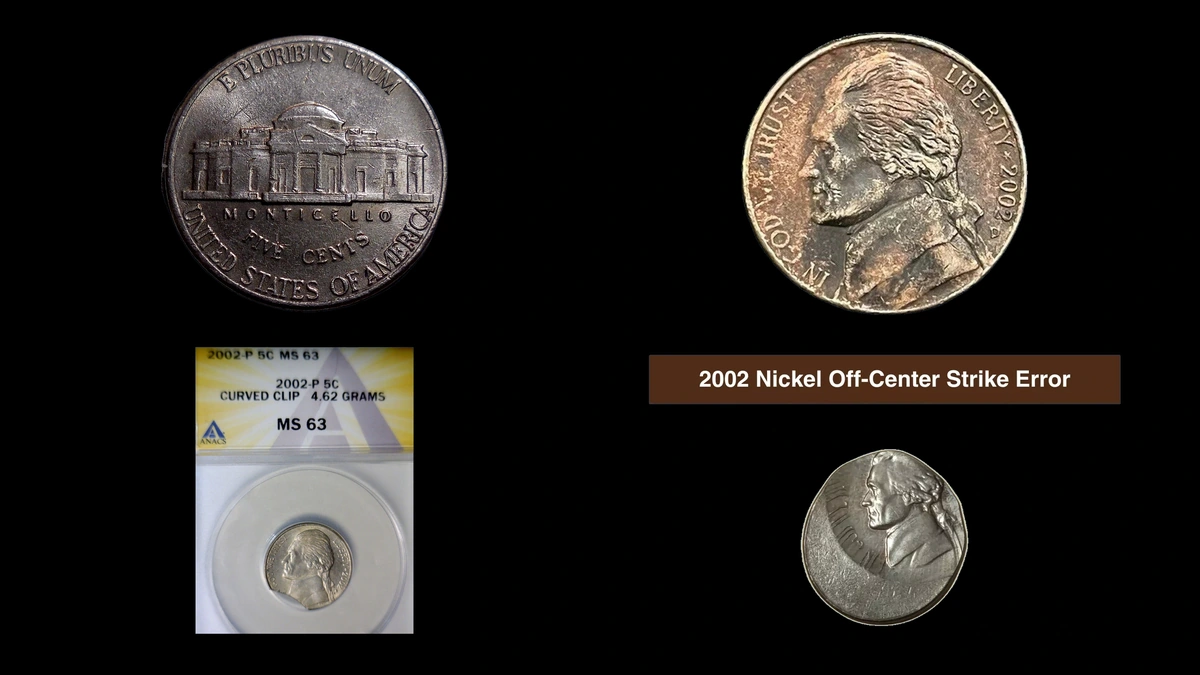
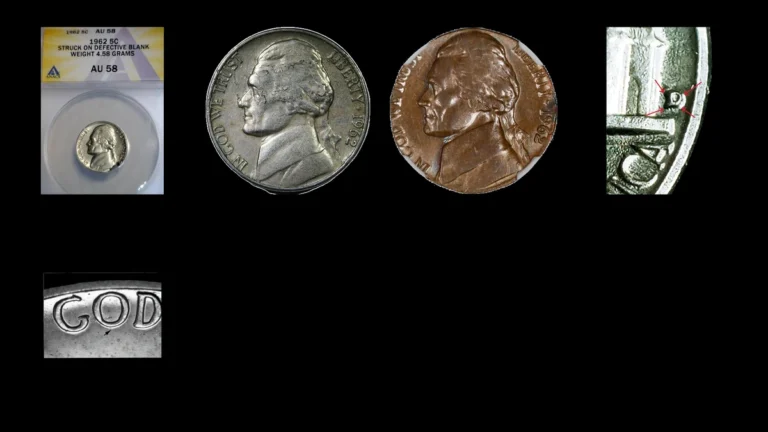
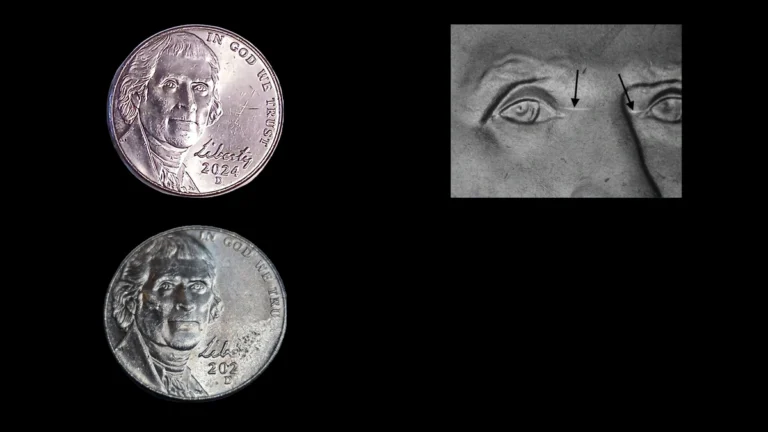
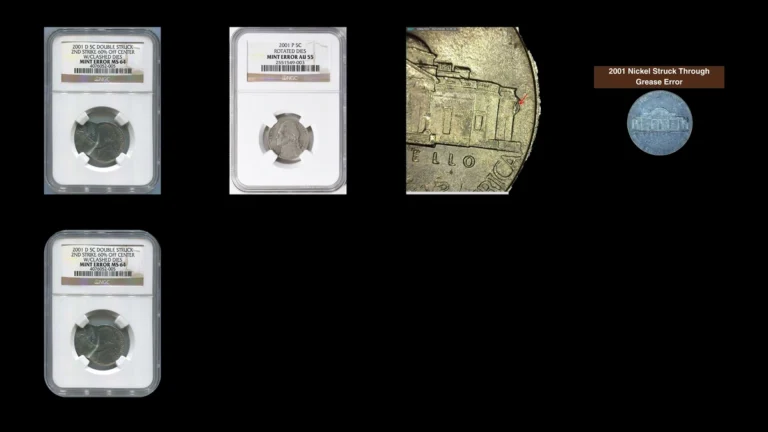
Photographs of both faces help separate several 2002 nickel errors: one design can shift sideways, the reverse can rotate, or an entire strike can miss the center of the blank.
Estimated values range from $5 to $1,500; the highest supplied completed comparison is $487.20 for a 1977-D die cap, a different year. Compare the two designs first, then inspect small raised features, surface metal, and the coin’s outline.
| Observation | Possible error | Estimated range |
|---|---|---|
| One face shifted | Misaligned die | $5–$75 |
| Reverse remains tilted after a controlled flip | Rotated die | $10–$200 |
| Extra outlines or raised marks | Clash, doubled die, crack, chip, or cud | $5–$500 |
| Unusual color or separating metal | Annealing error or lamination/split | $10–$600 |
| Gap or enlarged outline | Clip or broadstrike | $15–$300 |
| Design displaced or repeated | Off-center strike or double strike | $30–$900 |
| Cupped body | Die cap | $300–$1,500 |
1. 2002 Nickel Only One Design Sits Unevenly inside the Rim: Misaligned Die Error
Compare Jefferson’s border with Monticello’s before naming an apparent shift. One displaced face opposite a substantially centered face can indicate that one die moved sideways.
How to Identify
Photograph the coin straight on and trace the design against the complete outline on both sides. The supplied P and D reports establish no fixed direction, so the actual coin must supply that detail.
Look for dented or squeezed edges that could explain the uneven border after minting. For loose coins, normal reference measurements are about 5 grams and 21.21 millimeters, with a plain edge; these checks also support the shape assessments below.
What It’s Worth
$5–$75 is an estimated range for a clearly visible original misalignment. Tiny rim differences may carry little premium, and no completed 2002 sale is supplied for this reported type.
2. 2002 Nickel Monticello Remains Tilted after the Coin Is Flipped: Rotated Die Error
A rotated die changes the angular relationship between the two faces. It need not move either design toward the edge.
How to Identify
Hold Jefferson upright and turn the coin top to bottom around a horizontal axis without twisting it sideways. Monticello should return to the same tilted position on repeated tests if the alignment is genuinely unusual.
Measure the actual angle using a support that preserves the relationship between the faces. The 2002 P and D reports do not establish a specimen’s angle, and separately rotated photographs prove nothing about die alignment.
What It’s Worth
$10–$50 is an estimate for a clear modest rotation, rising to $50–$200 for stronger examples. A different-year 2015-D nickel rotated 90 degrees sold for $79 in October 2021; neither its angle nor its price is a documented 2002 result.
3. 2002 Nickel Fragments of the Opposite Design Appear in the Field: Die Clash Error
Faint building shapes near the portrait, or portrait fragments on the reverse, can result from a die clash. When the dies meet without a blank, their contact can leave marks that transfer to subsequently struck coins.
How to Identify
Use the older side-view Jefferson portrait and Monticello to explain the fragments. Comparisons with the later forward-facing portrait will give misleading results.
The supplied Philadelphia and Denver reports do not fix one diagnostic location. Several related outlines provide better evidence than one scratch, and later impressions made by squeezing finished coins together need to be excluded.
What It’s Worth
$10–$100 is a working estimate for recognizable original clashes. No particular 2002 clash has a supplied completed sale, and faint traces generally attract less interest than a clearly readable design relationship.
4. 2002 Nickel Letters or Portrait Edges Carry Raised Repetition: Doubled Die Error
Reported Philadelphia doubling concerns LIBERTY, IN GOD WE TRUST, or Jefferson’s outline. A genuine doubled die already contains the repeated design before it strikes a coin.
How to Identify
Confirm P below the date and examine complete features under changing light. Raised separation that stays fixed in the metal needs to match a specific variety pattern, rather than a moving reflection.
The reports do not establish one shared pattern for every thick letter. Flat shelves that narrow the main design can result from movement during striking and should not be treated as proof of a doubled die.
What It’s Worth
$10–$50 is an estimate for a confirmed minor variety, with stronger attractive examples potentially around $50–$150. No independently matched completed sale is supplied for a particular 2002 obverse variety.
5. 2002 Nickel Lines or Lumps Rise above the Design: Die Cracks, Chips, and Cuds Error
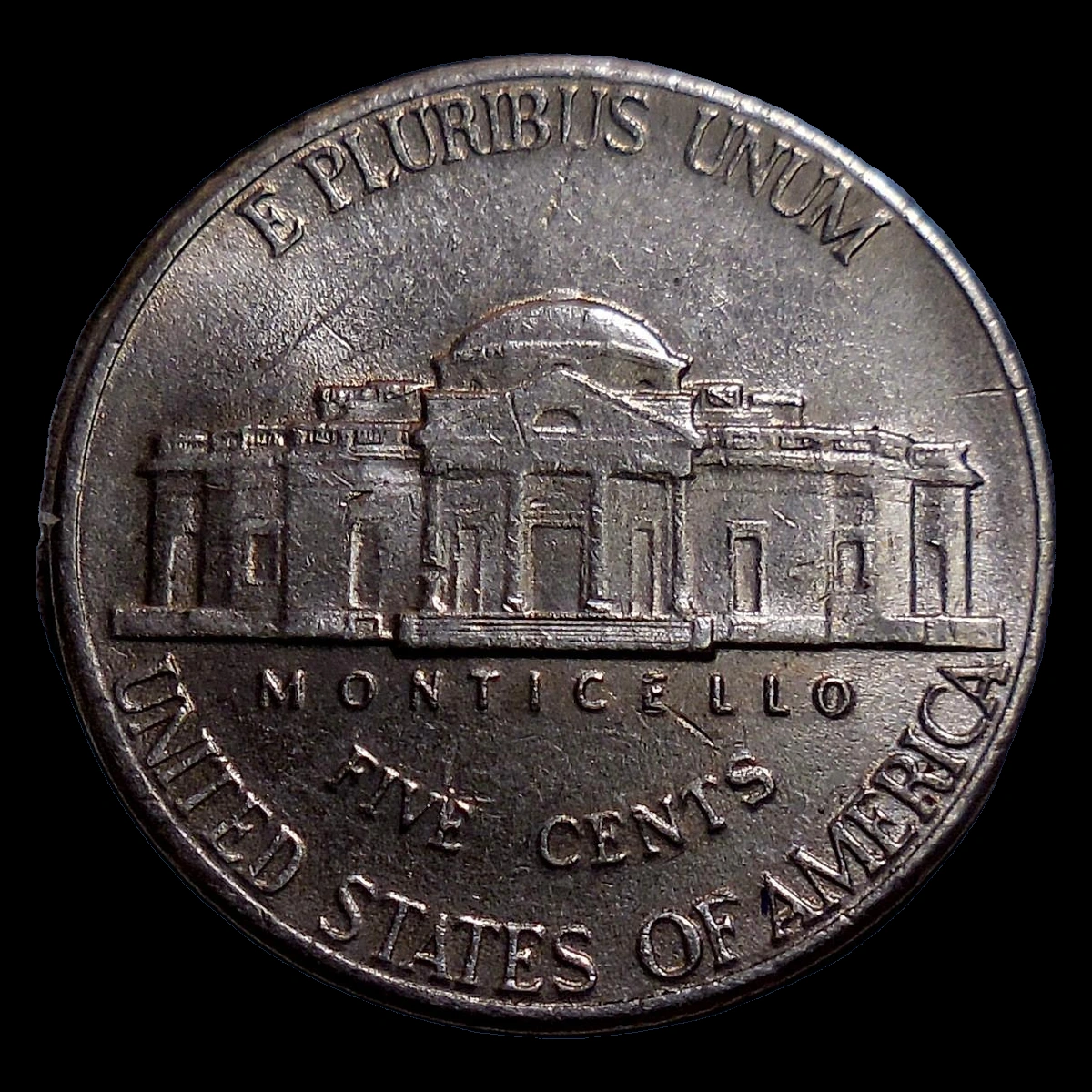
Die damage can appear on a coin as extra raised metal filling a crack or missing piece of steel. A narrow ridge is a crack, a small isolated lump may be a chip, and a larger rim-connected break is called a cud.
How to Identify
Ordinary P and D reports mention portrait-area lines and small bumps near LIBERTY. A separate Denver cud report places the reverse break between two and four o’clock when Monticello is upright.
A 2002-S Proof obverse crack is also reported, but its route is not established here. Keep that collector-coin finish and front-side crack separate from the Denver reverse cud.
Examine whether the raised metal blends into the original surface, and inspect the rim for impacts. A cut, attachment seam, or battered edge suggests a different origin.
What It’s Worth
$5–$50 is an estimate for small ordinary cracks and chips, $50–$300 for a clear cud, and $50–$500 for an attractive S Proof with an original crack. The Mint Error News Proof report supports the reported type but provides no completed sale price.
6. 2002 Nickel The Surface Has an Unusual Color: Reported Annealing Error
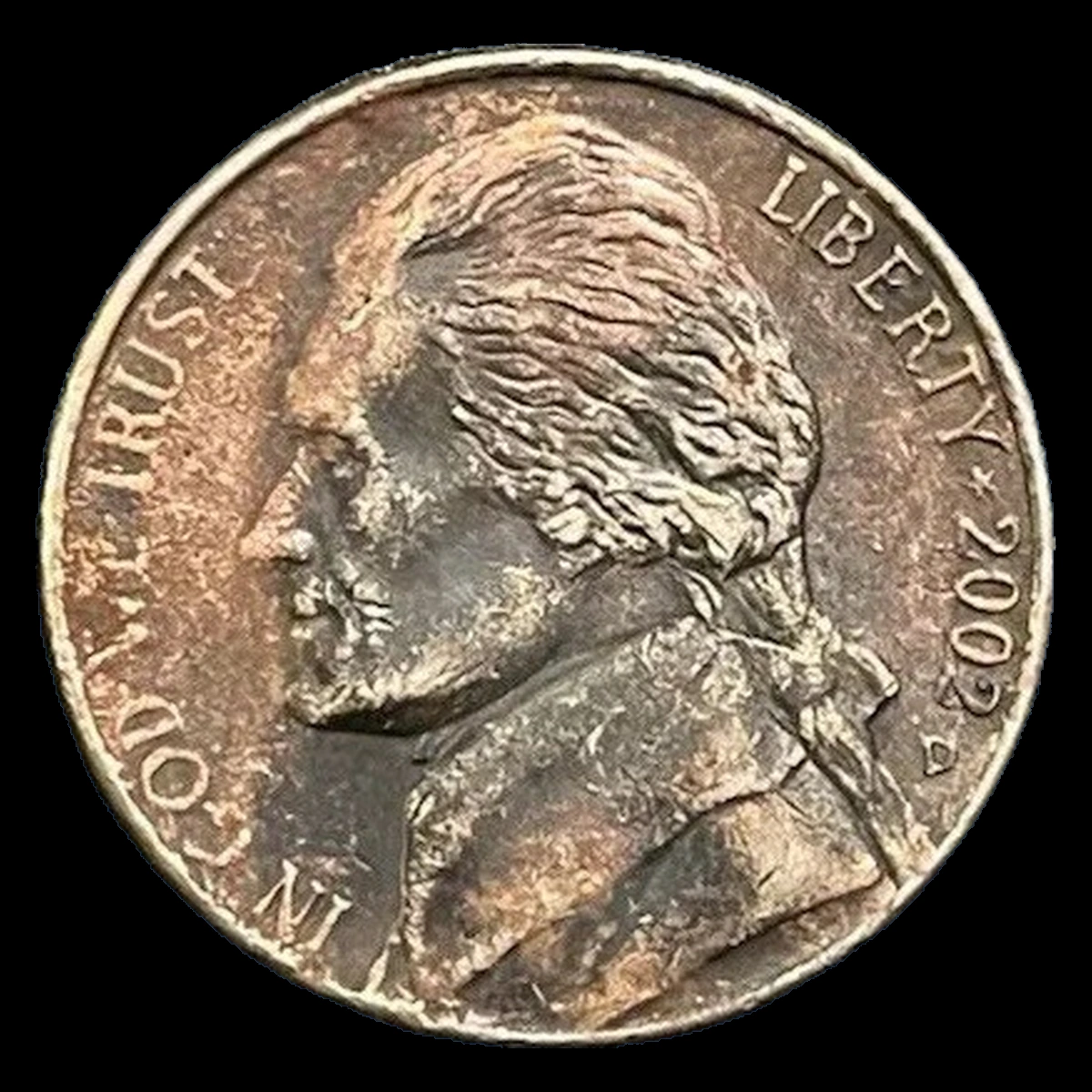
Annealing heats blanks to make the metal easier to strike, and a problem during that process can change their surface appearance. Reports include 2002 P and D examples, including an ungraded Denver seller specimen.
How to Identify
Inspect protected spaces around the lettering and compare both faces and the edge under neutral light. Crusts, corrosion, added plating, chemicals, and later heating can all complicate a color-based claim.
This nickel is copper-nickel alloy throughout, so a brown surface does not prove a missing nickel layer. Leave it unpolished for examination; an even color and normal weight alone cannot establish a Mint heating error.
What It’s Worth
$15–$175 is an estimated range for correctly identified improper annealing. A 2005-D example sold for $119 in December 2022, but that later-year sale does not authenticate the ungraded 2002 report.
7. 2002 Nickel A Layer Opens or Separates at the Front: Lamination or Split Planchet Error
The reported Philadelphia type has been described as a split planchet, meaning a blank whose metal separated internally. The available description does not settle whether an entire face split away, a local patch peeled, or when the separation occurred.
How to Identify
Follow the boundary of the separation and any design remaining on the exposed surface or attached flap. Those details are more useful for reconstructing the sequence than roughness alone.
Do not lift retained metal, and look for grinding marks or chemical damage that could explain a thin or rough coin. A substantial loss can reduce weight, while a retained layer may leave it nearly unchanged.
What It’s Worth
$10–$100 is an estimate for small genuine laminations, with major splits potentially around $100–$600. A 1981-P nickel struck on a 2.91-gram split blank sold for $30 in August 2021; its measured weight and pre-strike separation must not be assigned to the 2002 report.
8. 2002 Nickel Part of the Disk’s Outline Is Missing: Clipped Planchet Error
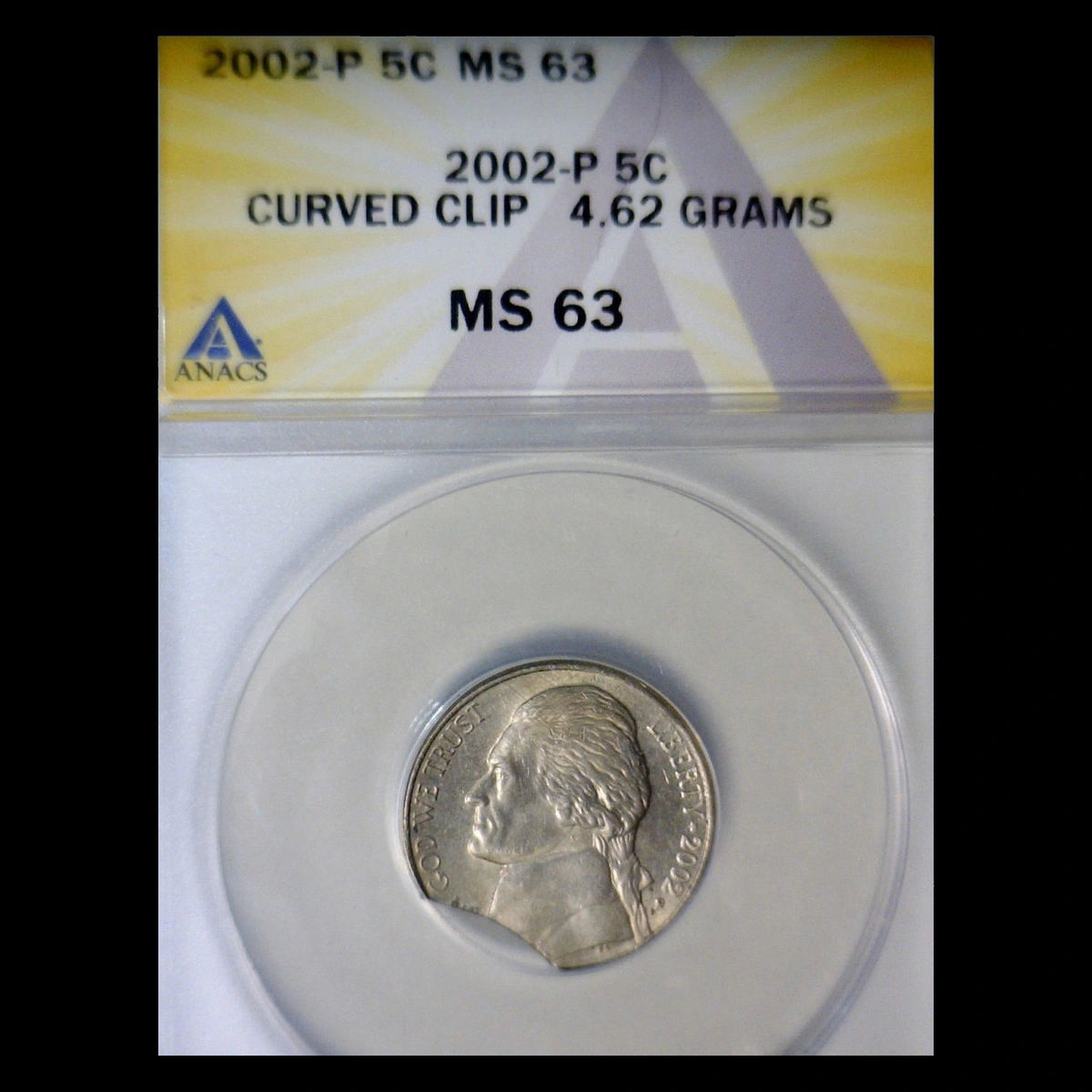
A clipped planchet reaches the dies with an incomplete outline. A blanking punch overlapping an earlier hole can create a curved gap, while other blanking problems can leave straight or irregular boundaries.
How to Identify
First distinguish missing metal from an intact crescent that simply lacks design. Then examine the ends of the gap for natural rim formation and design flow, checking for later saw or file marks.
Weakness opposite a clip can support the diagnosis, but may be subtle or absent. The supplied 2002 reports do not establish one percentage or one gap shape.
What It’s Worth
$15–$100 is an estimate for modest clips, with larger attractive examples potentially reaching $100–$250. A 1997-P nickel with a 20% curved clip brought $124 in March 2025; that separate sale establishes neither the size nor the shape of a 2002 clip.
9. 2002 Nickel Extra Metal Surrounds the Complete Design: Broadstrike Error
A broadstrike spreads beyond the usual diameter because the collar does not restrain the blank normally. The full intended design remains on the metal, even if the expanded border is uneven.
How to Identify
Trace all the outer lettering on both faces and compare the expanded area with the preserved relief. Missing design suggests an off-center component, while crushed details and hammer marks can reveal enlargement after minting.
A smooth edge alone proves little because ordinary Jefferson nickels already have plain edges. Both Philadelphia and Denver broadstrikes are reported for 2002 without a specimen-specific diameter.
What It’s Worth
$25–$100 is an estimate for modest examples, increasing to $100–$300 for stronger, attractive broadstrikes. The supplied $89 sale in March 2025 involved a 1999-P nickel, rather than a documented 2002 auction specimen.
10. 2002 Nickel A Blank Crescent Sits beside Missing Design: Off-Center Strike Error
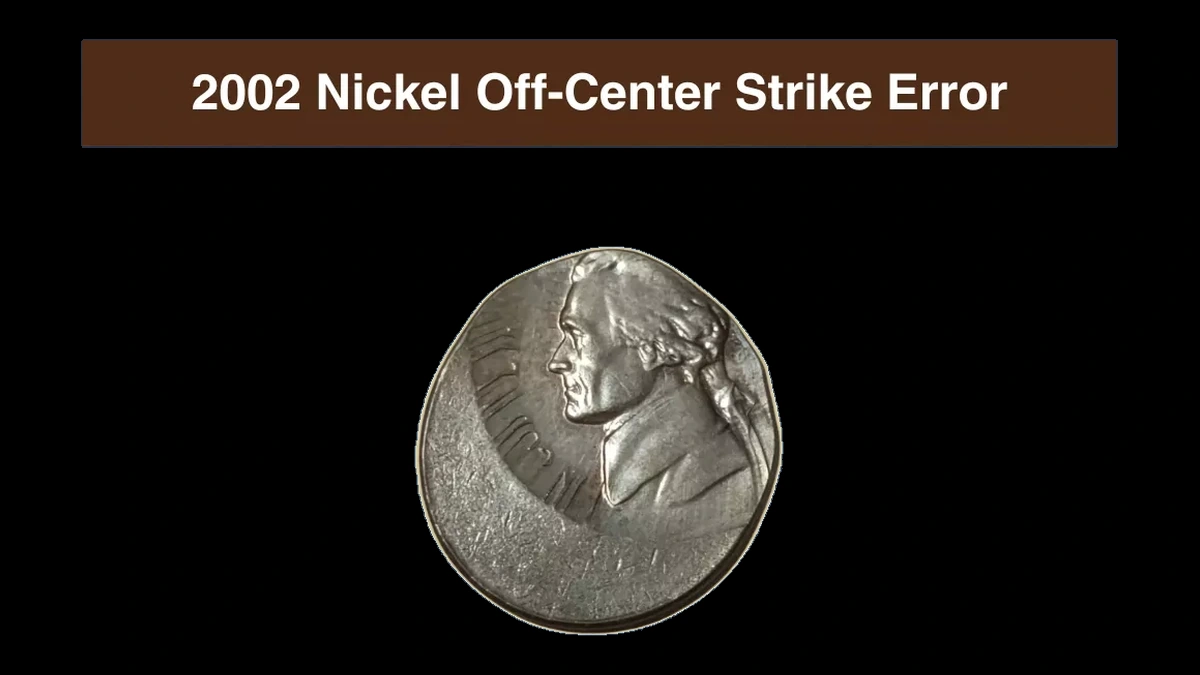
A blank positioned away from the dies’ center can receive only part of the intended design. Some metal remains unstruck while parts of Jefferson and Monticello fall beyond the disk.
How to Identify
Compare the displacement on both faces and inspect the boundary between struck and untouched metal. A single shifted face opposite a centered face points instead toward die misalignment.
Read the surviving date and mint before estimating the offset. The supplied reports include Denver but provide no primary auction measurement of that coin’s direction or percentage.
What It’s Worth
$30–$150 is an estimate for modest dated examples, with stronger attractive offsets potentially around $150–$650. A 1999-D nickel struck 65% off-center sold for $75 in September 2024, illustrating why displacement alone does not determine the price.
11. 2002 Nickel Large Design Elements Occupy Two Positions: Double Strike Error
A coin can receive another blow after moving within the press, leaving overlapping portions of the design. A Denver example is reported for 2002, although its second-strike direction and displacement are not established in the supplied record.
How to Identify
Choose a substantial repeated feature and trace both positions, then connect them with the reverse overlaps. The two faces should support a consistent striking sequence.
Thin shelves beside letters are not evidence of another blow. Sunken reversed impressions from finished coins pressed together later also need to be distinguished from original struck details.
What It’s Worth
$75–$300 is an estimate for recognizable double strikes, with strong overlaps on attractive coins potentially reaching $300–$900. A 2001-D example with its later strike 65% off-center brought $307.44 in June 2026; that nearby-year result does not establish the geometry of the 2002 report.
12. 2002 Nickel The Coin Forms a Cup: Die Cap Error
A struck coin that sticks to a die can be driven upward around it during further blows. That cupped coin is the die cap itself, distinct from later coins whose designs were struck through the covering metal.
How to Identify
Examine the side walls and follow the design into their curves without squeezing or straightening them. Sharp folds, hammer dents, and crushed lettering may reveal an ordinary coin bent after minting.
The supplied year list reports a Denver cap, but weak detail on a flat coin does not establish that identity. Photograph both faces and the side profile so the object’s shape can be evaluated.
What It’s Worth
$300–$1,500 is an estimated range for an authenticated 2002 die cap. A separate flat coin struck through a cap instead has an estimated range of $40–$300.
The supplied 1977-D cap comparison sold for $487.20 in July 2021. There is no completed sale supplied for the reported 2002 cap, and its depth and preservation would matter greatly.
Conclusion
Start a 2002 nickel assessment by recording both faces and the edge in a consistent orientation. That simple record separates sideways die movement, rotation, incomplete strikes, and repeated blows before small details distract from the whole coin.
Many categories here remain reports rather than documented 2002 auction specimens. Match the visible evidence, preserve delicate metal, and keep an estimate separate from a sale involving another year or a different finish.