Rare 1952 Dime Errors (List & Pictures)
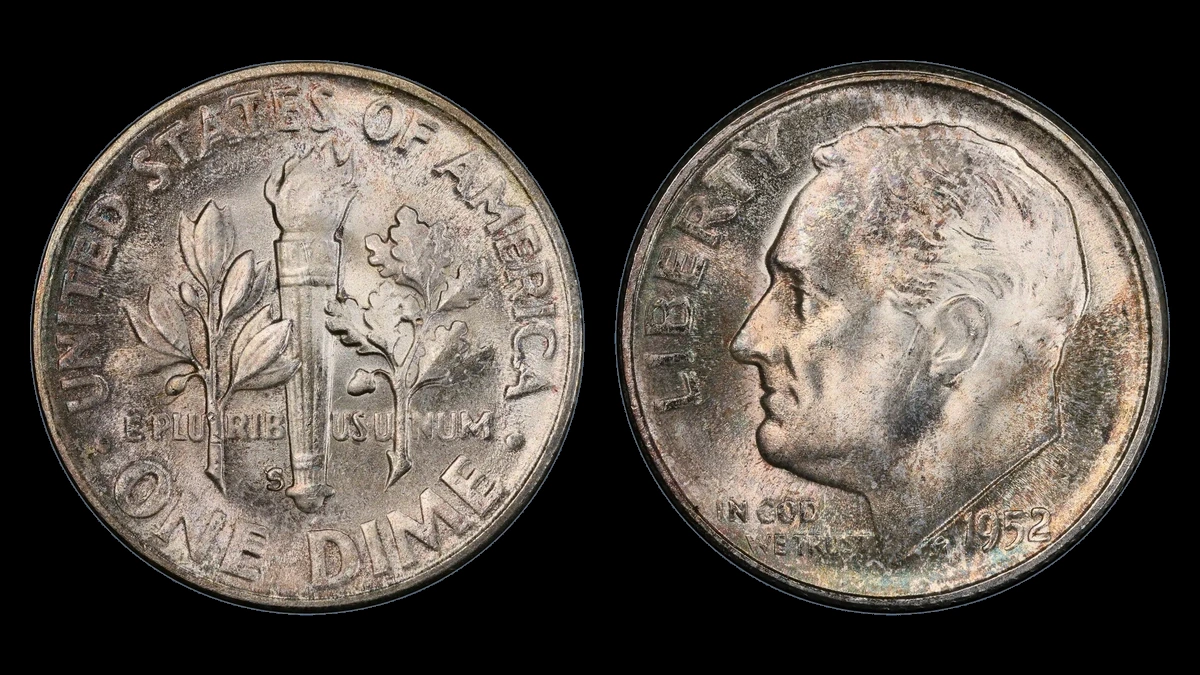
Before studying Roosevelt’s portrait, turn your dime over and find the tiny mint letter beside the torch. One repunched S on a 1952 dime helped a well-preserved example sell for $182 in May 2013.
The 1952 dime errors in this list range from weak letters to coins struck more than once, with estimated values of $10–$1,250. Begin with the mintmark, then work across the surfaces and around the edge.
1. 1952 Dime An Extra Outline around D or S — Repunched Mintmark Error
A mintmark could be punched into a die more than once before that tool was used to strike coins. Slightly different positions left traces of the earlier letter on every coin made from it.
The familiar S-over-S FS-501 has extra traces toward the upper left. Other S patterns point in different directions, while Denver examples include a northeast D and several rotated impressions.
How to Identify
Locate the D or S on the back, left of the torch base and above the E in ONE. Keep the photograph upright when comparing the direction of the extra strokes.
Match a complete pattern rather than any odd bump. A rotated D may leave tilted remnants instead of a second letter standing neatly beside the first.
Supporting scratches or chips must belong to that exact variety. Marks used to identify one S/S cannot automatically identify another.
What It’s Worth
$20–$350 is an estimated range for recognized D/D and S/S varieties. A PCGS MS66 FS-501 sold for $182 in May 2013, as recorded in the PCGS variety listing.
MS66 indicates a well-preserved unworn coin. Clear mintmark traces and clean surrounding metal make the variety easier to appreciate.
2. 1952 Dime A D That Barely Appears — Blocked Mintmark Error
Material lodged in the striking tool can stop part of the D from forming. This reported 1952-D error makes the letter weak, rather than adding a second outline.
A raised blob filling the center of a D is another shape entirely. It can result from a small break in the tool.
How to Identify
Search for a surviving portion of the D and compare it with the sharpness of nearby details. Heavy wear across the back offers a simpler explanation than a blockage affecting only the letter.
Philadelphia made ordinary dimes with no mintmark, so an empty space is not enough. Scraping or an unnaturally smooth patch can also indicate that a letter was removed later.
When only a tiny remnant survives, matching other marks from the same Denver die may be necessary. The year-guide report should not turn every no-mintmark dime into a weak-D error.
What It’s Worth
$10–$100 is the estimate for an identified original blocked-D strike. Strong nearby detail and a clear surviving letter shape help explain the error.
A normal Philadelphia dime or a coin with its mintmark worn away needs a different valuation.
3. 1952 Dime Extra Lines at the Date and Motto — Doubled Die Error
On a listed 1952-D front doubled die, WE TRUST, the initials JS, and the date show moderate separation. The duplicated details were already in the die before it struck the coin.
Several dimes can therefore carry the same pattern without any of them receiving a second blow.
How to Identify
Confirm the Denver mintmark, then take close-ups of all three listed areas. The extra outlines should agree with the cataloged pattern across the motto, initials, and date.
A thick ear or an isolated line beside LIBERTY cannot replace those checks. Flat, shelf-like doubling caused by movement during striking also differs from the raised duplicated design.
What It’s Worth
$20–$250 is an estimated range based on comparable silver Roosevelt doubled dies. Better-preserved coins with visible separation generally offer the clearest examples.
Wear that merges the outlines can reduce interest even when the coin comes from the correct die.
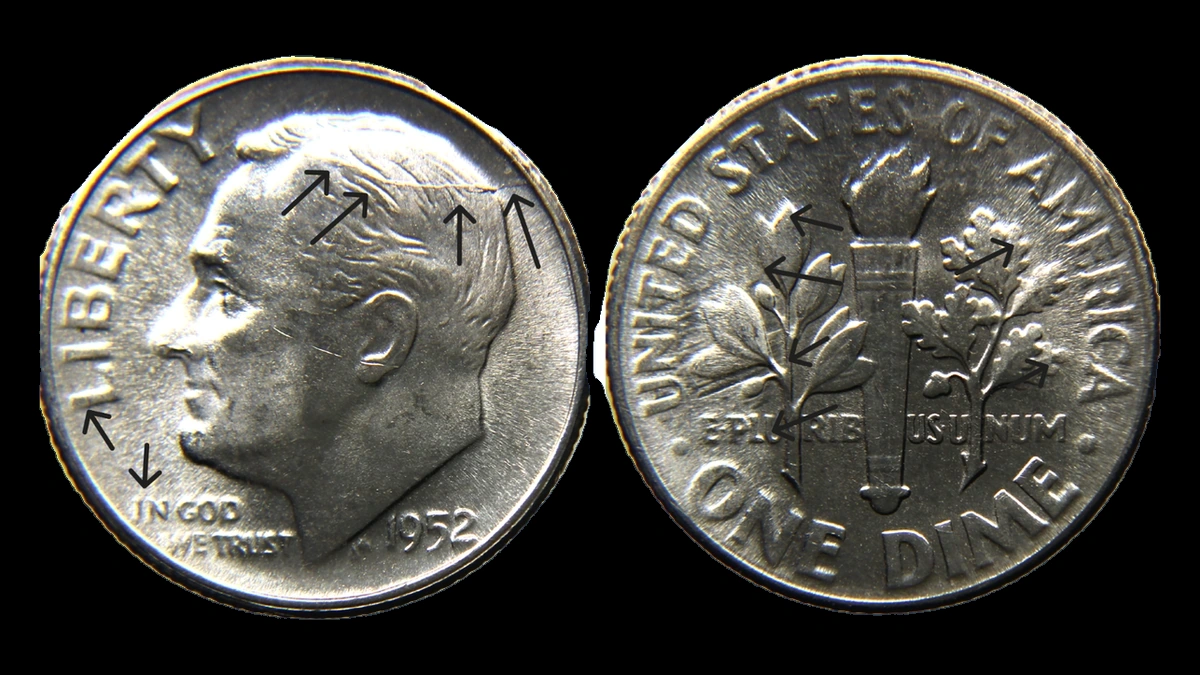
4. 1952 Dime A Line from Roosevelt’s Head to the Rim — Die Crack or Break Error
A raised line reaching from the head toward the edge is sometimes nicknamed a spike head. Coin metal filled a crack in the die, leaving a ridge on the finished dime.
Philadelphia examples have their own paths, while a separate San Francisco report describes a crack running from about 3:30 to 7 o’clock. Small chips and larger rim-connected breaks also fall within this broader group.
How to Identify
Trace the whole raised line under angled light. Do not match a Philadelphia coin to the San Francisco path just because both have a line near the portrait.
A narrow ridge is a crack; a small raised lump may be a chip. A larger blank patch joined to the rim is called a cud.
Inspect the nearby edge for a dent that could have pushed metal upward. A scratch can also leave a raised lip, but it has a cut beside it.
What It’s Worth
$10–$400 spans minor cracks through substantial rim breaks. Small cracks or chips generally fit $10–$100, with larger genuine cuds around $100–$400.
The size and visibility of the feature matter more than the nickname. Several faint lines need not be worth more than one clear break.
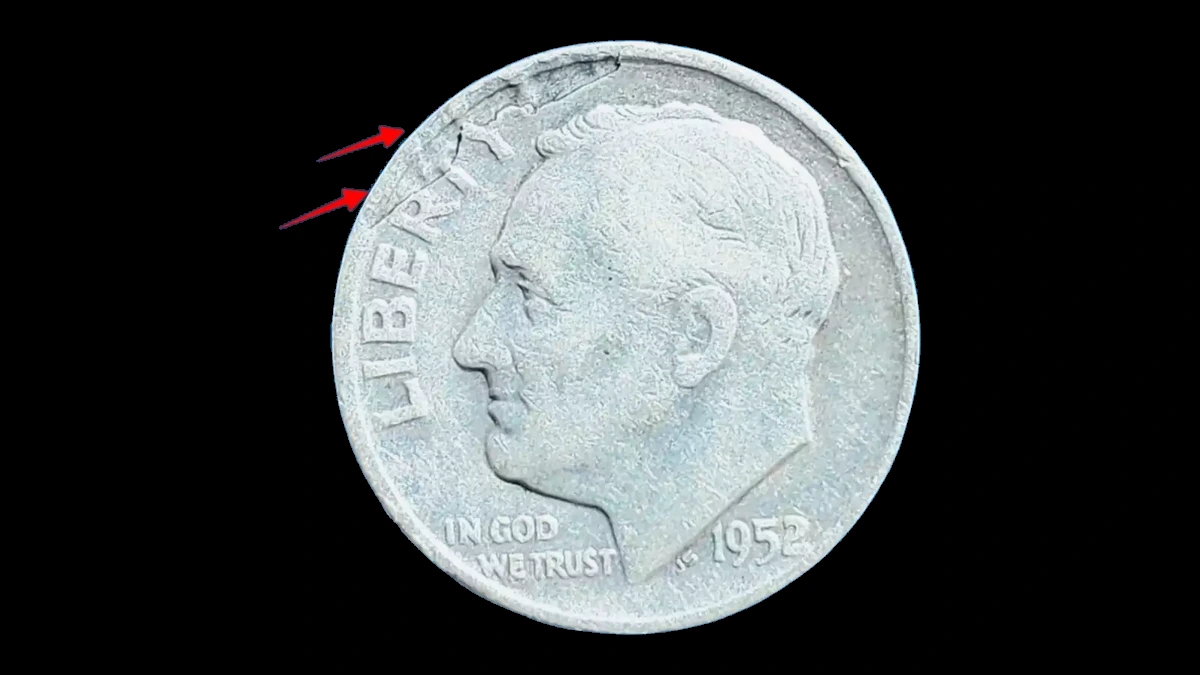
5. 1952 Dime A Thin Flake Lifting Away — Lamination Error
A silver dime can shed a thin layer where the original metal was weak. An attached flap or a shallow exposed patch can reveal this lamination error.
The general 1952 report does not establish a single mint or position. These coins are a mixture of 90% silver and 10% copper, without the separate copper core found in modern clad dimes.
How to Identify
Use side lighting to see beneath an attached flake, keeping it untouched. Follow any original design onto the lifted metal.
Scratches, chemical pits, or a freshly scraped patch suggest other causes. A brown area alone does not show that a copper core has been exposed.
What It’s Worth
$15–$150 is an estimated range for genuine peeling. A major front lamination on a 1942 Mercury dime sold for $89 in March 2023, offering a comparison from another silver dime design.
Larger visible flaws may attract more interest, although severe loss can remove too much of the design for some buyers.
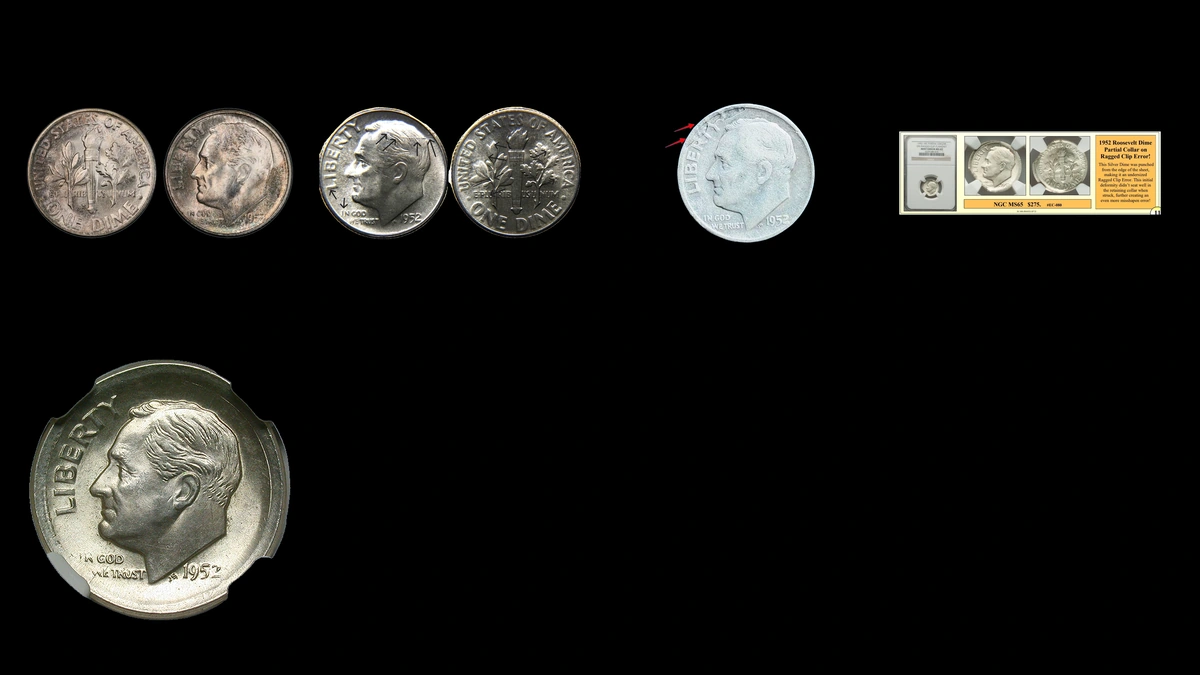
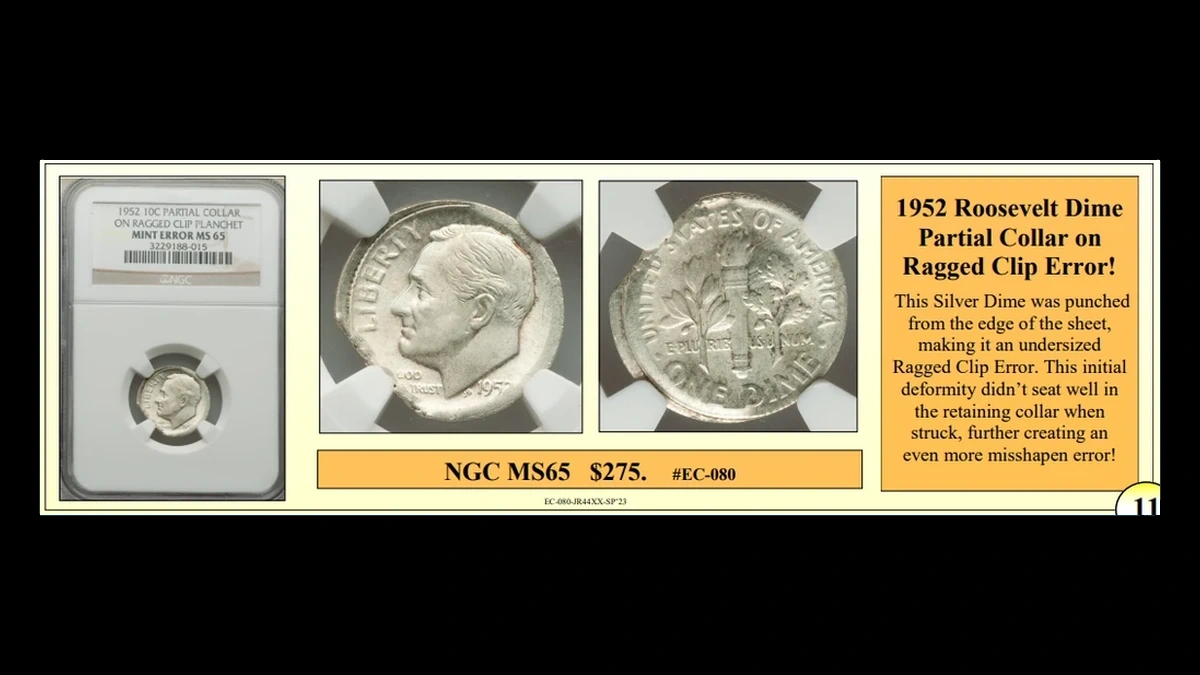
6. 1952 Dime A Ragged Gap and a Stepped Edge — Clip with Partial Collar Error
One Philadelphia 1952 dime combines two different features: a ragged missing section and a step around the edge. Its blank was incomplete, and it sat only partly within the collar ring during striking.
The collar normally limits the dime’s width and forms its edge grooves. The recorded coin received an NGC MS65 grade, indicating an attractive unworn example.
How to Identify
Start with an edge photograph that shows the step between contained and expanded metal. Follow the grooves through that transition, rather than treating a smooth filed strip as the same feature.
Next inspect the ragged gap for original struck metal at its boundary. Fresh burrs or saw marks can reveal a later cut.
A normal 1952 dime weighs 2.50 grams and measures about 17.9 mm across. A clip can lower the weight, while the partial-collar strike can alter the remaining outline.
What It’s Worth
$30–$500 covers modest clips through clearer combinations. Ordinary clips generally fit $30–$300, while ragged clips with an obvious original edge step can fall around $75–$500.
The MS65 Philadelphia combination sold for $144 in July 2021. That was the price of one coin carrying both features.
7. 1952 Dime A Broad Border around the Full Design — Broadstrike Error
A different 1952-D dime expanded beyond its usual outline when the collar failed to contain the strike. The design stayed on the metal, producing a broadstrike.
This NGC MS65 example is separate from the multiple-struck Denver coin discussed below.
How to Identify
Follow the outer letters on both faces to confirm that the whole design remains present. Measure the spread in several directions against the normal diameter above.
Look for an original border and edge, rather than flattened lettering or impact marks from later hammering. Any surviving grooves can help explain where collar contact occurred.
What It’s Worth
$30–$350 is a useful estimate for comparable genuine broadstrikes. The NGC MS65 1952-D example sold for $89 in July 2021.
More visible spreading can improve appeal, but it does not cancel wear or scratches.
8. 1952 Dime A Bare Crescent beside Missing Design — Off-Center Strike Error
A dime struck away from the center of the blank can lose part of the design beyond one edge. A crescent of unstruck metal remains on the opposite side.
The 1952 category is reported without a fixed mint or displacement percentage. An uneven rim alone does not establish this error.
How to Identify
Check that the date is readable and compare both faces for the same displacement. If the mintmark area is missing, the absence of a D or S does not establish Philadelphia.
The bare crescent should be original unstruck metal. A cut can remove design, but it cannot create that untouched part of the blank.
What It’s Worth
$100–$1,000 is an estimated range for genuine examples with readable dates. A 1964 silver dime struck 60% off center, graded ANACS MS65, sold for $134 in December 2025.
That other-year sale is a comparison, not a 1952 result. Date visibility and overall condition can matter as much as the amount of blank metal.
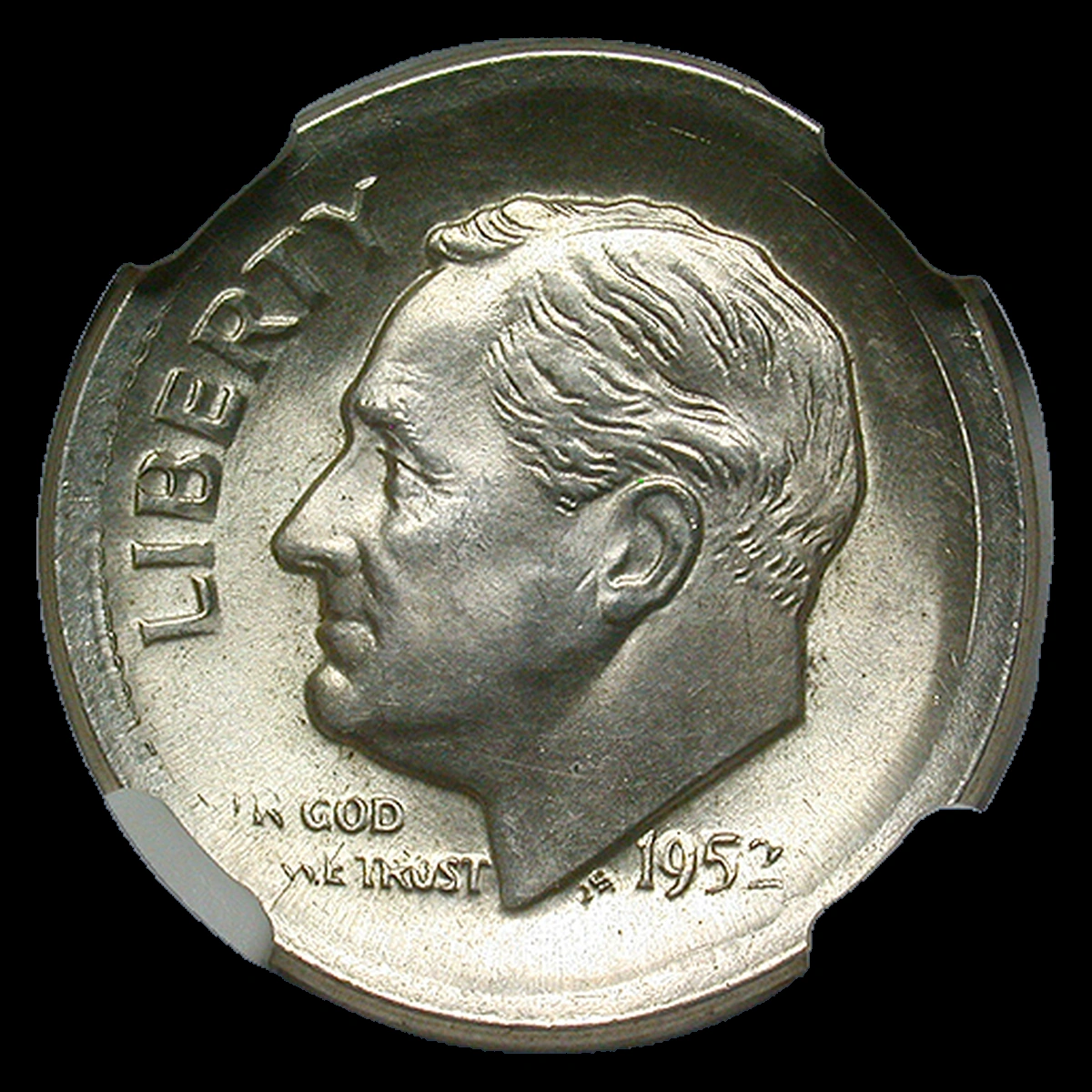
9. 1952 Dime Overlapping Designs on a Wide Coin — Multiple Strikes Error
A 1952-D dime received repeated impressions and also spread beyond its normal width. It was described as multiple-struck with a broadstrike, without an exact number of blows established.
NGC gave it an Uncirculated Details assessment: it had no circulation wear, but a later wheel mark on the back affected its condition.
How to Identify
Choose one recognizable letter group or portrait feature and follow its repeated positions. Connected details are better evidence of another strike than a vague doubled patch.
Do the same on the other face, keeping the later wheel mark separate. That damage crosses the finished design and does not create another struck portrait.
The expanded border supports the broadstrike part of the description. It does not tell you how many times the coin was struck.
What It’s Worth
$200–$1,250 is an estimated range for comparable genuine multiple strikes with broad spreading. Northeast Numismatics offered the recorded coin for $290; this was an asking price, not an auction result.
Clear repeated design helps, while the wheel mark limits the comparison with cleaner coins.
Conclusion
For small 1952 dime varieties, the mint letter and several matching design details are the best starting points. For larger errors, the relationship between the outline, edge, and struck design matters more.
Keep the ragged clip and partial collar together when describing that combination. On the multiple-struck coin, separate genuine extra impressions from the later wheel mark before comparing prices.