Rare 1869 Dime Errors (List & Pictures)
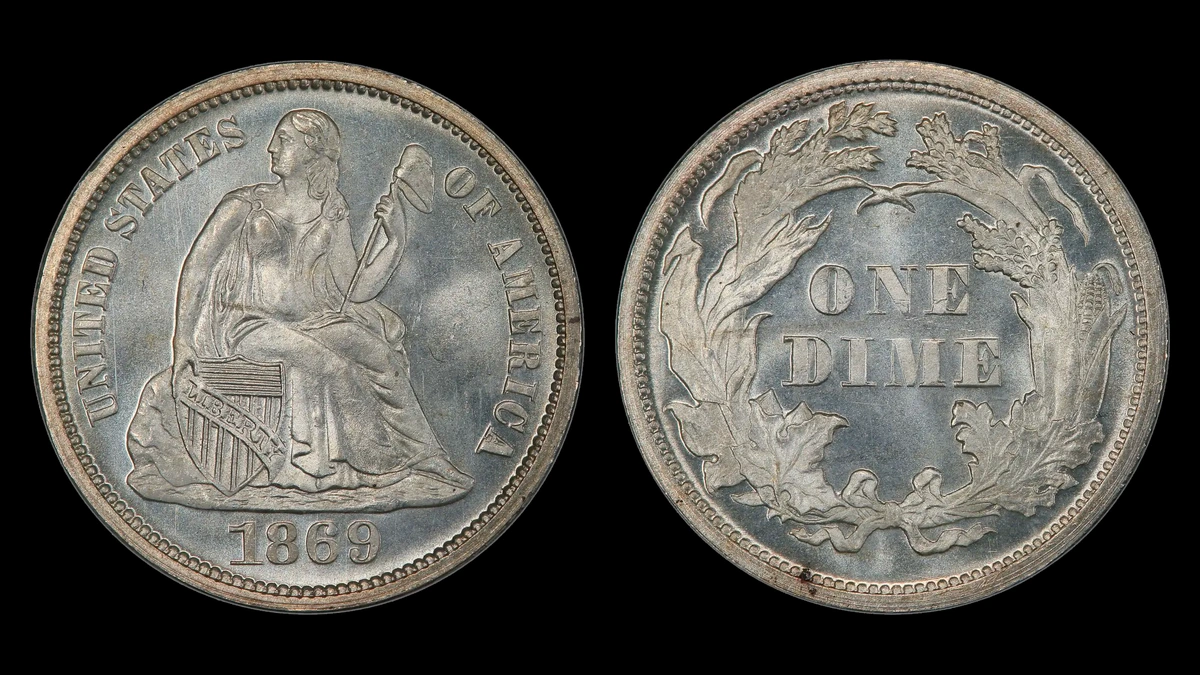
Leaf veins belong on the wreath; an extra raised line may not. For the 1869 Liberty Seated Dime errors discussed here, the useful clues lie near a lower oak leaf or between the ribbon ends.
Estimated whole-coin values span $150–$6,000. A different variety in PCGS MS66 sold for $4,440 in January 2025, offering a condition comparison rather than a recorded price for either crack pattern below.
1869 Dime An Extra Ridge Crosses the Lower Wreath: Reverse Die Crack Error
The F-102 variety shows a line through the lower right oak leaf. F-104a has a separate small crack between the ribbon ends.
Those numbers identify different die pairs, the steel tools that stamped each side. The lines are separate patterns and should not be joined into one supposed crack route.
A crack opens in the tool during use, allowing silver to enter the gap under pressure. The coin then shows the opening as a raised ridge rather than a cut.
The F-104a tools first made Proofs, specially finished collector coins, before being used for ordinary coins. That history does not make every later coin from them a Proof.
How to Identify
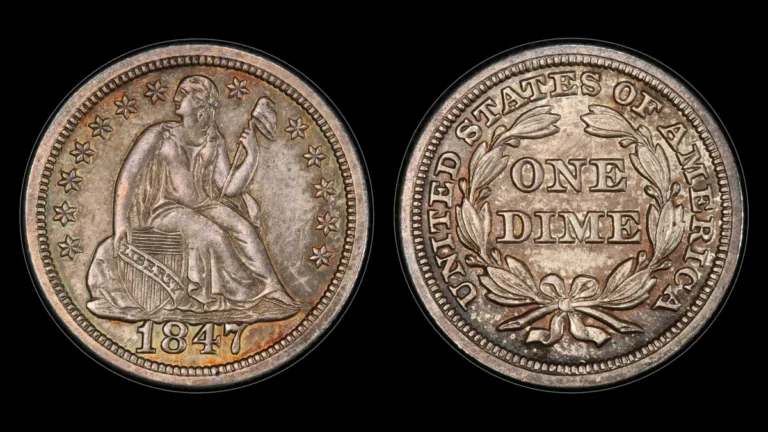
Find the lower right oak leaf or the space between the ribbon ends, depending on the candidate. Compare that location with the 1869 variety gallery.
Study normal leaf veins and ribbon folds before deciding a line is extra. Intended design can look surprisingly like a small crack in a tightly cropped image.
Turn the reverse under a lamp while using a magnifier. A true die-crack ridge rises above the surface, whereas a scratch cuts into the silver and may disturb its edges.
Keep full views of both faces with the close-up so the date, variety, and finish stay together. A short upper stroke on the date’s 1 is not enough to prove either crack.
For a loose coin, compare weight with about 2.49 grams and width with 17.90 mm, allowing for wear. Inspect the grooved edge for filing or damage, and identify ordinary versus Proof manufacture separately.
What It’s Worth
$150–$6,000 is an estimated range for identified ordinary Philadelphia examples, from worn coins to well-preserved unworn pieces. The estimate values the whole dime rather than a separate fee for its crack.
The January 2025 sale at $4,440 concerned F-105a, a different variety with a long upper stroke on the date’s 1. Its MS66 grade indicates no circulation wear and few marks.
That result helps show the importance of preservation. A small crack may add interest, but it cannot give a worn or damaged dime the condition value of a fine MS66.
Conclusion
Choose one crack location and match it carefully: the lower right oak leaf for F-102 or the ribbon ends for F-104a. Check its height under changing light so normal wreath detail and scratches do not become false matches.
Keep the date and finish attached to the identification. The working price range covers complete ordinary coins in different conditions, while collector Proofs require their own comparisons.