Rare 2002 Quarter Errors (List & Pictures)
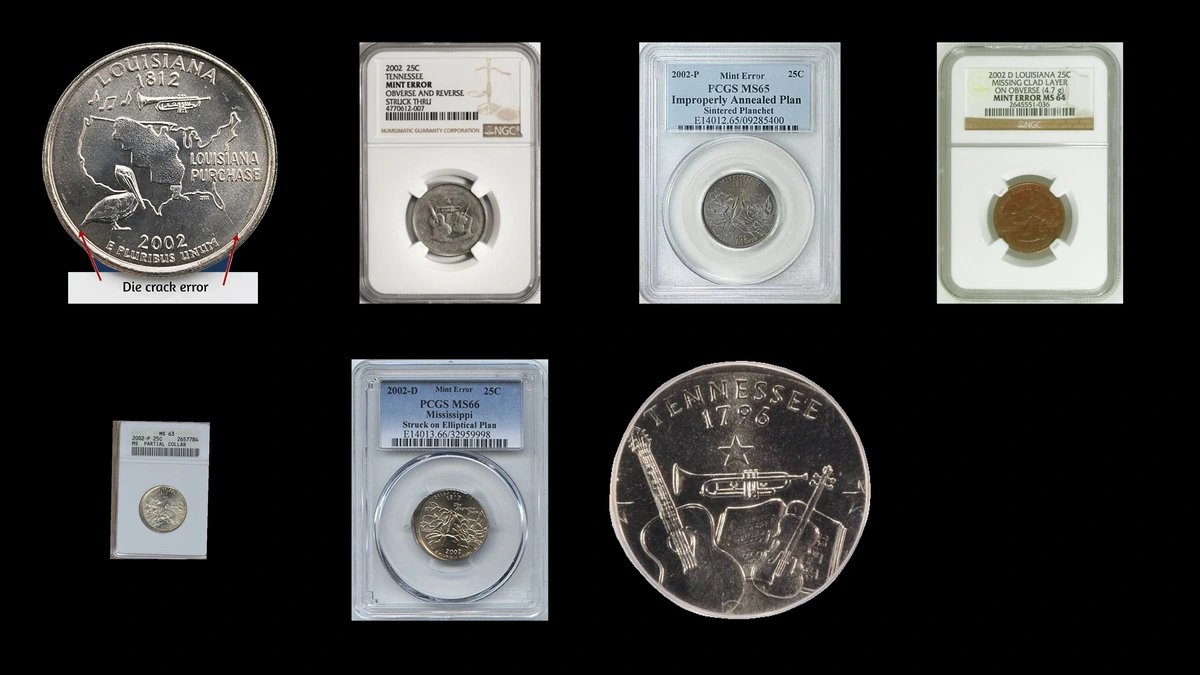
A racecar can survive on a quarter struck on a dime blank even when the date falls outside the metal. The documented Indiana example sold for $17,400 in August 2023.
Estimated values for 2002 State Quarter errors range from $2–$20,000. Identify Tennessee, Ohio, Louisiana, Indiana, or Mississippi first, then inspect the design, edge, and metal for the relevant comparison.
| What looks different? | Category to examine | Estimated value |
|---|---|---|
| Extra contour below the ear | State-specific doubled die | $10–$150 |
| Grooved edge meets a smooth step | Partial collar | $30–$300 |
| Oval or incomplete outline | Clipped or elliptical blank | $30–$1,000 |
| Quarter design on a dime-sized blank | Wrong planchet | $5,000–$20,000 |
A normal clad quarter has bonded metal layers, weighs 5.67 grams, and measures 24.26 millimeters across its grooved edge. A 90% silver Proof is a different collector issue with a normal weight of 6.25 grams.
1. 2002 Quarter A Second Contour Below Washington’s Ear: Doubled Die Error
Cataloged front patterns include Ohio D, Tennessee P and D, and Louisiana D examples. Their extra ear contours were present on the dies before striking.
Separate reports concern Tennessee reverse lettering, instruments, or ribbon, along with Indiana P and Mississippi front claims. One state’s ear pattern cannot establish every other variety.
How to Identify
Read the state and mintmark before comparing the lower earlobe. The Ohio doubled-die catalog supplies Ohio-specific comparisons rather than a universal Washington-quarter pattern.
For reverse claims, inspect the named reverse elements independently. Rounded repeated details and split contours differ from a flat mechanical shelf beside a letter.
What It’s Worth
A clearly matched minor doubled design suggests $10–$150 on an ordinary coin. Stronger visible contours and preserved surfaces support better comparisons.
The range does not supply a specific auction result for every state report. An unexplained thick letter should remain unattributed until its pattern matches.
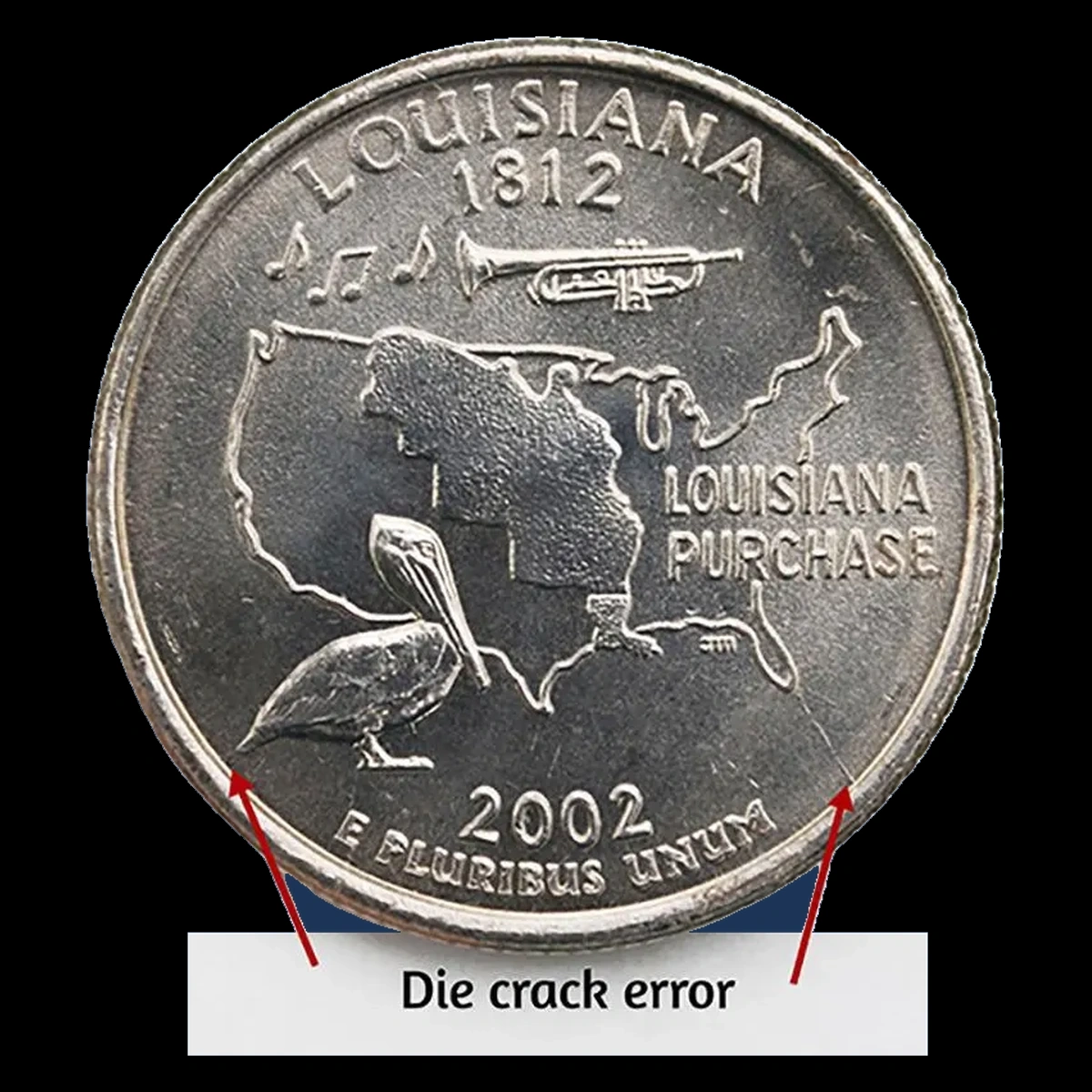
2. 2002 Quarter Extra Raised Lines near Instruments or Flowers: Die Cracks and Breaks Error
Tennessee reports place raised lines near instruments, while Ohio reports involve the astronaut or airplane. Louisiana has map-area features and a line near the pelican’s beak.
Mississippi reports include flower-edge cracks and a separate claimed rim cud. These are features of different coins, not one combined diagnostic pattern.
Metal entering a cracked or chipped die forms raised detail. A broad break connected to the rim is a cud; a normal string or flower outline is part of the intended design.
How to Identify
Compare the same state design before deciding a line is extra. Side lighting helps distinguish a raised ridge from an incuse scratch with a pushed-up lip.
For the claimed Mississippi cud, establish the actual rim connection and missing design. An interior lump or attached blob does not satisfy that description.
What It’s Worth
Small genuine cracks and chips suggest $2–$40; large clear rim cuds may fall around $40–$250.
A 1970-D nickel with two cuds sold for $63 in October 2022. That different coin provides a broad comparison, not a sale for the Mississippi report.
3. 2002 Quarter Faint Details Belong to the Opposite Face: Die Clash Error
A Louisiana clash report concerns traces transferred after the dies touched without a blank between them. Damaged tools can then copy portions of the opposite design onto later quarters.
The supplied report gives no universal location for those traces. It also requires the individual coin’s finish to be established.
How to Identify
Compare each faint outline with a reversed view of the opposite design. Its shape and position should work together rather than merely resemble one small bend.
Follow the trace under changing light to exclude fresh cuts or stains. Distinguish an ordinary circulation strike from a reflective Proof before choosing a price comparison.
What It’s Worth
A genuine Louisiana clash suggests an estimated $50–$300. Several clear corresponding details on original surfaces make a stronger case than a vague line.
No realized sale is supplied for the reported specimen. A Proof’s finish and metal would require a separate comparison from an ordinary clad coin.
4. 2002 Quarter Local Design Is Weak or Depressed: Struck Through Material Error
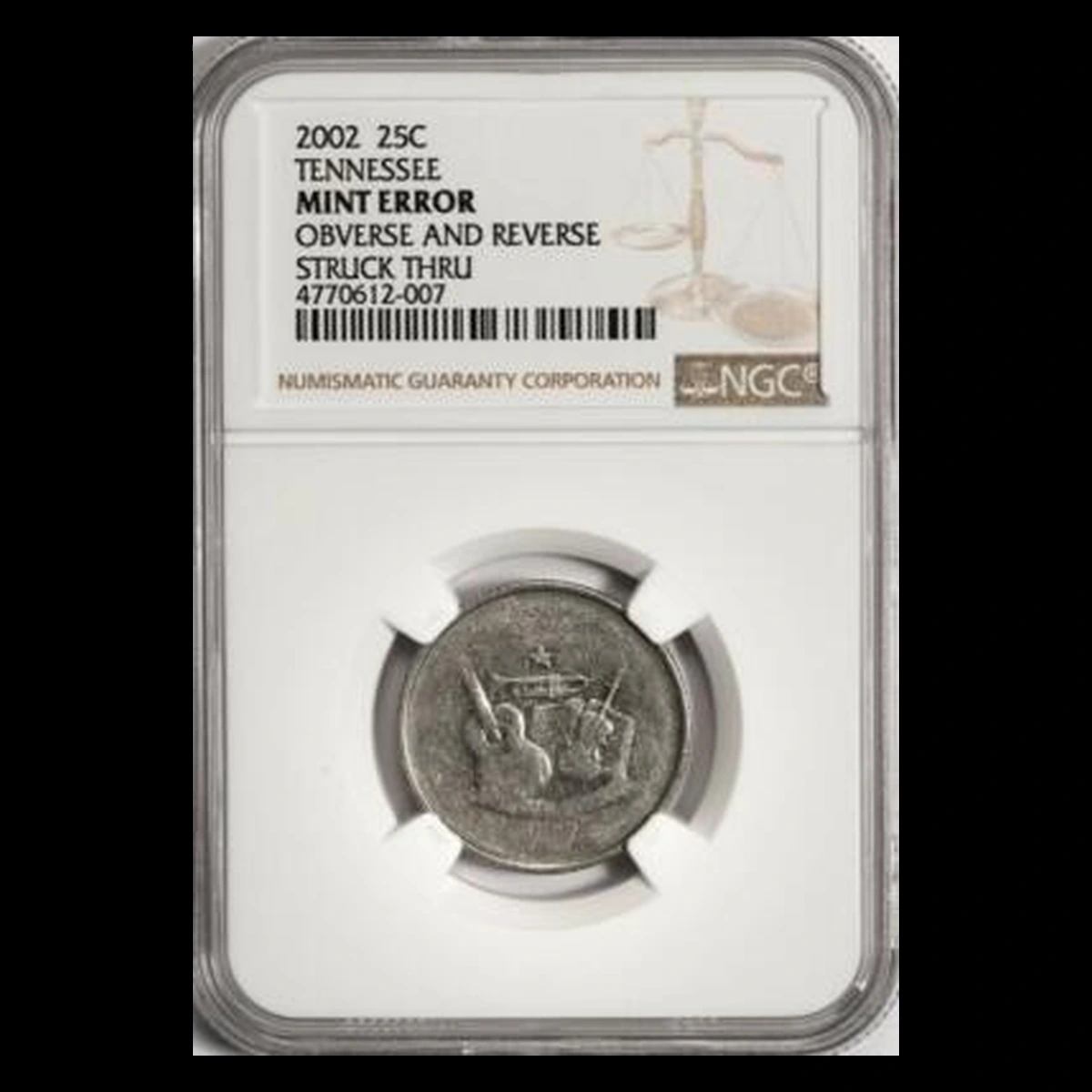
Tennessee has an NGC-labeled major struck-through example; Mississippi reports local depressions, and Indiana reports weaker detail from grease or similar buildup. Louisiana also has a depression reported near the pelican’s wing.
Material blocking a strike can leave different appearances depending on its shape and firmness. These reports need not share one obstruction or affected size.
How to Identify
Compare the interruption with nearby sharp design and inspect its boundary. A later impact can push metal outward or scrape details, while wear often weakens several exposed features together.
Identify the Louisiana coin’s actual finish along with its wing-area feature. Do not infer Proof metal or a specific trapped object from a depression alone.
What It’s Worth
Small genuine blocked details suggest $10–$75; large clear struck-through areas may reach $100–$500.
A 1986-P nickel struck through material sold for $204 in June 2023. That later denomination does not establish a price or obstruction for the 2002 state quarters.
5. 2002 Quarter Surface Metal Peels on Mississippi: Lamination Error
A local separation can leave a thin flap or shallow rough cavity in the Mississippi design. The report does not establish which face or exact feature is affected.
A fragment may remain attached or fall away. Neither situation automatically means the whole copper-nickel face is missing.
How to Identify
Find the attached boundary and examine how nearby design crosses or ends at the separation. Leave the flap untouched.
A deep scoop, piled-up metal, or a fresh pry mark suggests later interference. A natural thin seam surrounded by undisturbed struck surface offers better evidence.
What It’s Worth
Genuine localized Mississippi laminations suggest $15–$175. Broad clearly original flaws can attract more interest than tiny separations.
A 1911 Liberty nickel with front lamination sold for $51 in January 2023. Its different date and alloy provide only a modest general comparison.
6. 2002 Quarter Unusual Color from Blank Preparation: Improper Annealing Error
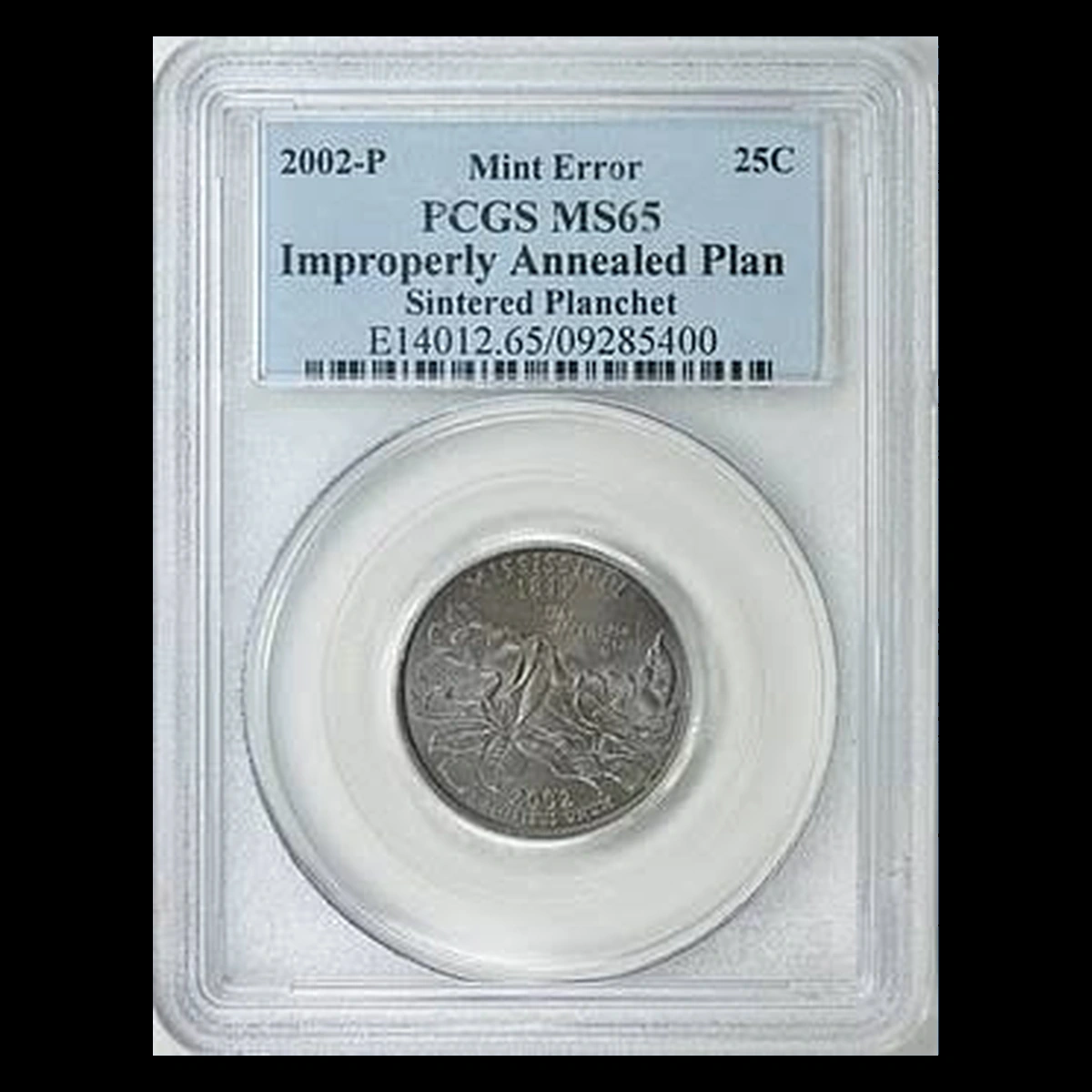
A Philadelphia Tennessee coin listed as ICG MS65 was described as improperly annealed or sintered. Annealing is the heating step used to prepare metal blanks for striking.
Abnormal treatment can affect the original surface. The precise color needs to be taken from this specimen, not guessed from the error name.
How to Identify
Compare the intact coin with an ordinary Tennessee quarter under neutral light. Look for corrosion, paint against lettering, coatings, or differences between the faces and edge.
Do not polish a patch to test it. Unusual color needs a supported mint origin because later staining can look similar.
What It’s Worth
A genuine Tennessee heating-related error suggests $40–$250, depending on clarity and original preservation.
A 2005-P dime with an annealing error sold for $74 in April 2015. It is not a recorded Tennessee-quarter sale.
7. 2002 Quarter Copper Replaces One Pale Face: Missing Clad Layer Error
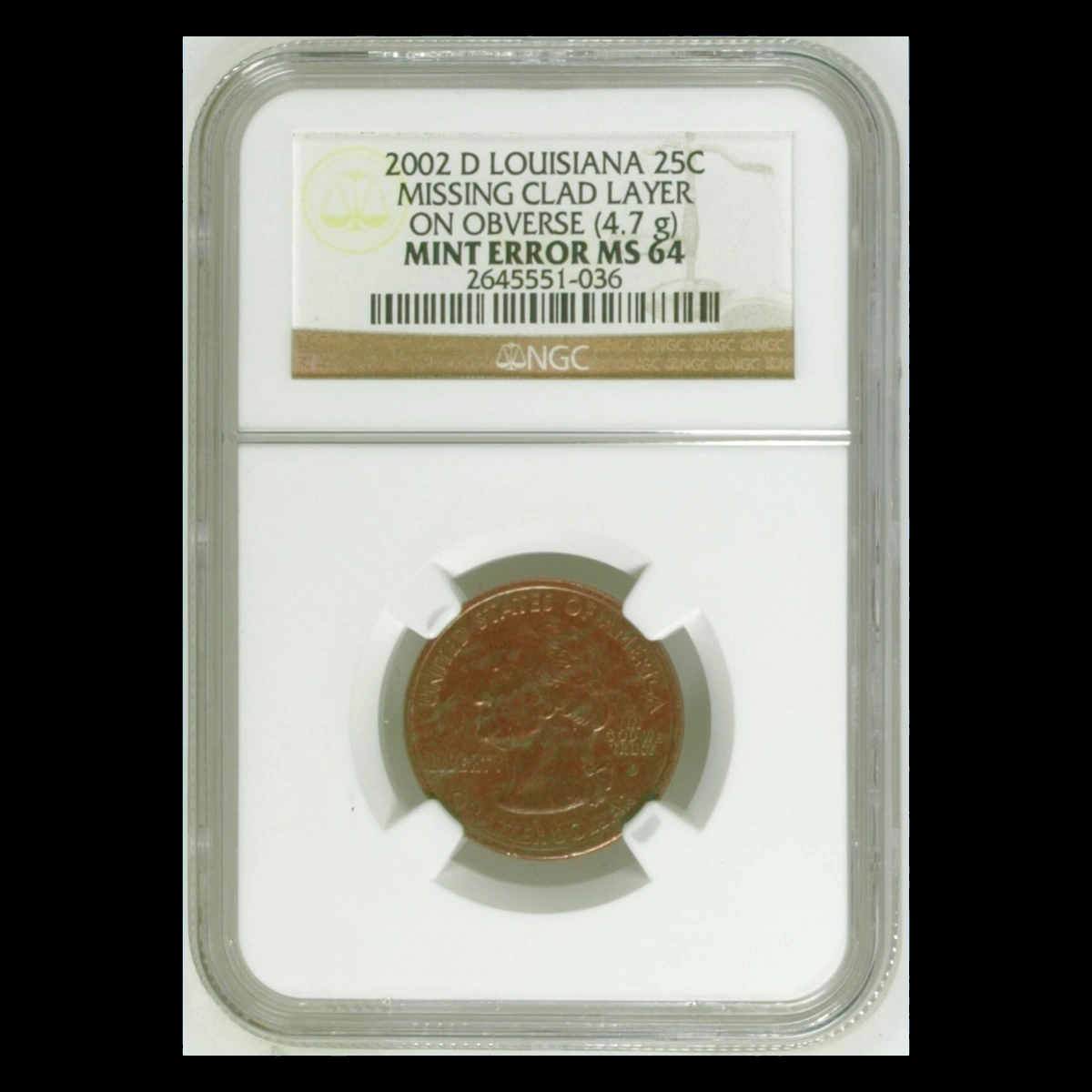
A reported Ohio P coin lacks the reverse layer and also has later front damage. Tennessee has a PCGS MS64 reverse-layer example, while Indiana has a separate PCGS MS65 front-layer coin.
Louisiana also has a missing-layer report. Their affected faces, measurements, and mintmarks remain specimen-specific.
How to Identify
Inspect original design on the exposed copper together with the surviving edge layers and actual weight. A full missing layer should reduce the mass from the clad standard.
Look for plating boundaries, chemical stripping, or grinding. Keep the Ohio coin’s front damage separate from its original reverse-layer loss.
What It’s Worth
Genuine full-layer losses suggest $100–$700. Local smaller losses and damaged examples call for more modest comparisons.
A 1999-D Connecticut quarter missing its reverse layer brought $149 in December 2024. It does not establish an exact value for the separate 2002 reports.
8. 2002 Quarter Wide and Narrow Borders on Different Faces: Misaligned Die Error
The Ohio D report describes a broad front border and a shifted reverse design. One die can move sideways relative to the blank without the other moving equally.
The report does not establish design loss from a blank sitting partly outside both tools. A wide rim alone cannot settle that distinction.
How to Identify
Compare both faces with a normal Ohio quarter at the same scale. Establish where each design sits relative to the metal outline.
Exclude grinding, flattening, and camera-angle distortion at the broad border. A mainly one-sided displacement supports misalignment more than a whole-blank off-center diagnosis.
What It’s Worth
A modest confirmed one-sided shift suggests $5–$75. Slight border differences can attract very little premium.
No completed sale is supplied for the Ohio report. A stronger price requires clear original displacement rather than an enlarged photograph of a wide rim.
9. 2002 Quarter Smooth Expansion Beside Edge Grooves: Partial Collar Error
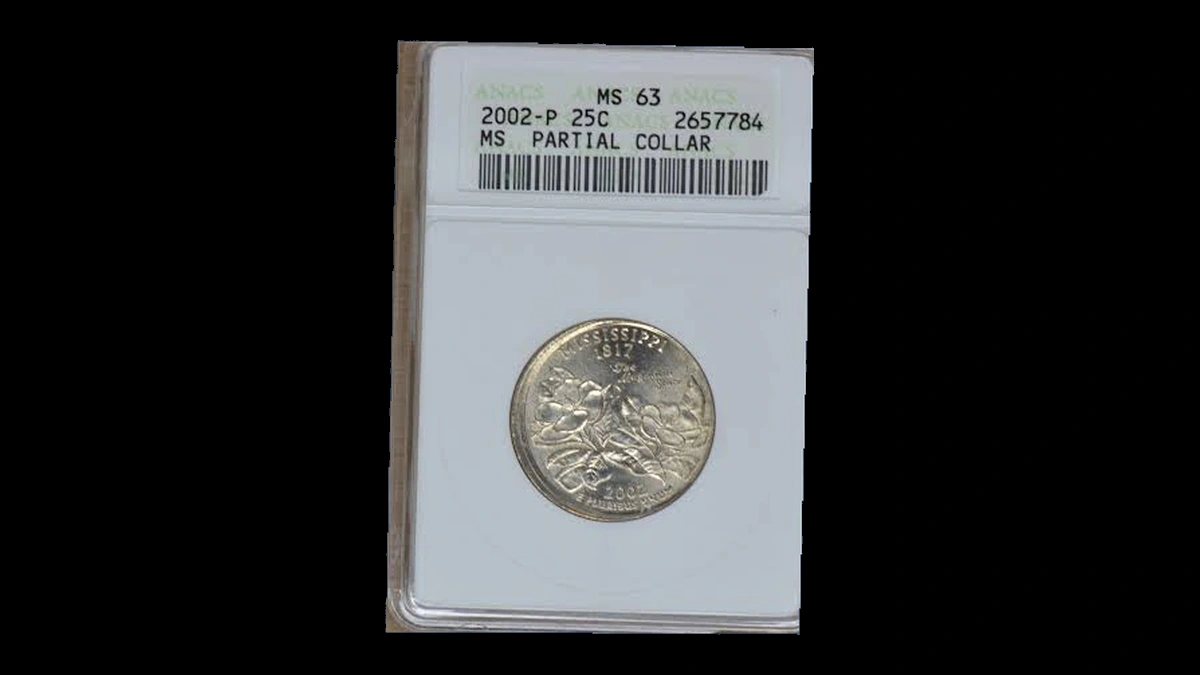
A specialist dealer lists a Philadelphia Mississippi partial-collar quarter. The blank sat only partly within the collar ring that controls diameter and forms grooves.
The unsupported portion expanded into a step beside the contained section. Its exact extent must be established from the coin.
How to Identify
View the edge from the side and follow the junction between grooved metal and wider smoother metal. Two circles on a face do not establish this structure.
Check for filed grooves or later squeezing. A naturally struck transition is more useful than a generic double-rim description.
What It’s Worth
Ordinary Mississippi partial-collar coins suggest $30–$300, depending on definition and preservation.
A 1990-P nickel with partial collar contact sold for $99 in June 2025. That different denomination supplies context rather than a specific quarter price.
10. 2002 Quarter An Oval Outline or Curved Shortage: Clipped Planchet Error
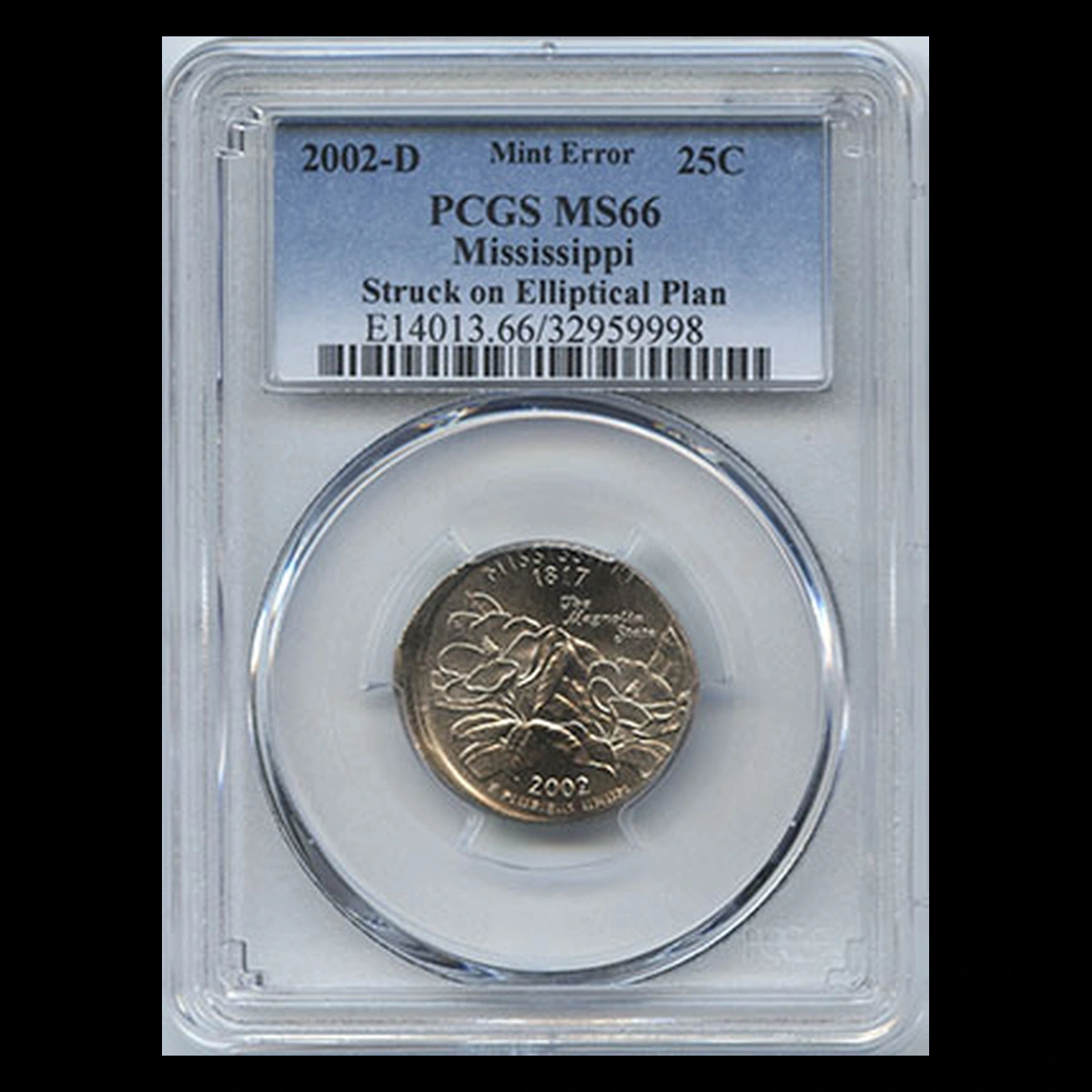
Cataloged Denver oval examples include Tennessee at 4.7 grams and Ohio at 5.0 grams. Indiana and Mississippi have their own recorded oval coins.
One Mississippi D combines an oval blank with a 5% off-center strike. A separate Mississippi P has a reported 5% curved clip.
How to Identify
The published elliptical-blank collection distinguishes these states and specimens. Compare the actual outline, remaining design, and original missing boundary instead of treating a curved bite as the oval coin.
On the Mississippi combination, missing metal and unstruck metal are different features. Inspect for filing or saw marks and keep the Tennessee and Ohio measurements tied to their respective coins.
What It’s Worth
Small curved clips suggest $30–$200; strong oval or combined-error pieces suggest $150–$1,000 for the whole coin.
A 1999-D Pennsylvania quarter with overlapping clips sold for $74 in December 2024. Its different shape is not an exact oval-blank comparison.
11. 2002 Quarter Silver Louisiana Proof Struck Off Center Error
The Louisiana report concerns an S-mint silver Proof with design missing beyond the blank and an untouched crescent on the other side. It is a collector issue with 90% silver composition.
No particular percentage or grade is supplied. Those details cannot be assigned from an ordinary clad off-center quarter.
How to Identify
Confirm the Proof finish and silver issue, using the 6.25-gram standard as a screening comparison for a loose example. A reflective ordinary coin is not automatically a Proof.
Compare both faces for corresponding lost design and untouched metal. Check the crescent for sanding or rubbing that could imitate an unstruck surface.
What It’s Worth
A genuine off-center silver Louisiana Proof suggests $300–$1,500, depending on displacement and preserved surfaces.
A clad 1999-P Georgia quarter struck 40% off center sold for $192 in December 2024. Its different metal and production method make it a lower-level comparison.
12. 2002 Quarter Complete Designs within Expanded Metal: Broadstrike Error
Ordinary broadstrike reports include Ohio D, Tennessee P, and Mississippi D. Each involves outward spreading without the collar’s normal restraint.
A separate Ohio S Proof has a cupped edge and clash marks on both faces. Its cup does not by itself prove attachment to a die as a cap.
How to Identify
Verify that the complete design remains within the expanded border and inspect original edge flow. Later hammering can enlarge a coin while flattening details.
For the Ohio Proof, examine the cup without compressing it and match clash traces to the opposite design. Establish clad or silver composition separately because the supplied cup description does not settle it.
What It’s Worth
Ordinary broadstrikes suggest $40–$350, while the cupped, clashed Ohio Proof has a separate estimated range of $500–$2,500.
The $99 result for the different 1990-P partial-collar nickel is only a related edge-error comparison. The Ohio Proof’s cup and clashes contribute to one whole-coin value.
13. 2002 Quarter Instruments or Letters Repeat in New Positions: Multiple Strikes Error
A Tennessee P coin in a PCGS collector registry is described as struck four times. Separate Ohio examples include D with a second strike 20% off center and P with a reported 10% displacement.
A moved coin can receive a second distinct rim and displaced design. These examples do not establish a flipover sequence without further evidence.
How to Identify
Follow repeated instruments or lettering inward from their respective strike borders. Each impression should fit a possible movement of the same blank.
Compare the other face before deciding whether the coin turned over. Small contours repeated in a doubled die do not explain a separately displaced rim.
What It’s Worth
Ordinary double strikes suggest $150–$900, while a clear four-strike Tennessee example suggests $500–$2,000.
A 2001-P dime with a second strike 75% off center sold for $114 in October 2021. Its different size and sequence do not price the four-strike quarter, whose impressions receive one total value.
14. 2002 Quarter Indiana Finishes Tilted after a Normal Flip: Rotated Dies Error
A Denver Indiana example is reported in MS64 condition with rotated alignment. Its exact angle must be measured from the coin.
The relationship between the dies changes the reverse’s final orientation even when each face otherwise looks normal. A crooked holder cannot establish that relationship.
How to Identify
Hold Washington upright and flip the coin from top to bottom without a sideways turn. Record the uninterrupted movement and repeat with a normal quarter held identically.
The abnormal reverse angle should recur consistently. Check an unusual edge for alteration rather than treating separate rotated photographs as proof.
What It’s Worth
A genuine Indiana rotation suggests $25–$400, with the measured angle and condition determining the useful comparison.
A 2015-D nickel rotated 90 degrees counterclockwise sold for $79 in October 2021. Neither that exact angle nor its sale belongs to the unmeasured Indiana report.
15. 2002 Quarter Quarter Designs on a Smaller Blank: Wrong Planchet Error
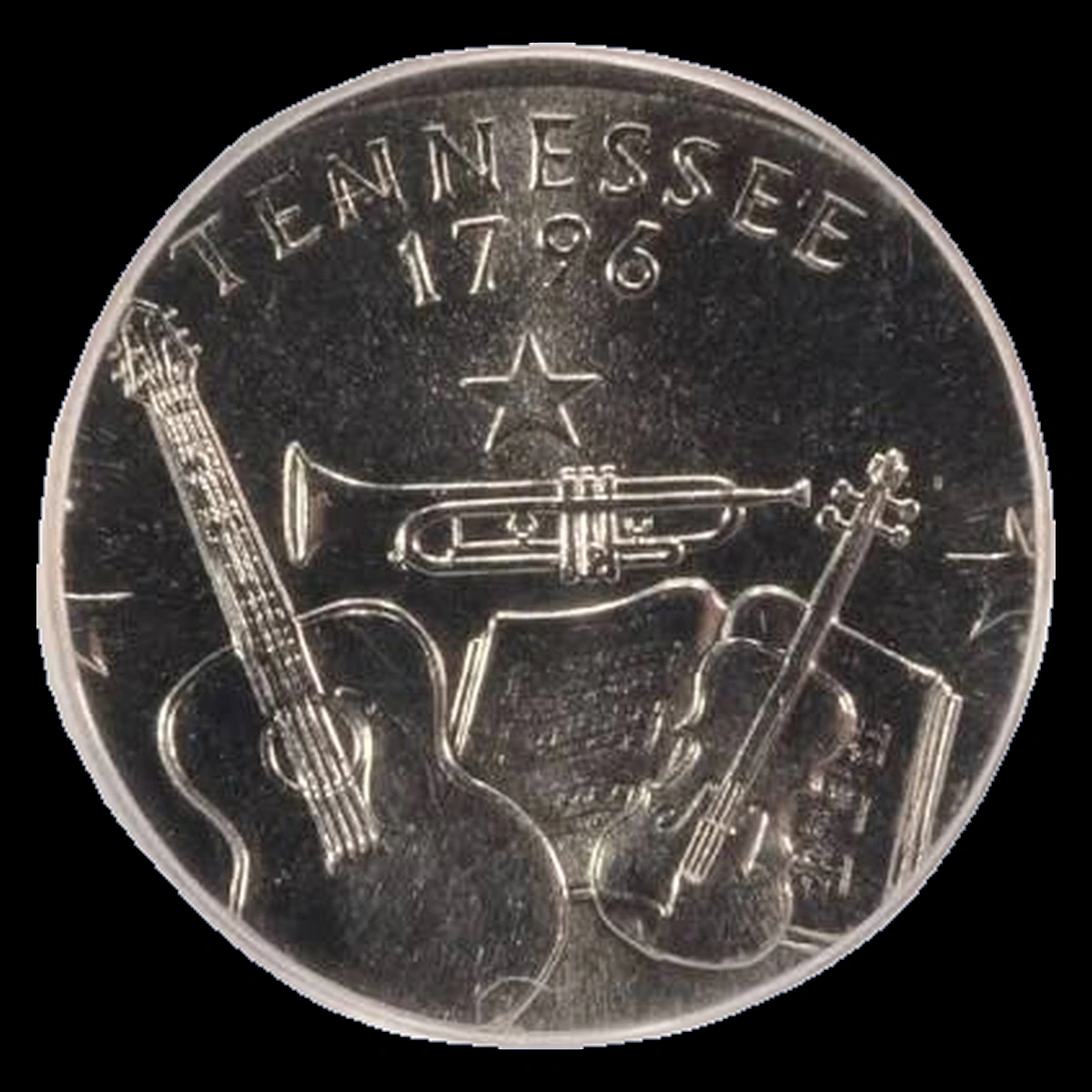
The documented Indiana dime-blank coin retains Washington, the racecar, and a P near the edge, while its date falls outside the metal. A Tennessee P dime-blank example loses both date and mintmark areas, so its identity depends on the auction and holder.
Tennessee also has a separate Denver dime-blank coin and a distinct nickel-blank report. A smaller blank does not mean an already struck dime or nickel was used.
How to Identify
Compare actual metal and dimensions with the starting standards: 2.268 grams and 17.91 millimeters for a clad dime blank, or 5 grams and about 21.2 millimeters for a nickel blank. These are standards, not supplied measurements of the individual auction coins.
Inspect where the quarter design naturally runs beyond the available metal and exclude trimming of an ordinary quarter. Preserve the holder’s identification when the struck date or mintmark is absent.
What It’s Worth
Dime-blank state quarters suggest $5,000–$20,000; an authenticated Tennessee nickel-blank example has a separate estimated range of $500–$2,000.
The Indiana PCGS MS64 dime-blank quarter sold for $17,400 in August 2023. Its absent date does not prevent the documented state-design attribution.
Sullivan Numismatics offers a Tennessee D PCGS MS65 example for $8,000. That is an asking price for another state and specimen, not a completed sale.
Conclusion
The same 2002 date covers five different state designs and several metal and finish combinations. A useful comparison keeps those identities intact rather than transferring one ear pattern, weight, or dramatic price to every quarter.
Document both faces and the edge, leave peeling or cupped metal undisturbed, and preserve attribution records when a small blank loses the date. One combined error still represents one coin and one overall value.