Rare 1866 Nickel Errors (List & Pictures)
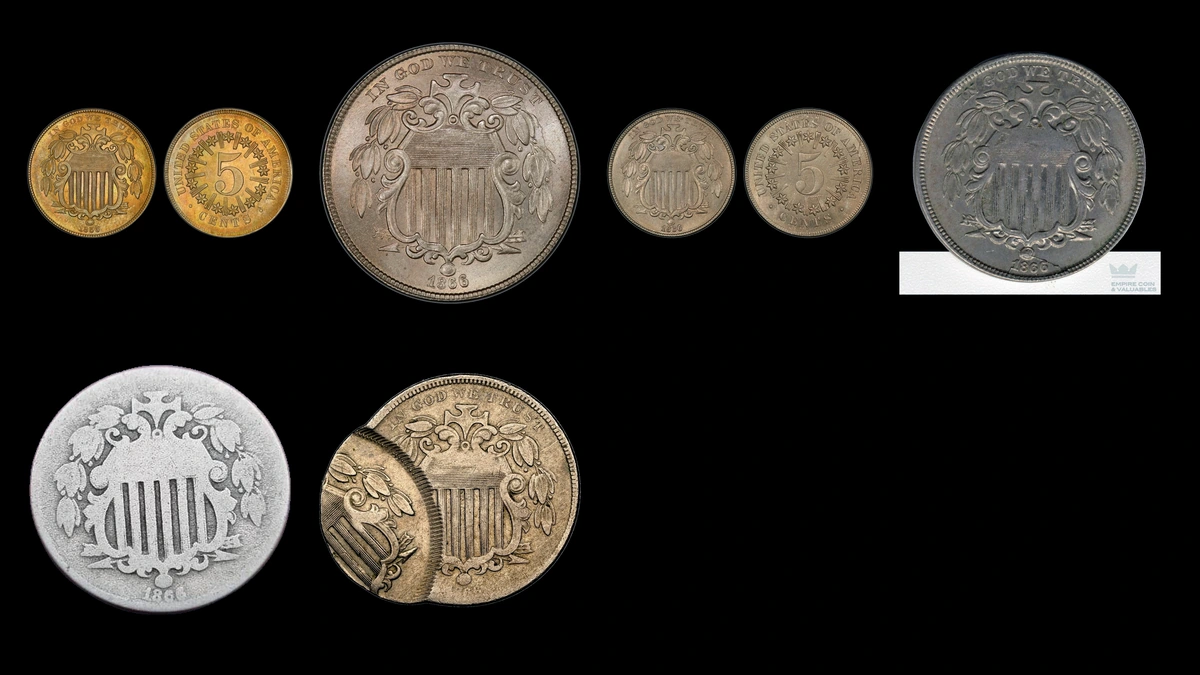
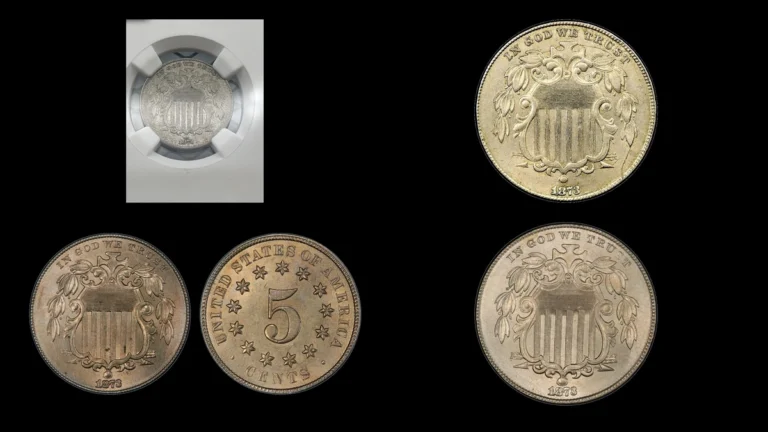
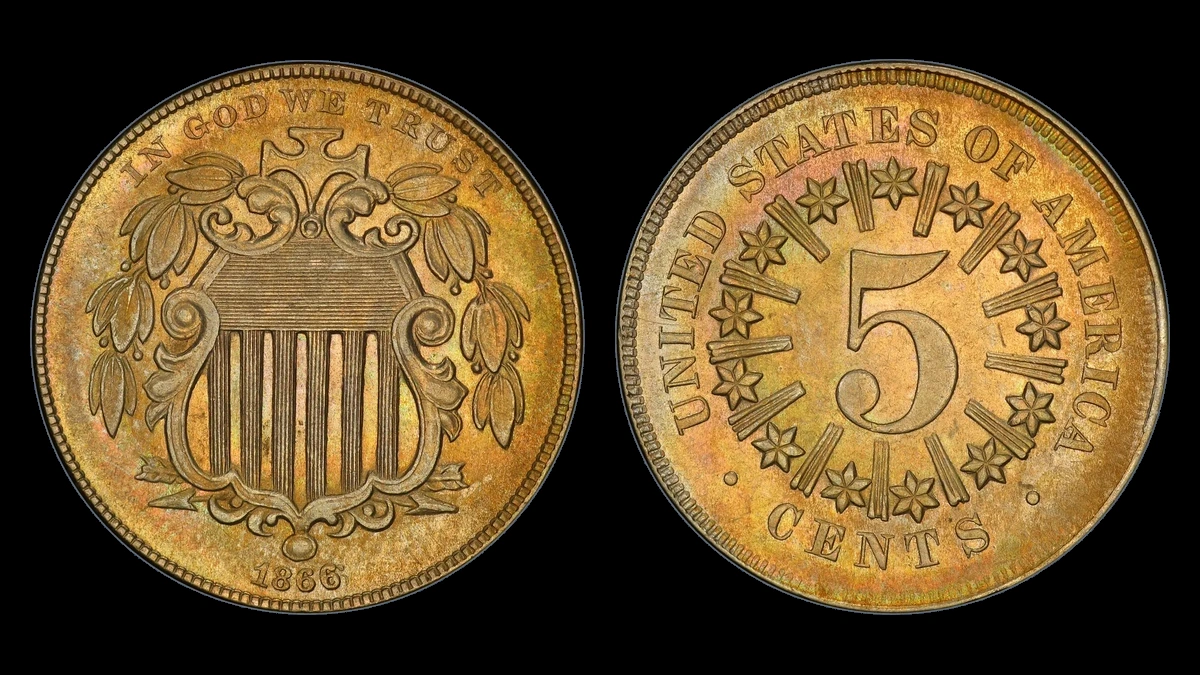
The rays between the reverse stars are normal on an 1866 Shield nickel. Identifying 1866 nickel errors means looking beyond those intended lines to altered tool detail, abnormal metal, or misplaced strikes.
Whole-coin estimates span $25–$15,000. A well-preserved coin struck 30% off center brought $11,100 in July 2022.
Begin with the date and motto, then compare reverse shape, surface defects, and the outline of the struck blank.
1. 1866 Nickel Extra Digit Strokes near the Date or Border: Repunched and Misplaced Dates Error
A date punch entering the tool more than once can leave remnants around the final numerals. Reported patterns include upper-right date traces, a separate lower-right 18, and extra detail below a 6.
Misplaced traces can sit farther from the ordinary digits. Cataloged examples include a 6 curve above the border teeth between the final two 6s, and a separate 1 top between its normal foot and the border.
How to Identify
Include the whole date and border teeth in one close-up. That context separates a remnant beside a normal digit from one misplaced beneath it.
Match one direction and pattern at a time, tracing a curve or bar that belongs to the earlier numeral. Do not merge the upper-right pattern, lower-right 18, and different misplaced traces unless they actually occur together.
Move the light to exclude reflections or cut scratches. The remnant should remain part of the original raised design.
What It’s Worth
Identifiable date-punch varieties are estimated at $75–$1,500. Pattern, visibility, and the complete coin’s preservation affect demand.
A repunched digit and a misplaced fragment may coexist on one coin. Their values should not be added as if they were separate complete nickels.
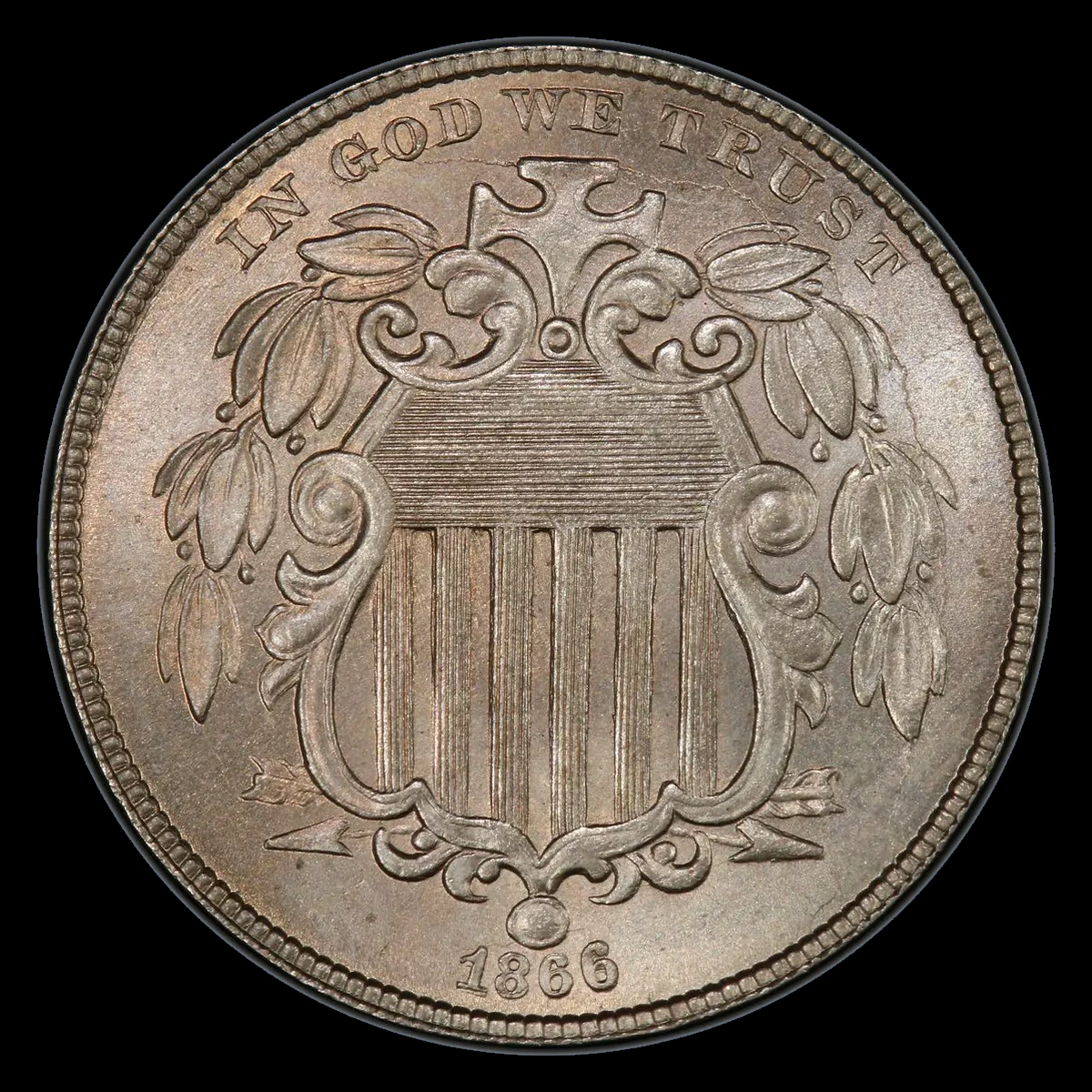
2. 1866 Nickel Another Outline along the Motto: Doubled Die Obverse Error
One cataloged pattern adds an outline along the left sides of IN GOD WE TRUST. Other examples show a different spread toward the lower left.
The repeated design belongs to the die, or stamping tool. One ordinary blow can transfer it to the nickel.
How to Identify
Keep the coin upright and follow several motto letters, rather than judging one broad edge. Compare the matching pattern in the Shield Nickel Varieties catalog.
The lower-left spread needs its own reference instead of being forced into the left-motto pattern. Rounded extra outlines should remain fixed when the light changes.
Flat shelves can result from movement during striking, while worn tools can thicken detail. Neither effect is confirmed die doubling merely because a letter looks large.
What It’s Worth
Matched ordinary-strike doubled dies are estimated at $100–$2,000. Strong separation and original surfaces support better comparisons than weak or heavily worn detail.
Additional date repunching or cracks belong in the same whole-coin assessment.
3. 1866 Nickel The Large 5 Points the Wrong Way: Rotated Dies Error
A normally aligned reverse should be upright after a controlled top-to-bottom turn from the upright shield. A tool that rotated in the press changes that relationship between the faces.
The catalog lists separate examples at about 135 degrees and close to 180 degrees. Their angles should not be treated as two readings of one coin.
How to Identify
Start with the shield upright and date below, then flip over a horizontal line through the center without a sideways spin. Repeat to establish a stable angle for the reverse 5.
Preserve that relationship in a simple holder or paired photographs. Images rotated independently cannot establish the coin’s actual alignment.
Measure the specimen’s direction and angle rather than assigning a catalog number from a tilted picture. The nearly half-turn example is a particularly clear visual comparison.
What It’s Worth
Clearly established large rotations are estimated at $100–$2,000. Readable dates, original surfaces, and an easily demonstrated angle influence the price.
Wear need not hide a rotation, but the angle alone does not create a fixed value.
4. 1866 Nickel Uneven Relief to the Right of CENTS: Buckled Die Error
A gradual surface change beside CENTS can reflect distortion of the tool itself. The catalog notes this buckling on examples from one reverse die, while another example from that die lacks it.
How to Identify
Keep the neighboring letters visible as low light moves across the area. Compare the actual change in surface level with a documented buckled example.
The tool identity alone is insufficient because the distortion is not present on every example. A shifting reflection also cannot supply a permanent surface feature.
Inspect the reverse area’s surroundings and the opposite face for an impact. A later dent or cut needs a different explanation from gradual distortion formed by the tool.
What It’s Worth
A clearly matched modest buckled-die feature is estimated at $25–$300. Subtle unevenness may contribute little on a heavily worn coin.
Original nearby detail makes the surface easier to compare; polishing, corrosion, or dents can obscure it.
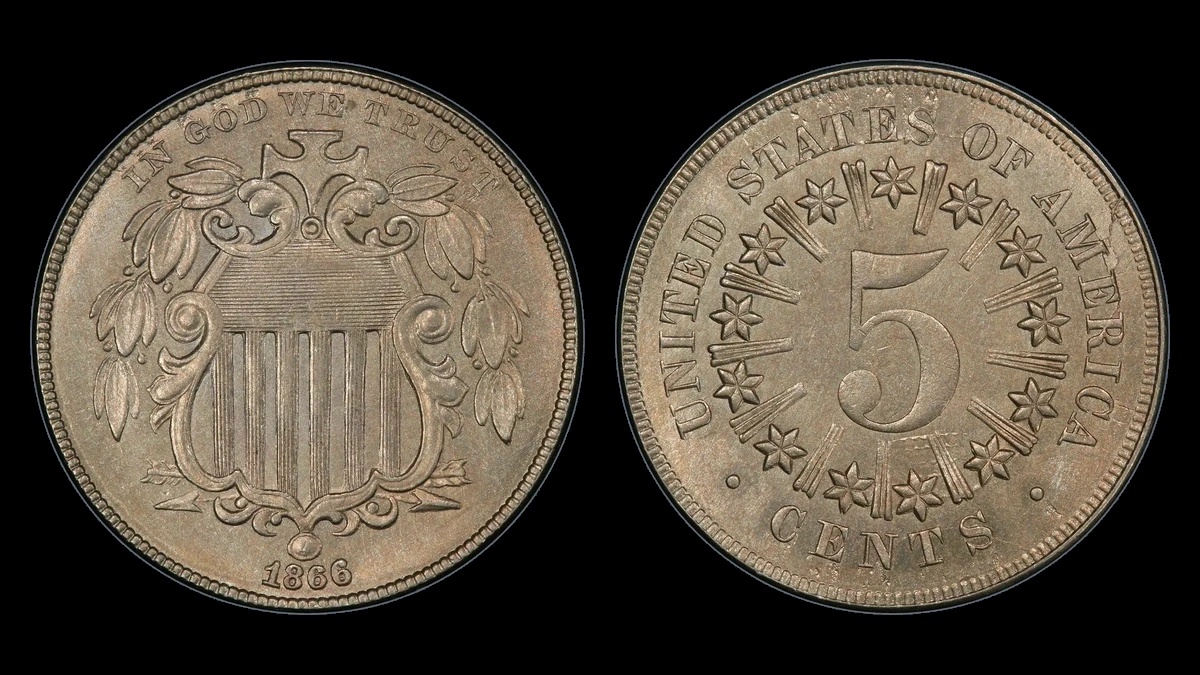
5. 1866 Nickel Faint Opposite-Design Fragments: Die Clash Error
Contact between the tools without a blank can leave marks that appear on later coins. Several 1866 examples are cataloged with weak or strong clashes.
How to Identify
Compare equal-size photographs of the shield and star-and-ray sides. A suspected trace should fit a genuine curve or angle from the opposite design.
Connected fragments are more persuasive than an isolated straight line. The catalog specifically questions a clash explanation for some horizontal marks below the large 5.
Keep the normal stars and rays visible as reference points. A scratch or tool-polishing line does not become a clash simply because it appears in open space.
What It’s Worth
Recognizable ordinary-strike clashes are estimated at $30–$400. Clear original fragments generally display better than faint lines that need imaginative completion.
Clashing, date repunching, and cracks may occur together. Assess the complete coin without adding several whole-coin ranges.
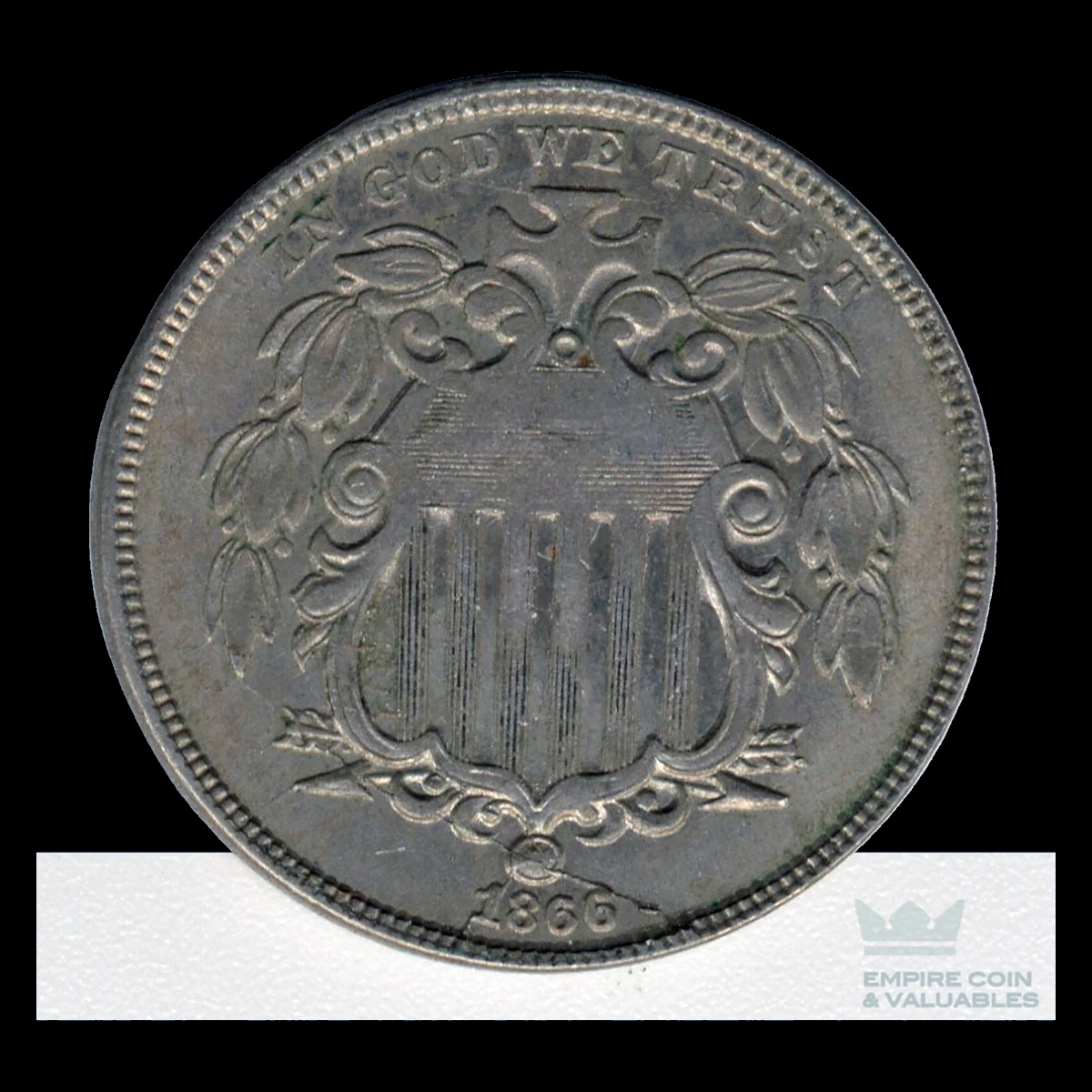
6. 1866 Nickel A Raised Line or Large Rim Patch: Die Cracks and Cuds Error
Reported crack paths pass through the cross, left leaves, or reverse lettering. A crack accepts metal during striking and leaves a raised ridge on the coin.
Larger edge breaks can produce cuds, or raised patches connected to the rim. A front break around 3–4 o’clock and another covering much of the date are separate examples.
How to Identify
Trace each line’s route through surrounding design before comparing it with a cataloged path. A ridge from a tool crack is not a split through the coin.
For a cud, confirm the rim connection and inspect the base for original struck metal. Added material or a later impact can also make a raised-looking lump.
Keep the 3–4 o’clock and date-area shapes separate. A visible year on one coin cannot supply missing digits on another.
What It’s Worth
Modest cracks are estimated at $25–$200, and large clear cuds at $150–$1,500. The amount of replaced design and preservation determine useful comparisons.
A date-covering break may be dramatic, but the coin’s identity still needs reliable evidence.
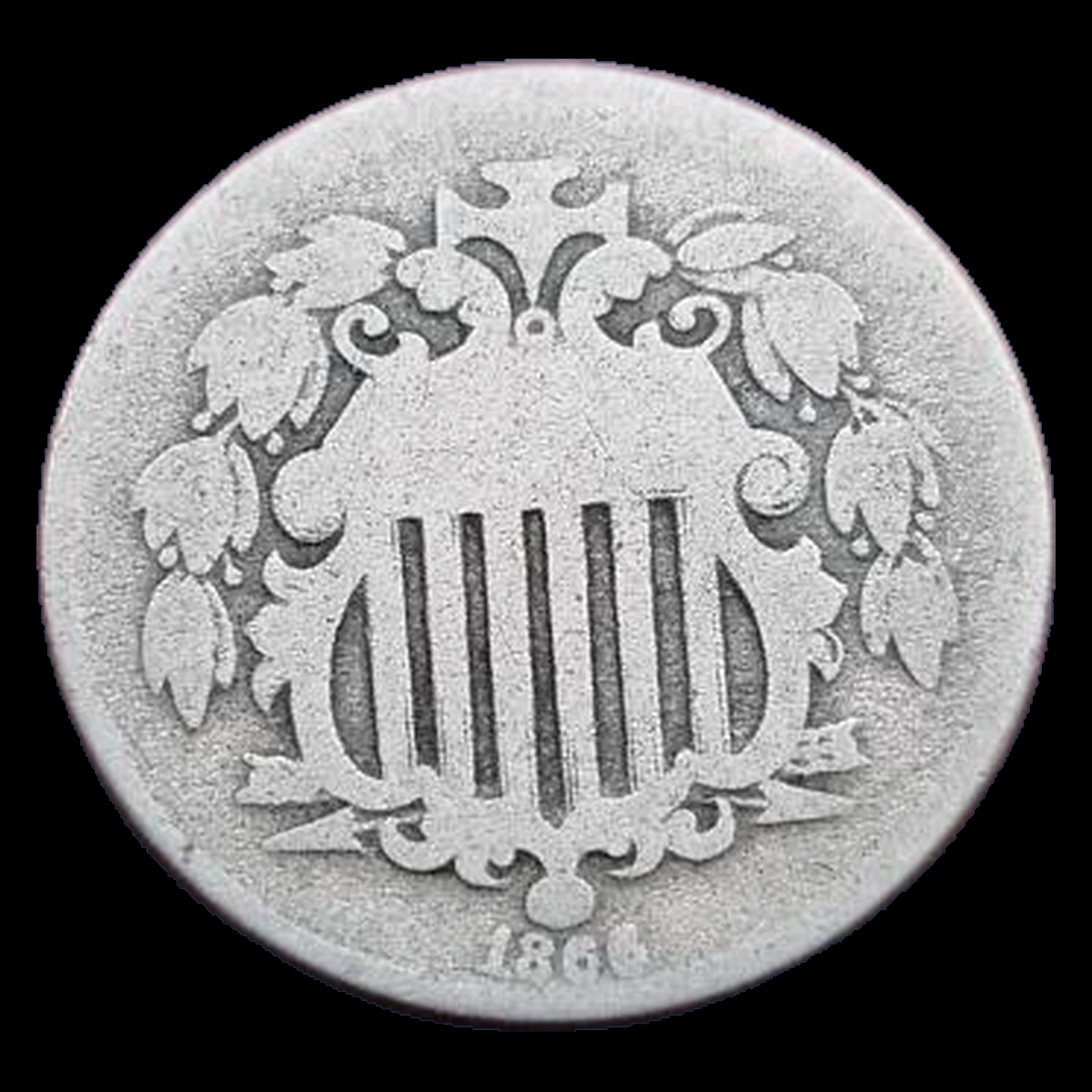
7. 1866 Nickel A Flap Separating from the Front: Lamination Error
GreatCollections cataloged an 1866 Rays nickel with front lamination in NGC MS65. A weakness within the alloy can leave a thin attached flap or an area where a layer has fallen away.
How to Identify
Inspect the attached boundary without lifting the metal. Original design extending onto a flap helps explain the separation’s relationship to striking.
The normal Shield nickel weighs 5 grams, measures 20.5 mm, and has a plain edge. Its copper-nickel alloy is not constructed from modern bonded outer sheets.
Detached metal can lower weight, while an attached flap may retain it. Keep corrosion, cutting, and fresh scraping separate from a natural layered opening.
What It’s Worth
Genuine laminations are estimated at $40–$800. Much of the appeal of the MS65 example can come from its unworn condition rather than the flaw alone.
A 1911 Liberty nickel with front peeling sold for $51 in January 2023. That different-design comparison does not assign the same value to an 1866 MS65.
8. 1866 Nickel Attached Extra Material below the Final 6: Retained Metal Error
The catalog’s marked photograph shows extra material immediately below the last digit. This particular example also belongs to a repunched-date variety.
The fragment’s alloy and origin are not identified. Its intact connection with the struck surface matters more than a guess that it is wire or scrap from another denomination.
How to Identify
Include the complete date in a side-lit image, then examine the contact from several angles. Look for evidence that the strike formed around the piece.
A particle resting across finished detail may have arrived later. Solder or dirt should not be accepted as retained mint material merely because it is attached.
Do not pull, scrape, or probe the fragment. Establish its presence during striking before naming a composition or source.
What It’s Worth
Authenticated retained metal of this general size is estimated at $150–$3,000. Visibility, original contact, and preservation influence interest.
The repunched date remains part of the same coin’s identity. It does not justify adding a second full valuation.
9. 1866 Nickel A Sunken Backward Shield on the Reverse: Brockage through a Capped Die Error
The recorded coin carries a recessed mirror image of the shield on its back. A struck coin covering the tool can press its raised design into the next blank, producing a brockage.
How to Identify
Use side light to confirm that the shield sinks into the metal. Reversing a photograph horizontally should make recognizable portions read in their normal orientation.
Follow connected shield details rather than one vague hollow. Inspect the surrounding rim for crushing that could suggest later squeezing of finished coins together.
The auction title describes a reverse struck through a capped die, and NGC assigned VG Details with scratches. Substantial wear and later scratches describe condition, not additional mint errors.
What It’s Worth
Authenticated early Shield brockages are estimated at $500–$5,000. The scratched, well-worn recorded piece needs comparison with impaired examples.
A readable backward shield can remain collectible despite wear, but a later coin-to-coin impression does not qualify for the same range.
10. 1866 Nickel A Second Design Far from the First: Double Strike Error
The Shield Nickels specialist illustration supplied by Ken Hill shows two strikes with the second far off center. Movement between blows left another group of design details beyond the first position.
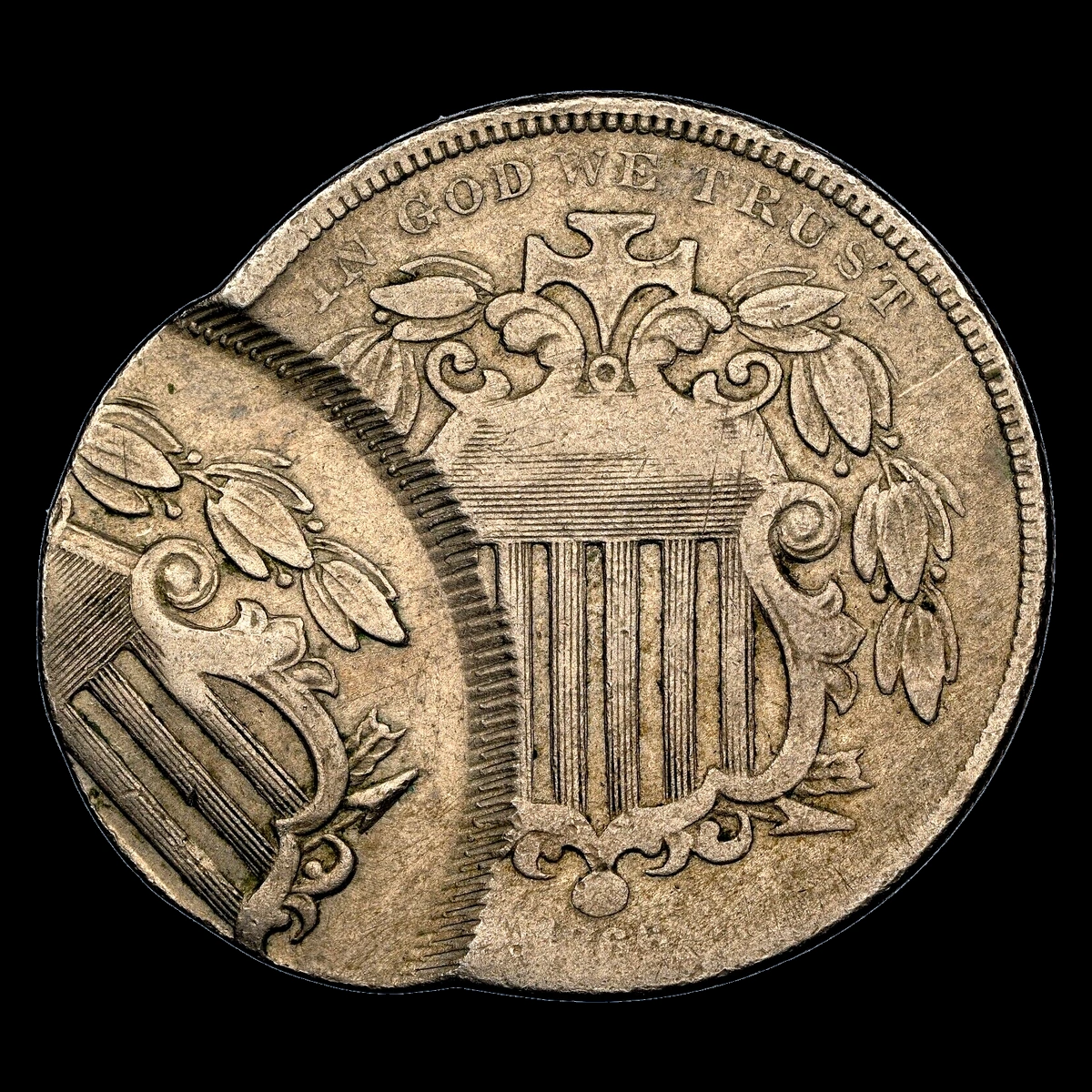
How to Identify
Locate the clearest first shield or large 5, then follow a separate group of related details. At the overlap, the later blow can flatten or cover the earlier impression.
Examine the other face for a sequence that agrees with the same movement. A few isolated bright lines or small doubled letters do not establish another whole strike.
No exact off-center percentage is supplied for the Ken Hill example. Preserve the date and whole outline in photographs instead of borrowing a number from another coin.
What It’s Worth
Authenticated double strikes of this kind are estimated at $1,000–$8,000. Readable sequence, year, and surface condition guide the comparison.
The exceptional single off-center example below sold for more than that working range. A greater number of blows does not automatically overcome a difference in preservation.
11. 1866 Nickel A Blank Crescent with the Date Intact: Off-Center Strike Error
The documented NGC MS66 nickel is 30% off center toward 11 o’clock. Its date and large reverse 5 survive even though much outer lettering misses the metal.
How to Identify
With the shield upright, compare the upper-left displacement with the untouched crescent opposite it. Both faces should fit the same misplaced blank.
Inspect the blank surface and plain edge for later filing or flattening. Off-center striking need not remove metal, even though part of the design never reaches it.
The example also has front die cracks. Those raised tool marks do not record additional off-center blows.
What It’s Worth
Dated off-center Shield nickels are estimated at $500–$12,000, from worn pieces to exceptional examples. The NGC MS66 coin sold for $11,100 in July 2022.
Its unusually strong preservation contributes to that result. A smaller shift, incomplete date, or damaged surface calls for a lower comparison.
12. 1866 Nickel Nickel Designs on a Smaller Copper-Alloy Disk: Cent-Blank Strike Error
A specialist study records a PCGS XF45 1866 Shield nickel struck on a cent blank. The smaller copper-alloy disk leaves less room for the nickel’s outside lettering.
This is a worn wrong-blank coin, not a specially made experimental pattern. Its actual weight is not supplied in the description.
How to Identify
Confirm the Shield five-cent design and large reverse 5, then compare how the lettering meets the smaller metal. The cropped design should result from striking, not cutting down a finished nickel.
A period Indian cent blank normally starts near 3.11 grams and 19.05 mm. Those are standards for comparison, and a later nickel strike may expand the outline.
Record actual measurements and inspect for grinding or coatings. Nondestructive alloy testing can help connect the smaller blank and appropriate metal without scratching away evidence.
What It’s Worth
Authenticated 1866 cent-blank nickels are estimated at $4,000–$15,000. A much better-preserved 1873 Shield nickel on a cent blank sold for $21,600 in May 2022.
That different-year, high-grade result is not a sale of the recorded XF45 1866 coin. Surviving date, original metal, and condition must remain part of the comparison.
Conclusion
The normal stars and rays provide useful reference points when examining an 1866 Shield nickel. Match extra date strokes, motto outlines, and faint transferred shapes to their own documented patterns before interpreting larger surface changes.
For major errors, retain the full date, both faces, and edge in photographs. Preserve attached metal and keep each coin’s sequence and condition together; multiple visible features still belong to one object with one overall value.