Rare 1911 Quarter Errors (List & Pictures)
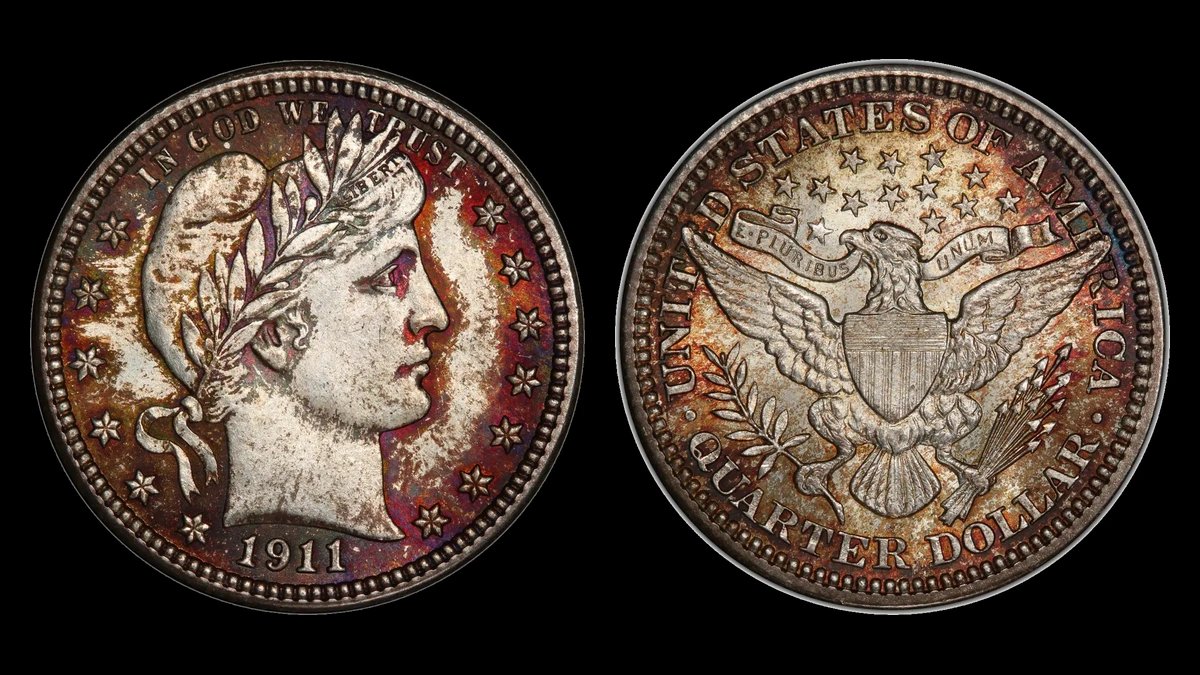
Estimated whole-coin values for 1911 quarter errors range from $50–$2,500. For context, a different doubled-die quarter, the 1945 Philadelphia FS-101 in MS65, sold for $552 in March 2018.
This guide explains Denver reverse doubling, two separate San Francisco mintmark patterns, and a reported Philadelphia off-center strike.
| Category | Mint | Estimated value |
|---|---|---|
| Doubled reverse | Denver | $50–$1,000 |
| Repunched S varieties | San Francisco | $75–$1,500 |
| Five-percent off-center strike | Reported Philadelphia | $300–$2,500 |
1. 1911 Quarter Doubled Reverse Design Error
The Barber Coin Collectors’ Society lists a Denver doubled-reverse variety for 1911. The supplied listing does not identify a particular letter or feather that can serve as a universal diagnostic.
A doubled die carries repeated design detail in the steel stamping tool. Each coin struck from that die can inherit the pattern without receiving two separate blows.
How to Identify
Confirm the D below the eagle before comparing the unusual reverse detail. A similar-looking feature on another mint’s coin does not establish this Denver variety.
Compare a full reverse view and close-ups with an identified example, looking for rounded extra outlines or split corners. A bright reflection, worn thick letter, or flat strike-related shelf is not a sufficient match.
What It’s Worth
A genuine 1911-D doubled-reverse quarter has an estimated whole-coin range of $50–$1,000. Clear detail and attractive preservation make comparisons more useful than faint worn traces.
A different 1945 Philadelphia FS-101 quarter graded PCGS MS65 brought $552 in March 2018. That Washington quarter has front doubling, so it provides context rather than a direct sale comparison for this Barber variety.
2. 1911 Quarter Repunched S Mintmark Varieties Error
The Barber Coin Collectors’ Society survey lists two patterns: an earlier S below the main letter and a larger S over remnants of a smaller one. They should be examined as separate varieties.
Mintmarks were punched into the die separately from its principal design. A repeat entry at another position or with a different-sized punch could preserve pieces of both impressions.
How to Identify
Find the S above QUARTER DOLLAR and examine its lower boundary for the southward remnant. That variety is described as having its mintmark closer to the D in DOLLAR, although position alone cannot prove repunching.
For the large-over-small pattern, trace the surviving smaller curves within and around the larger letter. A broad ordinary S or a dent beside it does not supply the required second outline.
Keep each pattern tied to its own reference photographs. Do not require one candidate to display both varieties at once.
What It’s Worth
An identified repunched-S quarter has an estimated whole-coin range of $75–$1,500. That amount includes the underlying San Francisco coin’s value as well as its condition and visible variety.
A later 1949-D/D FS-501 in PCGS MS65 sold for $384 in March 2018. It involves a different letter, year, and design, so its attribution and price should not be transferred to either 1911-S pattern.
3. 1911 Quarter Five-Percent Off-Center Strike Error
A reported Philadelphia example has a five-percent displacement and a PCGS AU53 grade. Its direction is not established in the supplied description.
AU53 describes light wear rather than the size of the shift. The striking error occurs when a blank sits off position and part of the design misses the metal.
How to Identify
Compare full views of both faces for images displaced on the same disc. Original unstruck metal should remain opposite the area where intended design runs beyond the edge.
Read the complete date and inspect the mintmark area below the eagle. An absent letter cannot establish Philadelphia if that portion of the design never reached the metal.
A centered reverse paired with an uneven front may indicate a shifted die instead. Filing can remove outer details but does not create an original blank arc.
What It’s Worth
A comparable genuine Philadelphia quarter with modest displacement has an estimated range of $300–$2,500. The report supplies no completed sale for the AU53 example.
Readable identity, original edges, wear, and scratches affect the comparison. A narrow shift should not automatically receive the price of a much more dramatic off-center coin.
Conclusion
The mint determines which comparison belongs to a 1911 Barber quarter: Denver reverse doubling, San Francisco repeated mintmarks, or the reported Philadelphia off-center example. Their visible effects arise at different stages of manufacture.
Match several details before assigning a variety, and keep both faces visible when assessing displacement. Original small strokes are valuable evidence, so preserve them rather than cleaning or trying to sharpen a worn-looking feature.