Rare 1950 Quarter Errors (List & Pictures)
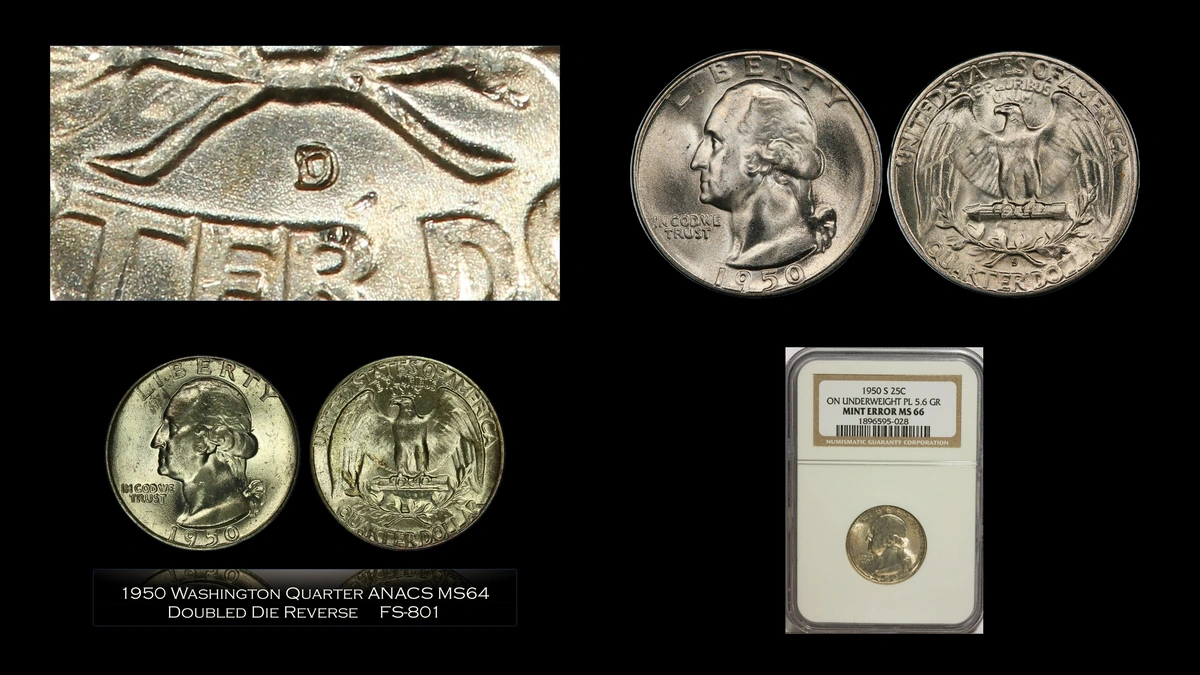
Turn a 1950 quarter over before judging its small mintmark. A D covering an earlier S helped an exceptional coin sell for $29,375 in June 2013.
The 1950 quarter errors here range from minor metal defects to valuable mintmark varieties, with estimated whole-coin values of $20–$30,000. Begin below the eagle, then examine the surface and outline.
1. 1950 Quarter One Mint Letter Covers Another: D/S and S/D Error
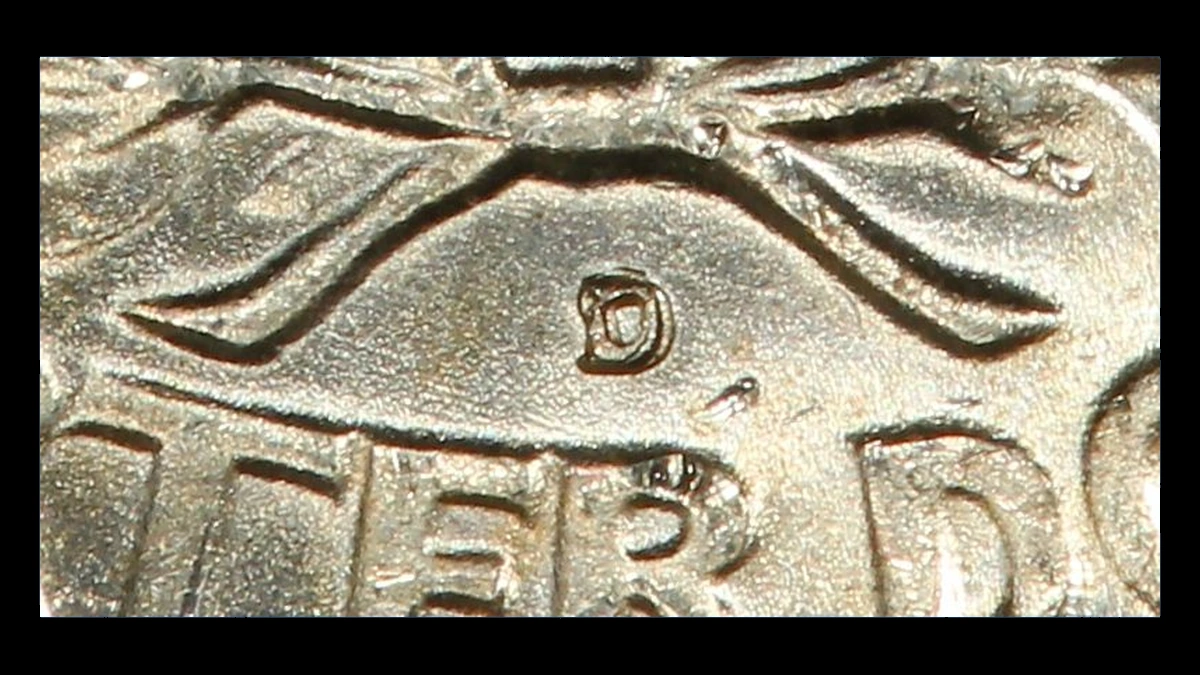
On D/S, a final D partly covers an earlier S in the stamping tool. On S/D, the final S covers an earlier D.
These are over-mintmarks: one letter replaced a different letter. The final visible letter identifies Denver or San Francisco as the issuing mint.
How to Identify
Read the stronger final letter first. For Denver D/S, look above and toward the upper left of the D for surviving S curves.
For San Francisco S/D, compare the earlier D fragments around the final S with an identified example. General thickness does not prove that two different letters are present.
Keep nearby scratches and flat shelves separate from the earlier punch. High-value candidates need a reliable match because altered mintmarks can look convincing in small photographs.
What It’s Worth
$40–$30,000 is the estimated range for D/S; S/D is estimated at $40–$18,000. Preservation accounts for much of that wide span.
A D/S graded MS67 brought $29,375 in June 2013. An S/D at the same grade sold for $16,450 in September 2013.
MS67 means exceptionally clean, unworn condition. Those results are not prices for ordinary worn examples.
2. 1950 Quarter Two Positions of the Same Letter: Repunched Mintmark Error
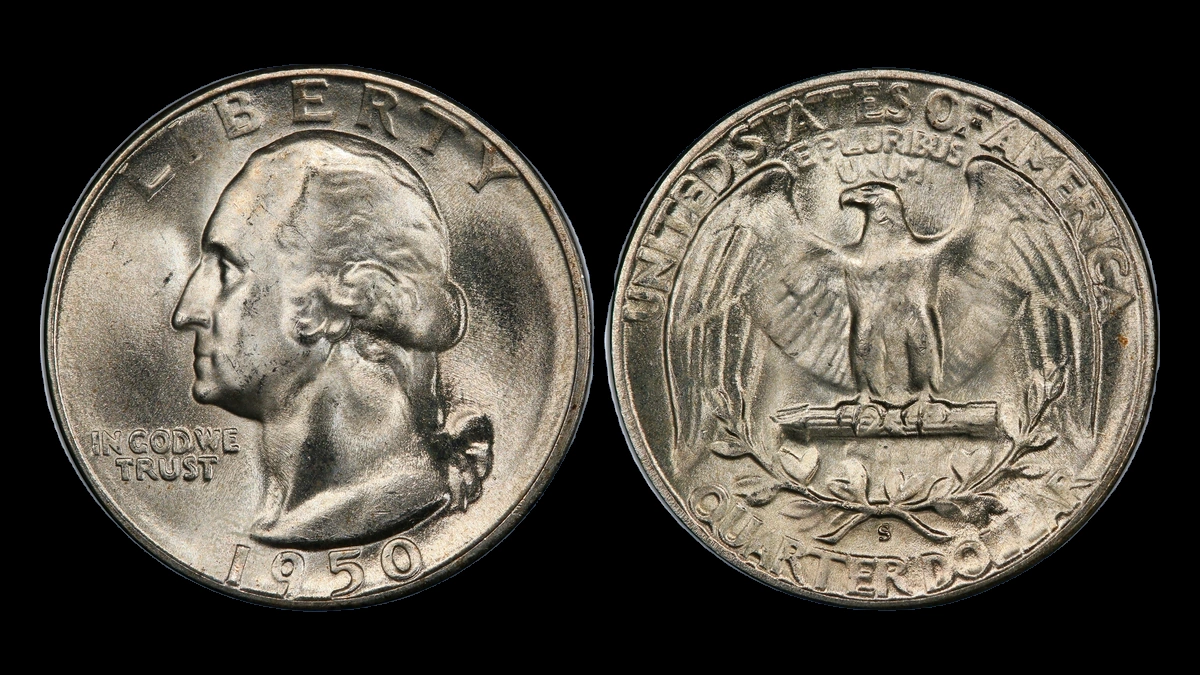
A D/D or S/S repeats the same mint letter, unlike the different-letter combinations above. Another punch in a slightly changed position left traces beside the final letter.
Both Denver and San Francisco circulation examples are reported for 1950.
How to Identify
Trace the main letter, then see whether the extra curve or stroke fits another copy of it. Use a reference from the same year and mint.
Several connected fragments give a better comparison than one bright line. Change the light angle and inspect for damage or tooling around the letter.
A D/S photograph is not a substitute for a D/D reference.
What It’s Worth
$25–$600 is the estimated range for confirmed repunched letters. A 1950-D/D graded MS64 was recorded at $264 in March 2018.
The S/S pattern needs its own comparison. Wear can hide the fragments needed to distinguish an earlier punch from a flat shelf.
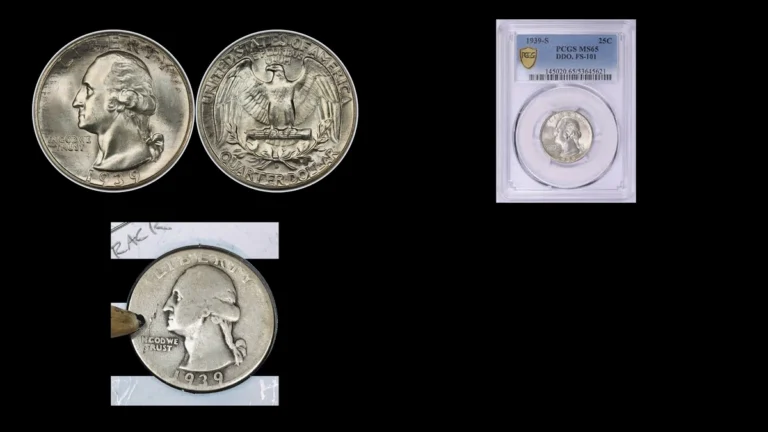
3. 1950 Quarter Extra Outlines across the Back: Doubled Die Reverse Error
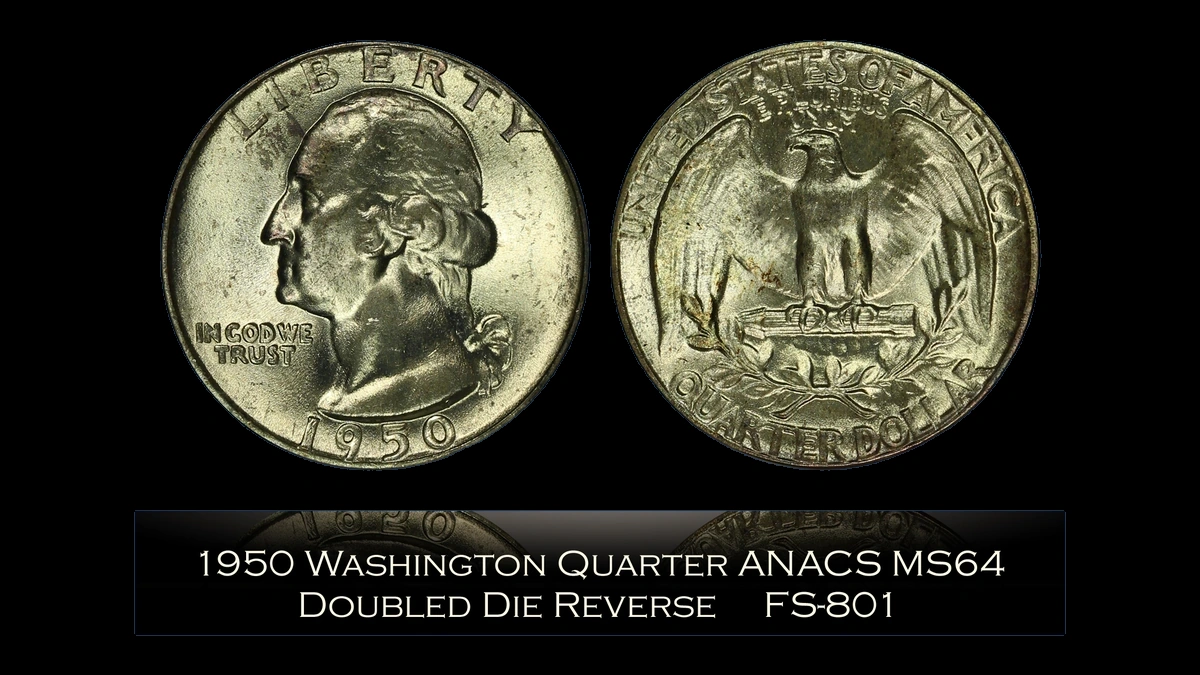
A doubled reverse die has repeated details in the back design before it strikes a coin. One blow then transfers that pattern.
Philadelphia, Denver, and San Francisco circulation examples are reported. Their mint-specific patterns should not be treated as interchangeable.
How to Identify
Choose a reference for the correct mint, then compare several letters and nearby design features. Rounded extra outlines should form a consistent pattern.
A lone thick letter or low flat shelf is weaker evidence. Keep the mintmark close-up separate, because a repunched letter does not establish doubling elsewhere on the back.
What It’s Worth
$30–$4,000 is the estimated range across the reported varieties and grades. Exceptional preservation contributes strongly to the upper end.
A Philadelphia MS67+ example sold for $3,525 in November 2016. In March 2018, a Denver MS66 brought $360 and a San Francisco MS66 brought $1,140.
These results belong to different coins and patterns, not one universal 1950 reverse variety.
4. 1950 Quarter A Flap or Shallow Opening in the Silver: Lamination Error
A weak area within the alloy can separate into a thin flap. If it comes away, a recess remains where metal is missing.
This is a lamination. A 1950 quarter is silver alloy throughout, so it does not have the modern clad coverings that can peel off later quarters.
How to Identify
Study where a flap joins the surface without lifting it. Follow the design into the break and inspect the exposed area.
Digging marks, corrosion pits, or a ridge pushed up by a gouge point to different causes. A rough patch alone does not establish original metal separation.
What It’s Worth
$20–$500 is the estimated range for a confirmed 1950 lamination. Large original separations with an intact flap may have more appeal than tiny flakes.
The estimate assumes a genuine manufacturing defect and includes the condition of the surrounding coin.
5. 1950 Quarter A Straight Gap at the Edge: Clipped Blank Error
The recorded San Francisco straight clip weighs 6.12 grams. ANACS graded it F12, meaning considerable wear with the main design still recognizable.
The gap existed before striking. That missing metal is separate from the coin’s later circulation wear.
How to Identify
Confirm the year and S, then inspect the straight boundary from the side. Look for sawing, filing, or a fresh cut through finished details.
Follow the rim into both ends of the gap. Weakness opposite the clip can help when present, but wear may hide it.
A regular silver quarter weighs 6.25 grams. The 6.12-gram measurement applies to this worn specimen, not every straight clip.
What It’s Worth
$20–$300 is the estimated range for genuine straight clips. A clear gap on an attractive coin is generally more appealing than a small defect with heavy damage.
Readable identity and an undisturbed clipped edge help support the comparison.
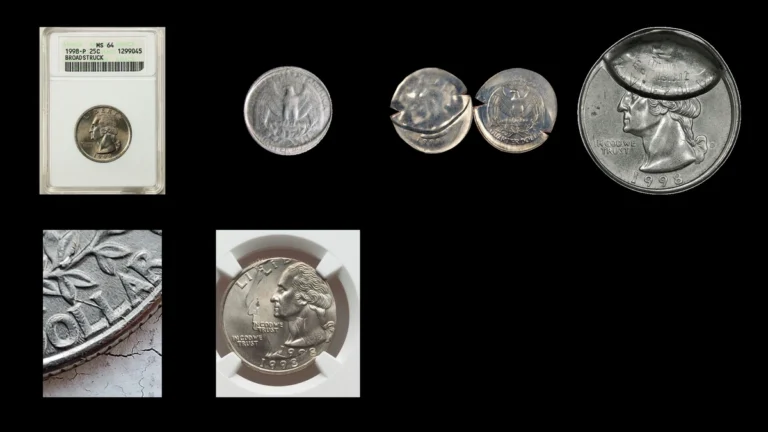
6. 1950 Quarter The Coin Spreads beyond Its Border: Broadstrike Error
A collar normally restrains the blank during striking. Without that ring’s full support, the metal can spread while retaining the complete design.
A 1950 broadstrike candidate needs that combination of extra metal and an intact picture. An unusual rim alone is not enough.
How to Identify
Trace all the outer lettering and compare the width with a normal quarter’s roughly 24.3 millimeters. Examine the expanded edge and its grooves together.
Check the portrait and eagle for unnatural crushing from later pressure. Hammering can widen a finished coin without creating a mint error.
What It’s Worth
$50–$500 is the estimated range for a confirmed 1950 broadstrike. A 1966 clad uncentered broadstrike sold for $222 in June 2024.
That is a different-year, different-metal comparison, not a recorded 1950 silver broadstrike sale.
7. 1950 Quarter A Plain Crescent beside an Incomplete Design: Off-Center Strike Error
Part of the design can miss the blank when it sits too far to one side. The opposite area remains plain metal.
Reports describe Philadelphia shifts around 10%–15% and a separate San Francisco example around 30%, reported as MS65. Those percentages do not describe every candidate.
How to Identify
Check that the blank crescent and lost design fit the same displacement on both faces. Read the date and any surviving mintmark.
If the mintmark area missed the strike, an absent letter does not prove Philadelphia origin. Also inspect the plain area for erased detail or grinding.
What It’s Worth
$50–$1,500 is the estimated range for an authenticated 1950 off-center quarter. Greater visible displacement can help when the year remains readable.
A different-year 1943-S silver quarter struck 35% off center sold for $2,640 in July 2022. It is not a sale of the reported 1950-S coin.
8. 1950 Quarter Full Quarter Identity at a Lower Weight: Underweight Blank Error
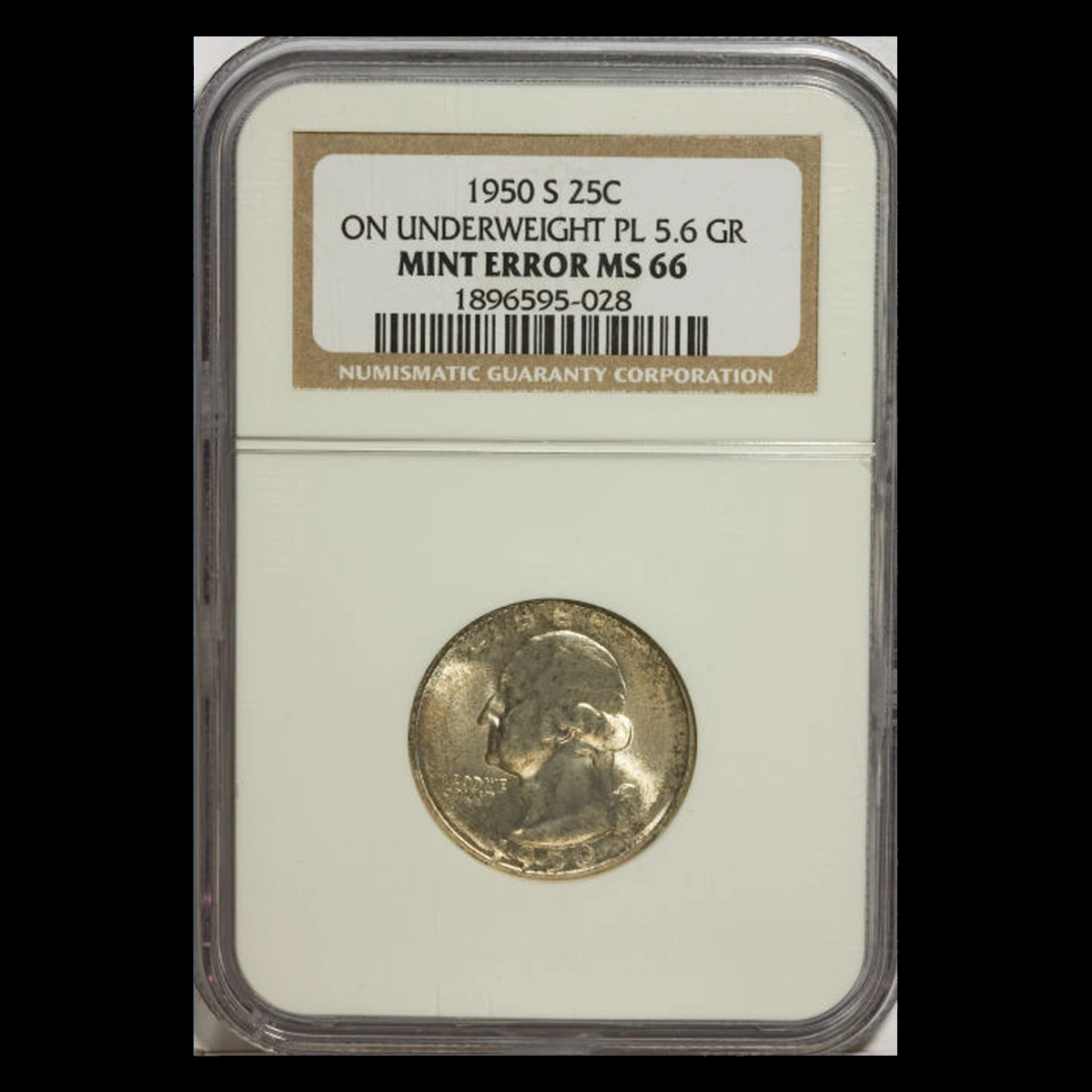
An NGC MS66 San Francisco example weighs 5.6 grams instead of the usual 6.25 grams. Its grade describes an unworn coin with very few marks.
The catalog identifies an underweight blank without naming the exact step that caused the shortage. A modern missing-clad-layer explanation does not fit this silver quarter.
How to Identify
Repeat the weight reading on a reliable scale if the coin is loose. Inspect the full edge for trimming and both faces for heavy wear or chemical metal loss.
Compare thickness and struck detail with a normal coin. A low weight identifies a question to investigate, not its cause by itself.
What It’s Worth
$75–$750 is the estimated range for comparable authenticated underweight silver quarters. Mint Error News reports $120.75 for the MS66 example in August 2009.
Keep its 5.6-gram measurement with that coin rather than assigning it to other light quarters.
9. 1950 Quarter Quarter Details on a Tiny Silver Blank: Dime-Blank Strike Error
The recorded NGC MS63 example weighs 2.5 grams. Its silver dime blank cannot hold the complete quarter design.
Both denominations used silver alloy, so color alone does not explain the error. The smaller original metal and crowded design provide the useful clues.
How to Identify
Follow the outer quarter details as they run beyond the edge. Look for a natural struck boundary rather than filing through a finished normal quarter.
A silver dime blank starts near 17.9 millimeters across, though it can spread during the strike. Compare the weight, outline, and surviving date together.
This is an unused dime blank; an earlier dime design is not required underneath.
What It’s Worth
$500–$2,500 is the estimated range for comparable authenticated 1950 dime-blank quarters. A 1954 example graded PCGS MS64 sold for $990 in September 2024.
That different-year comparison does not establish a sale for the 1950 MS63 coin. Readable date digits and an undamaged edge improve appeal.
Conclusion
A second copy of the same letter, a different letter underneath, and doubling across the reverse are three distinct checks. Start with the actual shapes before choosing a variety name.
For abnormal blanks, use the outline, edge, and weight together. The highest auction figures belong to exceptional coins; a correct identification still needs a condition comparison before applying a price.