Rare 1795 Draped Bust Dollar Errors (List & Pictures)
An exceptional silver dollar brought $763,750 in May 2016, showing how strongly preservation influences this early issue. Estimated whole-coin values for the 1795 Draped Bust dollar errors discussed here span $3,000–$800,000, including a famous copper piece of debated origin.
Compare the borders on both faces, then the edge inscription and metal. The name Off-Center Bust describes Liberty’s position in the design and does not by itself prove an off-center strike.
1. 1795 Dollar Opposite Weak Borders on the Two Faces: Misaligned Dies Error
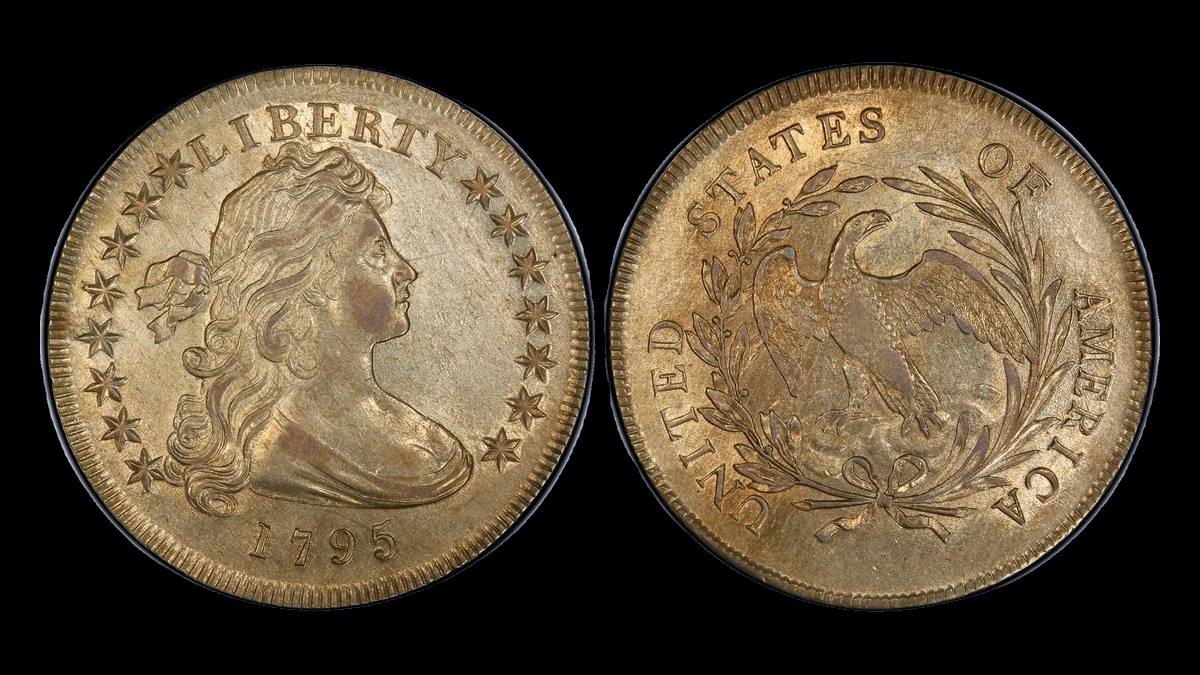
On the BB-51 die pairing, the upper front border can look weaker than the lower one. The reverse changes the pattern, with a weak lower border and unusually long beads along the top.
BB-51 identifies a particular pair of stamping tools. Their imperfect alignment explains this border relationship without requiring the blank itself to sit substantially off center.
Liberty’s leftward placement is a separate design characteristic known as the Off-Center Bust. Study the beads rather than treating that familiar variety name as an error diagnosis.
How to Identify
Place full photographs of both faces beside an attributed BB-51 example. Compare top and bottom borders on the front, then check for the opposite strength pattern on the reverse.
Use magnification to distinguish weakly formed beads from those flattened by circulation. Wear often affects other high details too, while a weak strike can leave nearby surfaces relatively sharp.
One thin border cannot demonstrate the whole pattern. Both faces need to support the same explanation.
What It’s Worth
$3,000–$200,000 is the estimated range for more usual silver examples across widely differing grades. Much of the value belongs to the early dollar’s rarity and condition.
PCGS records an AU58 at $35,650 in September 2011. An exceptional MS66 reached $763,750 in May 2016, far beyond that ordinary comparison range.
AU58 means only slight wear, while MS66 describes a much better preserved unworn coin. The difference is not a separate charge for each uneven border.
2. 1795 Dollar Another Sequence Around the Rim: Repeated Edge Lettering Error
Early dollar edge lettering was applied separately from the designs on the faces. An extra pass through the edge-lettering equipment could leave overlapping words or letter sequences.
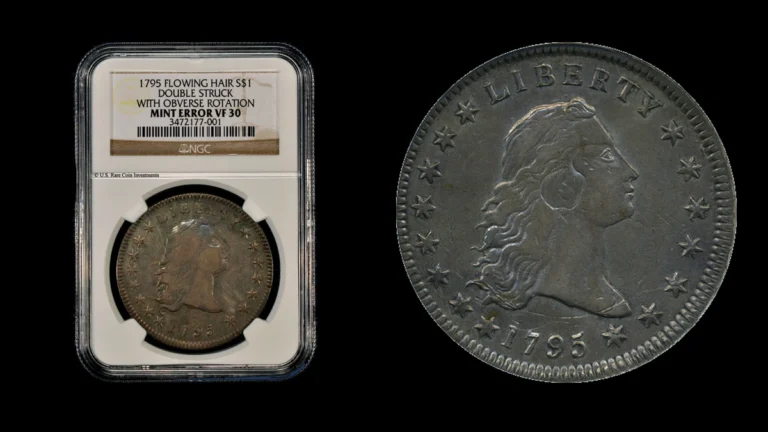
For the 1795 Draped Bust design, this remains a conditional category. Reports of doubled edge lettering on a 1795 dollar do not necessarily distinguish it from the earlier Flowing Hair design also dated 1795.
How to Identify
Confirm the portrait design before studying the edge. The date alone cannot tell the two 1795 dollar designs apart.
Photograph a loose coin’s inscription in overlapping sections and preserve their order. Follow the suspected second sequence across several letters instead of diagnosing it from one damaged character.
Isolated cuts or dents beside the text do not establish another lettering pass. Keep a certified coin sealed rather than opening its holder to expose the edge.
What It’s Worth
$5,000–$200,000 is a conditional whole-coin estimate for a genuine Draped Bust example with clearly repeated edge lettering. The evidence supplies no identified sale for that exact combination.
The underlying early dollar, its surface condition, and the clarity of the second inscription would all matter. A few battered letters should not inherit the value of a readable repeated sequence.
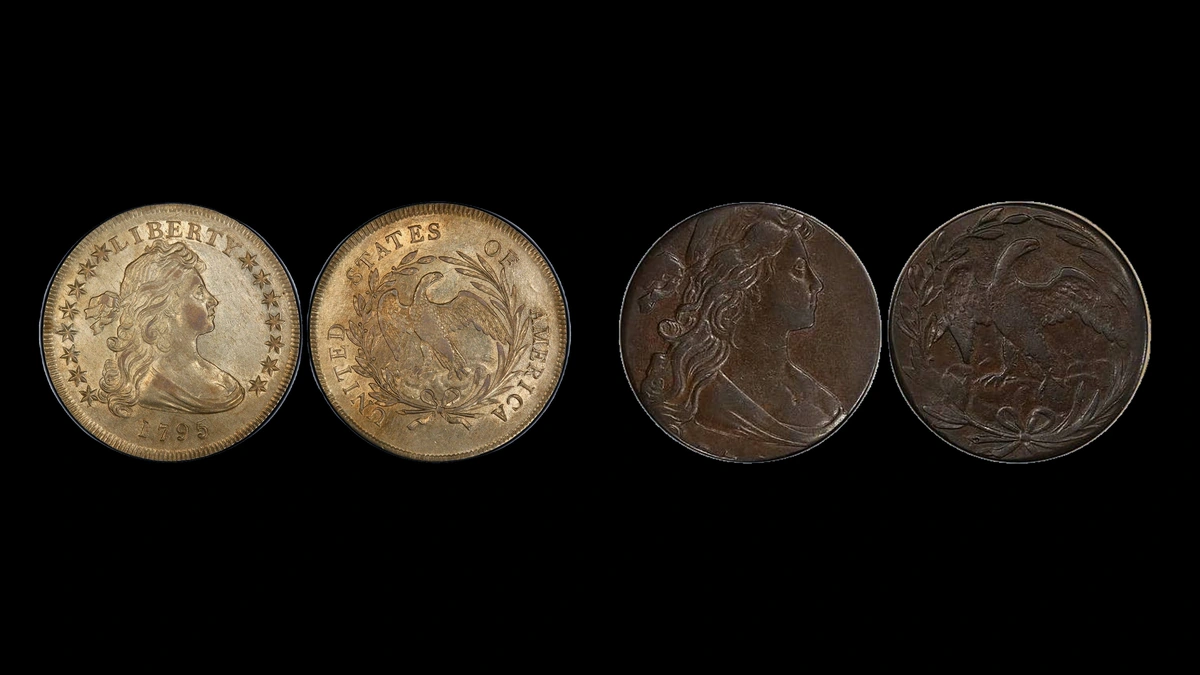
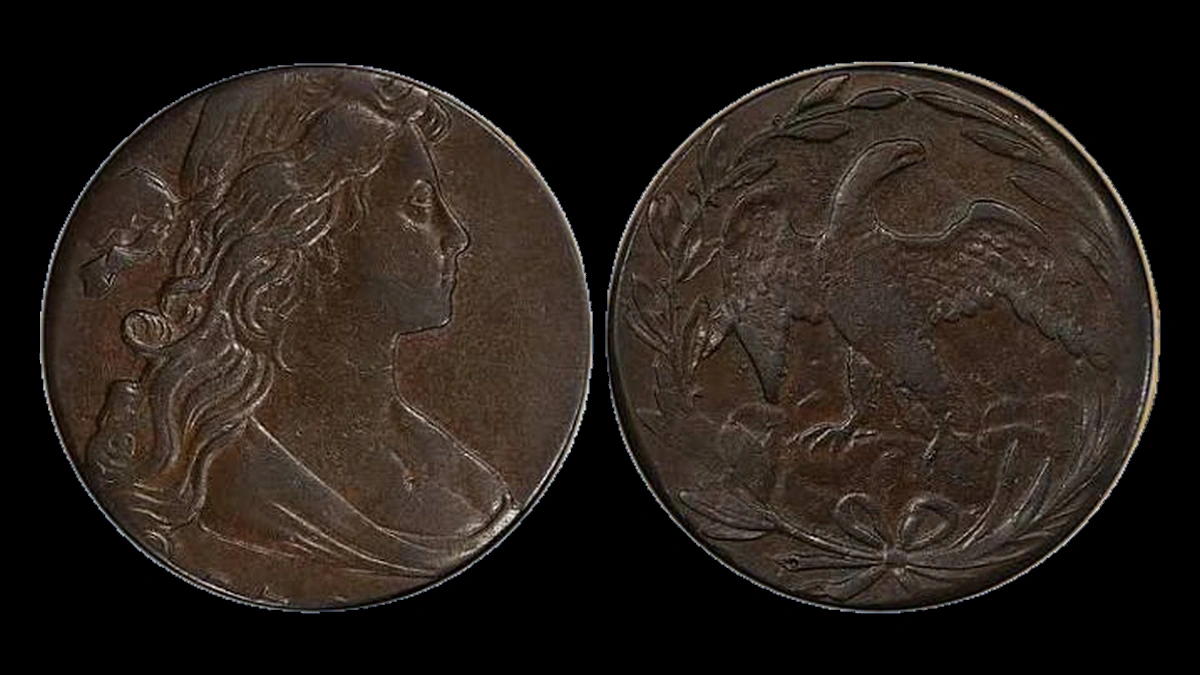
3. 1795 Dollar The Dollar Design Crowded onto Copper: The P34 Piece Error
The known P34 piece carries the dollar design on a small copper disc, with portions extending beyond its edge. Its reported weight is 96 grains, equivalent to approximately 6.22 g.
The faces also have a markedly different alignment. Whether this was a minting accident, a tool test, or a deliberately made unusual piece remains debated.
Even the actual production date is not established solely by the 1795 design. Its uncertain purpose belongs in the description rather than being replaced with a definite wrong-blank story.
How to Identify
Compare the surviving image, missing outer areas, and relationship between faces with the P34 photographs. A brown surface on a full-size silver dollar is not the same object.
Keep the weight units straight: 96 grains does not mean 96 grams. Copper composition and the much smaller amount of metal are central, but measurements alone cannot establish the known piece’s identity.
A claimed match needs comparison by an early-coin specialist with the exact surviving design. General resemblance to a small copper dollar does not establish its history.
What It’s Worth
$300,000–$800,000 is an estimate for this exceptional known piece, including its rarity and ownership history. It is not a range for ordinary dollars with copper-colored surfaces.
In January 2026, dealer Mike Byers reported a private sale in the middle six figures. No exact amount was disclosed, so the report cannot be presented as a precise auction result.
Conclusion
For a 1795 Draped Bust dollar, begin with what the evidence actually demonstrates. Opposite border weakness can indicate die alignment, while repeated edge lettering needs a coherent second sequence and confirmation of the portrait type.
The $3,000–$800,000 estimates cover very different complete coins. Exceptional preservation drives the highest silver result, and the small copper P34 piece retains its debated purpose and production history.