Rare 1879 Trade Dollar Errors (List & Pictures)
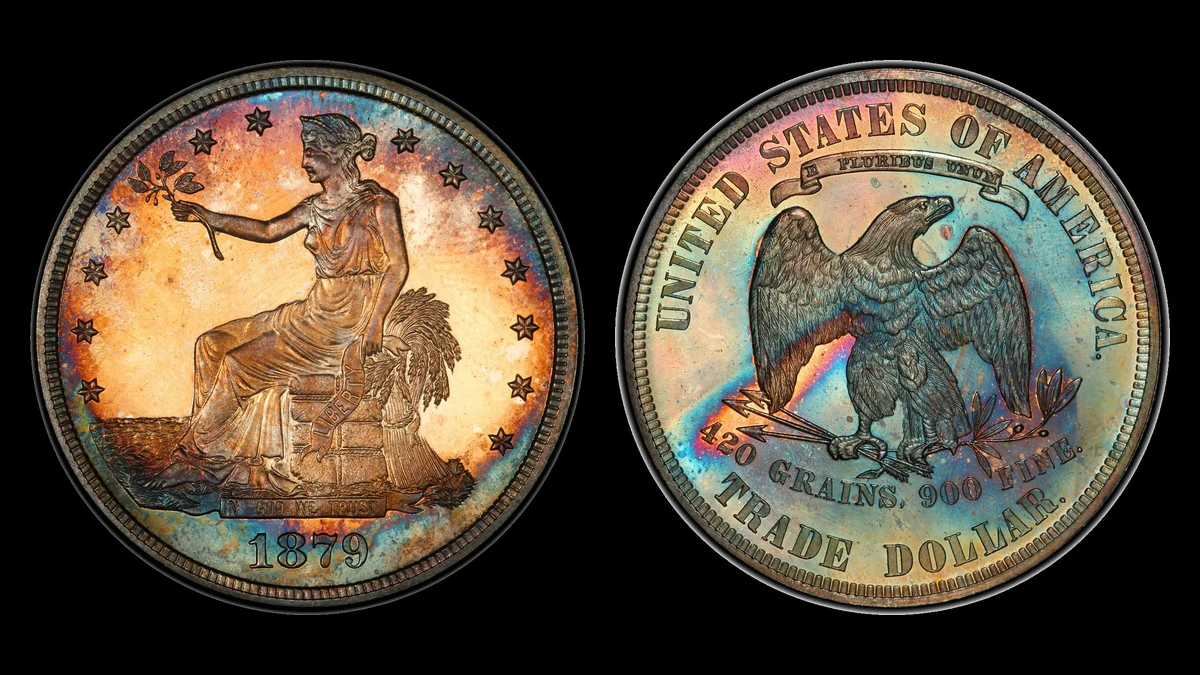
A tiny gap at the top of 8 and an extra stroke under 1 can both appear on an 1879 Trade dollar. These 1879 Trade dollar errors and die features occur on proofs, the specially prepared collector coins.
Estimated whole-coin values for the usual collector conditions discussed here span $1,000–$30,000. An exceptional PR68 brought $50,600 in October 2004 as a general preservation comparison, not an identified premium for any feature below.
1. 1879 Dollar An Imperfect Top on the 8: Defective Date Punch Error
The uppermost part of 8 can look slightly unfinished. The published explanation traces that shape to a small flaw in the punch used to place the date into the die.
More than one die could copy a defective punch, and two recorded front varieties share this feature. It is not evidence of a different year beneath the date.
How to Identify
Inspect the entire 8, keeping 1, 7, and 9 visible alongside it. Compare the imperfect top with a known 1879 example rather than isolating one shiny edge.
Look for a dent, scraping, or displaced metal extending into the field. A later hit can flatten a digit without reproducing the original punch flaw.
What It’s Worth
$1,000–$20,000 is the estimate for genuine examples from impaired to attractive proof condition. The figure prices the whole dollar rather than a separate bonus for its 8.
Cleaning and marks in the reflective fields may influence value more than this small detail. A sharper-looking defect is not necessarily rarer, since more than one front die carried it.
2. 1879 Dollar A Repeated Foot beneath 1: Repunched Date Error
The left end of the little foot beneath 1 can show an earlier punch outline. That foot is called a serif, and the extra stroke came from another placement of the date punch.
On this recorded front die, the left edge of 7 aligns with the right side of E in WE. The imperfect top of 8 can occur on the same coin.
How to Identify
Frame 1 and 7 together with WE above them, then compare the 7-to-E relationship. Move to the lower-left end of 1 and follow the surviving extra stroke.
The flawed 8 alone cannot distinguish the two recorded fronts. Use the repeated serif and alignment together rather than counting every bright date edge as another punch trace.
What It’s Worth
$1,500–$30,000 is the estimate for matched examples across impaired and well-preserved proof condition. The small repeated stroke does not replace an assessment of the overall surfaces.
PCGS records $50,600 for an exceptional PR68 in October 2004, without assigning that result to this repunched-1 variety. The imperfect 8 and repeated 1 on one dollar should not receive two whole-coin prices.
3. 1879 Dollar Gaps among Arrow or Eagle Feathers: Incomplete Die Detail Error
One reverse pattern has small arrow-feather fragments separated by reflective spaces between the claw and branch. A different pattern has incomplete feathers on the eagle’s legs and lower belly.
The arrow pattern was described on an 1879 coin in the June 1992 Katen sale, and the same die also served in 1883. The supplied descriptions do not settle the exact cause of the incomplete detail.
How to Identify
Decide which feather group you are examining before choosing a reference. Arrow gaps and missing leg or belly detail should not be assembled into one invented pattern.
Inspect the reflective spaces for later scratches or polishing, then retain a full front view to confirm 1879. A close-up of the reused reverse die cannot establish the year by itself.
What It’s Worth
$1,000–$20,000 is the estimate for identified 1879 proofs with these patterns in collector conditions. Surface preservation explains much of that range.
The 1992 catalog appearance provides no realized price for the arrow-feather example. It should not be turned into a sale at either end of the estimate.
Conclusion
The incomplete 8 can identify a punch feature, while the repeated 1 and 7-to-E alignment help distinguish a front die. Feather gaps need their own reverse comparison and a dated front view.
Judge the proof’s complete surfaces while examining these small details. The exceptional $50,600 record illustrates the influence of preservation, not a fixed added value for a date stroke or missing feather.