Rare 1880 Trade Dollar Errors (List & Pictures)
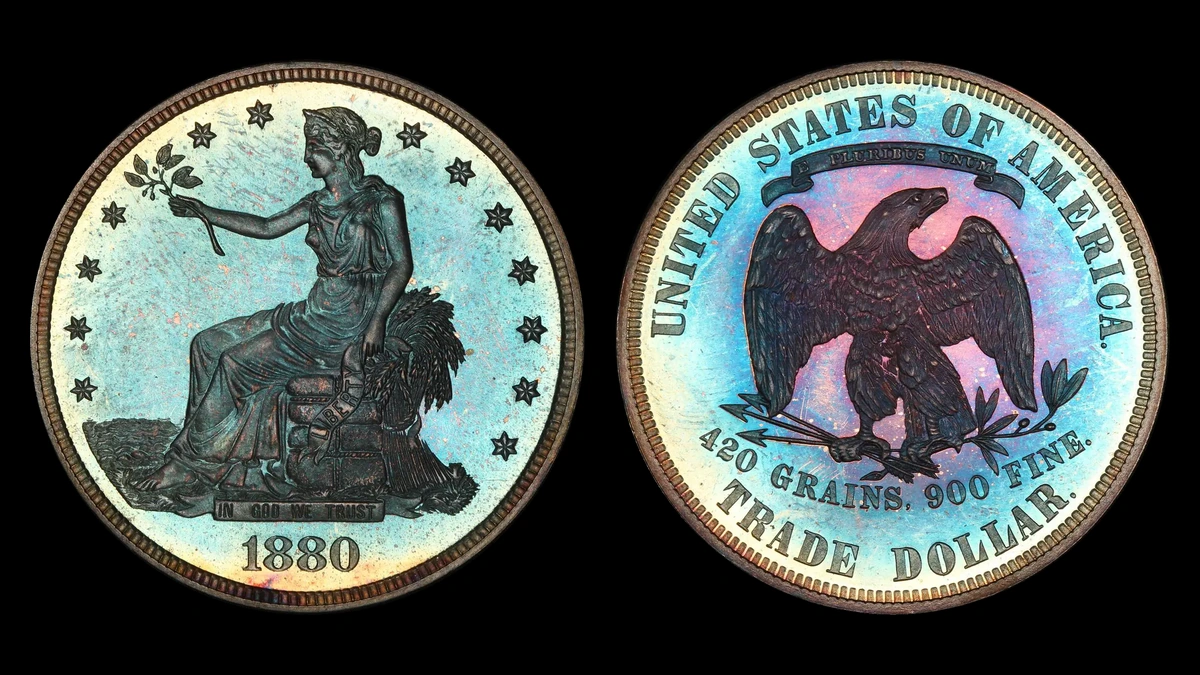
An exceptional 1880 Trade dollar Proof graded PR67 sold for $32,200 in March 2003. This 1880 Trade dollar errors guide examines paired reverse die details within an estimated whole-coin range of $1,500–$35,000.
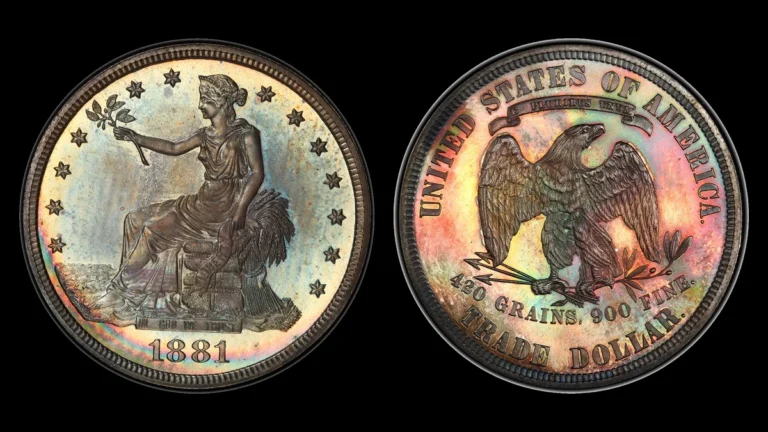
Compare the two Ls in DOLLAR, then inspect the shortened crossbar of 4 in 420 before treating either shape as damage.
1880 Dollar A shortened 4 and rounded second L: paired reverse die details Error
The two Ls in DOLLAR offer a convenient comparison on the coin itself. The upper edge of the lower right foot is flat on the first L but rounded on the second.
Above the word, the horizontal stroke of 4 in 420 stops short on its right side. Only a tiny dot-like remnant remains beyond the shortened stroke.
This combination identifies a commonly encountered reverse die used for 1880 Proofs. A die is the steel tool that transfers the design to the coin.
Another reverse die has a complete crossbar on 4. The difference therefore concerns the tool’s design details, rather than a piece broken from every affected finished coin.
Proofs were the only format produced for the 1880 Trade dollar. They were specially made for collectors, but that fact does not make every small design variation a major Mint error.
Minor date-position differences and the reflective finish are separate observations. Neither should be added as another error to the paired 4-and-L pattern.
How to Identify
Use a magnifier to compare the lower feet of both Ls side by side. Focus specifically on the upper edge of each rightward foot rather than the entire letter.
The first L provides the flat-edged reference. The second should show the rounded contour described for this reverse tool.
Next move to 4 in 420 and examine its horizontal stroke. Look for the shortened right side and the small remaining dot as a pair.
Change the lighting before deciding that a thin stroke is absent. A bright reflection on a Proof can conceal detail in one photograph and reveal it in another.
Inspect the silver around both features for scraping or disturbed metal. An isolated damaged digit is a different observation from matching paired shapes on an otherwise intact reverse.
Include the surrounding denomination and number in a close photograph. Wider context makes it easier to compare the two features without losing their positions.
What It’s Worth
Complete 1880 Trade dollar Proofs across impaired or worn through exceptionally preserved conditions have an estimated range of $1,500–$35,000.
PCGS records a PR67 at $32,200 on March 20, 2003. That is a general Proof transaction, not a separately priced sale of the incomplete-4 variety.
Original mirrored fields, scratches, and overall preservation matter much more than the small letter contours. The commonly encountered pattern does not justify automatically adding a large error premium.
An impaired Proof can retain clear lettering while falling far below an exceptional specimen in value. Compare the complete surfaces as well as the two identifying details.
Conclusion
The reverse pattern joins two observations: a rounded upper edge on the second L’s lower foot and a shortened right crossbar on 4. Compare both before choosing a die attribution or diagnosing damage.
The $32,200 record concerns a highly preserved Proof dollar. These common paired details help describe a coin, but its finish and condition remain the principal considerations in a whole-coin valuation.