Rare 1883 Trade Dollar Errors (List & Pictures)
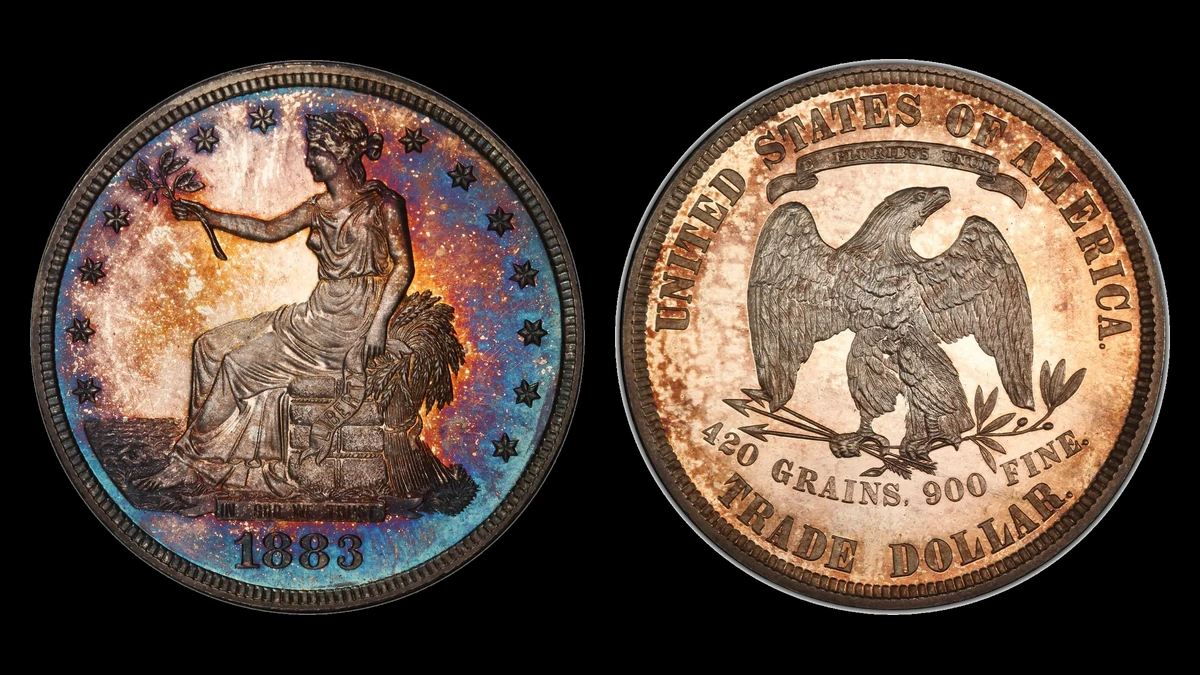
An exceptional 1883 Trade dollar Proof graded PR69 brought $164,500 in October 2020. Working whole-coin estimates for the 1883 Trade dollar errors and die features below are $1,500–$25,000 in more usual collector conditions.
Compare soft portrait detail, interrupted arrow feathers, and repeated letter bases separately, confirming the front date for each reverse pattern.
| Inspection area | Feature | Working range |
|---|---|---|
| Liberty’s head and stars | Weak original detail | $1,500–$20,000 |
| Arrows between claw and branch | Incomplete feather pattern | $1,500–$20,000 |
| Letter bases, especially FINE | Doubled reverse | $1,500–$25,000 |
1. 1883 Dollar The head or stars look flat: weak striking Error
All 1883 Trade dollars were Proofs, specially made for collectors. Even so, some have incompletely formed detail on Liberty’s head and the stars.
A reflective background does not guarantee a fully sharp design. Original strike weakness also differs from wear or later polishing that flattens high areas.
How to Identify
Compare the head with nearby stars and note which details are soft. Inspect whether surrounding lower areas retain sharper relief.
Move a light across the flat spots to study their surface texture. Wear can disturb exposed surfaces, while incomplete striking may leave original texture in a shallow area.
Check more than one photograph because glare can hide a star’s center. Use an identified 1883 Proof rather than another year’s normal strike as the main comparison.
What It’s Worth
Genuine Proofs with original weak detail have an estimated whole-coin range of $1,500–$20,000 across impaired through attractive collector examples.
The exceptional $164,500 PR69 result is general quality context, not a sale assigned to this weakness. A sharper coin in comparable condition may be more desirable.
2. 1883 Dollar Reflective gaps separate arrow-feather fragments: incomplete die detail Error
A described Proof has broken-looking arrow-feather details between the eagle’s claw and the branch. Small surviving fragments are separated by reflective surface.
The pattern was recorded on a coin offered in the Katen sale in June 1992. The description does not settle precisely how the incomplete detail developed.
The same reverse tool was also used in another year. Its appearance cannot establish 1883 without the front date.
How to Identify
Frame the claw, arrows, and branch together before examining a gap closely. Trace the surviving fragments and compare their shapes with the described pattern.
Look for scratches or disturbed silver crossing the missing sections. Damage to a finished coin should not be mistaken for the recorded die appearance.
Confirm the full 1883 date on the front. A related 1879 reverse photograph may show comparable detail but remains a photograph of an 1879 coin.
What It’s Worth
Identified 1883 Proofs with this feather pattern are estimated at $1,500–$20,000 in ordinary collector grades.
The 1992 sale appearance supplies no realized amount in the provided account. Surface quality and preservation determine much of the whole-coin comparison.
3. 1883 Dollar Lower letter edges repeat: doubled reverse Error
The reported doubled reverse is particularly clear at F, I, and E in FINE. Small extra outlines follow letter bases rather than forming an entirely separate inscription.
The repeated image existed in the die before the coin was struck. It differs from the whole coin receiving a shifted second blow or a flat shelf forming during striking.
This reverse die was shared with 1882. The front date remains essential even after the lettering pattern matches.
How to Identify
Photograph the same lettering under two light directions without moving the coin. A physical extra contour should remain at the same place as reflections change.
Begin with F, I, and E in FINE, then compare the surrounding 420 GRAINS, 900 FINE wording. Seek consistent repeated bases rather than every bright edge.
Keep an 1882 reference labeled with its actual year. Shared die detail can support a comparison without proving that the illustrated coin is dated 1883.
What It’s Worth
Matching 1883 examples have an estimated whole-coin range of $1,500–$25,000 across impaired through well-preserved Proofs.
PCGS records $164,500 for a PR69 at Legend in October 2020. That exceptional result does not identify this doubled-letter variety or establish its premium.
Clear repeated details can attract specialists, but they do not remove scratches or other condition problems from the valuation. The full Proof must remain the comparison.
Conclusion
Soft stars, gaps in arrow feathers, and doubled letter bases are different observations. Compare each at its actual location and assess whether original surface survives around the feature.
Because some reverse tools were shared across years, confirm 1883 on the front before assigning identity. The PR69 auction record reflects exceptional whole-coin preservation and stands apart from the usual collector-condition ranges used for these features.