Rare 1895 Dollar Errors (List & Pictures)
Scarcity does much of the work behind the prices of 1895 Morgan dollar errors. A peeling patch or repeated mintmark belongs to a coin whose date, mint, and condition may already carry substantial value.
The estimated whole-coin ranges here span $300–$20,000. An 1895-S VAM-4 with reflective surfaces, graded MS65PL, sold for $14,400 in January 2018.
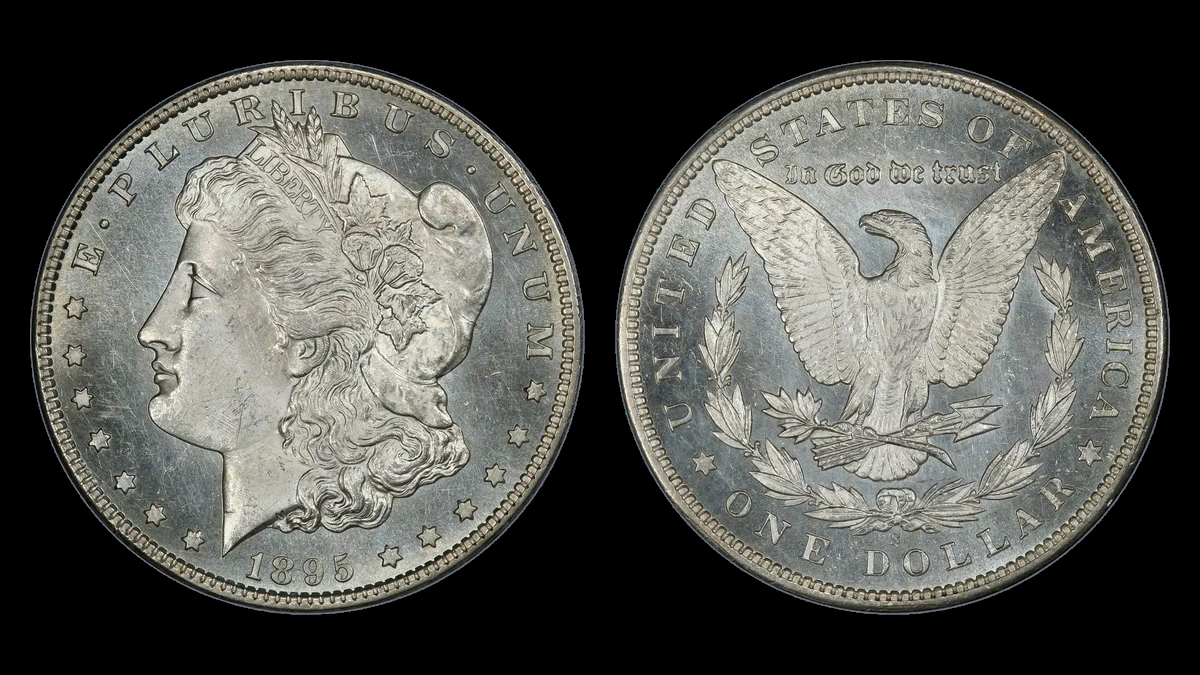
Turn to the reverse to compare the mintmark, raised break, and separating silver.
1. 1895 Dollar Extra Curves around the S: Repunched Mintmarks Error
The S beneath the wreath’s bow can retain part of an earlier letter. Workers punched the mintmark into the steel die by hand, and a later impression did not always cover the first.
Two reported patterns are grouped here: VAM-3 has an S/S with a curved dash, while VAM-4 preserves a sideways S beneath the final upright letter. The numbers identify different die varieties.
The repeated marks began on the tool. They do not mean the coin itself received two separate strikes.
How to Identify
Photograph the whole S and the surrounding surface below the bow. Under magnification, follow how the extra curves join or pass beneath the main letter.
For VAM-4, the remaining shapes must fit a sideways S. An irregular bump beside an upright S cannot establish that pattern.
Use a separate comparison for VAM-3’s repeated-S and curved-dash details. Do not assemble marks from both photographs into one supposed variety.
Flat shelves caused during striking and rough edges from damage need different explanations. A recognizable earlier letter is the useful evidence.
What It’s Worth
$400–$20,000 is the estimated whole-coin range for recognized repunched-S varieties, from worn to high unworn grades. Much of the upper value comes from scarce-date preservation.
PCGS records $14,400 for a VAM-4 MS65PL in January 2018. PL means reflective, prooflike surfaces on an ordinary production coin, not a specially made Proof.
That result belongs to VAM-4 in that condition. It is not the routine price of every dollar with extra metal around S.
2. 1895 Dollar A Raised Line through the Reverse D: Die Break Error
The reported 1895-S VAM-1A has a raised break line through a D on the reverse. The collector involved in its discovery described that feature on a San Francisco dollar.
When a die cracks, silver can fill the split and form a ridge during striking. The finished coin’s metal does not need to be cracked through.
How to Identify
Compare the reverse with a confirmed VAM-1A photograph and locate the affected D. Follow the line through and beyond the letter without inventing a route from its name alone.
Move a light from side to side to judge its height. A raised ridge differs from a cut, a scratch with pushed edges, or an actual opening in the coin.
Confirm the full 1895 date and the S beneath the wreath’s bow. The correct path, date, and mint need to appear on the same specimen.
What It’s Worth
$400–$10,000 is the estimate for an authenticated VAM-1A from worn through lightly worn condition. This includes the underlying value of the scarce 1895-S dollar.
A recognizable die break can interest variety collectors without creating a fixed extra charge. Attractive surfaces and remaining detail may matter more than how heavy the line looks in a close-up.
Exceptional unworn prices should not be applied to a heavily circulated coin merely because both show the break.
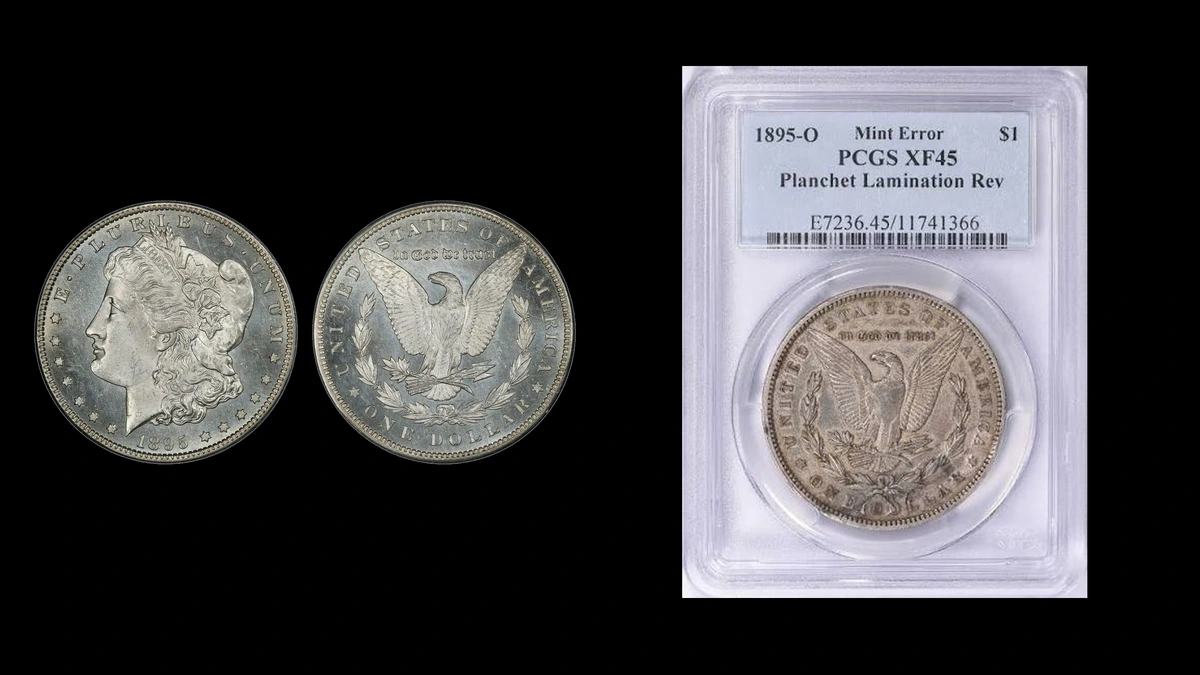
3. 1895 Dollar Peeling Silver on the Back: Lamination Error
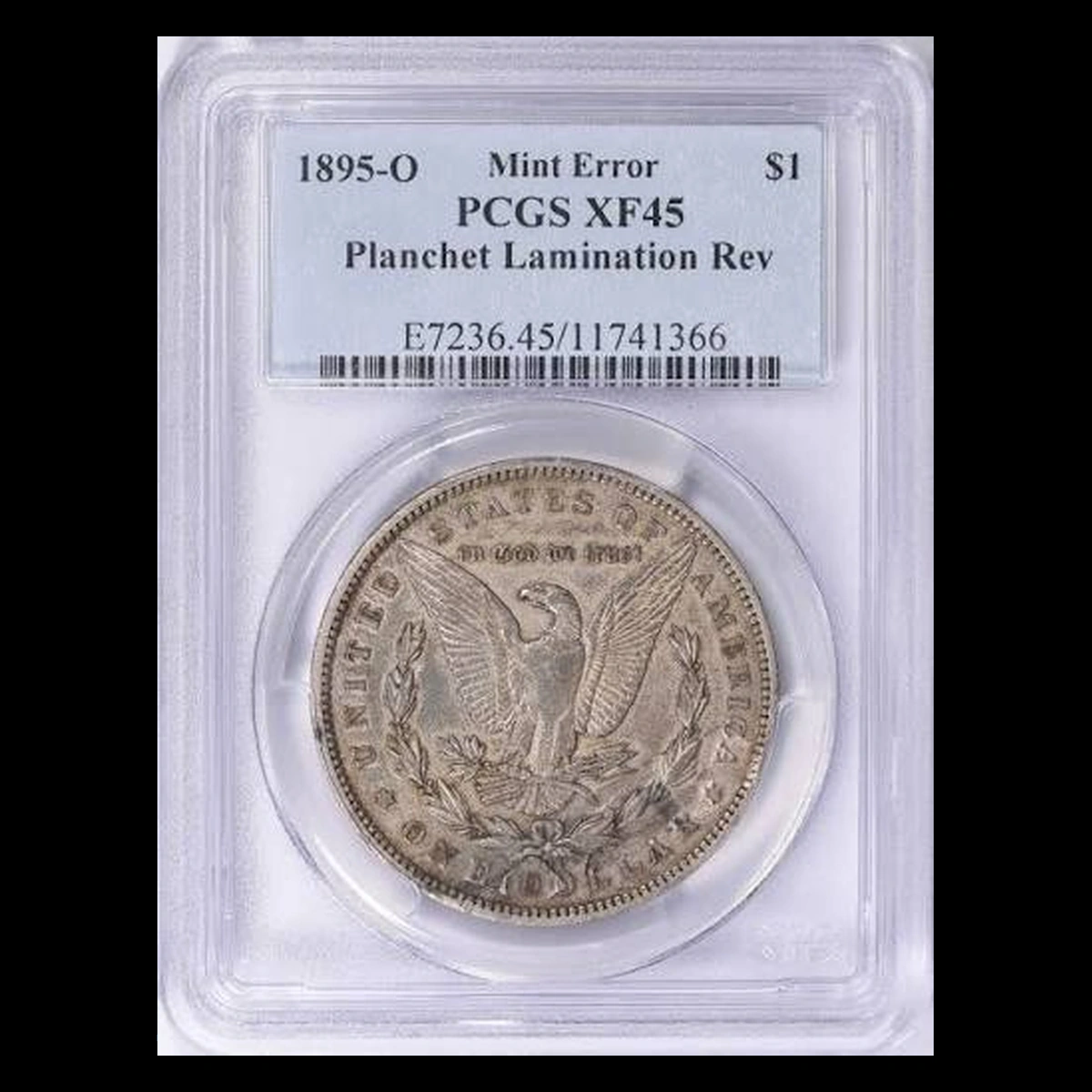
The reported 1895-O lamination affects the reverse, but its exact position is not established. It may appear as a thin lifted piece or a shallow patch where metal separated.
Morgan dollars contain a mixture of 90% silver and 10% copper. They do not have the bonded outer covering found on modern clad coins.
A weak area within that alloy can let a thin section peel. The term lamination describes this local separation rather than the loss of a modern coating.
How to Identify
Look along the boundary of the lifted or missing area under low light. An original layer should join the coin naturally rather than end in a freshly dug channel.
Keep any attached flap in place because it may preserve both design and the separation boundary. Bending it back removes useful evidence.
Check for nearby scraping, pushed metal, or corrosion that could explain a hollow after minting. Do not assign a spot around the eagle or wreath until the actual image establishes it.
A normal Morgan dollar weighs about 26.73 grams, but wear also reduces weight. The layered break is more informative than a small weight difference alone.
What It’s Worth
$300–$8,000 is the estimated whole-coin range for an authenticated 1895-O lamination from worn to lightly worn condition. The New Orleans date’s scarcity contributes heavily to that value.
An ordinary 1895-O graded AU58 brought $8,400 in August 2025. It was not a lamination sale and does not establish an error premium.
Genuine peeling can add collecting interest, while cleaning or later gouging may reduce the coin’s underlying value.
Conclusion
All three searches begin on the reverse, but they ask different questions: is there an earlier S, a ridge copied from a broken die, or metal separating within the coin? Keep those causes separate.
Price the complete 1895-O or 1895-S dollar first in the context of its condition and variety. A famous high-grade sale does not make every smaller or damaged example equally valuable.