Rare 1813 Half Dollar Errors (List & Pictures)
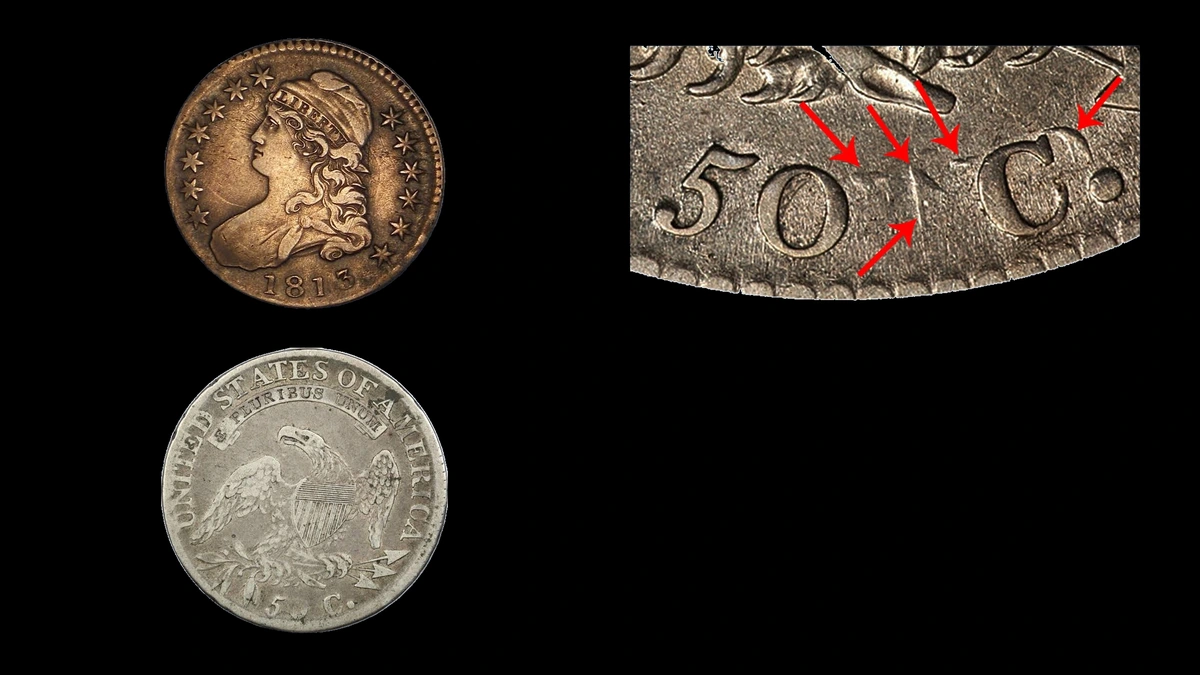
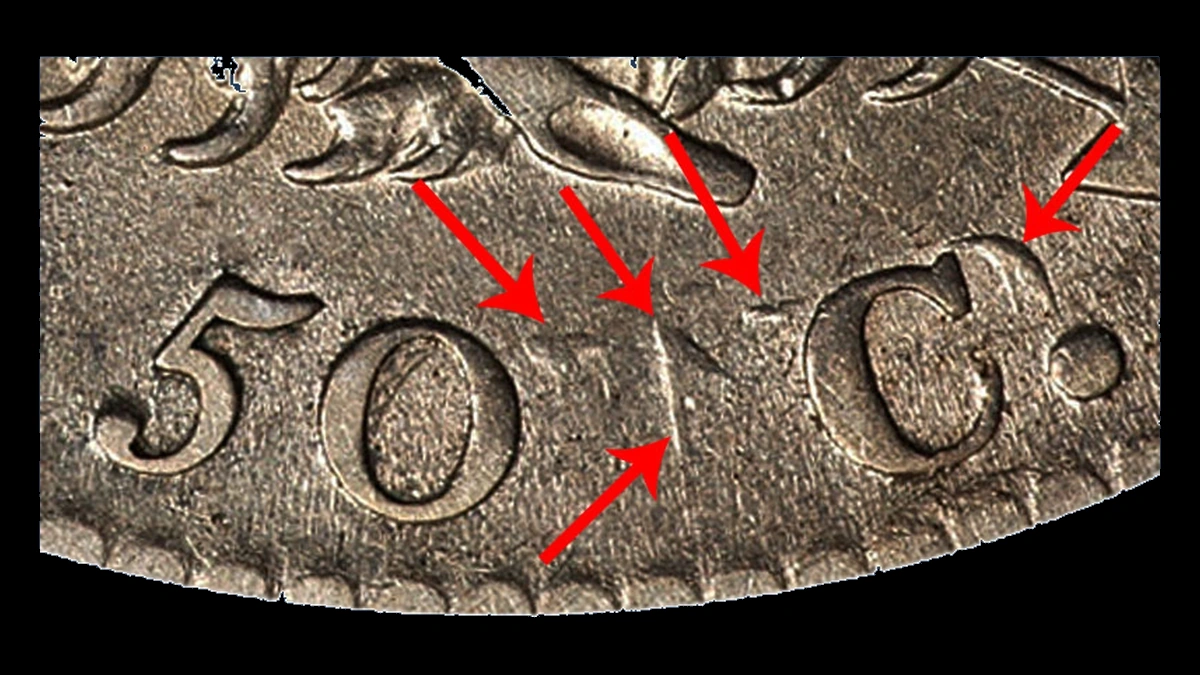
On an 1813 half dollar, surviving UNI letters beneath 50C reveal a correction in the die. One such coin sold for $1,967.62 in July 2025; the larger $3,300 striking-error comparison below concerns an 1809.
Estimated values for these 1813 half dollar errors run from $200–$3,500. Inspect the edge and outline, compare front traces, then examine the reverse letters, leaf cluster, and raised line.
| Clue | Inspection area | Feature | Estimated value |
|---|---|---|---|
| Irregular edge metal | Edge and adjoining faces | Planchet flaw | $200–$600 |
| Displaced design with plain margin | Whole outline | Ten-percent off-center strike | $800–$3,500 |
| Possible same-face remnants | Front or back design | Reported double strike | $900–$3,000 |
| Shield-like straight lines | Around and below Liberty’s ear | Die clash | $300–$1,800 |
| UNI fragments under 50C | Reverse denomination | Corrected denomination | $400–$2,500 |
| One leaf where two normally appear | Beside eagle’s leg | Single Leaf | $500–$2,000 |
| Raised horizontal line | Above upper scroll end | Reverse die crack | $250–$1,600 |
A normal unworn coin has a lettered edge, weighs about 13.48 grams, and measures roughly 32.5 mm. Wear and defects can affect those measurements, so use them alongside the design and surface examination.
1. 1813 Half Dollar A Flaw Interrupting the Edge: Planchet Defect Error
A collector reports an edge flaw on an 1813 O-102. The description attributes it to the original blank, or planchet, without identifying a clip or a peeling layer.
Missing metal, a split, and a thin detached sheet describe different defects. The outline alone does not choose between them.
How to Identify
Turn the coin to inspect the flaw from both faces and the side. Follow its boundary into nearby edge letters and struck detail.
Check for saw marks, compressed metal, or solder suggesting later alteration. A curved clip should only be named when its own evidence is present.
Keep dated front, reverse, and edge photographs together. The most useful clue is how the flaw meets the original struck surfaces rather than how conspicuous the gap appears.
What It’s Worth
Estimated range: $200–$600 for circulated examples with a modest identified edge defect and moderate to light wear. The reported O-102 has no supplied sale price.
An 1832 ANACS XF45 minor rim defect sold for $263.25 including fees in July 2025. It is a related manufacturing-defect comparison from another year, not a diagnosis or price for every 1813 rim notch.
2. 1813 Half Dollar The Design Shifted Within the Outline: Ten-Percent Off-Center Strike Error
GreatCollections listed an 1813 graded PCGS VF30 as ten percent off center. A misplaced blank leaves untouched metal opposite the area where intended design misses the silver.
The title supplies no clock direction. Use the actual coin’s photographs rather than adding an unsupported direction or larger percentage.
How to Identify
Compare uncropped views of both faces. Locate the unstamped margin and check whether missing design fits the same displacement on the other face.
One uneven rim paired with a centered opposite design can indicate a misaligned die. Filing can also imitate a plain patch by removing existing detail.
Examine the boundary and surviving edge letters, keeping the readable date in view. Match the two-sided displacement with the documented VF30 reference.
What It’s Worth
Estimated range: $800–$3,500 for circulated examples comparable to the documented ten-percent coin. The supplied 1813 listing establishes a specimen but gives no usable sale amount.
An 1809 struck fifteen percent off center brought $3,300 including fees in Downey’s Sale 57. Its Good Details grade and scratches mean a larger shift came with heavier wear and damage, so the comparison is not a percentage-based price formula.
3. 1813 Half Dollar A Second Impression May Survive: Reported Double Strike Error
A seller used both double-struck and clash wording for an 1813 O-110. The listing does not give a clear displaced date, rim, or portrait route proving a second blow to the coin.
A genuine double strike can leave several parts of the first image after the coin moves between blows. A clash instead transfers design between tools that contact each other without a blank.
How to Identify
Find more than one shifted feature on the same face. A date remnant, border arc, or portrait fragment should fit the same movement as the other surviving details.
Separate those from opposite-design fragments, such as shield lines in the portrait. Such traces can establish clashing without establishing two strikes on that individual coin.
O-110 identifies a variety, not an error by itself. Compare both complete faces before accepting the seller’s interpretation.
What It’s Worth
Estimated range: $900–$3,000 for a circulated 1813 with authenticated second-strike remnants. The seller’s unproven O-110 claim does not supply a transaction at that value.
An 1812 PCGS VF30 front double strike sold for $1,200 in 2018, and an 1819/8 PCGS XF45 double strike brought $2,280 in July 2025. The second comparison also carries an overdate, so both its date variety and strike matter.
4. 1813 Half Dollar Straight Shield Traces Beside the Ear: Clashed Dies Error
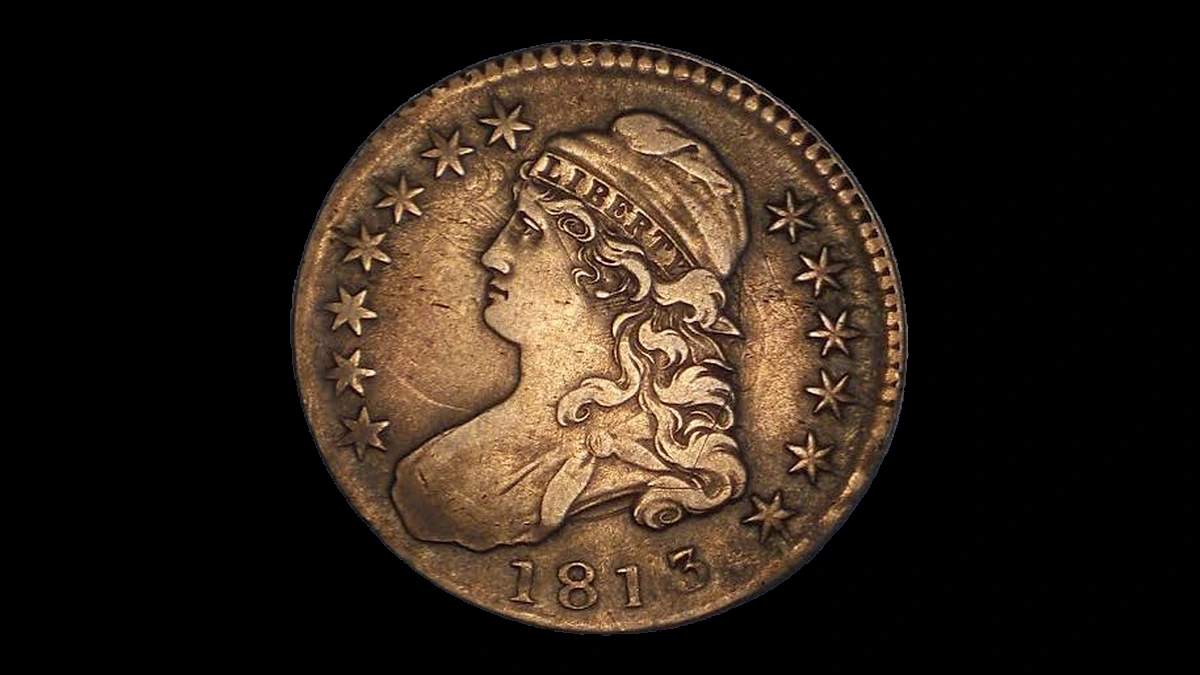
A collector’s illustrated O-102 has straight lines around and below Liberty’s ear that fit the reverse shield. They differ from the normal curves of her hair.
The dies had met without a blank between them, allowing shield detail to mark the front tool. Later strikes copied those unwanted traces beside the portrait.
How to Identify
Place the shield image beside the ear close-up and compare the spacing and direction of the extra lines. Keep a full portrait view to establish exactly where they occur.
Normal hair and unrelated scratches should not be grouped into an imagined shield pattern. The transferred design must explain the arrangement of the marks.
Downey also described extensive clashing on a separate O-105a. The O-102 ear location should not automatically be assigned to that other example.
What It’s Worth
Estimated range: $300–$1,800 from moderately worn to lightly worn examples with readable clashes. A Downey AU53 with extensive clashing brought $1,430 including fees in Sale 45.
An O-105a PCGS AU55 sold for $1,560 at Heritage in January 2025. These are complete-coin comparisons and do not assign a separate value to one shield trace.
5. 1813 Half Dollar Earlier Letters Beneath 50C: Corrected Denomination Error
Parts of UNI remain below and beside the denomination on the 50C/UNI variety. Letters intended to begin UNITED were first placed where the value belonged, then corrected in the die with 50C.
Surviving fragments can occur below the characters, between 0 and C, and beyond C. The correction took place in the tool, not by overstriking a finished coin with another denomination.
How to Identify
Keep all of 50C visible and inspect each of the three surrounding areas. Several remnants that fit together are stronger evidence than a single letter-like scratch.
Compare with an identified O-101-family reverse, then confirm the 1813 front. A grading label may omit the variety name, so the metal’s actual arrangement remains important.
Check nearby silver and edge lettering for alteration. A later cut might resemble one stroke but should not recreate the coherent corrected inscription.
What It’s Worth
Estimated range: $400–$2,500 for circulated examples from moderate wear through attractive AU condition. GreatCollections records $1,967.62 for PCGS XF45+ CAC in July 2025.
Readable letter remnants and appealing surfaces contributed to that comparison. An ordinary 1813 without the correction cannot inherit its variety value simply from the year.
6. 1813 Half Dollar Only One Leaf Is Clearly Present: Single Leaf Error
In the cluster left of the eagle’s leg, die polishing removed the shallow second leaf from the developed Single Leaf variety. Later coins repeated the reduced design.
The Pogue catalog describes an intermediate example with a faint second leaf remaining. That earlier stage should be kept separate from the fully developed missing-leaf appearance.
How to Identify
Compare a normal two-leaf reverse and an identified Single Leaf at similar wear levels. This helps separate general wear from actual removal of detail in the die.
Change the light angle to look for any second outline. Nearby detail should be preserved well enough to support the comparison.
Inspect for scraping, scratches, or a locally smoothed patch that could hide a leaf after striking. A weak branch alone does not establish the variety.
What It’s Worth
Estimated range: $500–$2,000 for identified developed Single Leaf examples with moderate to light wear. A PCGS AU55 brought $1,586 at Heritage in January 2026.
Original surfaces and a firm stage identification matter. A coin retaining part of the second leaf requires the intermediate comparison rather than automatic use of the developed variety’s range.
7. 1813 Half Dollar A Raised Line Above the Scroll: Reverse Die Crack Error
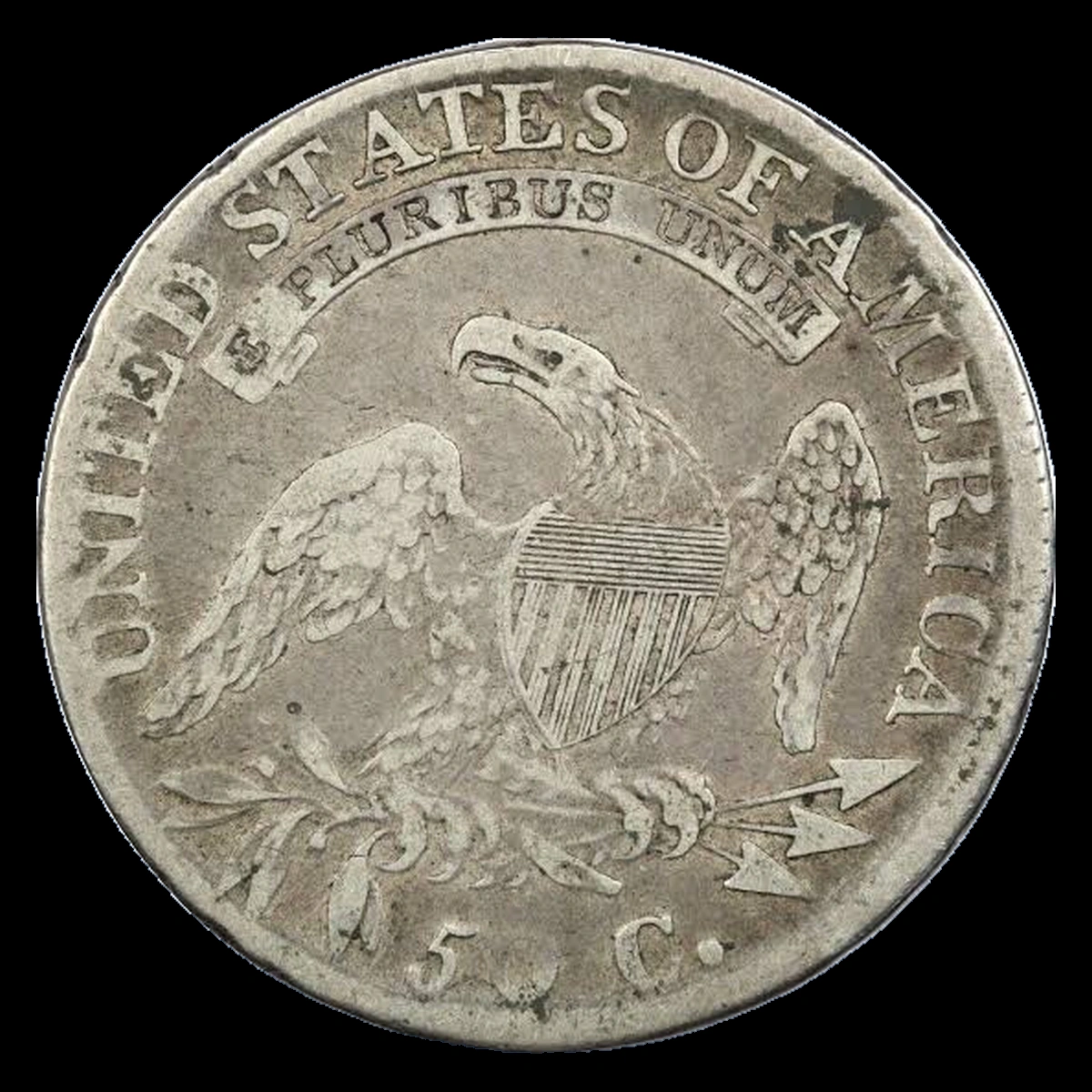
Heritage describes a horizontal crack above the scroll’s upper end on an O-107a graded PCGS MS64. The location is above the ordinary ribbon border rather than part of it.
Silver filled a narrow fracture in the reverse die during striking. Coins made after the fracture developed could share the resulting ridge.
How to Identify
Locate the scroll in a full reverse view before enlarging the smooth area over its upper end. Retain the normal border as a guide.
Side lighting should reveal a raised line without a scratched channel down its center. Dark toning alone does not show whether a feature rises or sinks.
Match both faces with O-107a and keep the lettered edge in the record. The full variety comparison supports the localized line identification.
What It’s Worth
Estimated range: $250–$1,600 from Very Fine to attractive AU examples. Greysheet records $1,260 for an NGC AU55 CAC O-107a at Heritage in January 2025.
The earlier MS64 description identifies the crack’s location rather than setting every coin’s condition. The AU55 sale values the whole variety, not the line alone.
Conclusion
Use the outline for edge and positioning problems, the origin of extra impressions for double-strike claims, and the precise reverse details for corrected letters, leaf loss, and cracks. Shield traces around the ear belong to their documented clash reference.
The $200–$3,500 estimates cover different conditions and evidence. Preserve uncertainty around the O-110 seller claim and keep other-date comparisons separate from actual 1813 results.