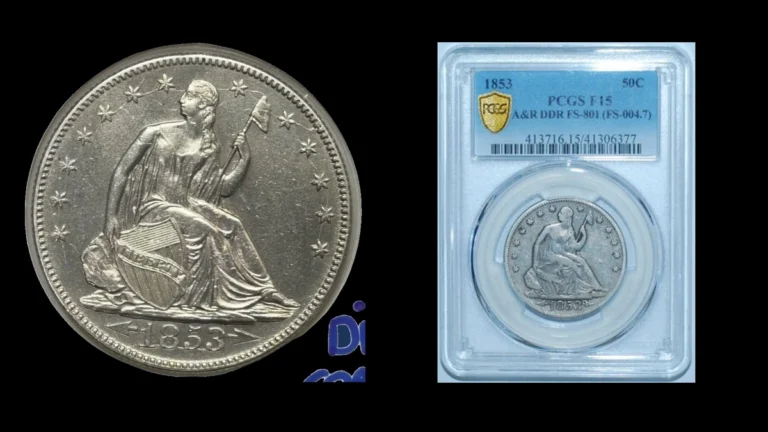
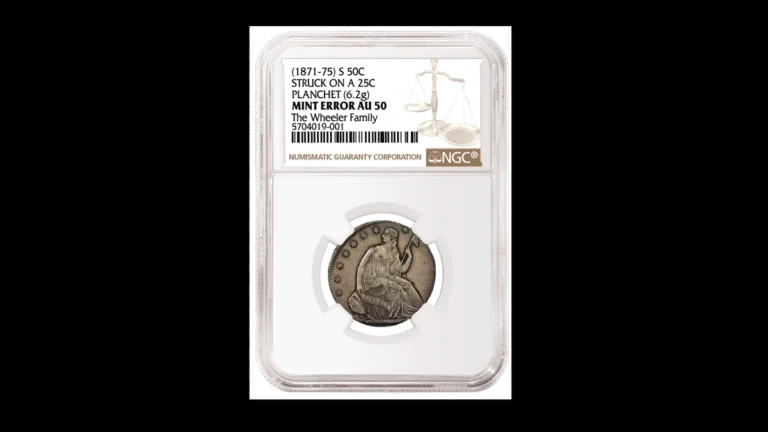
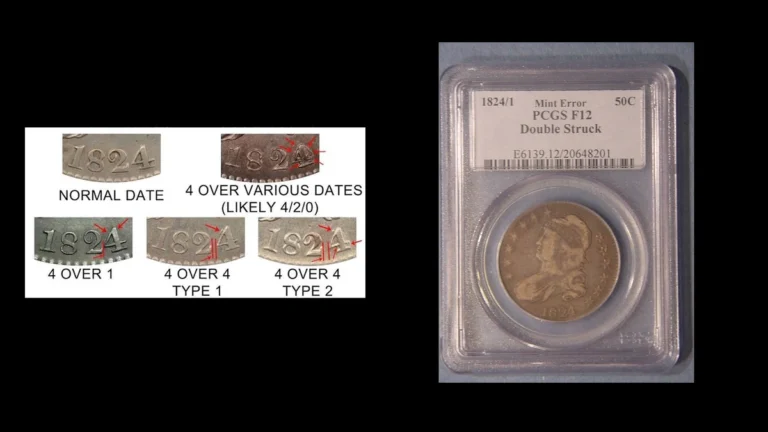
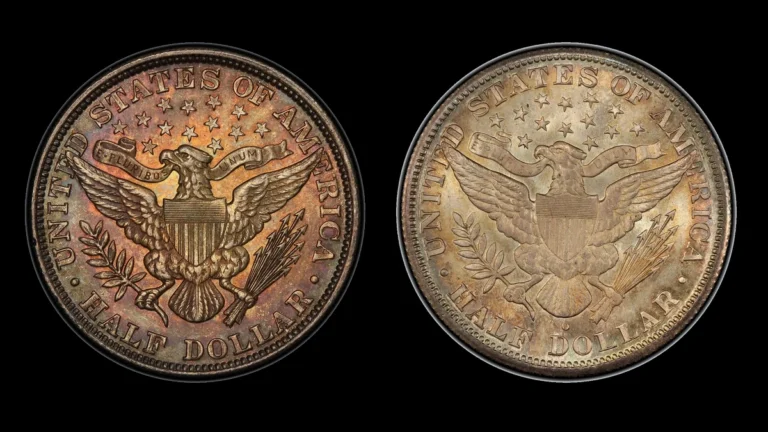
Rare 1857 Half Dollar Errors (List & Pictures)
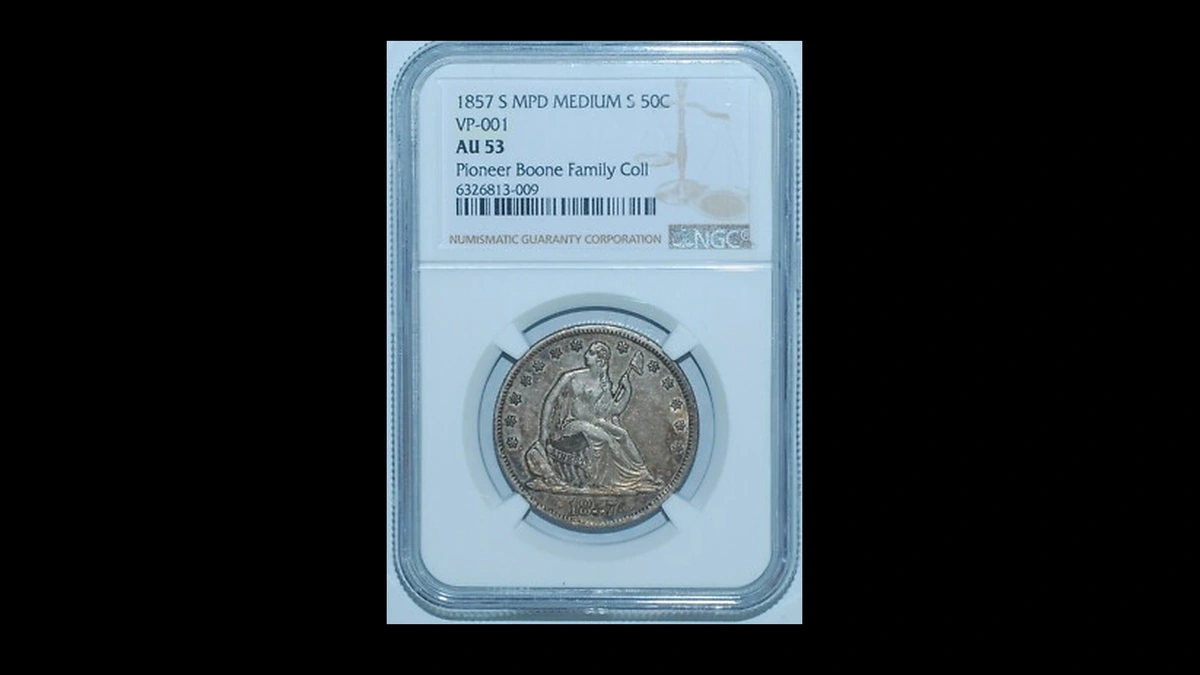
The rock above an 1857 half dollar’s date can conceal pieces of misplaced numbers. A New Orleans example with that feature sold for $7,200 in August 2024.
Estimated values for these 1857 half dollar errors run from $150 to $7,500. Inspect the rock, digits, and lower rim before following raised lines, faint transferred shapes, and the reverse’s alignment.
| Visible clue | Inspection area | Error | Estimated value |
|---|---|---|---|
| Numeral pieces in the rock | Above the normal date | Misplaced date | $250–$7,500 |
| Earlier strokes near normal digits | Date, with patterns varying by mint | Repunched date | $250–$1,500 |
| A raised lump connected to the rim | Below the date on Philadelphia coins | Rim cud | $250–$1,000 |
| Fine raised routes | Date and reverse lettering | Die cracks | $175–$700 |
| Fragments of the other face’s design | Elbow, shield, and right wing areas | Clashed dies | $200–$650 |
| Eagle leans after a controlled flip | Relationship between both faces | Rotated reverse | $150–$550 |
O indicates New Orleans, S indicates San Francisco, and no mintmark indicates Philadelphia. Use each mint’s own references; normal unworn weight is about 12.44 grams and diameter about 30.6 mm, with edge grooves.
1. 1857 Half Dollar Pieces of Numbers Hide in the Rock: Misplaced Date Error
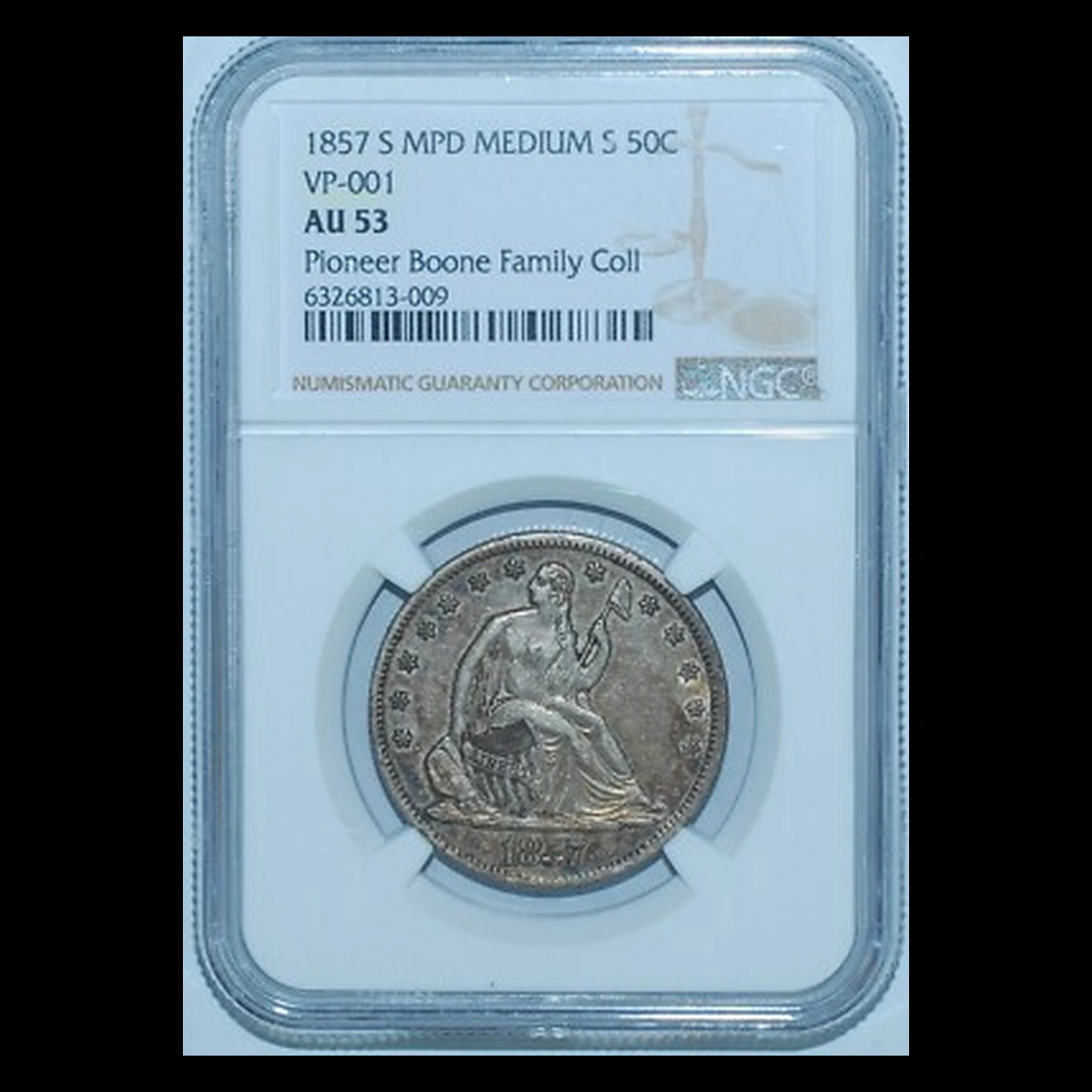
On the Philadelphia reference, bottoms of numbers remain in the rock above the date. The New Orleans example has extra numeral detail above 57.
A worker applied the date punch too high on the die, the steel stamping tool. Fragments of that misplaced impression survived when the correct date was added.
How to Identify
Include the full date and rock together before enlarging a fragment. The position above the normal date separates this feature from repunching directly beside a digit.
Compare with a normal coin so ordinary rock lines do not become imagined numerals. Then match the candidate’s raised curve or straight stroke to an identified example from the correct mint.
The Philadelphia and New Orleans patterns have a shared cause but different positions. An O-mint close-up cannot establish the exact Philadelphia remnants.
What It’s Worth
Estimated range: $250–$7,500 from worn coins to exceptionally preserved examples. The auction archive records $7,200 for a PCGS MS64 CAC 1857-O in August 2024.
That coin had no circulation wear and strong overall quality. A Philadelphia example in ANACS AU50 had a reported $425 sale in February 2026, showing why the extra fragment alone cannot determine the price.
2. 1857 Half Dollar Extra Date Strokes Remain Beside the Digits: Repunched Date Error
Smaller remnants near the intended date can record repeated punch applications in slightly different positions. Unlike the misplaced fragments above, these lie close to the normal digits.
Reports include Philadelphia and New Orleans varieties, plus a San Francisco auction description with extra detail left of 1. That direction belongs to the S-mint example.
How to Identify
Read the mintmark before selecting a date photograph. Keep all four digits in view while comparing the earlier numeral pieces.
A genuine remnant should follow part of a number’s shape. Scratches are cuts, and flat shelves can result from movement during striking rather than a second date-punch position.
For San Francisco, inspect left of 1 against the matching example. The other mints need their own positions established instead of borrowing that specific clue.
What It’s Worth
Estimated range: $250–$1,500 for identified circulated examples across the reported mints. A PCGS AU50 Large O WB-4 listing identifies a particular New Orleans repunched-date coin.
The supplied information does not give that listed coin’s final price. Ordinary New Orleans AU50 and AU55 sales of $780 in December 2025 and $763 in January 2026 offer light-wear comparisons instead.
3. 1857 Half Dollar A Lump Joins the Rim Below the Date: Rim Cud Error
The reported Philadelphia feature is a small raised area connected to the rim beneath the date. A rim-connected die break of this kind is called a cud.
A piece broke from the outer edge of the die, leaving a space for silver to enter during striking. That opening became the raised lump on the coin.
How to Identify
Photograph the date, border teeth, and lump together. A tight crop can hide whether the raised area actually connects with the rim.
Trace its full boundary through the surrounding border. An isolated interior bump is a different feature, while an edge blow can flatten and push existing metal outward.
Inspect for glue or solder sitting on the surface and compare the shape with the documented Philadelphia example. A generally swollen rim is not enough to establish the same die break.
What It’s Worth
Estimated range: $250–$1,000 for circulated examples matching the below-date cud. Ordinary Philadelphia coins with moderate to light wear offer comparisons around $240–$399.
A distinct original rim break may attract collector interest. The upper value remains an estimate, not a supplied auction result for the specific reference coin.
4. 1857 Half Dollar Narrow Ridges Follow the Date and Lettering: Die Cracks Error
Philadelphia reports describe a line below the date and others around the reverse inscription and denomination. These fine raised features differ from the broader rim lump.
A narrow crack in the die admits a thin line of metal. Its impression stands above the struck coin, whereas a later scratch cuts into it.
How to Identify
Follow the date-area line continuously and preserve the surrounding numbers as landmarks. Repeat the process for the lettering and denomination on the reverse.
Use light from opposite sides to check whether each line is raised. Corrosion, scratches, and torn surface metal can create interruptions that do not belong to a die-crack route.
Match the path with the correct example rather than connecting unrelated marks across gaps. Several separate cracks can belong to one coin without having the same route on every 1857 half.
What It’s Worth
Estimated range: $175–$700 for circulated coins, depending on preservation and clarity of the lines. Ordinary Philadelphia references include PCGS XF40 at $260 in April 2026 and NGC AU55 at $399 in May 2026.
Those grades range from moderate to light wear. They help establish the whole coin’s value, while multiple cracks should not be assigned separate amounts and added together.
5. 1857 Half Dollar Faint Opposite-Side Shapes Appear Near the Design: Clashed Dies Error
Reported Philadelphia locations include below Liberty’s elbow, the lower right of the reverse shield, and below the eagle’s right wing. The extra shapes can be traces from the opposite face.
When dies collide without a blank between them, each can pick up parts of the other design. Later coins may show those clash marks alongside their normal detail.
How to Identify
Compare photographs of both faces and try to match each faint trace to a recognizable piece of the other design. Maintain the nearby normal detail in the close-up to establish location.
Move the light to separate shallow transferred shapes from scratches. A single line is less convincing than a connected fragment in the proper position.
A separate 1857 cent is known with half-dollar design traces, but that does not prove these halves carry cent-design marks. This report concerns the stated clash locations on Philadelphia half dollars.
What It’s Worth
Estimated range: $200–$650 for worn Philadelphia examples with recognizable traces. Ordinary NGC AU55 sales include $381 in March 2025 and $399 in May 2026.
AU55 denotes slight wear. Those ordinary-coin results do not identify clashes, and the estimate should reflect whether the extra shapes can actually be matched.
6. 1857 Half Dollar The Eagle Leans Right After a Flip: Rotated Reverse Error
One Philadelphia die pairing is reported with about 12 degrees of clockwise rotation early in use and about 30 degrees later. Both faces can retain complete centered designs while their orientation changes.
The measurements apply to that pairing, not every coin dated 1857. Photographs independently turned upright can hide the angle.
How to Identify
Fix the coin securely in a protective holder with Liberty upright against a reference line. Turn top over bottom without a sideways twist.
The eagle should normally finish upright; measure a rightward lean with a protractor if present. Repeat the movement to exclude shifting within the holder.
Preserve both orientations in the same record. The slant of a single seller photograph cannot establish the relative alignment of the faces.
What It’s Worth
Estimated range: $150–$550 for worn Philadelphia examples with measurable rotation. Ordinary PCGS XF40 and AU50 sales were reported at $240 in August 2025 and $338 in September 2025.
Neither identifies a rotated example. They compare moderate and lighter wear on the underlying date rather than assigning a value per degree of rotation.
Conclusion
The date and lower border provide a useful starting route through misplaced numbers, repunching, cuds, and cracks. Other faint shapes need an opposite-face comparison, while rotation requires a repeatable physical flip.
Estimated values of $150–$7,500 include different mints and sharply different grades. The $7,200 New Orleans example was a high-quality unworn coin, so its result should not be applied to every small numeral fragment on a circulated half.