Rare 1822 Quarter Errors (List & Pictures)
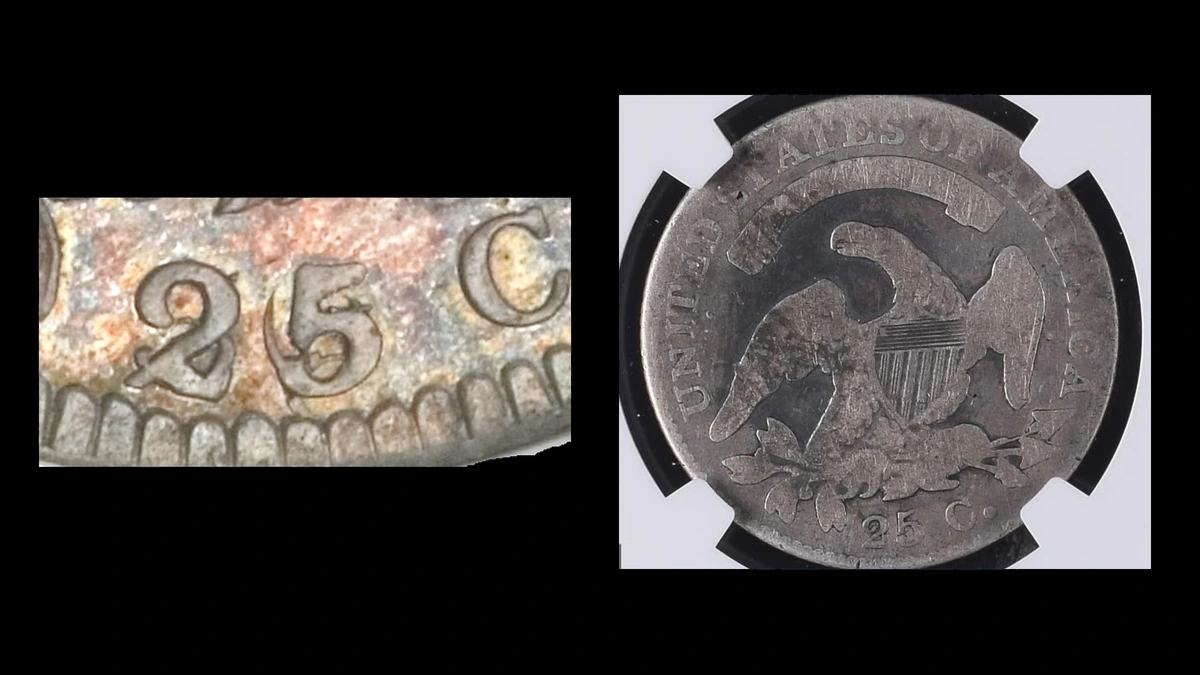
The value of 1822 quarter errors depends heavily on which variety is actually present. A superb ordinary-strike 25/50 C example in MS66 sold for $195,500 in March 2006, while a small metal peel on an ordinary quarter belongs in a very different comparison.
Supplied whole-coin estimates span $100–$200,000. Read the denomination first, examine the arrows as a group, and then assess any separating metal without disturbing it.
| Where to look | Feature | Estimated whole-coin value |
|---|---|---|
| Below the eagle | 25 punched over 50, B-2 | $2,500–$200,000 |
| Eagle’s arrows | Incomplete-arrow B-3 combination | $10,000–$50,000 |
| Lower-left front | Small lamination | $100–$2,000 ordinarily; $10,000–$50,000 if the coin is B-3 |
1. 1822 Quarter Older Numerals Beneath 25 C: Blundered Denomination Error
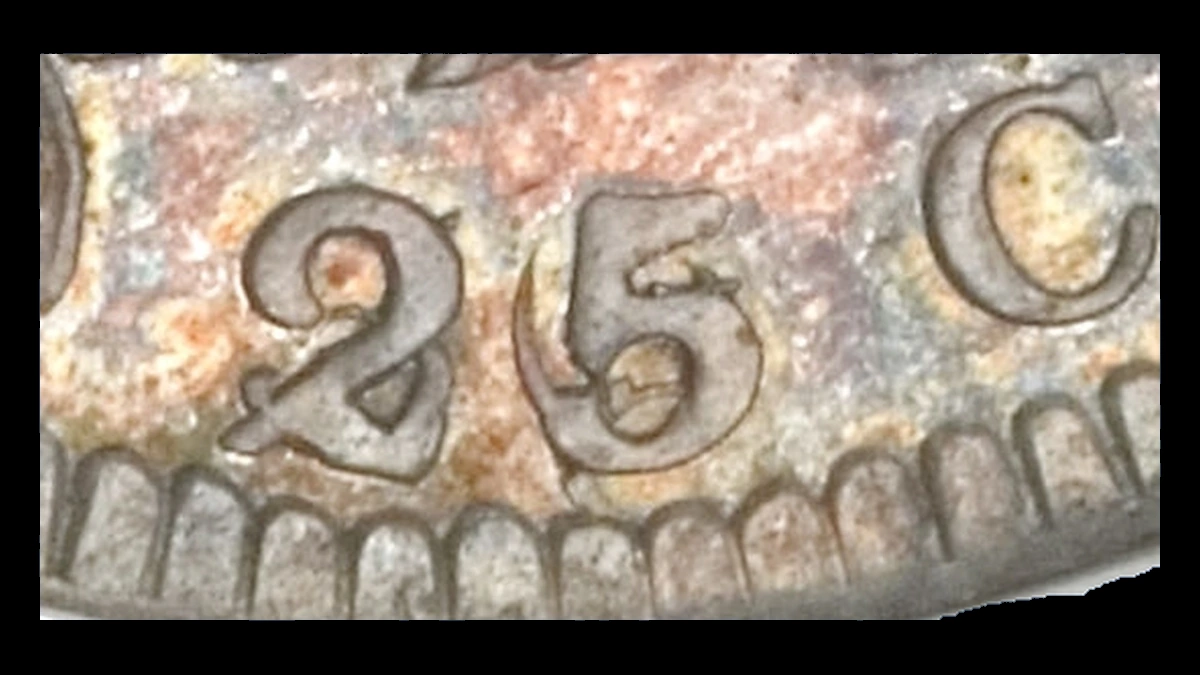
The extra curves around 25 C belong to an earlier 50 punched into the die. Correcting the denomination did not erase all of those original numeral shapes.
The resulting variety is called 25/50 C or B-2. Both names refer to the same corrected denomination, not a quarter struck twice or a half dollar reduced in size.
How to Identify
Establish that the coin is a large-size quarter before interpreting its numbers. The normal starting dimensions are about 27.5 millimeters and 6.74 grams, while an ordinary half dollar reading 50 C is a separate denomination.
With about 10× magnification, trace the final 2 and 5 below the eagle. Then compare the older curves around and beneath them with an authenticated 25/50 example.
Include the entire denomination and adjacent design in the enlargement. Isolating one bright line can make a scratch look more significant than it is.
Use light from two directions to distinguish raised numeral remnants from incuse cuts. Wear may merge the impressions, but the underlying shapes should stay at the same positions as the lighting changes.
A polished or reflective background does not establish that the coin is a specially produced Proof. Its manufacturing category and actual condition need to agree with the chosen price comparison.
What It’s Worth
$2,500–$200,000 is the supplied estimate from identifiable worn examples through exceptionally preserved unworn coins. Cleaning, scratches, and other surface damage can substantially change a specimen’s appeal.
The ordinary-strike B-2 record includes an MS66 example at $195,500 in March 2006. That exceptional unworn grade is central to understanding the result.
A worn coin still needs enough of the earlier digits to establish the variety. The high record does not price an uncertain patch of lines beneath an ordinary denomination.
2. 1822 Quarter Interruptions in the Eagle’s Arrows: Incomplete-Arrow B-3 Variety Error
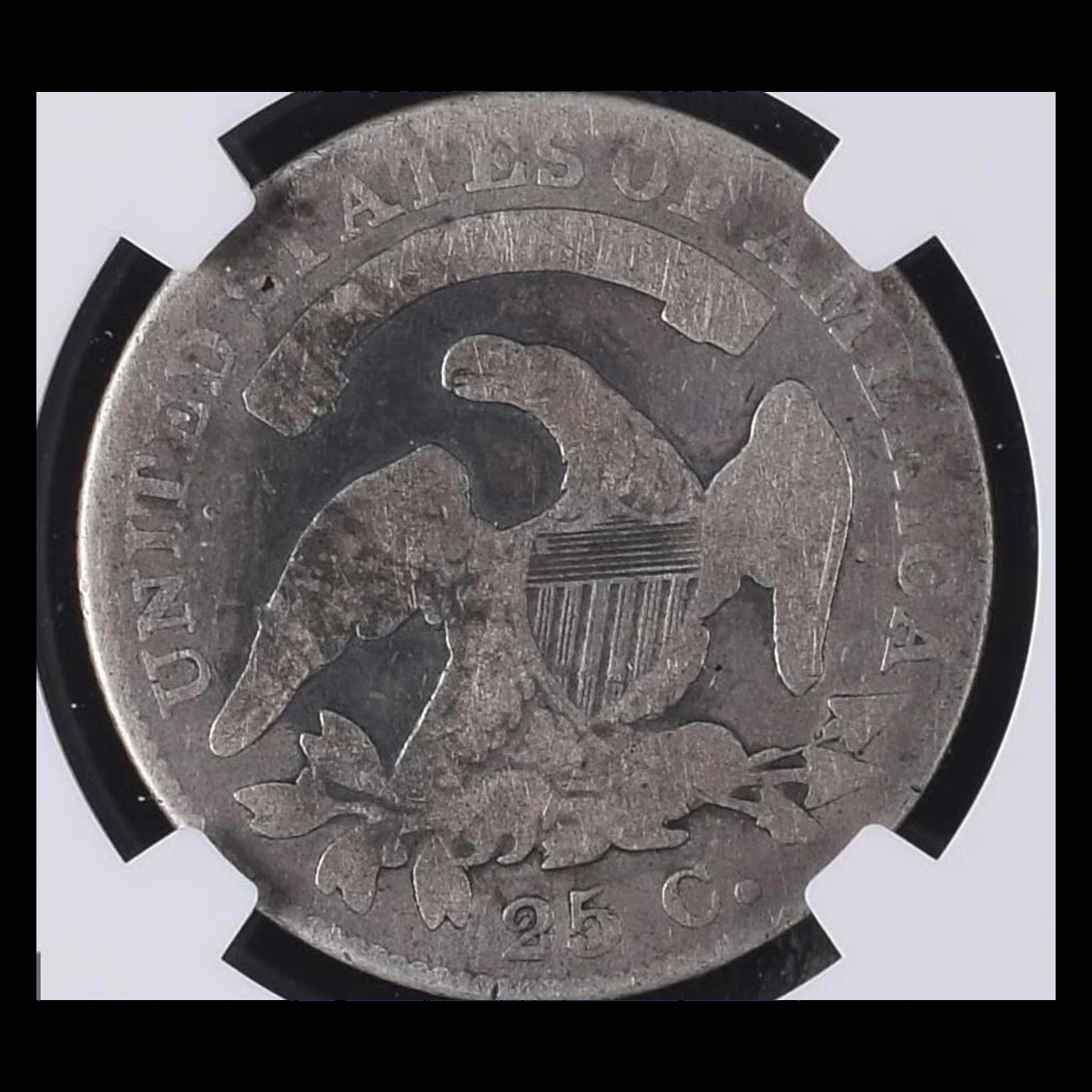
The B-3 reverse has an interrupted upper arrow shaft and an incomplete shaft and head on the lowest arrow. Together, these details help identify a particular die combination.
The 1822 discovery was announced in 2017 and graded AG3, indicating very heavy wear. Enough of its reverse pattern survived to establish the variety despite the poor overall preservation.
How to Identify
Compare the complete arrow group before judging one weak tip. Trace the upper shaft and then the lowest shaft and head against a verified 1822 B-3 photograph.
Use nearby feathers and lettering to confirm the arrangement. Missing detail that merely follows general wear does not establish the unusual die.
The same reverse die later served other years after repairs changed its arrow detail. An 1824 or 1828 quarter with repaired arrows cannot demonstrate the original 1822 pattern.
Keep the date readable in the full-coin record and compare the front as well as the reverse. A specialist should assess heavily worn candidates when the remaining arrow details are insufficient for a secure match.
What It’s Worth
$10,000–$50,000 is the supplied specialist estimate for a confirmed 1822 B-3. It is not a completed auction result for the discovery coin.
The discovery’s AG3 grade illustrates why rarity of the die combination can matter more than wear alone. Another matching example would still need its own condition assessment.
The known discovery also carries a small lamination on its front. That feature belongs to the same complete coin and is not an additional price to add to this estimate.
3. 1822 Quarter A Thin Peel at the Lower-Left Front: Lamination Error
A small separation near eight o’clock on the front appears on the B-3 discovery coin. Lamination describes a weakness within the metal that allows a thin portion to separate from the surrounding surface.
NGC’s account of the discovery describes that feature on the heavily worn AG3 quarter. The peel is an additional physical characteristic, not the sole diagnostic of B-3.
How to Identify
When comparing the discovery, locate the lower-left front with the whole portrait upright. Preserve enough adjacent design in the photograph to distinguish the reported patch from unrelated pits or scrapes.
Side lighting can show an attached edge and the boundary of natural separation. Do not bend, lift, or remove any remaining flap to test it.
A sharp cut with displaced silver, loose dirt, or corrosion may explain another rough patch. Heavy wear can soften the edge of a true peel, so the metal structure needs examination beyond a single shadow.
A similar lamination elsewhere on an 1822 quarter does not identify the rare discovery variety. The arrow group and complete die match must establish that separately.
What It’s Worth
$100–$50,000 is the combined supplied range, but it covers two different situations. An ordinary 1822 quarter with a small genuine peel is estimated at $100–$2,000, while an authenticated B-3 combination is estimated at $10,000–$50,000 as a whole coin.
The upper tier reflects the rare variety rather than an enormous premium for a tiny metal separation. Neither tier is a disclosed sale of the discovery specimen.
Conclusion
Read the denomination and arrow group before attaching a rare-variety name to an 1822 quarter. The 25/50 correction concerns earlier numerals in a die, while B-3 requires a distinct combination with incomplete arrows.
A lamination concerns the metal itself and may occur on the same coin as a valuable variety. Keep those observations separate during identification, then assess the complete coin once rather than adding guide estimates for each visible feature.