Rare 1805 Quarter Errors (List & Pictures)
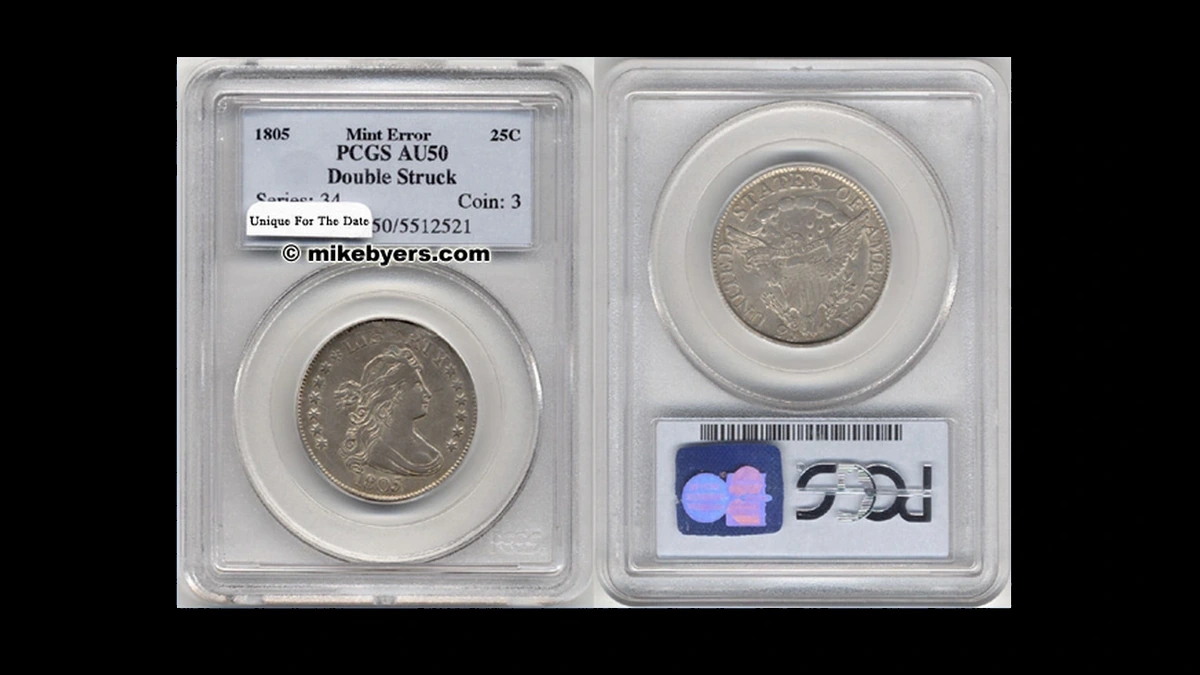
An 1805 quarter with both die cracks and clash marks sold for $1,560 in May 2024. Estimated whole-coin values for the 1805 quarter errors below range from $300–$25,000.
First follow raised lines through the date and portrait, then separate faint transferred shapes from displaced remnants of a second strike.
| Clue | Explanation | Whole-coin range |
|---|---|---|
| Raised line through stars, date, or letters | Die crack | $300–$10,000 |
| Faint outline from the opposite design | Die clash | $300–$8,000 |
| Out-of-place letters under the eagle’s tail | Double strike | $1,000–$25,000 |
1. 1805 Quarter Raised lines through the date and stars: die cracks Error
The date offers two clear places to begin: the foot of 1 and the area below 5. Recorded crack routes lead left from the first location or rise through 5 toward Liberty’s bust.
Another route crosses points of the fourth star on the left, between the border and Liberty’s hair below the lower ribbon. Reverse cracks affect the tops of STA and the first T in STATES.
These lines formed as the dies split and coin metal entered the openings. A die is the steel tool that stamps the design; its developing cracks can appear more strongly on later strikes.
How to Identify
Illuminate a suspected line from opposite sides to determine whether it stands above the surface. A scratch cuts downward, though pushed-up metal beside it can create a misleading bright edge.
Count upward from the lowest left star to locate the fourth star for the ribbon-area comparison. Follow the entire route through the star rather than judging one short section.
Check the date and reverse lettering separately. The recorded paths do not require every coin to show all stages equally clearly.
What It’s Worth
Estimated whole-coin values run from $300–$10,000 for circulated through attractive lightly worn examples. The quarter’s underlying grade and surface quality remain major parts of that price.
An NGC VF30 example sold for $1,560 in May 2024. Its crack rises through 5 toward Liberty’s clothing, and the coin also carries clash marks.
VF30 describes moderate circulation wear with substantial detail remaining. Scratches beside a genuine crack should still be counted as condition issues.
2. 1805 Quarter Faint extra artwork on either face: die clash Error
A clash begins when the dies meet without a silver blank between them. Their contact can mark one die with traces of the opposing design, which later coins then receive.
The early-quarter reference records strong reverse clash traces, while the May 2024 auction coin shows traces on both faces. Neither fact means the affected coin was necessarily struck twice.
How to Identify
Place same-size photographs of both faces beside each other and compare an extra outline with the opposite design. A convincing match should connect several parts of the shape and their positions.
The supplied account does not identify every transferred curl, feather, or letter. Use a documented example to determine the actual feature before assigning a name to a stray line.
Check the surface under changing light for cuts or later impressed marks. Large displaced word fragments require examination for another strike instead.
What It’s Worth
A working range is $300–$8,000 for worn through lightly worn 1805 quarters with recognizable clashes. Strong traces on attractive surfaces are easier to evaluate than faint shapes among scratches.
The $1,560 May 2024 VF30 sale discussed above also illustrates this category. It is the same coin with the date crack, so the price must not be counted twice.
3. 1805 Quarter Letters below the eagle’s tail: double strike Error
One recorded double-struck 1805 quarter preserves parts of RICA and the denomination’s C below the eagle’s tail. Their unusual positions reveal an earlier impression that survived after the coin moved and received another blow.
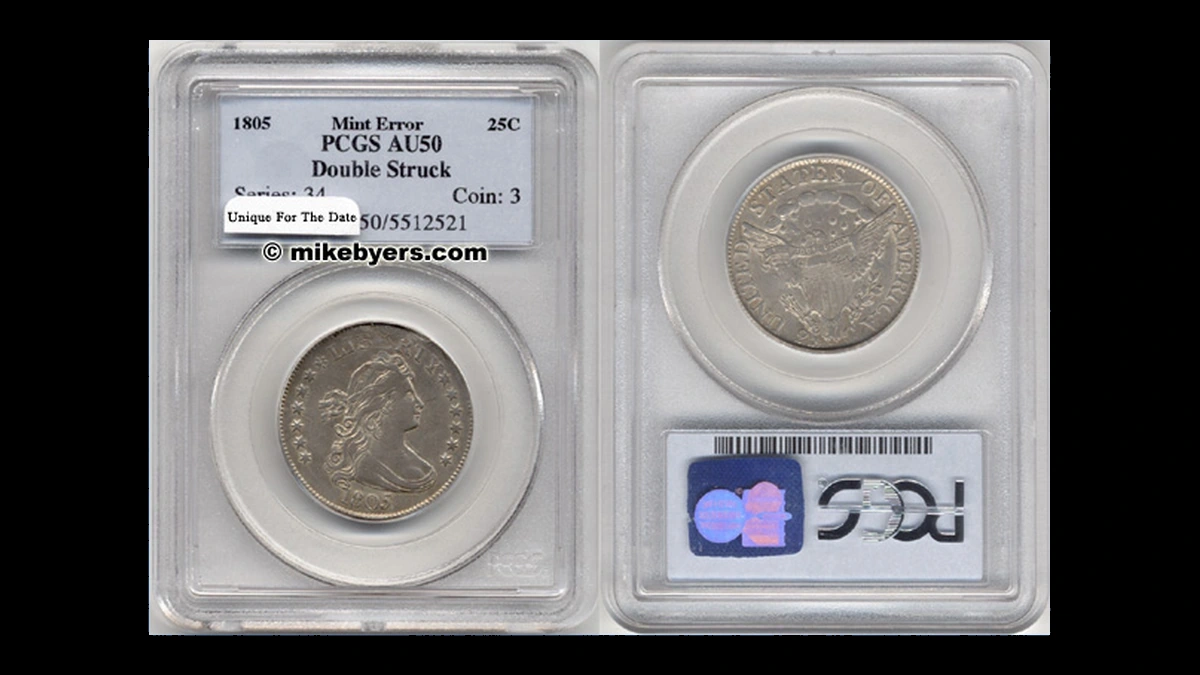
A separately published double-struck coin is graded PCGS AU50. Its grade indicates light circulation wear, but it does not establish that it shares the older reference coin’s exact remnants.
How to Identify
Locate the extra letters within a complete reverse image. Compare their shapes with AMERICA and the denomination, then consider how one displaced impression could explain their arrangement.
A normal C can sit close to the tail feathers on some 1805 varieties. That close placement alone is not evidence of two strikes.
Examine the front for supporting overlap and check that the impressions were made during minting. Do not give the separate AU50 coin the first example’s precise letter locations without a matching photograph.
What It’s Worth
Genuine worn through attractive lightly worn double strikes have an estimated range of $1,000–$25,000. Readable separated impressions can have a strong influence on collector interest.
A double-struck example described as VF30 sold for $1,265 in November 1998. The older entry does not specify a grading service.
No sale price is supplied for the separately published PCGS AU50 specimen. Its grade should not be used to invent a realized result.
Conclusion
The most useful distinction on an 1805 quarter is between a raised crack, a transferred outline, and a displaced strike. Each leaves a different relationship to the normal design.
Wear does not prevent an interesting attribution, but it can erase the evidence needed to support one. Judge the complete coin, including scratches or cleaning, and keep combined crack-and-clash examples under a single whole-coin value.